This comprehensive analysis evaluates whether Palio (PAL) is a viable investment opportunity in the AI-powered gaming sector. Currently trading at $0.002984 with a $567,000 market cap, PAL has declined 90% from its all-time high of $0.0314, reflecting the token's extreme volatility and early-stage development challenges. The article examines PAL's core investment characteristics, including its community-first distribution model, AI companion pet ecosystem on Xterio platform, and technical infrastructure on BSC blockchain. Short-term price forecasts range from $0.0026-$0.0038, while long-term projections through 2031 suggest potential prices reaching $0.0062 under optimistic conditions. The analysis provides targeted investment strategies for different investor profiles and emphasizes critical risk factors including limited liquidity (only 3,914 holders), regulatory uncertainties, and unproven ecosystem adoption. Investors can monitor real-time PAL performance on Gate, though the article recommends conservativ
Introduction: Palio (PAL) Investment Position and Market Prospects
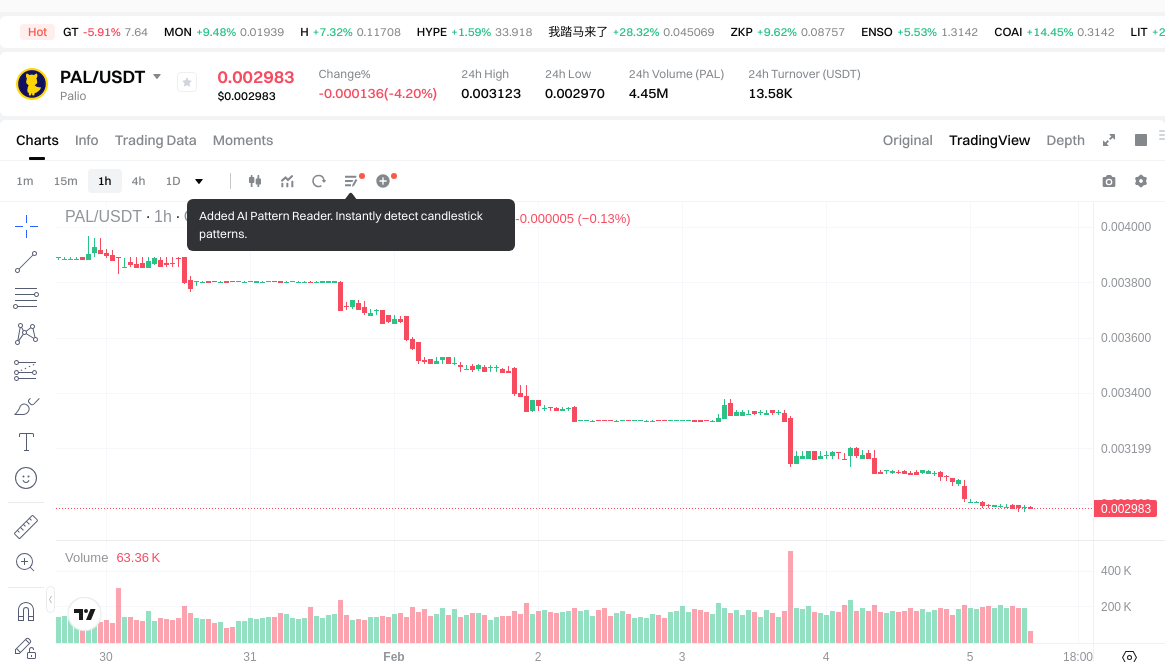
PAL is an emerging digital asset in the cryptocurrency field. As the first token launched on the Xterio platform in 2025, it has established itself within the AI-powered gaming and digital companion sector. As of February 5, 2026, Palio holds a market capitalization of approximately $566,960, with a circulating supply of 190,000,000 tokens and a current price around $0.002984. With its "Community First" positioning and focus on AI-driven emotional companion pets, PAL has attracted attention from observers asking "Is Palio (PAL) a good investment?" This article provides a comprehensive analysis of PAL's investment characteristics, historical price movements, future price outlook, and associated risks to serve as a reference for potential investors.
I. Palio (PAL) Price History Review and Investment Value Status
- 2025: Initial token launch on Xterio platform → PAL debuted at $0.05 with significant early volatility
- July 2025: Peak trading period → Price reached $0.0314 during initial market enthusiasm
- January 2026: Market correction phase → Price declined from peak levels to $0.002127
- February 2026: Current stabilization period → Trading around $0.002984 with moderate fluctuations
Current PAL Investment Market Status (February 2026)
- PAL current price: $0.002984
- Market sentiment (Fear & Greed Index): Data not available in provided materials
- 24-hour trading volume: $13,593.72
- Market capitalization: $566,960
- Circulating supply: 190,000,000 PAL (19% of total supply)
- Total supply: 1,000,000,000 PAL
- Trading on 5 exchanges with 3,914 token holders
Click to view real-time PAL market price
II. Core Factors Influencing Whether PAL is a Good Investment
Supply Mechanism and Scarcity (PAL Investment Scarcity)
- Total supply capped at 1,000,000,000 PAL tokens → impacts price dynamics and investment value
- Current circulating supply represents 19.0% of total supply (190,000,000 tokens) → indicates substantial token release potential
- Historical price movement: token experienced significant volatility, with price ranging from $0.002127 to $0.0314 since launch → reflects market-driven scarcity effects
- Investment consideration: fixed maximum supply structure provides potential long-term scarcity framework, though current low circulation ratio suggests ongoing supply expansion
Institutional Investment and Mainstream Adoption (Institutional Investment in PAL)
- Team composition includes veterans from Tencent, Happy Elements, and FunPlus → brings established gaming industry credibility
- Community-first token distribution model with no investor or team allocations → differentiates from traditional institutional-backed tokens
- Current holder base stands at 3,914 addresses → indicates early-stage community development
- Platform integration: launched as the first token on Xterio platform → provides ecosystem positioning within gaming and AI sectors
Macroeconomic Environment Impact on PAL Investment
- Market capitalization of $566,960 with 0.00011% market dominance → positions as micro-cap asset sensitive to broader crypto market conditions
- 24-hour trading volume of $13,593.72 → reflects relatively limited liquidity conditions
- Current trading across 5 exchanges → indicates emerging market accessibility
Technology and Ecosystem Development (Technology & Ecosystem for PAL Investment)
- AI Agent integration: ecosystem focuses on AI-powered companion pets → targets emerging AI-crypto intersection
- Gaming platform foundation: built on Xterio gaming platform → provides application-layer utility beyond speculative trading
- BEP-20 standard deployment on BSC chain → ensures compatibility with established blockchain infrastructure
- Ecosystem vision centers on emotional companion experiences through AI technology and gaming integration → targets niche use case within broader Web3 gaming sector
III. PAL Future Investment Forecast and Price Outlook (Is Palio (PAL) worth investing in 2026-2031)
Short-term Investment Forecast (2026, short-term PAL investment outlook)
Based on available market forecasts, PAL demonstrates varied short-term price trajectories:
- Conservative forecast: $0.0026 - $0.0030
- Neutral forecast: $0.0030 - $0.0035
- Optimistic forecast: $0.0035 - $0.0038
According to multiple prediction models, PAL may reach approximately $0.003812 by the end of February 2026, reflecting a modest growth trajectory in the near term. The four-hour timeframe indicates a bearish trend with declining 50-day moving averages, suggesting potential volatility in short-term holdings.
Mid-term Investment Outlook (2027-2028, mid-term Palio (PAL) investment forecast)
- Market stage expectation: PAL is projected to enter a gradual recovery and consolidation phase during this period, with technical indicators suggesting potential stabilization after recent declines.
- Investment return forecast:
- 2027: $0.0017 - $0.0044 (representing approximately 13% average growth from 2026 baseline)
- 2028: $0.0033 - $0.0051 (representing approximately 29% cumulative growth from 2026 baseline)
- Key catalysts: The Palio ecosystem's development of AI-driven companion features and gaming integrations may serve as potential growth drivers, alongside broader market sentiment in the AI and gaming token sectors.
Price prediction models indicate PAL may reach $0.002425 in 2028 with a projected growth rate of 10.25%, though this varies across different forecasting methodologies.
Long-term Investment Outlook (Is PAL a good long-term investment?)
- Baseline scenario: $0.0029 - $0.0056 (assuming steady ecosystem development and moderate market conditions)
- Optimistic scenario: $0.0041 - $0.0064 (assuming enhanced platform adoption and favorable crypto market cycles)
- Risk scenario: $0.0016 - $0.0029 (under conditions of prolonged market downturn or limited ecosystem expansion)
For detailed PAL long-term investment and price predictions: Price Prediction
2026-02-05 to 2031 Long-term Outlook
- Base scenario: $0.0029 - $0.0057 USD (corresponding to steady progress and gradual mainstream application growth)
- Optimistic scenario: $0.0041 - $0.0064 USD (corresponding to large-scale adoption and favorable market environment)
- Transformative scenario: Above $0.0073 USD (such as breakthrough ecosystem developments and mainstream penetration)
- 2031-12-31 projected high: $0.0062 USD (based on optimistic development assumptions)
The 200-day moving average has been declining since September 2025, indicating weaker long-term trends. Long-term forecasts suggest PAL prices may range between $0.001553 and $0.007282 for the 2026-2031 period, with potential cumulative growth of 89% by 2031 under favorable conditions. However, these projections remain subject to market volatility and ecosystem development progress.
Disclaimer: The above forecasts are derived from historical data analysis and predictive models and do not constitute investment advice. Cryptocurrency markets are highly volatile, and actual prices may differ significantly from projections. Investors should conduct independent research and assess their risk tolerance before making investment decisions.
| Year |
Predicted High Price |
Predicted Average Price |
Predicted Low Price |
Price Change |
| 2026 |
0.00381824 |
0.002983 |
0.00259521 |
0 |
| 2027 |
0.0043527936 |
0.00340062 |
0.0017343162 |
13 |
| 2028 |
0.005117252976 |
0.0038767068 |
0.00329520078 |
29 |
| 2029 |
0.00544134566448 |
0.004496979888 |
0.00413722149696 |
50 |
| 2030 |
0.006360528353587 |
0.00496916277624 |
0.002882114410219 |
66 |
| 2031 |
0.006231330121404 |
0.005664845564913 |
0.004078688806737 |
89 |
IV. Palio Investment Strategy and Risk Management (How to invest in Palio)
Investment Methodology (Palio investment strategy)
Investors considering Palio (PAL) may adopt different approaches based on their risk tolerance and market outlook:
-
Long-term holding (HODL Palio): This strategy suits conservative investors who believe in the project's long-term vision centered on AI-powered companion pets and the Xterio platform ecosystem. Given Palio's "Community First" philosophy with no investor or team allocations, patient holders may benefit from potential ecosystem growth as the AI agent pets and gaming features develop. However, investors should note the token's significant decline from its all-time high of $0.0314 (July 7, 2025) to the current price of $0.002984, representing approximately a 90% decrease.
-
Active trading: Traders relying on technical analysis and swing trading may find opportunities in Palio's price volatility. Recent data shows varied performance across timeframes: +0.1% (1H), -4.16% (24H), -22.93% (7D), and -5.58% (30D). The 24-hour trading range between $0.00297 and $0.003123 indicates ongoing price fluctuations that active traders might capitalize on, though the relatively modest daily trading volume of approximately $13,594 suggests limited liquidity.
Risk Management (Risk management for Palio investment)
-
Asset allocation ratios:
- Conservative investors: Consider limiting Palio exposure to 1-3% of total cryptocurrency portfolio, given its ranking at #2941 by market capitalization and early-stage development
- Moderate investors: May allocate 3-7% while monitoring project milestones and ecosystem adoption
- Experienced investors: Could maintain 7-15% allocation with active position management and clear stop-loss parameters
-
Risk hedging strategies: Implement diversification across multiple asset classes including established cryptocurrencies, stablecoins, and traditional assets. Consider position sizing based on market conditions and correlation with broader crypto market movements. The token's 94% decline over one year underscores the importance of portfolio diversification.
-
Secure storage:
- Cold wallets: Hardware wallets (such as Ledger or Trezor) provide optimal security for long-term PAL holdings
- Hot wallets: Use reputable software wallets for active trading amounts only
- Contract verification: Always verify the official BSC contract address (0xb7e548c4f133adbb910914d7529d5cb00c2e9051) before any transactions to avoid scam tokens
V. Palio Investment Risks and Challenges (Risks of investing in Palio)
-
Market risks: Palio exhibits substantial price volatility, evidenced by its 90%+ decline from ATH and 22.93% drop over seven days. The token's market capitalization of approximately $567,000 and modest trading volume indicate susceptibility to significant price swings. With only 19% of maximum supply currently circulating (190 million out of 1 billion total), future token releases could create additional selling pressure. The dominance metric of 0.00011% reflects minimal market presence compared to established cryptocurrencies.
-
Regulatory risks: As a BEP-20 token operating within the gaming and AI sectors, Palio faces evolving regulatory landscapes across jurisdictions. Different countries maintain varying stances on cryptocurrency gaming tokens and AI-related digital assets, creating uncertainty for cross-border operations and user adoption.
-
Technical risks: The project's dependency on the Xterio platform infrastructure introduces platform-specific risks. Integration complexity between AI agent pets, gaming mechanics, and blockchain technology presents potential points of technical failure. Smart contract vulnerabilities on the BSC network could affect token security. With approximately 3,914 holders, the relatively concentrated holder base may impact network effects and adoption velocity.
-
Project-specific risks: Despite team members' backgrounds from companies like Tencent, Happy Elements, and FunPlus, Palio remains an early-stage project. The success of AI companion pets and gaming ecosystem development remains uncertain. Competition from established blockchain gaming platforms and AI-integrated projects poses adoption challenges.
VI. Conclusion: Is Palio a Good Investment?
-
Investment value summary: Palio presents an experimental opportunity in the convergence of AI, gaming, and blockchain technology, built with a community-focused distribution model. The project's long-term potential depends heavily on successful execution of its AI agent pets concept and gaming ecosystem development on the Xterio platform. However, the token has experienced severe price volatility, declining significantly from its launch price of $0.05 and all-time high of $0.0314 to current levels around $0.002984. Short-term price movements remain highly unpredictable given limited liquidity and early development stage.
-
Investor recommendations:
✅ Beginners: Consider small position sizing through dollar-cost averaging if interested in the gaming-AI concept. Prioritize secure wallet storage using hardware wallets. Thoroughly research the project fundamentals and only invest amounts you can afford to lose entirely.
✅ Experienced investors: Monitor project development milestones, ecosystem adoption metrics, and holder growth. Implement strict position limits and stop-loss strategies given high volatility. Consider swing trading opportunities while maintaining defensive risk management.
✅ Institutional investors: Conduct comprehensive due diligence on team execution capabilities, technical architecture, and competitive positioning. Any strategic allocation should remain minimal given early-stage nature and limited market data.
⚠️ Disclaimer: Cryptocurrency investments carry substantial risks including potential complete loss of capital. Palio's significant price decline, limited liquidity, and early-stage development present elevated risk factors. This content provides informational analysis only and does not constitute investment advice. Conduct independent research and consider consulting financial professionals before making investment decisions.
VII. FAQ
Q1: What is Palio (PAL) and why is it attracting investor attention?
Palio (PAL) is an emerging cryptocurrency token positioned as the first digital asset launched on the Xterio platform in 2025, focusing on AI-powered companion pets within the gaming ecosystem. It operates on the BSC network as a BEP-20 token with a total supply capped at 1 billion tokens. The project attracts attention primarily due to its "Community First" distribution model—with zero allocations to investors or team members—and its unique positioning at the intersection of AI technology, gaming, and blockchain. The development team includes veterans from major gaming companies like Tencent, Happy Elements, and FunPlus, lending industry credibility to the project's vision of creating emotional companion experiences through AI integration.
Q2: How has PAL performed historically as an investment?
PAL has experienced significant price volatility since its launch. The token debuted at $0.05 in 2025 and reached an all-time high of $0.0314 in July 2025 during initial market enthusiasm. However, it has since declined approximately 90% from that peak to its current price around $0.002984 as of February 2026. This trajectory reflects substantial downward pressure, with recent performance showing -22.93% over 7 days and -94% over one year. The token's market capitalization stands at approximately $567,000 with a daily trading volume of roughly $13,594, indicating limited liquidity. Only 19% of the total supply (190 million tokens) currently circulates, with approximately 3,914 holders.
Q3: What are the key factors that could influence PAL's future investment value?
Several factors may impact PAL's investment outlook: (1) Supply dynamics: With only 19% of tokens currently circulating, future token releases could create additional selling pressure. (2) Ecosystem development: The success of AI agent pets features and gaming integrations on the Xterio platform will be critical growth drivers. (3) Market positioning: As a micro-cap asset with 0.00011% market dominance, PAL remains highly sensitive to broader cryptocurrency market conditions. (4) Technical development: The project's ability to execute its vision of AI-powered companion experiences and gaming mechanics will determine long-term adoption. (5) Competition: The token faces challenges from established blockchain gaming platforms and other AI-integrated projects in the sector.
Q4: What is the price outlook for PAL from 2026 to 2031?
Price forecasts for PAL vary significantly across different scenarios. For 2026, conservative estimates range from $0.0026-$0.0030, while optimistic forecasts suggest $0.0035-$0.0038. By 2028, predictions indicate potential prices between $0.0033-$0.0051, representing approximately 29% cumulative growth from 2026 baseline under moderate conditions. Long-term projections through 2031 suggest a range of $0.0016-$0.0073 depending on ecosystem development and market conditions, with optimistic scenarios forecasting prices up to $0.0062 by end-2031. However, technical indicators show declining moving averages since September 2025, suggesting weaker long-term trends. These forecasts remain highly speculative given limited market data and early-stage development.
Q5: What investment strategies and risk management approaches are recommended for PAL?
Investment approaches should vary based on risk tolerance: Long-term holders might consider PAL as a high-risk position aligned with belief in the AI gaming concept, though the significant decline from all-time highs warrants caution. Active traders may capitalize on price volatility within the $0.00297-$0.003123 range, though limited liquidity poses execution challenges. Asset allocation recommendations: Conservative investors should limit exposure to 1-3% of crypto portfolio, moderate investors 3-7%, and experienced investors up to 7-15% with active management. Risk management essentials include: implementing strict stop-loss parameters, diversifying across established cryptocurrencies and asset classes, using hardware wallets for secure storage, and verifying the official BSC contract address (0xb7e548c4f133adbb910914d7529d5cb00c2e9051) before transactions.
Q6: What are the primary risks associated with investing in PAL?
PAL carries multiple risk categories: (1) Market risks: Extreme volatility with 90%+ decline from peak, modest $567,000 market cap, and low trading volume create significant price swing susceptibility. Future token releases from the 81% non-circulating supply could increase selling pressure. (2) Regulatory risks: Evolving cryptocurrency regulations across jurisdictions, particularly regarding gaming tokens and AI-related digital assets, create compliance uncertainties. (3) Technical risks: Dependencies on Xterio platform infrastructure, smart contract vulnerabilities on BSC network, and integration complexity between AI, gaming, and blockchain components present operational challenges. (4) Project-specific risks: Early-stage development with unproven AI companion pet concept, intense competition from established platforms, and relatively concentrated holder base of 3,914 addresses may impact adoption velocity.
Q7: Is Palio a good investment for beginners versus experienced investors?
The suitability of PAL differs significantly by investor experience level. For beginners: PAL represents a high-risk, speculative opportunity that should only comprise a minimal portfolio allocation through dollar-cost averaging, with investments limited to amounts one can afford to lose completely. Priority should focus on secure wallet storage and thorough project research. For experienced investors: PAL may offer swing trading opportunities given volatility, but requires strict position limits, stop-loss strategies, and continuous monitoring of development milestones and ecosystem metrics. For institutional investors: Comprehensive due diligence on technical architecture, competitive positioning, and team execution capabilities is essential, with any strategic allocation remaining minimal given early-stage nature and limited market history. All investor categories should approach PAL with defensive risk management and realistic expectations given the token's significant historical decline and uncertain development trajectory.
Q8: How does PAL's "Community First" model affect its investment characteristics?
PAL's "Community First" distribution model fundamentally differentiates it from traditional token launches by allocating zero tokens to investors or team members, channeling all distribution directly to community participants. This approach theoretically aligns incentives more closely with community growth and reduces potential selling pressure from early investor unlocks that often impact token prices. However, this model also presents considerations for investment analysis: the absence of institutional backing may limit access to capital and strategic partnerships that could accelerate development. The community-driven approach requires organic adoption momentum, which the current holder count of 3,914 addresses suggests remains in early stages. While the model promotes decentralization ideals, investors should assess whether community governance structures and engagement levels can sustain long-term ecosystem development without traditional financial backing mechanisms.
* The information is not intended to be and does not constitute financial advice or any other recommendation of any sort offered or endorsed by Gate.