Is Rubic (RBC) a good investment?: A comprehensive analysis of its market potential, technical fundamentals, and risk factors for 2024
Introduction: Rubic (RBC)'s Investment Position and Market Outlook
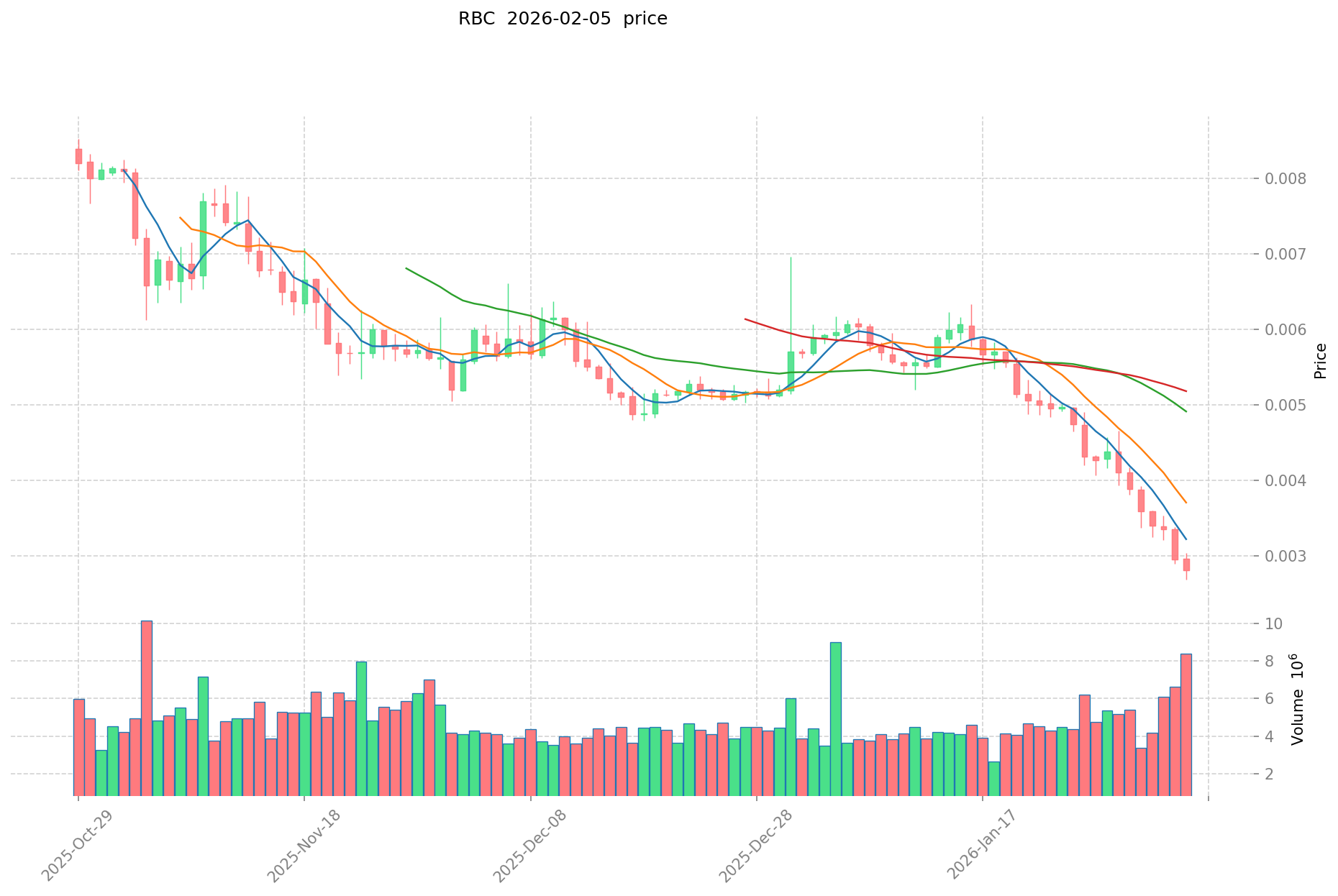
RBC is a notable asset in the cryptocurrency field. As of February 2026, Rubic maintains a market capitalization of approximately $583,634, with a circulating supply of around 210,470,547 tokens, and the current price hovering near $0.002773. As a DeFi service platform that integrates token creation, management, and trading, Rubic aims to incorporate multi-chain P2P transactions into its existing services while developing additional products such as liquidity pools. The platform has issued RBC tokens to serve as fuel within its ecosystem. With its position in the decentralized finance space, RBC has gradually become a focal point when investors discuss "Is Rubic (RBC) a good investment?" This article provides a comprehensive analysis of RBC's investment value, historical trends, future price projections, and investment risks to offer reference for investors.
I. Rubic (RBC) Price History Review and Current Investment Value
Rubic (RBC) Investment Performance
- February 2021: RBC reached a price level of $0.793213, representing a significant valuation milestone in its early trading period.
- December 2022: The token experienced substantial decline, with price falling to $0.00066293 during market downturn conditions.
- December 2025: RBC was trading at approximately $0.005127, reflecting continued volatility in valuation.
Current RBC Investment Market Status (February 2026)
- RBC current price: $0.002773
- 24-hour trading volume: $24,054.33
- Market capitalization: $583,634.83
- Circulating supply: 210,470,547.56 RBC
Click to view real-time RBC market price
II. Core Factors Influencing Whether RBC Is a Good Investment
Supply Mechanism and Scarcity (RBC Investment Scarcity)
- Maximum supply capped at 1,000,000,000 RBC with current circulating supply of 210,470,547.559481 RBC (approximately 21.05% of total supply) → affects price dynamics and investment valuation
- Historical price range: RBC traded between $0.00066293 (December 23, 2022) and $0.793213 (February 6, 2021), demonstrating significant price volatility over its trading history
- Investment significance: The controlled supply structure and gradual release mechanism serve as foundational elements for evaluating long-term investment potential
Macro-Economic Environment's Impact on RBC Investment
- Monetary policy and interest rate changes → influence investment attractiveness across crypto asset markets
- Inflation environment considerations → affect positioning within digital asset portfolios
- Geopolitical uncertainty factors → may influence demand patterns for crypto assets
Technology and Ecosystem Development (Technology & Ecosystem for RBC Investment)
- Platform functionality: Rubic's DeFi service platform integrates token creation, management, and trading capabilities → provides utility foundation for token economics
- Multi-chain P2P transaction integration: Expansion of cross-chain trading services aims to enhance platform functionality → influences ecosystem development trajectory
- User interface improvements: Ongoing upgrades targeting simplified operation → affect platform accessibility and adoption potential
- Liquidity pool development: Additional product offerings under development → contributes to ecosystem expansion considerations
- RBC token utility: Functions as internal platform fuel → ties token value to platform usage and activity levels
III. RBC Future Investment Forecast and Price Outlook (Is Rubic(RBC) worth investing in 2026-2031)
Short-term Investment Forecast (2026, short-term RBC investment outlook)
- Conservative forecast: 0.00174258 - 0.002766 USD
- Neutral forecast: 0.002766 USD
- Optimistic forecast: 0.002766 - 0.00315324 USD
Mid-term Investment Outlook (2027-2028, mid-term Rubic(RBC) investment forecast)
- Market stage expectation: Early growth phase with potential ecosystem expansion in the DeFi cross-chain exchange sector
- Investment return forecast:
- 2027: 0.001775772 - 0.0034627554 USD
- 2028: 0.001669817604 - 0.004238767764 USD
- Key catalysts: Platform upgrades, multi-chain integration enhancements, and liquidity pool development
Long-term Investment Outlook (Is RBC a good long-term investment?)
- Base scenario: 0.001669817604 - 0.004238767764 USD (assuming steady platform development and moderate DeFi market growth)
- Optimistic scenario: 0.00342697951344 - 0.00510321949284 USD (assuming accelerated adoption and favorable market conditions in 2029)
- Risk scenario: Below 0.001669817604 USD (under adverse market conditions or platform development setbacks)
View RBC long-term investment and price forecast: Price Prediction
2026-02-05 - 2031 Long-term Outlook
- Base scenario: 0.002766 - 0.004634803543041 USD (corresponding to steady progress and gradual mainstream application enhancement)
- Optimistic scenario: 0.003522450692711 - 0.005005587826484 USD (corresponding to large-scale adoption and favorable market environment)
- Transformative scenario: Above 0.005005587826484 USD (in case of breakthrough ecosystem developments and mainstream adoption)
- 2031-12-31 forecast high: 0.005005587826484 USD (based on optimistic development assumptions)
Disclaimer: The above forecasts are for reference only and do not constitute investment advice. Cryptocurrency markets are highly volatile, and investors should conduct thorough research and assess their risk tolerance before making investment decisions.
| Year | Predicted High Price | Predicted Average Price | Predicted Low Price | Price Change |
|---|---|---|---|---|
| 2026 | 0.00315324 | 0.002766 | 0.00174258 | 0 |
| 2027 | 0.0034627554 | 0.00295962 | 0.001775772 | 6 |
| 2028 | 0.004238767764 | 0.0032111877 | 0.001669817604 | 15 |
| 2029 | 0.00510321949284 | 0.003724977732 | 0.00342697951344 | 34 |
| 2030 | 0.004855508473662 | 0.00441409861242 | 0.003619560862184 | 59 |
| 2031 | 0.005005587826484 | 0.004634803543041 | 0.003522450692711 | 67 |
IV. Rubic Investment Strategy and Risk Management (How to invest in DeFi tokens)
Investment Methodology (Rubic investment strategy)
-
Long-term Holding (HODL Rubic): Suitable for conservative investors who believe in the long-term development of decentralized finance platforms. This approach involves purchasing RBC tokens and holding them through market fluctuations, focusing on the platform's fundamental value proposition of multi-chain P2P trading and liquidity services.
-
Active Trading: Relies on technical analysis and swing trading strategies. Given Rubic's historical price volatility, with a 24-hour price change of -6.92% and 7-day decline of -35.66%, active traders may seek to capitalize on price movements through careful market timing and technical indicators.
Risk Management (Risk management for Rubic investment)
-
Asset Allocation Ratio:
- Conservative investors: Limit RBC exposure to 1-3% of total crypto portfolio
- Aggressive investors: May allocate 5-10% to DeFi platform tokens
- Professional investors: Could consider higher allocations based on comprehensive research and risk tolerance
-
Risk Hedging Strategies: Implement diversified portfolio approaches combining multiple asset classes. Consider pairing DeFi tokens with more established cryptocurrencies to balance risk exposure. Avoid concentration in single-platform tokens.
-
Secure Storage: Utilize cold wallets for long-term holdings and hardware wallets (such as Ledger or Trezor) for enhanced security. Hot wallets should only contain amounts needed for active trading. Always verify contract addresses (0x3330BFb7332cA23cd071631837dC289B09C33333 for ETH chain) before transactions.
V. Rubic Investment Risks and Challenges (Risks of investing in DeFi tokens)
-
Market Risk: Rubic exhibits substantial volatility, with a 30-day decline of -53.89% and 1-year decline of -87.53%. The token's market cap of approximately $583,635 indicates relatively low liquidity, which can amplify price swings. Daily trading volume of $24,054 suggests limited market depth.
-
Regulatory Risk: DeFi platforms face evolving regulatory frameworks across jurisdictions. Policy changes regarding decentralized exchanges, cross-chain trading, and token classifications could impact platform operations and token value. Regulatory uncertainty remains a significant consideration for investors.
-
Technical Risk: Multi-chain integration and P2P trading mechanisms involve complex smart contract architecture. Potential vulnerabilities in cross-chain bridges, liquidity pools, or platform upgrades could expose users to security risks. Platform dependencies on multiple blockchain networks introduce additional technical complexity.
VI. Conclusion: Is DeFi Platform Token a Good Investment?
-
Investment Value Summary: Rubic represents a specialized DeFi service platform focused on multi-chain token creation, management, and trading. While the platform addresses real needs in the decentralized finance ecosystem, the token has experienced significant price volatility, declining substantially from its historical high. The project's limited market capitalization and trading volume suggest it remains a smaller-scale platform within the competitive DeFi landscape.
-
Investor Recommendations: ✅ Beginners: Consider dollar-cost averaging with minimal allocation, prioritize secure wallet storage, and thoroughly research platform functionality before investing.
✅ Experienced Investors: May employ swing trading strategies while maintaining diversified portfolio allocations. Monitor platform development updates and on-chain metrics.
✅ Institutional Investors: Conduct comprehensive due diligence on platform technology, team, and competitive positioning. Strategic allocation should align with broader DeFi exposure strategy.
⚠️ Disclaimer: Cryptocurrency investments carry substantial risk. This content is for informational purposes only and does not constitute investment advice. Conduct thorough research and consider your financial situation before making investment decisions.
VII. FAQ
Q1: What is Rubic (RBC) and how does its platform work?
Rubic (RBC) is a DeFi service platform token that powers a multi-chain decentralized exchange ecosystem. The platform integrates token creation, management, and trading capabilities while focusing on cross-chain P2P transactions and liquidity pool development. RBC tokens function as the internal fuel for platform operations, with a maximum supply capped at 1 billion tokens and current circulation of approximately 210.47 million tokens (21.05% of total supply). The platform aims to simplify decentralized trading across multiple blockchain networks through an improved user interface and expanding cross-chain integration.
Q2: Is Rubic (RBC) a good investment in 2026?
RBC presents significant investment risks that require careful consideration. Currently priced at $0.002773 with a market cap of approximately $583,635, the token has experienced substantial volatility, including a 1-year decline of -87.53% and 30-day decline of -53.89%. While price forecasts suggest potential recovery ranges between $0.00174258-$0.00315324 for 2026, the token's limited liquidity (daily volume of $24,054) and small market capitalization indicate heightened risk exposure. Conservative investors should limit allocation to 1-3% of crypto portfolios, while recognizing that DeFi platform tokens carry inherent volatility and regulatory uncertainty.
Q3: What are the main factors affecting RBC token price?
Three primary factors influence RBC valuation: (1) Supply mechanism—with only 21.05% of tokens currently circulating, the gradual release schedule affects price dynamics and scarcity considerations; (2) Platform development—multi-chain integration progress, liquidity pool expansion, and user adoption rates directly impact token utility and demand; (3) Macro-economic environment—monetary policy changes, DeFi sector trends, and overall cryptocurrency market sentiment affect investment attractiveness. Additionally, the token's position within the competitive DeFi exchange landscape influences comparative valuation against larger platforms.
Q4: What is the long-term price forecast for Rubic through 2031?
Long-term forecasts project varying scenarios based on platform development and market conditions. Base scenario estimates range from $0.002766 (2026) to $0.004634803543041 (2031), representing steady growth with gradual mainstream adoption. Optimistic scenarios suggest potential highs of $0.005005587826484 by 2031, contingent on accelerated ecosystem development and favorable DeFi market expansion. However, risk scenarios indicate possible prices below $0.001669817604 under adverse conditions or platform setbacks. These projections assume continued platform functionality and competitive positioning within the evolving DeFi landscape, though actual performance may vary significantly.
Q5: How should I store and secure my RBC tokens?
Secure storage requires multi-layered approaches based on investment timeframe. For long-term holdings, utilize cold wallets or hardware wallets (such as Ledger or Trezor) that store private keys offline, minimizing exposure to online vulnerabilities. Hot wallets should only contain amounts needed for active trading due to internet connectivity risks. Always verify the official Rubic contract address (0x3330BFb7332cA23cd071631837dC289B09C33333 for Ethereum chain) before conducting transactions to avoid scam tokens. Enable two-factor authentication on exchange accounts and maintain backup seed phrases in secure, offline locations. Never share private keys or seed phrases with third parties.
Q6: What are the main risks of investing in Rubic (RBC)?
Three critical risk categories require evaluation: (1) Market risk—extreme volatility with historical price ranging from $0.00066293 to $0.793213, limited liquidity with daily volume under $25,000, and small market cap amplifying price swings; (2) Regulatory risk—evolving DeFi regulations across jurisdictions may impact cross-chain trading operations and platform functionality; (3) Technical risk—complex smart contract architecture across multiple blockchain networks introduces potential vulnerabilities in cross-chain bridges and liquidity mechanisms. The platform's competitive position within the crowded DeFi exchange sector adds execution risk regarding user adoption and market share growth.
Q7: What investment strategies are suitable for different types of RBC investors?
Investment approaches should align with risk tolerance and experience levels. Beginners should employ dollar-cost averaging with minimal allocation (1-3% of crypto portfolio), focusing on platform research and secure storage practices before investing. Experienced investors may utilize swing trading strategies to capitalize on price volatility while maintaining diversified portfolio allocations and monitoring on-chain metrics for trading signals. Institutional investors should conduct comprehensive due diligence on platform technology, team credentials, and competitive positioning, integrating RBC allocation within broader DeFi exposure strategies. All investor types must recognize the speculative nature of small-cap DeFi tokens and avoid overconcentration in single-platform investments.
Q8: How does Rubic compare to other DeFi exchange platforms?
Rubic operates in the competitive decentralized exchange sector with differentiation focused on multi-chain P2P trading integration and simplified user experience. However, the platform's relatively small market capitalization ($583,635) and limited trading volume ($24,054 daily) indicate early-stage development compared to established protocols. While the platform's token creation, management, and cross-chain trading features address specific DeFi needs, larger competitors typically offer deeper liquidity, more extensive blockchain support, and stronger network effects. Investors should evaluate Rubic's unique value propositions against execution risks inherent in smaller-scale platforms competing with well-funded, established alternatives.
Share
Content
Introduction: Rubic (RBC)'s Investment Position and Market Outlook
I. Rubic (RBC) Price History Review and Current Investment Value
II. Core Factors Influencing Whether RBC Is a Good Investment
III. RBC Future Investment Forecast and Price Outlook (Is Rubic(RBC) worth investing in 2026-2031)
IV. Rubic Investment Strategy and Risk Management (How to invest in DeFi tokens)
V. Rubic Investment Risks and Challenges (Risks of investing in DeFi tokens)
VI. Conclusion: Is DeFi Platform Token a Good Investment?
VII. FAQ
How to Buy Cryptocurrency


Trending Cryptocurrencies



What will be the market capitalization of USDC in 2025? Analysis of the stablecoin market landscape.

How is DeFi different from Bitcoin?

What is DeFi: Understanding Decentralized Finance in 2025

USDC stablecoin 2025 Latest Analysis: Principles, Advantages, and Web3 Eco-Applications

Development of Decentralized Finance Ecosystem in 2025: Integration of Decentralized Finance Applications with Web3
2025 USDT USD Complete Guide: A Must-Read for Newbie Investors

Top 7 Machine Learning Applications

What Is Treasure? A Comprehensive Overview of the MAGIC Cryptocurrency
Which cryptocurrency should you buy? A guide to selecting the top coins
Ultimate Guide to MVRV Z-Score for Bitcoin Price Forecasting and Trading

What Is Crypto Asset Staking? A Guide to Earning Passive Income