Is Shyft Network (SHFT) a good investment?: Analyzing Growth Potential, Tokenomics, and Market Risks in 2024

Introduction: Shyft Network (SHFT) Investment Position and Market Outlook
Shyft Network (SHFT) represents a specialized asset in the cryptocurrency sector, having launched in March 2021 with a focus on data trust and identity verification infrastructure. As of February 2026, SHFT maintains a market capitalization of approximately $594,740, with a circulating supply of around 2.34 billion tokens, currently trading at $0.0002547. The token serves as the operational and payment mechanism within the Shyft Network protocol, which aims to bridge isolated datasets across public and private ecosystems. With a market ranking of 2905 and holding 2,913 addresses, SHFT has established a presence in the blockchain data infrastructure space. This article provides a comprehensive analysis of SHFT's investment characteristics, historical performance, future price considerations, and associated risks to inform potential investment decisions.
I. Shyft Network (SHFT) Price History Review and Current Investment Value Status
SHFT Historical Price Trends and Investment Performance
- 2021: SHFT reached a notable price level on March 28, 2021, trading at $6.34 → Early investors experienced substantial valuation during this period
- 2025: Market downturn phase → Price declined to $0.0002186 by April 9, 2025, representing significant correction from previous levels
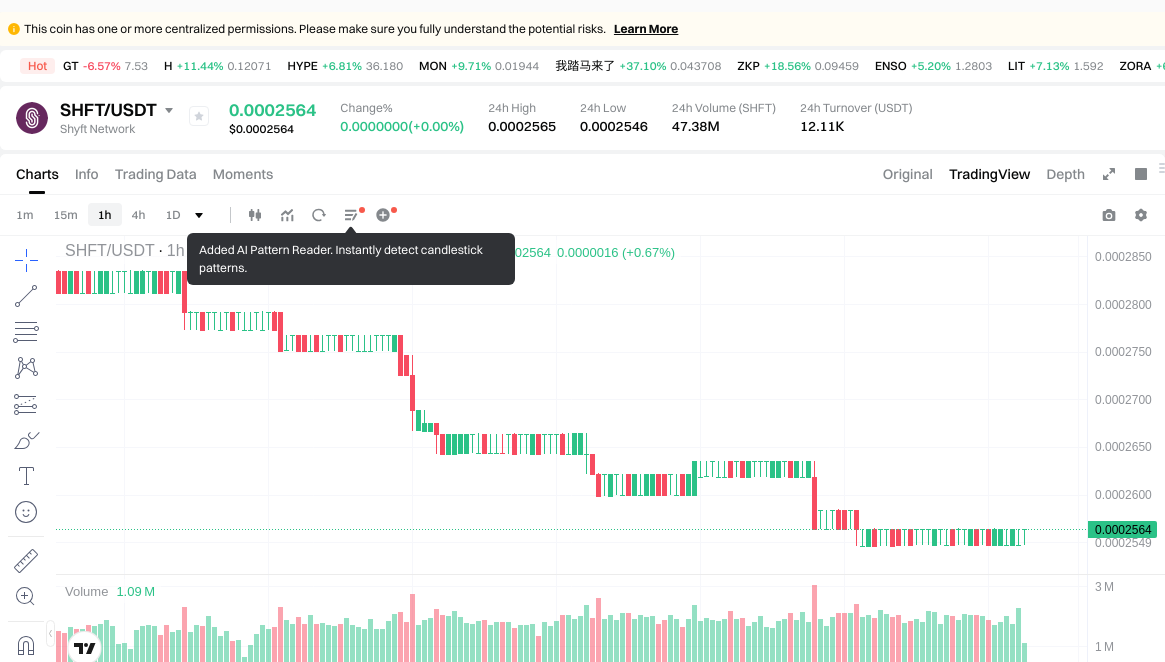
- Recent Period: Price volatility continues → Trading around $0.0002547 with modest 24-hour fluctuation of 0.03%
Current SHFT Investment Market Status (February 2026)
- SHFT current price: $0.0002547
- Market capitalization: Approximately $594,740
- 24-hour trading volume: $12,060.56
- Token holder distribution: 2,913 addresses
- Circulating supply: 2.34 billion SHFT (92.66% of max supply)
- Market cap to fully diluted valuation ratio: 92.66%
Click to view real-time SHFT market price
II. Core Factors Affecting Whether SHFT is a Good Investment (Is Shyft Network(SHFT) a Good Investment)
Supply Mechanism and Scarcity (SHFT investment scarcity)
- Supply structure → impacts price and investment value
- SHFT has a maximum supply of 2,520,000,000 tokens with approximately 92.66% already in circulation (2,335,062,791 tokens)
- Investment significance: limited additional supply may reduce future dilution pressure
Institutional Investment and Mainstream Adoption (Institutional investment in SHFT)
- Current holder base: approximately 2,913 holders as of February 2026
- Market participation: SHFT remains actively traded with ongoing ecosystem development
- Trading availability: listed on at least one exchange platform
Macroeconomic Environment's Impact on SHFT Investment
- Broader crypto market conditions influence SHFT's investment attractiveness
- Market volatility considerations: SHFT experienced price fluctuations with recent declines of 10.19% (7-day) and 25.53% (30-day)
- Economic uncertainty factors may affect overall cryptocurrency investment sentiment
Technology and Ecosystem Development (Technology & Ecosystem for SHFT investment)
- Core protocol functionality: Shyft Network aggregates trust and verification across public and private data ecosystems
- Data bridging capability: enables context layering to transform raw data into meaningful information
- Application scope: SHFT token facilitates payments for network security, operations, and data market transactions across identity systems
- Digital reputation framework: the network supports development of identity and credibility infrastructure through incentivized data contextualization
III. SHFT Future Investment Forecast and Price Outlook (Is Shyft Network (SHFT) worth investing in 2026-2031)
Short-term Investment Forecast (2026, short-term SHFT investment outlook)
- Conservative Forecast: $0.000209 - $0.000242
- Neutral Forecast: $0.000242 - $0.000255
- Optimistic Forecast: $0.000255 - $0.000267
Mid-term Investment Outlook (2027-2029, mid-term Shyft Network (SHFT) investment forecast)
-
Market Stage Expectation: According to available predictions, SHFT may experience gradual growth as the protocol develops its trust verification infrastructure and data marketplace capabilities. The token's utility in network security and identity system payments could support moderate price appreciation during this period.
-
Investment Return Forecast:
- 2027: $0.000219 - $0.000360
- 2028: $0.000233 - $0.000382
- 2029: $0.000211 - $0.000506
-
Key Catalysts: Network adoption growth, expansion of data marketplace partnerships, developments in digital identity verification systems, and broader blockchain protocol integration.
Long-term Investment Outlook (Is SHFT a good long-term investment?)
- Base Scenario: $0.000288 - $0.000447 (assuming steady protocol development and moderate adoption of trust verification services)
- Optimistic Scenario: $0.000447 - $0.000533 (assuming accelerated adoption of digital identity solutions and expanded ecosystem partnerships)
- Risk Scenario: $0.000209 - $0.000288 (considering potential market headwinds or slower-than-expected protocol adoption)
Click to view SHFT long-term investment and price forecast: Price Prediction
2026-02-05 - 2031 Long-term Outlook
- Base Scenario: $0.000288 - $0.000437 USD (corresponding to steady progress and stable mainstream application growth)
- Optimistic Scenario: $0.000437 - $0.000533 USD (corresponding to large-scale adoption and favorable market conditions)
- Transformative Scenario: Above $0.000533 USD (such as breakthrough progress in ecosystem and mainstream adoption)
- 2031-12-31 Predicted High: $0.000533 USD (based on optimistic development assumptions)
Disclaimer: The above predictions are based on historical data analysis and market modeling. Cryptocurrency markets are highly volatile and unpredictable. This information does not constitute investment advice. Investors should conduct their own research and consider their risk tolerance before making any investment decisions.
| Year | Predicted High Price | Predicted Average Price | Predicted Low Price | Price Change |
|---|---|---|---|---|
| 2026 | 0.000267435 | 0.0002547 | 0.000208854 | 0 |
| 2027 | 0.00036027315 | 0.0002610675 | 0.0002192967 | 2 |
| 2028 | 0.00038212449975 | 0.000310670325 | 0.00023300274375 | 21 |
| 2029 | 0.000505740222067 | 0.000346397412375 | 0.000211302421548 | 36 |
| 2030 | 0.000447372258082 | 0.000426068817221 | 0.000391983311843 | 67 |
| 2031 | 0.000532799055935 | 0.000436720537651 | 0.00028823555485 | 71 |
IV. SHFT Investment Strategy and Risk Management (How to invest in SHFT)
Investment Methodology (SHFT investment strategy)
Long-term Holding (HODL SHFT): This approach may suit investors with a stable risk tolerance. Long-term holders typically focus on the fundamental value proposition of Shyft Network's data trust and verification protocol, rather than short-term price fluctuations. Given SHFT's role in facilitating cross-ecosystem data bridging and digital reputation frameworks, investors adopting this strategy would need to evaluate the project's long-term adoption prospects and network utility growth.
Active Trading: This strategy relies on technical analysis and swing trading techniques. Traders may utilize price trend data, such as the 24-hour price change of 0.03% or the 7-day decline of -10.19%, to identify entry and exit points. The token's relatively low trading volume of approximately $12,060 within 24 hours suggests lower liquidity, which could present both opportunities and challenges for active traders seeking to capitalize on price movements.
Risk Management (Risk management for SHFT investment)
Asset Allocation Ratio: Investment allocation should align with individual risk profiles:
- Conservative investors might limit SHFT exposure to less than 1-2% of their total portfolio, given the token's significant volatility and market cap rank of 2905
- Moderate investors could consider a 3-5% allocation as part of a diversified cryptocurrency portfolio
- Experienced investors with higher risk tolerance might allocate 5-10%, while maintaining awareness of the token's historical price range from $0.0002186 to $6.34
Risk Hedging Solutions: A multi-asset portfolio approach may help mitigate concentration risk. Investors could consider:
- Diversifying across different cryptocurrency sectors and asset classes
- Maintaining positions in more established digital assets alongside smaller-cap tokens like SHFT
- Utilizing portfolio rebalancing strategies to manage exposure levels
Secure Storage: Proper storage is critical for protecting SHFT holdings:
- Cold wallets provide offline storage with enhanced security for long-term holdings
- Hot wallets may be suitable for smaller amounts needed for active trading
- Hardware wallets offer a balance between security and accessibility for medium to large holdings
V. SHFT Investment Risks and Challenges (Risks of investing in SHFT)
Market Risk: SHFT exhibits notable price volatility, with a 30-day decline of -25.53% and a 1-year decrease of -46.25%. The token's relatively small market capitalization of approximately $594,740 and limited trading volume may contribute to price fluctuations. The current price of $0.0002547 remains significantly below the all-time high of $6.34 recorded in March 2021, while approaching the all-time low of $0.0002186 from April 2025.
Regulatory Risk: As a blockchain protocol dealing with data trust, verification, and identity systems, Shyft Network operates in a regulatory landscape that varies across jurisdictions. Policy uncertainties regarding data privacy, digital identity, and cryptocurrency operations in different countries could impact the project's development and token utility. The token's contract address on the Ethereum network means it is also subject to regulations affecting the Ethereum ecosystem.
Technical Risk: The protocol's focus on aggregating trust and verification across public, private, licensed, and unlicensed networks introduces technical complexity. Potential risks include:
- Network security vulnerabilities that could affect data integrity or token security
- Challenges in maintaining interoperability across multiple ecosystem types
- Risks associated with protocol upgrades or modifications to the underlying infrastructure
- The reliance on intermediaries within the identity system for data market payments
VI. Conclusion: Is SHFT a Good Investment?
Investment Value Summary: SHFT presents a specialized value proposition focused on data trust and digital identity infrastructure. The token's utility within the Shyft Network ecosystem for paying security and operational costs, as well as facilitating data market transactions, provides a functional basis for potential long-term value. However, the token has experienced substantial price decline over the past year, with significant volatility across multiple timeframes.
Investor Recommendations:
✅ Beginners: Consider small, regular investments (dollar-cost averaging) if interested in the data verification sector, combined with secure wallet storage. Beginners should thoroughly research the project's fundamentals and start with minimal allocation given the token's volatility and lower liquidity.
✅ Experienced Investors: May explore swing trading opportunities based on technical analysis, while maintaining SHFT as a minor component within a diversified cryptocurrency portfolio. Active monitoring of development updates and network adoption metrics would be advisable.
✅ Institutional Investors: Could evaluate SHFT within the context of broader data infrastructure and digital identity themes, though the token's current market position and liquidity levels may present challenges for larger allocations.
⚠️ Notice: Cryptocurrency investment carries substantial risk. This content is for informational purposes only and does not constitute investment advice. Investors should conduct independent research and consult financial professionals before making investment decisions.
VII. FAQ
Q1: What is the Shyft Network (SHFT) token and what is its primary use case?
SHFT is the native utility token of Shyft Network, a blockchain protocol focused on data trust and identity verification infrastructure. The token serves as the operational and payment mechanism within the network, enabling users to pay for network security, operations, and data market transactions across identity systems. Launched in March 2021, the protocol aims to bridge isolated datasets across public and private ecosystems by aggregating trust and verification data. The token facilitates the transformation of raw data into meaningful, contextualized information through the network's digital reputation framework, supporting the development of identity and credibility infrastructure across multiple blockchain ecosystems.
Q2: How has SHFT performed historically and what is its current market position?
SHFT has experienced significant volatility since its launch, reaching an all-time high of $6.34 on March 28, 2021, before declining substantially to its current price of approximately $0.0002547 as of February 2026. The token has a market capitalization of around $594,740 and ranks 2905 in the overall cryptocurrency market. Recent performance shows declines of 10.19% over seven days, 25.53% over thirty days, and 46.25% over one year. With approximately 2,913 holders and a 24-hour trading volume of $12,060.56, SHFT maintains a relatively small but active market presence. The token has a circulating supply of 2.34 billion SHFT, representing 92.66% of its maximum supply of 2.52 billion tokens.
Q3: What are the price predictions for SHFT from 2026 to 2031?
Based on market modeling and historical data analysis, SHFT price forecasts suggest gradual growth potential with significant variability. For 2026, predictions range from $0.000209 (conservative) to $0.000267 (optimistic). Mid-term forecasts for 2027-2029 project prices between $0.000211 and $0.000506, depending on adoption rates and market conditions. Long-term predictions through 2031 estimate a base scenario of $0.000288 to $0.000437, with an optimistic scenario reaching $0.000533 by the end of 2031. These projections assume steady protocol development, expanded ecosystem partnerships, and growing adoption of digital identity solutions. However, cryptocurrency markets are highly volatile and unpredictable, and actual performance may differ significantly from these forecasts.
Q4: What are the main investment risks associated with SHFT?
SHFT presents several key investment risks that potential investors should consider. Market risk is significant, evidenced by the token's substantial price decline from its $6.34 all-time high to current levels near $0.0002547, coupled with high volatility and limited trading liquidity. Regulatory risk stems from the protocol's involvement in data privacy, digital identity, and cross-jurisdictional operations, where policy changes could impact functionality and adoption. Technical risks include potential network security vulnerabilities, challenges maintaining interoperability across multiple ecosystem types, and reliance on complex infrastructure for data verification and trust aggregation. Additionally, the token's small market capitalization of approximately $594,740 and low daily trading volume increase susceptibility to price manipulation and liquidity constraints.
Q5: How should investors approach SHFT as part of their portfolio strategy?
Investment approach should align with individual risk tolerance and experience level. Conservative investors might limit SHFT exposure to 1-2% of their total portfolio given the token's volatility and market position. Moderate investors could consider 3-5% allocation as part of diversified cryptocurrency holdings, while experienced investors with higher risk tolerance might allocate 5-10% while maintaining awareness of the token's significant price range. Long-term holding (HODL) strategies may suit those believing in the fundamental value of data trust and verification infrastructure, focusing on protocol adoption rather than short-term fluctuations. Active traders might utilize technical analysis and swing trading techniques, though should note the relatively low liquidity. Risk management through portfolio diversification, secure storage (hardware or cold wallets), and regular rebalancing is essential for all investor types.
Q6: What factors could drive SHFT's future value appreciation?
Several catalysts could potentially support SHFT's value growth. Network adoption represents a primary driver, as increased usage of Shyft Network's data verification services and identity infrastructure would enhance token utility. Expansion of data marketplace partnerships and integration with broader blockchain protocols could increase demand for SHFT tokens needed for network operations and security payments. Developments in digital identity verification systems and regulatory clarity around data privacy frameworks might boost adoption of the protocol's trust aggregation capabilities. The token's limited additional supply (92.66% already circulating) may reduce future dilution pressure. However, realization of these potential catalysts remains uncertain and depends on successful execution of the project's roadmap and broader market acceptance of blockchain-based identity solutions.
Q7: What makes Shyft Network different from other blockchain projects?
Shyft Network distinguishes itself through its specialized focus on data trust and verification infrastructure across multiple ecosystem types. Unlike many blockchain projects that operate within single networks, Shyft aims to bridge isolated datasets across public, private, licensed, and unlicensed ecosystems. The protocol's core capability involves context layering—transforming raw data into meaningful information through trust aggregation and verification services. This positions SHFT within the digital identity and reputation framework sector, where the token facilitates payments for intermediaries in identity systems and data market transactions. The protocol's emphasis on cross-ecosystem interoperability and data contextualization represents a distinct value proposition compared to general-purpose blockchain platforms or single-function decentralized applications.
Q8: Is SHFT suitable for beginner cryptocurrency investors?
SHFT presents significant challenges for beginner investors due to several factors. The token's extreme volatility, evidenced by a decline from $6.34 to current levels around $0.0002547, requires substantial risk tolerance. Limited liquidity with only $12,060 in 24-hour trading volume can make entry and exit more difficult. The project's technical complexity involving data trust infrastructure and identity verification may be harder for beginners to evaluate compared to more established cryptocurrencies. However, beginners interested in the data verification sector could consider small, regular investments through dollar-cost averaging strategies, starting with minimal allocation (less than 1% of portfolio). Proper education on secure wallet storage, thorough research of project fundamentals, and understanding of cryptocurrency market dynamics are essential prerequisites before considering any SHFT investment.
Share
Content
Introduction: Shyft Network (SHFT) Investment Position and Market Outlook
I. Shyft Network (SHFT) Price History Review and Current Investment Value Status
II. Core Factors Affecting Whether SHFT is a Good Investment (Is Shyft Network(SHFT) a Good Investment)
III. SHFT Future Investment Forecast and Price Outlook (Is Shyft Network (SHFT) worth investing in 2026-2031)
IV. SHFT Investment Strategy and Risk Management (How to invest in SHFT)
V. SHFT Investment Risks and Challenges (Risks of investing in SHFT)
VI. Conclusion: Is SHFT a Good Investment?
VII. FAQ
How to Buy Cryptocurrency


Trending Cryptocurrencies



2025 SUI coin: price, buying guide, and Staking rewards

How to Buy Crypto: A Step-by-Step Guide with Gate.com

HNT Price in 2025: Helium Network Token Value and Market Analysis

What is SwissCheese (SWCH) and How Does It Democratize Investment?

Cardano (ADA) Price Analysis and Outlook for 2025

How to Invest in Metaverse Crypto

Free Money for App Registration: Crypto Rewards Guide
Top 4 Cryptocurrency Exchanges for Free Registration Bonuses

What is Slippage? How Can We Avoid It While Trading Crypto?
Mining Calculator: How to Calculate Mining Profitability
Revolut Quiz Answers