SubQuery Network (SQT) is a blockchain data indexing infrastructure token serving over 160 chains through decentralized APIs, addressing critical Web3 ecosystem needs. This comprehensive analysis examines whether SQT represents a viable investment opportunity by evaluating its token utility, market positioning, and growth potential. The article reviews SQT's significant 84.92% annual decline to current price levels near all-time lows, while analyzing supply mechanics, technical capabilities, and ecosystem expansion prospects. Detailed price forecasts span 2025-2030 across conservative, neutral, and optimistic scenarios, with long-term projections ranging from $0.000527 to $0.000847 by 2030 under favorable conditions. Investment strategies encompass long-term holding, active trading, and risk management protocols including asset allocation guidelines and secure storage solutions on Gate and other platforms. The analysis concludes that SQT suitability depends on individual risk tolerance, with conservative inve
Introduction: SubQuery Network (SQT) Investment Position and Market Outlook
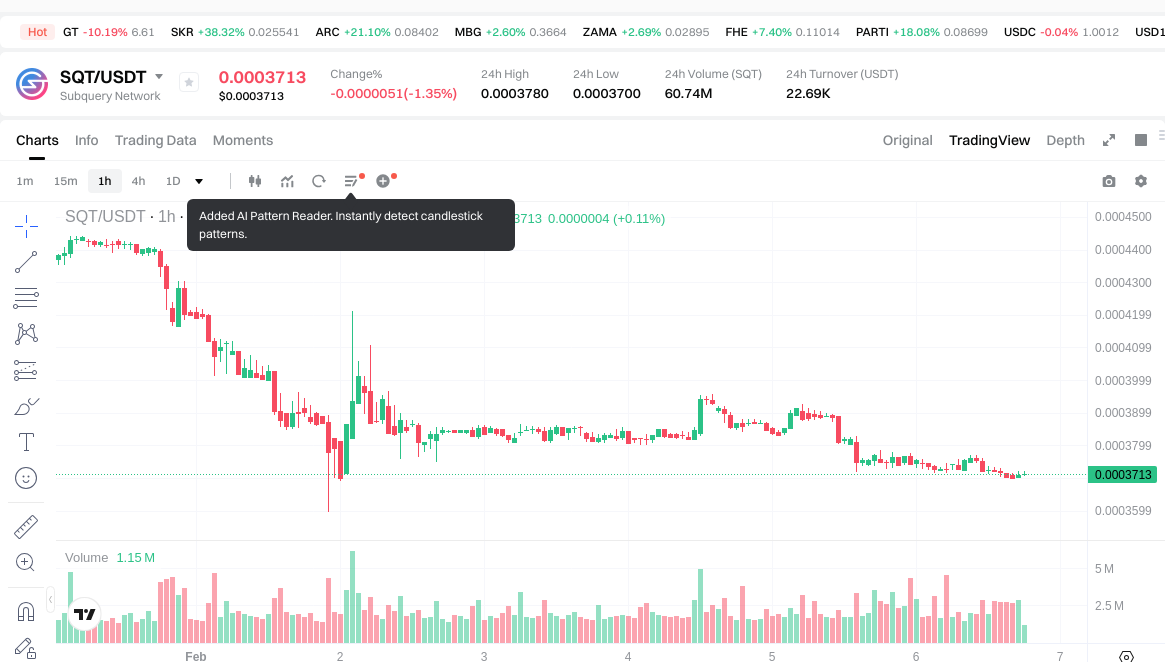
SQT represents a notable asset in the cryptocurrency domain, focusing on Web3 infrastructure innovation since its launch in 2024. As of February 2026, SubQuery Network holds a market capitalization of approximately $368,468.79, with a circulating supply of around 993,713,034 tokens, and the current price stands at approximately $0.0003708. Positioned as a blockchain data indexer providing fast, flexible, reliable, and decentralized APIs for over 160 chains, SQT has gradually become a focal point for investors discussing "Is SubQuery Network (SQT) a good investment?" This article comprehensively analyzes SQT's investment value, historical trends, future price projections, and investment risks, providing reference insights for investors.
Over the past year, SQT has experienced significant price fluctuations, with a 1-year performance showing a decline of 84.92%. The token reached a notable price level of $0.045 in April 2024, while recording a lower price point of $0.0003034 in January 2026. Recent performance shows a 30-day increase of 12.91%, though the 7-day trend indicates a decrease of 14.93%. With approximately 3,880 holders and a market dominance of 0.00015%, SQT operates within the decentralized infrastructure sector, supporting builders in creating Web3 applications. The token's circulating supply represents approximately 9.94% of its total supply of 10,010,059,082 tokens, with a maximum supply cap of 10,000,000,000 tokens.
I. SubQuery Network (SQT) Price History Review and Current Investment Value
- February 2024: SQT token officially launched on exchanges with an initial offering price of $0.0095, marking the project's entry into public trading markets.
- April 2024: Token experienced notable upward momentum, with price movements reflecting broader market interest in data infrastructure solutions within the Web3 ecosystem.
- 2024-2025: Market cycle brought significant price adjustments, with valuation fluctuating from elevated levels to lower trading ranges during periods of sector-wide corrections.
- January 2026: Price stabilization occurred as the token found support levels, with trading activity reflecting ongoing project development and ecosystem expansion efforts.
Current SQT Investment Market Status (February 2026)
- Current SQT Price: $0.0003708
- 24-Hour Trading Volume: $22,587.07
- Market Capitalization: $368,468.79
- Circulating Supply: 993,713,034 SQT (approximately 9.94% of total supply)
- Holder Count: 3,880 addresses
- Available Trading Venues: Listed on 1 exchange platform
Click to view real-time SQT market price
II. Core Factors Affecting Whether SQT Is a Good Investment
Supply Mechanism and Scarcity (SQT Investment Scarcity)
- SubQuery Network (SQT) has a maximum supply of 10 billion tokens, with approximately 993.71 million tokens (9.94%) currently in circulation. The controlled token release mechanism may create scarcity pressure over time.
- The market cap to fully diluted valuation ratio stands at 9.94%, indicating that a substantial portion of the total supply remains locked or unvested, which could influence future price dynamics as additional tokens enter circulation.
- Investment significance: The limited circulating supply relative to total supply may support scarcity-driven value appreciation, though investors should monitor the token unlock schedule for potential dilution effects.
Technology and Ecosystem Development (Technology & Ecosystem for SQT Investment)
- SubQuery Network operates as a blockchain data indexer providing decentralized APIs across over 160 blockchain networks, positioning itself as critical Web3 infrastructure.
- The project's multi-chain indexing capabilities enable developers to access and organize on-chain data across hundreds of networks, which may enhance ecosystem adoption and utility value.
- The expansion of DeFi, NFT, and other Web3 applications utilizing SubQuery's indexing services could strengthen the network's fundamental value proposition and drive demand for SQT tokens as the ecosystem matures.
III. SQT Future Investment Forecast and Price Outlook (Is SubQuery Network(SQT) worth investing in 2025-2030)
Short-term Investment Outlook (2025, short-term SQT investment outlook)
- Conservative forecast: $0.000359128 - $0.0004664
- Neutral forecast: $0.0004664 - $0.000553
- Optimistic forecast: $0.000553 - $0.0008762
Mid-term Investment Outlook (2026-2027, mid-term SubQuery Network(SQT) investment forecast)
- Market stage expectation: The market may experience moderate growth as the blockchain data indexing sector continues to develop, with potential fluctuations influenced by broader Web3 infrastructure adoption trends.
- Return on investment forecast:
- 2026: $0.00019663 - $0.00051198
- 2027: $0.000353192 - $0.0005165433
- Key catalysts: Expansion of supported blockchain networks, increased adoption of decentralized APIs, and broader Web3 ecosystem development.
Long-term Investment Outlook (Is SQT a good long-term investment?)
- Base scenario: $0.000527990114754 - $0.000732146292459 (assuming steady annual growth rate of approximately 5% and moderate market expansion)
- Optimistic scenario: $0.000703986819672 - $0.000847318536157 (assuming accelerated adoption of blockchain data indexing solutions and favorable market conditions)
- Risk scenario: Below $0.0003034 (under extreme market downturns or significant competitive pressure)
Click to view SQT long-term investment and price forecast: Price Prediction
2026-02-06 - 2030 Long-term Outlook
- Base scenario: $0.000527990114754 - $0.000732146292459 (corresponding to steady progress and gradual mainstream application enhancement)
- Optimistic scenario: $0.000703986819672 - $0.000847318536157 (corresponding to large-scale adoption and favorable market environment)
- Transformative scenario: Above $0.0008762 (if the ecosystem achieves breakthrough progress and mainstream adoption)
- 2030-12-31 predicted high: $0.000847318536157 (based on optimistic development assumptions)
Disclaimer: The above price predictions are based on historical data analysis and current market trends, and do not constitute investment advice. Cryptocurrency markets are highly volatile, and actual prices may differ significantly from forecasts. Investors should conduct thorough research and consider their own risk tolerance before making any investment decisions.
| Year |
Predicted High Price |
Predicted Average Price |
Predicted Low Price |
Price Change |
| 2026 |
0.00051198 |
0.000371 |
0.00019663 |
0 |
| 2027 |
0.0005165433 |
0.00044149 |
0.000353192 |
19 |
| 2028 |
0.0007041544755 |
0.00047901665 |
0.0003305214885 |
29 |
| 2029 |
0.000816388076595 |
0.00059158556275 |
0.00042594160518 |
59 |
| 2030 |
0.000732146292459 |
0.000703986819672 |
0.000527990114754 |
89 |
| 2031 |
0.000847318536157 |
0.000718066556066 |
0.000380575274714 |
93 |
IV. SQT Investment Strategy and Risk Management (How to invest in SubQuery Network)
Investment Methodology (SQT investment strategy)
Long-term Holding (HODL SQT)
Long-term holding may be suitable for steady investors who believe in the fundamental value proposition of blockchain data indexing infrastructure. SubQuery Network positions itself as a critical infrastructure component serving over 160 chains, which could provide structural growth potential as Web3 adoption expands. Investors considering this approach should evaluate the project's technical roadmap, partnership ecosystem, and competitive positioning within the data indexing sector.
Given SQT's substantial price decline of 84.92% over the past year and current trading near historical lows ($0.0003708 vs. all-time low of $0.0003034), long-term investors should carefully assess whether current valuation represents a recovery opportunity or reflects fundamental challenges. The token's low circulation ratio of approximately 9.94% suggests significant future supply releases that could impact price dynamics.
Active Trading
Active trading strategies rely on technical analysis and swing trading approaches. SQT exhibits considerable price volatility, with 24-hour fluctuations and a 14.93% decline over the past 7 days, which may create opportunities for experienced traders. The relatively modest 24-hour trading volume of approximately $22,587 indicates lower liquidity compared to major cryptocurrencies, potentially resulting in wider spreads and slippage during position entry and exit.
Traders should monitor key technical levels, including the all-time high of $0.045 (April 2024) and all-time low of $0.0003034 (January 2026), while considering the token's limited exchange availability (currently listed on 1 exchange according to available data).
Risk Management (Risk management for SQT investment)
Asset Allocation Ratios
- Conservative investors: Given SQT's high volatility profile and early-stage market position, conservative portfolios might limit exposure to 1-3% of total crypto allocation, or 0.1-0.5% of overall investment portfolio
- Aggressive investors: Those with higher risk tolerance and conviction in Web3 infrastructure growth could allocate 5-10% of crypto portfolio, understanding the potential for substantial losses
- Professional investors: Institutional participants may consider strategic positions as part of broader Web3 infrastructure thesis, with appropriate hedging mechanisms and liquidity management protocols
Risk Hedging Solutions
Diversification across multiple assets remains fundamental to risk management. Investors holding SQT might consider:
- Multi-asset portfolio construction including established cryptocurrencies, stablecoins, and traditional assets
- Correlation analysis with other blockchain infrastructure tokens to avoid concentrated sector exposure
- Position sizing relative to liquidity constraints given SQT's limited trading venues
- Regular portfolio rebalancing to maintain target allocation percentages
Secure Storage
SQT operates on ERC20 standard (Ethereum) and Base EVM networks based on contract addresses. Appropriate storage options include:
- Cold wallets: Hardware wallets supporting ERC20 tokens (such as Ledger, Trezor) provide enhanced security for long-term holdings
- Hot wallets: Software wallets with ERC20 compatibility for active trading, while understanding increased security risks
- Multi-signature solutions: For larger holdings, multi-signature wallets add additional security layers
- Exchange custody: Limited to trading amounts only, as centralized custody introduces counterparty risk
Investors should verify contract addresses through official sources (0x09395a2A58DB45db0da254c7EAa5AC469D8bDc85 for Ethereum, 0x858c50C3AF1913b0E849aFDB74617388a1a5340d for Base) before conducting transactions.
V. SQT Investment Risks and Challenges (Risks of investing in SubQuery Network)
Market Risks
High Volatility: SQT demonstrates substantial price volatility, with a one-year decline of 84.92% and recent 7-day decrease of 14.93%. Current price ($0.0003708) represents approximately 99.2% decline from all-time high ($0.045), illustrating extreme volatility characteristics. The 24-hour price range ($0.00037 to $0.000378) shows continued fluctuation even at compressed price levels.
Price Manipulation Concerns: With relatively limited trading volume ($22,587 in 24 hours) and availability on minimal exchanges, SQT may be susceptible to price manipulation through large orders or coordinated trading activities. The low market capitalization (approximately $368,469) and modest holder base (3,880 addresses) could amplify the impact of concentrated trading activity.
Liquidity Constraints: Limited exchange listings and trading volume may result in execution challenges, wider bid-ask spreads, and potential difficulty exiting positions during market stress periods.
Regulatory Risks
Policy Uncertainty Across Jurisdictions: Cryptocurrency regulatory frameworks continue evolving globally, with different approaches across major markets. Infrastructure tokens like SQT may face classification questions regarding securities regulations, utility token status, and cross-border operational requirements.
Compliance Requirements: As blockchain data indexing involves processing and providing access to blockchain information, potential data privacy regulations, cross-chain operational licenses, and decentralized service provider classifications could impact project operations and token utility.
Evolving Enforcement Actions: Regulatory authorities worldwide are increasing scrutiny of cryptocurrency projects, exchanges, and service providers, creating ongoing compliance risks and potential operational disruptions.
Technical Risks
Network Security Vulnerabilities: As infrastructure supporting multiple blockchain networks (160+ chains), SubQuery's security architecture requires robust protection against exploits, smart contract vulnerabilities, and potential attack vectors. Any security breach could significantly impact token value and project credibility.
Upgrade Implementation Challenges: Blockchain infrastructure projects must continuously evolve to support new networks, maintain compatibility, and implement technical improvements. Failed upgrades, delayed roadmap execution, or technical limitations in scaling could affect competitive positioning.
Dependency Risks: As a data indexing service, SubQuery's functionality depends on underlying blockchain networks' performance, stability, and adoption. Technical issues or declining usage of supported chains could indirectly impact SubQuery's value proposition.
Smart Contract Risks: Given deployment on Ethereum and Base networks via ERC20 standard, smart contract bugs, vulnerabilities, or exploits present ongoing technical risks requiring continuous security audits and monitoring.
VI. Conclusion: Is SubQuery Network a Good Investment?
Investment Value Summary
SubQuery Network (SQT) represents a specialized investment in blockchain data indexing infrastructure, serving over 160 chains with decentralized API services. The project addresses a technical need within Web3 ecosystem development, potentially benefiting from broader blockchain adoption trends.
However, current market performance presents considerable challenges. The token has experienced an 84.92% decline over the past year, trading near all-time lows with modest liquidity and limited exchange availability. The low circulation ratio (approximately 9.94%) indicates substantial token supply yet to enter circulation, which may create ongoing selling pressure.
Long-term investment potential depends on successful execution of technical roadmap, competitive differentiation within the data indexing sector, and broader Web3 infrastructure adoption. Short-term price dynamics reflect substantial volatility, as evidenced by recent 7-day decline of 14.93% and narrow trading ranges.
Investor Recommendations
✅ Beginners:
- Consider dollar-cost averaging approach if pursuing exposure, limiting position size to minimal portfolio percentage (1-2% of crypto allocation)
- Utilize secure hardware wallet storage supporting ERC20 tokens
- Verify official contract addresses before transactions
- Understand that current price levels near all-time lows do not guarantee recovery
✅ Experienced Investors:
- Evaluate wave trading opportunities given volatility patterns, while managing liquidity constraints
- Construct portfolio allocation considering correlation with other blockchain infrastructure tokens
- Monitor technical developments, partnership announcements, and competitive landscape
- Implement strict risk management protocols including stop-loss levels and position sizing rules
✅ Institutional Investors:
- Assess strategic long-term allocation as part of broader Web3 infrastructure thesis
- Conduct thorough due diligence on technical architecture, token economics, and competitive moat
- Consider liquidity constraints and potential difficulty in position building or liquidation
- Evaluate custody solutions appropriate for ERC20 standard tokens
⚠️ Disclaimer: Cryptocurrency investments carry substantial risk including potential total loss of capital. This content is provided for informational purposes only and does not constitute investment advice, financial advice, trading advice, or recommendations. Market conditions, project fundamentals, and regulatory environments may change materially. Investors should conduct independent research and consult qualified financial advisors before making investment decisions.
VII. FAQ
Q1: What is SubQuery Network (SQT) and why does it matter for Web3 infrastructure?
SubQuery Network (SQT) is a blockchain data indexer providing fast, flexible, reliable, and decentralized APIs across over 160 blockchain networks. The project serves as critical infrastructure enabling developers to efficiently access and organize on-chain data without building custom indexing solutions. As Web3 applications increasingly require multi-chain data access for DeFi protocols, NFT platforms, and decentralized applications, SubQuery's multi-chain indexing capabilities address a fundamental technical need. The token operates on Ethereum (ERC20) and Base networks, with the native SQT token facilitating network operations and governance within the decentralized infrastructure ecosystem.
Q2: Is SubQuery Network (SQT) a good investment considering its 84.92% decline over the past year?
The investment suitability of SQT depends on individual risk tolerance and investment timeframe. Current market performance presents significant challenges, with the token trading at approximately $0.0003708 (near all-time low of $0.0003034) after declining 84.92% over the past year. However, trading near historical lows could represent either a recovery opportunity or reflection of fundamental challenges. The low circulation ratio (approximately 9.94% of total supply) suggests substantial future token releases that may create selling pressure. Conservative investors should limit exposure to 1-3% of crypto allocation, while understanding the potential for continued volatility. Price forecasts suggest potential recovery ranges between $0.000527990114754 - $0.000847318536157 by 2030 under optimistic scenarios, though cryptocurrency markets remain highly unpredictable.
Q3: What are the primary risks associated with investing in SubQuery Network (SQT)?
SQT investment carries multiple risk categories. Market risks include extreme volatility (99.2% decline from all-time high), limited liquidity with 24-hour trading volume of approximately $22,587, and availability on minimal exchanges creating potential manipulation concerns. Technical risks involve network security vulnerabilities across 160+ supported chains, smart contract risks on Ethereum and Base networks, and dependency on underlying blockchain performance. Regulatory risks stem from evolving cryptocurrency frameworks globally, potential classification questions regarding securities status, and data privacy requirements for blockchain data processing. The modest holder base (3,880 addresses) and low market capitalization ($368,469) amplify the impact of concentrated trading activity and potential exit difficulties during market stress.
Q4: How should investors securely store SubQuery Network (SQT) tokens?
SQT tokens operate on ERC20 standard (Ethereum) and Base EVM networks, requiring appropriate storage solutions based on holding duration and trading frequency. For long-term holdings, hardware wallets supporting ERC20 tokens (such as Ledger or Trezor) provide enhanced security through cold storage. Active traders may utilize software wallets with ERC20 compatibility, accepting increased security risks for convenience. Larger holdings benefit from multi-signature solutions adding additional security layers. Investors should verify official contract addresses (0x09395a2A58DB45db0da254c7EAa5AC469D8bDc85 for Ethereum, 0x858c50C3AF1913b0E849aFDB74617388a1a5340d for Base) through official sources before conducting transactions. Exchange custody should be limited to trading amounts only, as centralized storage introduces counterparty risk.
Q5: What are the realistic price expectations for SubQuery Network (SQT) through 2030?
Price forecasts suggest varied scenarios depending on market conditions and project execution. Short-term outlook for 2025 ranges from conservative $0.000359128 to optimistic $0.0008762. Mid-term forecasts for 2026 project $0.00019663 - $0.00051198, while 2027 estimates range $0.000353192 - $0.0005165433. Long-term projections through 2030 present base scenario of $0.000527990114754 - $0.000732146292459 (assuming steady 5% annual growth), optimistic scenario of $0.000703986819672 - $0.000847318536157 (accelerated adoption), and transformative scenario above $0.0008762 (breakthrough mainstream adoption). These predictions assume continued Web3 infrastructure development and broader blockchain data indexing adoption, though actual prices may differ significantly due to market volatility, competitive pressures, and regulatory changes.
Q6: How does SubQuery Network compare to other blockchain data indexing solutions?
SubQuery Network positions itself as multi-chain infrastructure supporting over 160 blockchain networks with decentralized API services. This broad network coverage differentiates the project from single-chain or limited multi-chain competitors. However, investors should evaluate competitive dynamics within the data indexing sector, including established players and emerging alternatives. Key differentiation factors include technical architecture, decentralization level, developer adoption rates, partnership ecosystem, and pricing models. The project's fundamental value proposition depends on maintaining competitive advantages as blockchain data infrastructure evolves. Current market metrics (modest trading volume, limited exchange listings, low market capitalization) suggest investors should assess whether technical capabilities translate into sustainable competitive moat and ecosystem adoption.
Q7: What investment strategy is most appropriate for SubQuery Network (SQT)?
Investment strategy depends on risk tolerance and market outlook. Long-term holding (HODL) may suit investors believing in Web3 infrastructure growth potential, though requiring conviction despite 84.92% annual decline and substantial unreleased token supply. Conservative portfolios should limit exposure to 1-3% of crypto allocation, while aggressive investors might allocate 5-10% understanding potential losses. Active trading approaches leverage volatility patterns, requiring technical analysis skills and acceptance of liquidity constraints given $22,587 daily volume. Dollar-cost averaging provides systematic exposure for beginners, mitigating timing risks while building positions gradually. All strategies require strict risk management including position sizing, diversification across multiple assets, stop-loss protocols, and regular portfolio rebalancing to maintain target allocations.
Q8: What catalysts could drive SubQuery Network (SQT) price recovery?
Potential positive catalysts include expansion of supported blockchain networks beyond current 160+ chains, increased adoption of decentralized APIs by DeFi and NFT applications, strategic partnerships with major blockchain ecosystems, and successful technical roadmap execution. Broader Web3 infrastructure development and mainstream blockchain adoption could drive structural demand for data indexing services. Additional exchange listings would improve liquidity and accessibility, potentially attracting larger investor base. Token unlock schedule completion could reduce selling pressure concerns. However, negative catalysts include competitive pressure from alternative indexing solutions, technical vulnerabilities or security breaches, regulatory restrictions on decentralized infrastructure services, and overall cryptocurrency market downturns. Investors should monitor development announcements, partnership expansions, and competitive landscape evolution when evaluating recovery potential.
* The information is not intended to be and does not constitute financial advice or any other recommendation of any sort offered or endorsed by Gate.