This comprehensive analysis examines whether Vertus (VERT), a custodial wallet token on the TON blockchain, represents a viable investment opportunity. The article evaluates VERT's current market position with a $730,407 market cap, reviews historical price trends since its January 2025 launch, and analyzes core investment factors including supply mechanisms, ecosystem development, and technology integration. It presents price forecasts across multiple timeframes from 2026-2031, discusses investment strategies for different investor profiles from newcomers to institutions, and details critical risk factors including market volatility, regulatory uncertainty, and technical dependencies. The analysis provides actionable guidance on asset allocation, storage solutions, and due diligence requirements, concluding that VERT offers early-stage growth potential tempered by substantial risks requiring careful portfolio positioning and risk management practices.
Introduction: Vertus (VERT) Investment Position and Market Outlook
VERT is a token associated with Vertus, a custodial wallet on the TON blockchain designed to build an extensive ecosystem of DeFi products accessible directly through Telegram. As of February 04, 2026, VERT has a market capitalization of approximately $730,407.46, with a circulating supply of 549,840,000 tokens and a current price around $0.0013284. The token holds a market ranking of 2,748 and maintains a market share of 0.000058%. With a total supply of 1,200,000,000 tokens and a circulation ratio of 45.82%, VERT represents an emerging asset in the TON blockchain ecosystem. The project aims to simplify crypto processes by leveraging TON blockchain's speed, scalability, and security, offering features such as an easy-to-use wallet, VERT mining, and DApp integration. This article will comprehensively analyze VERT's investment value, historical trends, future price forecasts, and associated risks to provide reference information for those evaluating whether Vertus (VERT) represents a suitable investment opportunity.
I. Vertus (VERT) Price History Review and Current Investment Value Status
- 2025: VERT launched on January 16, 2025 at $0.025 → Early participants experienced significant volatility in initial trading
- 2025: Price reached $0.0295 on January 17, 2025 → VERT showed notable upward momentum shortly after listing
- 2025: Market correction occurred from late January through February → Price declined from $0.0295 to $0.00045
Current VERT Investment Market Status (February 2026)
- VERT current price: $0.0013284
- Market sentiment (Fear & Greed Index): Data not available in provided materials
- 24-hour trading volume: $26,137.97
- Institutional investor positions: Data regarding institutional holdings not available in provided materials
Click to view real-time VERT market price
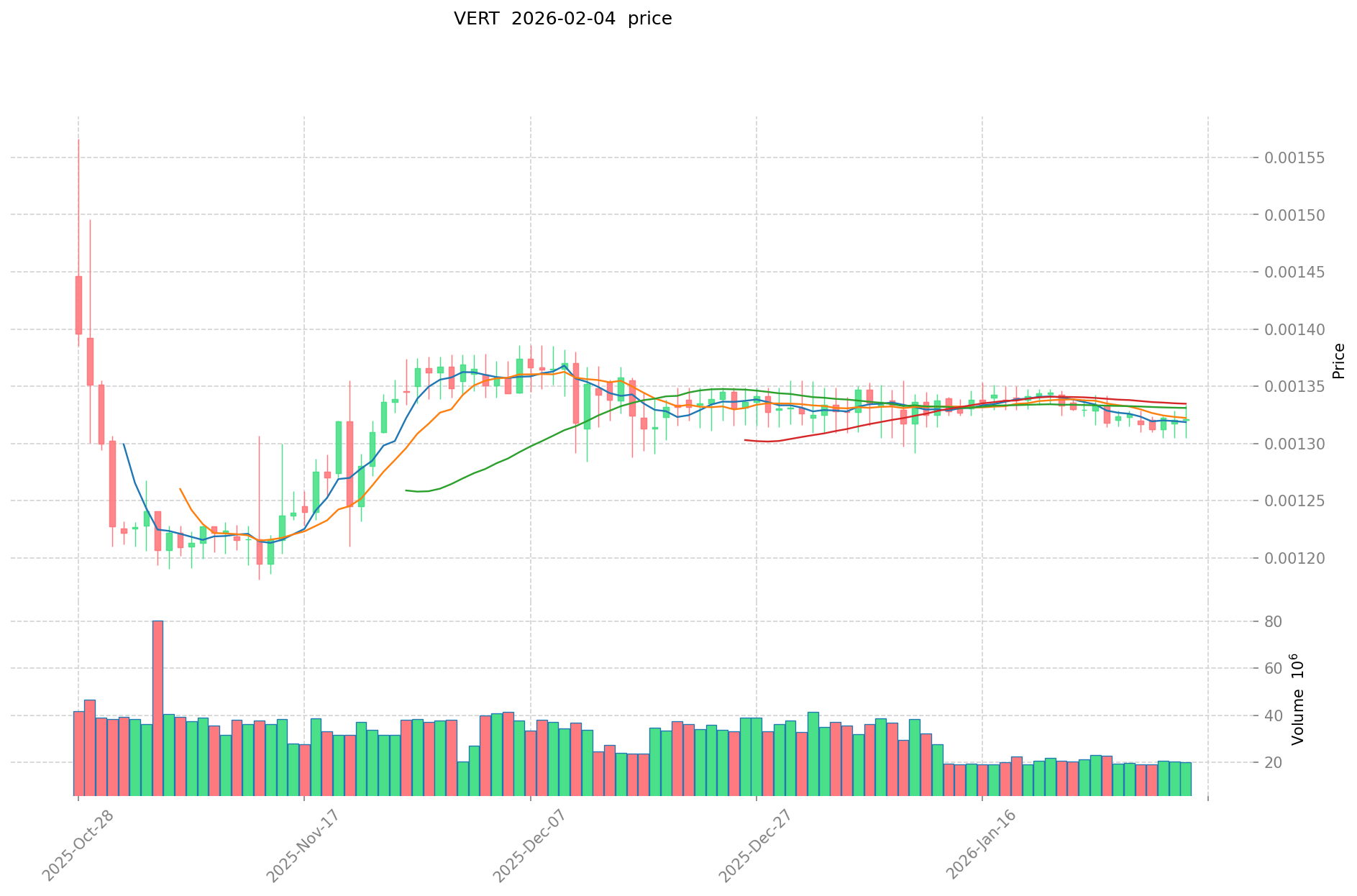
II. Core Factors Affecting Whether VERT is a Good Investment
Supply Mechanism and Scarcity (VERT Investment Scarcity)
- Total Supply Configuration → Impact on Price and Investment Value: Vertus has a total supply of 1,200,000,000 VERT tokens with an unlimited maximum supply. The current circulating supply stands at 549,840,000 tokens, representing approximately 45.82% of the total supply.
- Investment Significance: The unlimited maximum supply model may present challenges for scarcity-based value appreciation, as continuous token issuance could potentially dilute individual token value over time.
Institutional Investment and Mainstream Adoption (Institutional Investment in VERT)
- Holder Distribution Trend: As of the latest data, Vertus has attracted 143,332 token holders, indicating a growing user base for a relatively new project launched in January 2025.
- Mainstream Platform Integration: Vertus is currently listed on 4 exchanges, suggesting early-stage adoption within the crypto trading ecosystem.
Macroeconomic Environment's Impact on VERT Investment
- Market Performance Context: VERT has demonstrated significant volatility since launch, with price movements ranging from a low of $0.00045 to $0.0295, reflecting the influence of broader market conditions and risk sentiment on emerging crypto assets.
- Uncertainty Factors: Macroeconomic conditions, including monetary policy shifts and risk appetite changes in traditional financial markets, may continue to influence investor interest in smaller-cap crypto assets like VERT.
Technology and Ecosystem Development (Technology & Ecosystem for VERT Investment)
- TON Blockchain Integration: Vertus operates as a custodial wallet on the TON blockchain, leveraging the network's speed, scalability, and security features to simplify user access to DeFi services.
- Telegram-Based Accessibility: The project's direct integration with Telegram provides a user-friendly entry point, potentially lowering barriers for mainstream users entering cryptocurrency markets.
- Ecosystem Features: Core functionalities include wallet management, VERT mining capabilities, and decentralized application (DApp) integration, aiming to provide intuitive access to web3 technologies.
- DeFi Product Ecosystem: The project's stated goal is to build an extensive ecosystem of DeFi products, creating a bridge between traditional users and decentralized finance opportunities, which could support long-term value development if successfully implemented.
III. VERT Future Investment Forecast and Price Outlook (Is Vertus(VERT) worth investing in 2026-2030)
Short-term Investment Forecast (2026, short-term VERT investment outlook)
- Conservative forecast: $0.000693 - $0.00133
- Neutral forecast: $0.00133 - $0.00160
- Optimistic forecast: $0.00160 - $0.00187
Mid-term Investment Outlook (2027-2028, mid-term Vertus(VERT) investment forecast)
- Market phase expectation: Based on available data, VERT may experience gradual development within the TON blockchain ecosystem, with price movements potentially influenced by DeFi product expansion and Telegram integration adoption.
- Investment return forecast:
- 2027: $0.000912 - $0.00182
- 2028: $0.00125 - $0.00250
- Key catalysts: DApp integration progress, VERT mining adoption rate, and overall TON blockchain ecosystem development.
Long-term Investment Outlook (Is VERT a good long-term investment?)
- Base scenario: $0.00169 - $0.00333 (assuming steady ecosystem development and consistent user growth)
- Optimistic scenario: $0.00293 - $0.00381 (assuming accelerated DeFi product adoption and expanded Telegram user base)
- Risk scenario: Below $0.000693 (under adverse market conditions or ecosystem development setbacks)
View VERT long-term investment and price forecast: Price Prediction
2026-02-04 - 2031 Long-term Outlook
- Base scenario: $0.00169 - $0.00253 USD (corresponding to steady progress and gradual mainstream application growth)
- Optimistic scenario: $0.00295 - $0.00381 USD (corresponding to large-scale adoption and favorable market conditions)
- Transformative scenario: Above $0.00381 USD (in case of breakthrough ecosystem developments and mainstream adoption)
- 2031-12-31 forecast high: $0.00381 USD (based on optimistic development assumptions)
Disclaimer: Price forecasts are subject to market volatility and various external factors. Past performance does not guarantee future results.
| Year |
Predicted High Price |
Predicted Average Price |
Predicted Low Price |
Price Change |
| 2026 |
0.00186578 |
0.0013327 |
0.000693004 |
0 |
| 2027 |
0.0018231336 |
0.00159924 |
0.0009115668 |
20 |
| 2028 |
0.002498332728 |
0.0017111868 |
0.001249166364 |
28 |
| 2029 |
0.0029466636696 |
0.002104759764 |
0.00183114099468 |
58 |
| 2030 |
0.003333939466176 |
0.0025257117168 |
0.001692226850256 |
90 |
| 2031 |
0.003808773268934 |
0.002929825591488 |
0.002109474425871 |
120 |
IV. Vertus Investment Strategy and Risk Management (How to invest in Vertus)
Investment Methodology (Vertus investment strategy)
-
Long-term holding (HODL Vertus): This approach may suit investors who prefer a conservative strategy and believe in the long-term development of the TON blockchain ecosystem and Vertus's DeFi integration vision. Given Vertus's focus on bridging traditional users with decentralized finance through Telegram accessibility, long-term holders may consider the project's potential expansion in user adoption and ecosystem growth.
-
Active trading: Traders utilizing technical analysis and swing trading strategies should note Vertus's price volatility. Based on available data, VERT has shown notable price fluctuations with short-term changes ranging from -0.32% (1H) to +0.54% (7D), while the 1-year performance indicates +101.25% growth. Active traders may leverage these price movements, though careful analysis of support and resistance levels is essential.
Risk Management (Risk management for Vertus investment)
-
Asset allocation ratio:
- Conservative investors: Consider allocating a small percentage (1-3%) of the overall crypto portfolio to VERT, given its relatively lower market capitalization ($730,407.456) and ranking (#2748).
- Aggressive investors: May increase exposure to 5-10% depending on risk tolerance and conviction in the TON ecosystem.
- Professional investors: Should conduct thorough due diligence on Vertus's custodial wallet model, DApp integration roadmap, and competitive positioning within the TON blockchain before determining allocation.
-
Risk hedging solutions: Diversification across multiple digital assets, including established cryptocurrencies and different blockchain ecosystems, can help mitigate concentration risk. Investors may also consider maintaining positions in stablecoins or traditional assets as hedging instruments.
-
Secure storage:
- Hot wallets: Suitable for active trading amounts, ensuring convenient access for transactions on supported exchanges.
- Cold wallets: Recommended for long-term holdings, particularly hardware wallets that support TON blockchain tokens.
- Self-custody considerations: While Vertus operates as a custodial wallet on TON, investors holding VERT tokens should evaluate storage options based on their security preferences and trading frequency.
V. Vertus Investment Risks and Challenges (Risks of investing in Vertus)
-
Market risks: VERT demonstrates considerable price volatility, with historical data showing significant price range between $0.00045 (ATL on February 25, 2025) and $0.0295 (ATH on January 17, 2025). The current circulating supply of 549,840,000 tokens represents 45.82% of the total supply (1,200,000,000), with an unlimited maximum supply, which may create potential dilution concerns. The relatively low trading volume ($26,137.97 in 24h) and limited exchange availability (4 exchanges) may result in liquidity constraints and susceptibility to price manipulation.
-
Regulatory risks: As a custodial wallet service integrated with Telegram and operating on the TON blockchain, Vertus may face evolving regulatory scrutiny across different jurisdictions. Regulatory frameworks for crypto custody services, DeFi protocols, and messaging platform-integrated financial services continue to develop globally, creating uncertainty for the project's operational model and geographic expansion.
-
Technical risks: The project's reliance on TON blockchain infrastructure means that any network-level vulnerabilities, consensus mechanism issues, or major protocol upgrades could impact Vertus's functionality. As a custodial solution, security considerations include protection of user funds, smart contract vulnerabilities in DApp integrations, and the potential risks associated with centralized custody models. The relatively recent launch (January 16, 2025) means the platform has limited operational history for assessing long-term technical stability.
VI. Conclusion: Is Vertus a Good Investment?
-
Investment value summary: Vertus presents an interesting value proposition as a TON blockchain-based custodial wallet with DeFi ecosystem integration accessible through Telegram. The project addresses user experience barriers in cryptocurrency adoption by simplifying complex processes and providing intuitive web3 access. The 1-year performance data (+101.25%) suggests potential growth momentum, though this should be contextualized within a limited operational timeframe. The project's relatively small market capitalization and holder base (143,332 holders) indicate early-stage development with corresponding growth potential and elevated risk.
-
Investor recommendations:
✅ Newcomers: Consider a dollar-cost averaging (DCA) approach with small, regular investments rather than lump-sum positions. Prioritize understanding TON blockchain fundamentals and secure wallet storage practices before investing.
✅ Experienced investors: May explore swing trading opportunities based on technical analysis, given the token's price volatility patterns. Maintain diversified portfolio allocation and monitor developments in Vertus's DApp ecosystem expansion and user adoption metrics.
✅ Institutional investors: Should conduct comprehensive due diligence on Vertus's custodial model, regulatory compliance framework, competitive positioning within TON ecosystem, and long-term development roadmap before considering strategic allocation.
⚠️ Disclaimer: Cryptocurrency investments carry substantial risk due to price volatility, technological uncertainties, and regulatory changes. This content is for informational purposes only and does not constitute investment advice. Investors should conduct independent research and consider their financial situation and risk tolerance before making investment decisions.
VII. FAQ
Q1: What is Vertus (VERT) and how does it work on the TON blockchain?
Vertus (VERT) is a custodial wallet token operating on the TON blockchain, designed to provide accessible DeFi services directly through Telegram integration. The platform leverages TON blockchain's speed, scalability, and security to offer simplified crypto processes including wallet management, VERT mining capabilities, and decentralized application (DApp) integration. With a current market capitalization of approximately $730,407 and 549,840,000 tokens in circulation (45.82% of total supply), Vertus aims to bridge traditional users with decentralized finance opportunities through an intuitive, Telegram-based interface that lowers entry barriers for mainstream cryptocurrency adoption.
Q2: What are the short-term and long-term price forecasts for VERT?
Short-term forecasts for 2026 range from conservative ($0.000693 - $0.00133) to optimistic ($0.00160 - $0.00187) scenarios. Mid-term outlook suggests gradual development, with 2027 predictions between $0.000912 - $0.00182 and 2028 forecasts of $0.00125 - $0.00250. Long-term projections for 2031 indicate potential high of $0.00381 under optimistic conditions, though this depends heavily on DApp integration progress, VERT mining adoption rates, and overall TON ecosystem growth. These forecasts assume various development scenarios and are subject to significant market volatility, technological developments, and external factors affecting the broader cryptocurrency market.
Q3: What are the primary risks associated with investing in VERT?
VERT investment carries several significant risks: market risks include considerable price volatility (historical range from $0.00045 to $0.0295), limited liquidity with low 24-hour trading volume ($26,137.97), and availability on only 4 exchanges. The unlimited maximum supply presents potential dilution concerns for token value. Regulatory risks stem from evolving global frameworks for custodial services, DeFi protocols, and messaging platform-integrated financial services. Technical risks include dependency on TON blockchain infrastructure, smart contract vulnerabilities, centralized custody model concerns, and limited operational history since the January 16, 2025 launch. Investors should carefully assess these factors against their risk tolerance.
Q4: How should different investor types approach VERT allocation?
Investment strategy varies by investor profile: conservative investors should consider allocating 1-3% of their crypto portfolio given VERT's relatively low market capitalization and ranking (#2748), while aggressive investors may increase exposure to 5-10% based on risk tolerance. Newcomers should employ dollar-cost averaging (DCA) with small, regular investments rather than lump-sum positions, prioritizing understanding of TON blockchain fundamentals and secure storage practices. Experienced investors may explore swing trading opportunities leveraging technical analysis of volatility patterns. Institutional investors require comprehensive due diligence on custodial models, regulatory compliance, competitive positioning, and development roadmap before strategic allocation decisions.
Q5: What factors could influence VERT's long-term investment value?
Several critical factors impact VERT's long-term value proposition: the unlimited supply model may challenge scarcity-based appreciation, while growing holder base (143,332 holders) indicates expanding adoption potential. TON blockchain integration provides technical advantages in speed, scalability, and security. Telegram accessibility lowers user adoption barriers, potentially supporting mainstream entry. Key catalysts include DApp integration progress, VERT mining adoption rates, DeFi product ecosystem expansion, and overall TON blockchain development. Macroeconomic conditions, including monetary policy shifts and risk appetite changes, will influence investor interest. Success depends heavily on achieving stated goals of building extensive DeFi product ecosystems and effectively bridging traditional users with decentralized finance opportunities.
Q6: What storage options should VERT investors consider for security?
VERT storage strategy should align with investment approach and security preferences: hot wallets suit active trading amounts, ensuring convenient access for transactions on the 4 supported exchanges, though they carry higher security risks due to internet connectivity. Cold wallets, particularly hardware wallets supporting TON blockchain tokens, are recommended for long-term holdings to minimize exposure to online threats. While Vertus operates as a custodial wallet on TON, investors holding VERT tokens should evaluate storage options based on trading frequency and security priorities. Self-custody considerations require understanding the trade-offs between convenience and security. Diversification across multiple storage solutions may provide balanced approach combining accessibility for trading with security for long-term holdings.
* The information is not intended to be and does not constitute financial advice or any other recommendation of any sort offered or endorsed by Gate.