This comprehensive analysis evaluates WAM (WAM) as a blockchain gaming investment opportunity, examining its current market position with a $437,652.70 market cap and $0.0006441 price as of February 2026. The article analyzes WAM's play-to-earn platform mechanics, fixed token supply of 1 billion with 67.95% circulation, and historical performance showing a significant decline from its $0.194038 peak in December 2021. Key investment considerations include the platform's 7,340 holders, limited liquidity across 2 Gate exchanges, and accessibility through mobile browsers and app stores. The analysis presents three long-term price scenarios through 2031, ranging from conservative forecasts of $0.000644-$0.001022 to optimistic projections above $0.001083. Risk factors encompass market volatility, regulatory uncertainty, technical vulnerabilities on the BSC network, and concentrated holder distribution, with tailored investment strategies recommended for different investor profiles from conservative to institutional
Introduction: Wam (WAM) Investment Position and Market Outlook
WAM is a crypto asset in the blockchain gaming sector, launched in December 2021 as a play-to-earn platform that enables users to compete in casual tournaments for crypto rewards. As of February 6, 2026, WAM maintains a market capitalization of approximately $437,652.70 with a circulating supply of around 679,479,421 tokens, while the current price stands at approximately $0.0006441. The platform operates across mobile web browsers and app stores, offering a tournament-based gaming ecosystem where player rankings determine access to higher-value competitions. With 7,340 holders and availability on 2 exchanges, WAM represents a niche segment within the GameFi ecosystem. This article provides a comprehensive analysis of WAM's investment characteristics, historical price movements, future price considerations, and associated risks to serve as a reference for market participants evaluating the question "Is Wam (WAM) a good investment?"
I. Wam (WAM) Historical Price Review and Current Investment Value
- 2021: WAM reached price levels near $0.194038 on December 20, 2021 → Early investors experienced substantial returns during this period
- 2022-2024: Market underwent significant correction → Price declined from higher levels toward lower ranges
- 2025-2026: Sustained market pressure → Price movement from previous ranges to $0.00053227 recorded on February 5, 2026
Current WAM Investment Market Status (February 2026)
- WAM current price: $0.0006441
- 24-hour trading volume: $25,598.46
- Market capitalization: $437,652.70
- Circulating supply: 679,479,421 WAM (67.95% of total supply)
Click to view real-time WAM market price
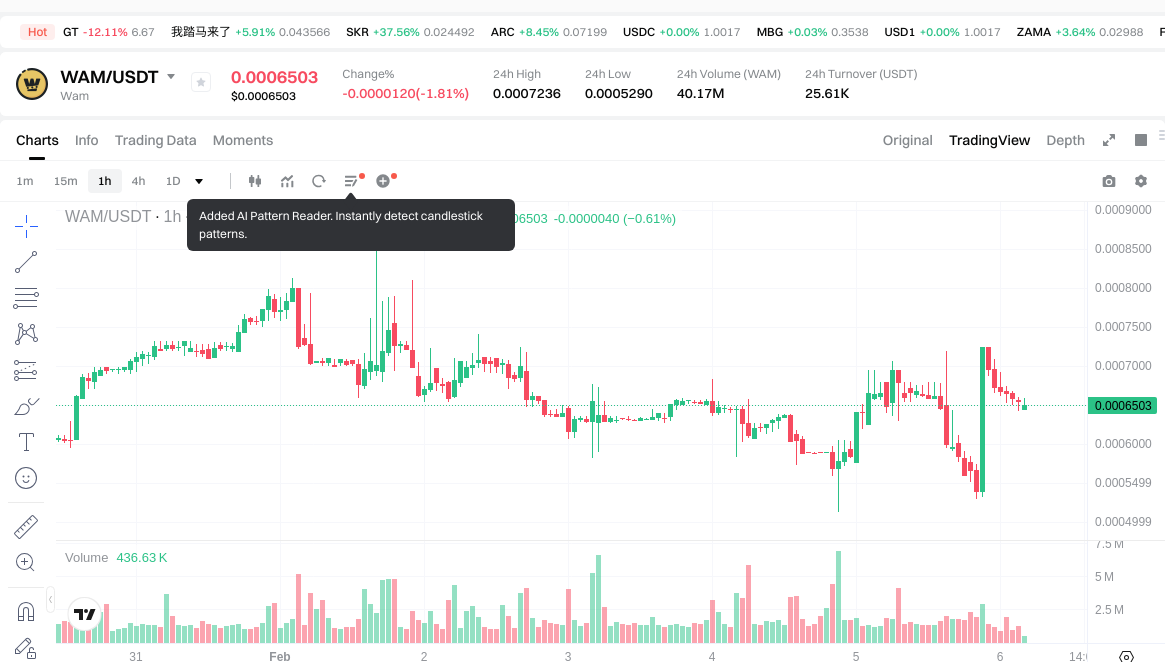
II. Core Factors Influencing Whether WAM is a Good Investment
Supply Mechanism and Scarcity (WAM Investment Scarcity)
- Fixed Maximum Supply → Influences Price and Investment Value
WAM maintains a maximum supply cap of 1,000,000,000 tokens, with a current circulating supply of 679,479,421 tokens, representing approximately 67.95% of the total supply. This fixed supply mechanism creates a built-in scarcity model, where the limited token availability may influence long-term price dynamics as demand fluctuates.
The historical price data indicates significant volatility, with WAM reaching a price point of $0.194038 in December 2021, compared to the current price of $0.0006441 as of February 6, 2026. This represents a substantial decline from historical levels, demonstrating how supply dynamics interact with market demand cycles.
- Investment Significance: Scarcity is a key element supporting long-term investment considerations
The fixed supply structure positions WAM within the category of deflationary token models, where no additional tokens can be created beyond the predetermined maximum. However, with approximately 32% of tokens still not in circulation, future supply releases could impact the scarcity perception and price stability. Investors evaluating WAM's scarcity factor should monitor the circulating supply ratio, which currently stands at 67.95%, and consider how the remaining token distribution may affect market dynamics.
Institutional Investment and Mainstream Adoption (Institutional Investment in WAM)
- Holder Distribution Data: 7,340 token holders
The current holder count of 7,340 addresses suggests a relatively limited distribution network compared to larger cryptocurrency projects. This holder concentration may indicate early-stage adoption patterns, though specific institutional investment data is not available in the reference materials. The exchange availability across 2 trading platforms provides basic market access, though this represents limited mainstream integration compared to more established cryptocurrencies.
Macroeconomic Environment's Impact on WAM Investment
- Market Performance Context → Investment Attractiveness Considerations
WAM's recent price performance reflects broader cryptocurrency market dynamics, with declines of -2.5% (1H), -4.3% (24H), -5.14% (7D), -22.24% (30D), and -63.55% (1Y). These metrics suggest sensitivity to prevailing market conditions, though direct correlations to specific macroeconomic factors such as monetary policy, interest rate changes, or inflation hedging characteristics are not substantiated in the available materials.
The token's market capitalization of $437,652.70 and 24-hour trading volume of $25,598.46 indicate relatively modest liquidity levels. This market structure may respond differently to macroeconomic pressures compared to larger-capitalization assets, with potentially higher volatility during periods of economic uncertainty.
Technology and Ecosystem Development (Technology & Ecosystem for WAM Investment)
- Play-to-Earn Gaming Platform → Core Value Proposition
WAM operates as a play-to-earn cryptocurrency gaming platform, enabling users to participate in casual gaming tournaments with cryptocurrency rewards. The platform is accessible through mobile web browsers and downloadable applications from Google Play and the App Store, providing multi-platform accessibility for user engagement.
The gaming ecosystem incorporates a ranking system where player performance determines tournament access levels, with higher-tier competitions offering increased entry fees and larger reward pools. The platform's reward distribution mechanism allocates prizes algorithmically based on tournament scores and rankings, with WAM.app contributing additional WAM tokens to each tournament's prize pool.
- BSC Network Deployment → Technical Infrastructure
The WAM token operates on the Binance Smart Chain (BSC) network, with the contract address 0xebbaeff6217d22e7744394061d874015709b8141 verifiable through BscScan. This blockchain infrastructure provides the technical foundation for token transactions and smart contract functionality supporting the gaming platform's reward distribution system.
The project's ecosystem focuses on social gaming experiences inspired by amateur sports tournaments, aiming to facilitate digital connections among players globally. However, specific technical upgrade roadmaps, DeFi integrations, NFT implementations, or payment application expansions are not detailed in the available materials.
III. WAM Future Investment Forecast and Price Outlook (Is Wam (WAM) worth investing in 2026-2031)
Short-term Investment Forecast (2026, short-term WAM investment outlook)
Based on available data, WAM's short-term price movements in 2026 present varied scenarios:
- Conservative forecast: $0.000358 - $0.000551
- Neutral forecast: $0.000551 - $0.000715
- Optimistic forecast: $0.000715 - $0.000780
As of February 6, 2026, WAM is trading at $0.0006441, showing a 24-hour decline of 4.3%. The token has demonstrated significant volatility over recent periods, with a 7-day decline of 5.14% and a 30-day decline of 22.24%. The 2026 average price prediction stands at approximately $0.0006503, suggesting potential stabilization around current levels throughout the year.
Mid-term Investment Outlook (2027-2029, mid-term Wam (WAM) investment forecast)
-
Market stage expectation: The mid-term period may witness gradual recovery and potential growth as the play-to-earn gaming sector continues to evolve and attract user engagement.
-
Investment return forecast:
- 2027: $0.000551 - $0.000987, representing potential growth of approximately 11% year-over-year
- 2028: $0.000741 - $0.001039, indicating possible accumulation of approximately 32% growth
- 2029: $0.000860 - $0.001068, suggesting continued upward momentum with approximately 46% cumulative growth
-
Key catalysts: Platform user acquisition, tournament participation rates, competitive gaming landscape developments, and broader crypto gaming sector sentiment may influence WAM's trajectory during this period.
Long-term Investment Outlook (Is WAM a good long-term investment?)
- Baseline scenario: $0.000643 - $0.001022 (assuming steady platform development and moderate user base expansion through 2031)
- Optimistic scenario: $0.001022 - $0.001083 (assuming accelerated adoption of play-to-earn models and successful platform scaling)
- Risk scenario: Below $0.000643 (in cases of declining user engagement, increased competition, or adverse market conditions)
Click to view WAM long-term investment and price forecast: Price Prediction
2026-2031 Long-term Outlook
- Base scenario: $0.000644 - $0.001022 USD (corresponding to steady progress and gradual mainstream application improvement)
- Optimistic scenario: $0.001022 - $0.001083 USD (corresponding to large-scale adoption and favorable market environment)
- Transformative scenario: Above $0.001083 USD (if the ecosystem achieves breakthrough developments and mainstream popularization)
- 2031-12-31 forecast high: $0.001083 USD (based on optimistic development assumptions)
Disclaimer: The above forecasts are based on historical data patterns and current market observations. Cryptocurrency investments carry substantial risk, and past performance does not guarantee future results. Market conditions, regulatory changes, platform developments, and competitive dynamics may significantly impact actual outcomes. This analysis does not constitute investment advice, and investors should conduct thorough research and consider their risk tolerance before making investment decisions.
| Year |
Predicted High Price |
Predicted Average Price |
Predicted Low Price |
Price Change |
| 2026 |
0.00078036 |
0.0006503 |
0.000357665 |
0 |
| 2027 |
0.0009871554 |
0.00071533 |
0.0005508041 |
11 |
| 2028 |
0.001038516094 |
0.0008512427 |
0.000740581149 |
32 |
| 2029 |
0.00106771371861 |
0.000944879397 |
0.00085984025127 |
46 |
| 2030 |
0.001036485454539 |
0.001006296557805 |
0.000694344624885 |
56 |
| 2031 |
0.001082674466542 |
0.001021391006172 |
0.000643476333888 |
58 |
IV. WAM Investment Strategy and Risk Management (How to invest in WAM)
Investment Methodology (WAM investment strategy)
Long-term Holding (HODL WAM): This approach may suit investors seeking exposure to the play-to-earn gaming sector. Given WAM's position as a platform enabling users to compete in casual tournaments for crypto rewards, long-term holders would be betting on increased adoption of blockchain-based gaming models and the platform's ability to expand its user base over time.
Active Trading: Traders employing technical analysis might monitor WAM's price movements, which have shown notable volatility. As of February 6, 2026, WAM traded at $0.0006441, reflecting a 24-hour decline of 4.3% and a 7-day decrease of 5.14%. The token's 24-hour trading range between $0.000529 and $0.0007236 indicates potential opportunities for short-term position management based on support and resistance levels.
Risk Management (Risk management for WAM investment)
Asset Allocation Ratios:
- Conservative investors might limit WAM exposure to 1-3% of their crypto portfolio, given its lower market capitalization of approximately $437,653 and ranking of 3,113 among cryptocurrencies.
- Aggressive investors willing to accept higher volatility might allocate 5-10% to WAM as part of a gaming/metaverse sector diversification strategy.
- Professional investors could consider tactical positions while maintaining strict stop-loss protocols, particularly given the 30-day decline of 22.24%.
Risk Hedging Strategies: A diversified portfolio approach combining WAM with established cryptocurrencies and traditional assets could help mitigate sector-specific risks. Investors might also consider correlation analysis with broader gaming tokens and entertainment-focused digital assets.
Secure Storage:
- Cold wallets provide optimal security for long-term WAM holdings, minimizing exposure to online vulnerabilities.
- Hot wallets may be suitable for active traders requiring frequent access, though with appropriate security protocols.
- Hardware wallets offer a balanced solution, combining security with reasonable accessibility for medium-term holders.
V. WAM Investment Risks and Challenges (Risks of investing in WAM)
Market Risks: WAM demonstrates considerable price volatility, with a 1-year decline of 63.55% from $0.001767 to current levels. The token reached an all-time high of $0.194038 on December 20, 2021, representing a decline of over 99% from peak values. With a relatively modest 24-hour trading volume of approximately $25,598, the token may experience liquidity challenges that could amplify price movements during periods of significant buying or selling pressure.
Regulatory Risks: As a play-to-earn gaming platform, WAM operates in a regulatory environment that continues to evolve across different jurisdictions. Changes in gaming regulations, cryptocurrency classification policies, or restrictions on blockchain-based reward systems could impact the platform's operations and token utility. Investors should monitor regulatory developments in key markets where WAM.app operates.
Technical Risks: The platform's infrastructure relies on blockchain technology, as evidenced by its BSC (BNB Smart Chain) contract address (0xebbaeff6217d22e7744394061d874015709b8141). Technical vulnerabilities in smart contracts, network congestion issues, or challenges in scaling the platform to accommodate user growth could affect token performance. Additionally, the competitive landscape of blockchain gaming platforms presents ongoing challenges for maintaining and expanding market position.
Project-Specific Risks: With approximately 7,340 holders and a circulating supply of 679,479,421 tokens (67.95% of maximum supply), WAM's relatively concentrated holder base and limited exchange availability (trading on 2 exchanges) may present additional considerations for liquidity and price stability.
VI. Conclusion: Is WAM a Good Investment?
Investment Value Summary: WAM represents a niche opportunity within the blockchain gaming and play-to-earn sector. The platform's accessible model—enabling users to compete in casual tournaments via mobile browsers or app downloads—addresses a specific market segment. However, the token has experienced substantial price contraction, with current trading levels significantly below historical peaks and ongoing negative momentum across multiple timeframes.
Investor Recommendations:
✅ Beginners: New investors should approach WAM cautiously, starting with minimal allocations. Dollar-cost averaging over extended periods could help mitigate entry timing risks. Secure storage in reputable wallets is essential, given the token's BSC blockchain infrastructure.
✅ Experienced Investors: Those with gaming sector expertise might consider tactical positions based on platform development milestones and user adoption metrics. Portfolio diversification remains critical, with WAM positioned as a speculative allocation rather than a core holding.
✅ Institutional Investors: Professional allocators evaluating gaming and metaverse exposures should conduct thorough due diligence on WAM's competitive positioning, user retention metrics, and revenue model sustainability before considering any strategic allocation.
⚠️ Disclaimer: Cryptocurrency investments carry substantial risks, including potential total loss of capital. This analysis is provided for informational purposes only and does not constitute investment advice. Investors should conduct independent research and consult with qualified financial advisors before making investment decisions.
VII. FAQ
Q1: What is WAM and how does its play-to-earn model work?
WAM is a blockchain gaming token launched in December 2021 that powers a play-to-earn platform enabling users to compete in casual gaming tournaments for cryptocurrency rewards. The platform operates through mobile web browsers and downloadable applications from Google Play and App Store, featuring a ranking-based system where player performance determines access to different tournament tiers. Higher-ranked players can enter competitions with increased entry fees and larger prize pools, with rewards distributed algorithmically based on tournament scores and rankings. WAM.app contributes additional WAM tokens to each tournament's prize pool, creating an ecosystem where competitive gaming skill directly translates to crypto earnings.
Q2: Why has WAM's price declined significantly from its all-time high?
As of February 6, 2026, WAM trades at approximately $0.0006441, representing a decline of over 99% from its all-time high of $0.194038 reached on December 20, 2021. This substantial correction reflects multiple factors including broader cryptocurrency market cycles that affected gaming tokens particularly severely during 2022-2024, the relatively limited holder base of 7,340 addresses suggesting constrained network effects, and modest liquidity with 24-hour trading volume of approximately $25,598. The token's availability on only 2 exchanges and a market capitalization of $437,653 indicate that WAM remains in an early adoption phase, with price performance reflecting challenges in scaling user engagement and competing within the crowded blockchain gaming sector.
Q3: What are the key risks associated with investing in WAM?
WAM investment carries several notable risks. Market risks include substantial volatility demonstrated by a 1-year decline of 63.55% and negative momentum across 24-hour (-4.3%), 7-day (-5.14%), and 30-day (-22.24%) timeframes. Liquidity constraints arising from limited exchange availability and modest trading volume may amplify price movements during significant buying or selling periods. Regulatory risks involve evolving policies regarding play-to-earn gaming platforms and cryptocurrency classification across different jurisdictions. Technical risks encompass smart contract vulnerabilities on the BSC network (contract: 0xebbaeff6217d22e7744394061d874015709b8141), potential scaling challenges as the platform grows, and competition from established blockchain gaming platforms. Additionally, the relatively concentrated holder base and 67.95% circulating supply ratio present considerations for price stability.
Q4: What investment strategies are appropriate for different types of WAM investors?
Conservative investors should limit WAM exposure to 1-3% of their crypto portfolio, utilizing dollar-cost averaging to mitigate entry timing risks and storing tokens in cold wallets for maximum security. Experienced investors with gaming sector expertise might allocate 5-10% as part of a diversified gaming/metaverse strategy, employing active trading techniques based on technical analysis of support levels (recent low: $0.000529) and resistance points (recent high: $0.0007236). Professional investors should conduct thorough due diligence on platform metrics including user retention, tournament participation rates, and revenue model sustainability before considering tactical positions with strict stop-loss protocols. All investor categories should maintain diversification across established cryptocurrencies and traditional assets to mitigate sector-specific risks inherent in the blockchain gaming space.
Q5: What is WAM's long-term price outlook through 2031?
Based on historical data patterns and current market observations, WAM's long-term forecast presents three scenarios. The base scenario projects prices ranging from $0.000644 to $0.001022 through 2031, assuming steady platform development and moderate user base expansion. The optimistic scenario estimates $0.001022 to $0.001083, contingent upon accelerated adoption of play-to-earn models and successful platform scaling. The risk scenario anticipates prices below $0.000643 in cases of declining user engagement or increased competition. Specific year-end projections include: 2026 average of $0.0006503, 2027 reaching $0.00071533 (11% growth), 2028 at $0.0008512427 (32% cumulative growth), and 2031 potentially achieving $0.001021391006172 (58% total growth). However, these forecasts carry substantial uncertainty, as cryptocurrency investments involve significant risk and past performance does not guarantee future results.
Q6: How does WAM's tokenomics structure affect its investment potential?
WAM implements a fixed maximum supply cap of 1,000,000,000 tokens, creating a deflationary scarcity model that may influence long-term price dynamics. As of February 6, 2026, the circulating supply stands at 679,479,421 tokens, representing approximately 67.95% of total supply. This means 32% of tokens remain undistributed, and future supply releases could impact scarcity perception and price stability. The fixed supply structure positions WAM within deflationary token models where no additional tokens can be created beyond the predetermined maximum. Investors evaluating WAM's scarcity factor should monitor the circulating supply ratio and consider how the remaining token distribution through platform rewards and potential future allocations may affect market dynamics and investment value over time.
Q7: What role does institutional investment play in WAM's market development?
Current data indicates WAM maintains 7,340 token holders, suggesting a relatively limited distribution network compared to larger cryptocurrency projects. This holder concentration indicates early-stage adoption patterns, though specific institutional investment data is not publicly available. The token's availability on 2 trading platforms provides basic market access but represents limited mainstream integration compared to more established cryptocurrencies. The modest market capitalization of approximately $437,653 and 24-hour trading volume of $25,598 suggest that institutional participation remains minimal at present. For institutional investors considering exposure to the blockchain gaming sector, WAM's current market structure requires thorough due diligence on competitive positioning, user acquisition metrics, and platform revenue sustainability before any strategic allocation decisions.
Q8: How does WAM's technical infrastructure support its platform functionality?
WAM operates as a BEP-20 token on the Binance Smart Chain (BSC) network, with the verifiable contract address 0xebbaeff6217d22e7744394061d874015709b8141 accessible through BscScan. This blockchain infrastructure provides the technical foundation for token transactions and smart contract functionality supporting the gaming platform's reward distribution system. The BSC network offers advantages including lower transaction fees and faster confirmation times compared to Ethereum mainnet, making it suitable for frequent microtransactions typical in gaming environments. The platform's multi-platform accessibility through mobile web browsers, Google Play, and App Store downloads enables broad user reach. However, investors should note that reliance on BSC infrastructure exposes the token to network-specific risks including potential congestion, validator centralization concerns, and technical vulnerabilities that could affect platform operations and token utility.
* The information is not intended to be and does not constitute financial advice or any other recommendation of any sort offered or endorsed by Gate.