This comprehensive analysis evaluates whether XELS is a good investment in 2024-2026. XELS, an eco-technology platform focused on decentralized climate disclosure using blockchain and NFT-based carbon offset tracking, operates with a market cap of approximately $627,511 and current price of $0.032035. The article examines XELS's price history from its 2021 peak of $13.95, current market position with 1,748 holders, and supply mechanism featuring 93.28% circulation ratio. Key investment factors include institutional adoption, macroeconomic impacts, and platform technology on Ethereum. Short-term forecasts range from $0.020-$0.051, with long-term projections reaching $0.038-$0.081 by 2031. The guide provides investment strategies, risk management approaches, and security recommendations for different investor profiles on Gate exchange.
Introduction: XELS (XELS) Investment Position and Market Outlook
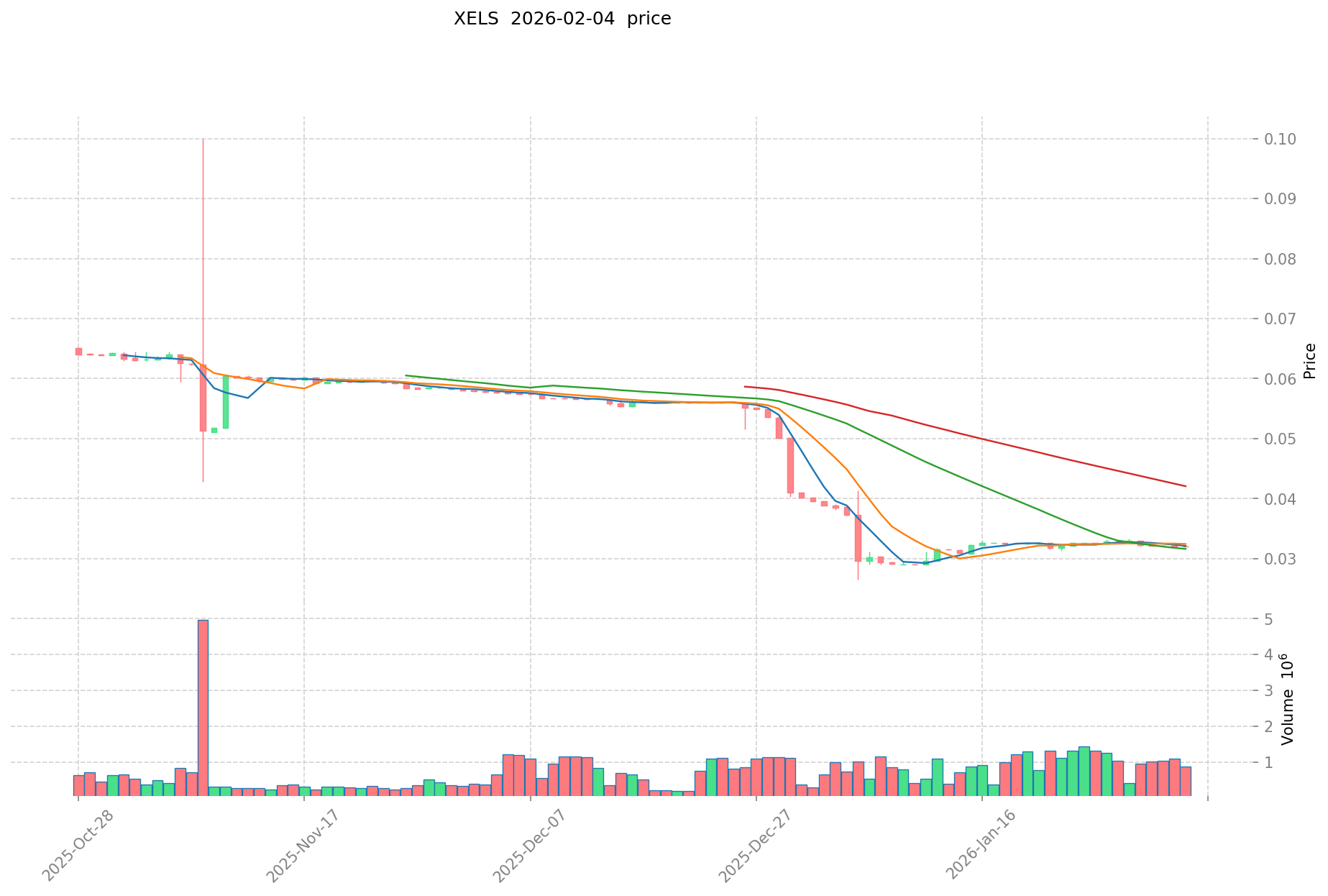
XELS is a digital asset in the cryptocurrency field. As an eco-technology platform focused on decentralized climate disclosure, it was established in 2018. As of February 5, 2026, XELS has a market capitalization of approximately $627,511, with a circulating supply of about 19,588,304 tokens. The current price is around $0.032035. With its positioning as a blockchain-based platform addressing climate change through NFT-based carbon offset activity records, XELS has gradually become a focal point when investors discuss "Is XELS a good investment?" This article will comprehensively analyze XELS's investment value, historical trends, future price predictions, and investment risks to provide reference for investors.
I. XELS (XELS) Price History Review and Current Investment Value Status
- 2021: December 14 reached a significant price level of $13.95 → early investors experienced substantial gains during this period
- 2025: Current trading range around $0.059296 → XELS price has experienced considerable adjustment from earlier levels
- 2021-2026: Market cycle → price movement from $13.95 to current levels around $0.032035
Current XELS Investment Market Status (February 2026)
- XELS current price: $0.032035
- Market sentiment (Fear & Greed Index): data not available in provided materials
- 24-hour trading volume: $30,475.78
- Institutional investor holdings: approximately 1,748 holders
Click to view real-time XELS market price
II. Core Factors Influencing Whether XELS is a Good Investment
Supply Mechanism and Scarcity (XELS Investment Scarcity)
- Fixed Supply Structure → XELS operates with a maximum supply of 21,000,000 tokens and a current circulating supply of approximately 19,588,304 tokens (93.28% of total supply), which establishes a relatively predictable supply framework that may influence long-term value considerations.
- Historical Price Patterns → The token has experienced price movements ranging from $0.02887104 to previous elevated levels, demonstrating volatility characteristics common in digital assets with limited supply.
- Investment Consideration → The high circulation ratio (93.28%) indicates that most tokens are already in market circulation, which may affect future supply-side dynamics and requires careful evaluation by potential investors.
Institutional Investment and Market Adoption (Institutional Investment in XELS)
- Holder Distribution → As of February 05, 2026, XELS has approximately 1,748 token holders, reflecting a relatively modest holder base compared to major cryptocurrencies.
- Market Position → XELS maintains a market dominance of 0.000026%, indicating a niche position within the broader cryptocurrency ecosystem with limited mainstream adoption at present.
- Exchange Accessibility → The token is available on 1 exchange, which may present liquidity considerations for investors evaluating entry and exit strategies.
Macroeconomic Environment Impact on XELS Investment
- Market Capitalization Context → With a market capitalization of approximately $627,511 and fully diluted valuation of $672,735, XELS operates in the lower market cap segment, which may exhibit different sensitivity patterns to macroeconomic factors compared to larger digital assets.
- Trading Activity → The 24-hour trading volume of $30,475.78 suggests relatively modest market activity, which investors should consider when evaluating liquidity conditions.
- Price Performance Metrics → Recent price movements show a 1-hour change of +0.18%, 24-hour change of +0.2%, 7-day decline of -2.48%, 30-day gain of +9.16%, and 1-year decline of -61.04%, reflecting varied performance across different timeframes.
Technology and Ecosystem Development (Technology & Ecosystem for XELS Investment)
- Core Platform Focus → XELS positions itself as an eco-technology platform focused on decentralized climate disclosure, utilizing blockchain technology for carbon offset activity tracking through NFT-based records.
- Environmental Application → The platform aims to provide transparency in environmental reporting for enterprises, addressing corporate social responsibility concerns related to carbon emissions throughout supply chains.
- Blockchain Implementation → XELS is deployed on the Ethereum network (contract address: 0x397Deb686C72384FAd502A81f4d7fDb89e1f1280), operating within the established Ethereum ecosystem infrastructure.
III. XELS Future Investment Forecast and Price Outlook (Is XELS(XELS) worth investing in 2026-2031)
Short-term Investment Forecast (2026, short-term XELS investment outlook)
- Conservative forecast: $0.020 - $0.032
- Neutral forecast: $0.032 - $0.038
- Optimistic forecast: $0.038 - $0.051
Mid-term Investment Outlook (2027-2028, mid-term XELS(XELS) investment forecast)
-
Market stage expectation: XELS may experience gradual growth as the platform continues to develop its eco-technology solutions and carbon offset tracking capabilities. The token could benefit from increasing enterprise adoption of blockchain-based environmental reporting tools.
-
Investment return forecast:
- 2027: $0.020 - $0.051
- 2028: $0.041 - $0.063
-
Key catalysts: Platform adoption by enterprises seeking transparent carbon footprint reporting, expansion of NFT-based carbon offset certification services, and growing regulatory focus on environmental disclosure.
Long-term Investment Outlook (Is XELS a good long-term investment?)
- Baseline scenario: $0.034 - $0.060 (assuming steady platform development and moderate enterprise adoption)
- Optimistic scenario: $0.054 - $0.081 (assuming accelerated corporate sustainability initiatives and expanded platform functionality)
- Risk scenario: $0.020 - $0.038 (in case of limited market adoption or increased competition in blockchain-based environmental solutions)
Click to view XELS long-term investment and price forecast: Price Prediction
2026-02-05 - 2031 Long-term Outlook
- Baseline scenario: $0.038 - $0.063 USD (corresponding to steady progress and gradual mainstream application growth)
- Optimistic scenario: $0.063 - $0.081 USD (corresponding to large-scale adoption and favorable market conditions)
- Transformative scenario: Above $0.081 USD (if the ecosystem achieves breakthrough developments and mainstream adoption)
- 2031-12-31 forecast high: $0.081 USD (based on optimistic development assumptions)
Disclaimer: The above forecasts are for reference only and do not constitute investment advice. Cryptocurrency markets are highly volatile, and actual prices may differ significantly from projections. Past performance does not guarantee future results.
| Year |
Predicted High Price |
Predicted Average Price |
Predicted Low Price |
Price Change |
| 2026 |
0.038442 |
0.032035 |
0.02018205 |
0 |
| 2027 |
0.051095825 |
0.0352385 |
0.020085945 |
10 |
| 2028 |
0.063455728875 |
0.0431671625 |
0.04057713275 |
34 |
| 2029 |
0.06717242156625 |
0.0533114456875 |
0.034652439696875 |
66 |
| 2030 |
0.065061288317025 |
0.060241933626875 |
0.054217740264187 |
88 |
| 2031 |
0.080820578153815 |
0.06265161097195 |
0.038217482692889 |
95 |
IV. XELS Investment Strategy and Risk Management (How to invest in XELS)
Investment Strategy (XELS investment strategy)
Long-term Holding (HODL XELS)
Long-term holding may suit investors who believe in the environmental technology sector's growth potential. This approach involves acquiring XELS tokens and maintaining positions through market cycles, potentially benefiting from the platform's development in carbon offset tracking and corporate environmental disclosure solutions.
Active Trading
Active trading strategies rely on technical analysis and market timing. Given XELS's price fluctuations, traders may consider:
- Monitoring volume patterns (current 24-hour volume: $30,475.78)
- Analyzing support and resistance levels within the recent range
- Implementing stop-loss mechanisms to manage downside exposure
Risk Management (Risk management for XELS investment)
Asset Allocation Ratios
- Conservative investors: Consider limiting XELS exposure to 1-3% of crypto portfolio
- Moderate investors: May allocate 3-7% depending on risk tolerance
- Aggressive investors: Could consider higher allocations with appropriate risk controls
Risk Hedging Approaches
- Diversification across multiple blockchain assets
- Balancing exposure with established cryptocurrencies
- Regular portfolio rebalancing based on performance
Secure Storage
- Cold wallets: Recommended for long-term holdings
- Hot wallets: Suitable for active trading amounts only
- Hardware wallets: Consider devices supporting ERC-20 tokens (XELS contract address: 0x397Deb686C72384FAd502A81f4d7fDb89e1f1280 on Ethereum)
V. XELS Investment Risks and Challenges (Risks of investing in XELS)
Market Risks
- High volatility: XELS has experienced significant price movements, with a historical high of $13.95 and recent low of $0.02887104
- Limited liquidity: With a 24-hour trading volume of approximately $30,475.78 and listing on one exchange, liquidity constraints may impact execution
- Market cap considerations: Current market capitalization around $627,511 indicates relatively small market size
Regulatory Risks
- Environmental credit markets face evolving regulatory frameworks across jurisdictions
- Carbon offset certification standards may change, affecting platform utility
- Digital asset regulations vary significantly by country and continue to develop
Technical Risks
- Smart contract vulnerabilities on the Ethereum network could pose security concerns
- Platform adoption depends on corporate demand for blockchain-based environmental disclosure
- Competition from other environmental technology solutions
Project-Specific Considerations
- Circulating supply represents 93.28% of maximum supply (19.59M of 21M tokens)
- Holder count of 1,748 suggests relatively limited adoption
- Platform success depends on continued corporate interest in transparent environmental reporting
VI. Conclusion: Is XELS a Good Investment?
Investment Value Assessment
XELS operates in the environmental technology sector, focusing on carbon offset tracking and corporate transparency. The platform's approach to blockchain-based environmental disclosure addresses growing corporate demand for verifiable sustainability reporting. However, the token has experienced considerable price fluctuations, and market adoption remains in early stages.
Investor Recommendations
✅ Beginners:
- Consider dollar-cost averaging to mitigate entry timing risks
- Use secure wallet storage (hardware wallet supporting ERC-20 tokens)
- Start with small allocations to understand market dynamics
- Research the environmental credit market fundamentals
✅ Experienced Investors:
- May evaluate technical analysis for potential trading opportunities
- Consider correlation with broader environmental technology trends
- Monitor platform development and corporate adoption metrics
- Maintain appropriate position sizing within diversified portfolio
✅ Institutional Investors:
- Assess alignment with ESG investment mandates
- Evaluate platform's competitive position in environmental disclosure space
- Consider liquidity constraints for larger positions
- Monitor regulatory developments in carbon credit markets
⚠️ Important Notice: Cryptocurrency investments involve substantial risk and high volatility. This content is for informational purposes only and does not constitute investment advice. Conduct thorough research and consider your financial situation before investing.
VII. FAQ
Q1: Is XELS a good investment for beginners in 2026?
XELS may be suitable for beginners who are willing to accept high risk and have a specific interest in environmental technology blockchain applications, but it requires careful consideration due to its volatility and limited liquidity. The token has experienced significant price fluctuations, declining from a historical high of $13.95 to the current price of approximately $0.032035, representing a -61.04% decline over the past year. Beginners should start with small allocations (1-3% of crypto portfolio), use dollar-cost averaging strategies to mitigate entry timing risks, and store tokens in secure hardware wallets supporting ERC-20 tokens. The platform's focus on carbon offset tracking and corporate environmental disclosure addresses a growing market need, but the relatively small holder base (1,748) and modest trading volume ($30,475.78 in 24 hours) indicate early-stage adoption that may present both opportunities and risks.
Q2: What is the long-term price prediction for XELS through 2031?
Based on analytical projections, XELS could reach between $0.038 and $0.081 by 2031, depending on market conditions and platform adoption rates. The baseline scenario suggests a price range of $0.038 to $0.063, assuming steady platform development and moderate enterprise adoption of blockchain-based environmental reporting tools. The optimistic scenario projects $0.063 to $0.081, contingent on accelerated corporate sustainability initiatives and expanded platform functionality. Key price milestones include potential growth to $0.051 by 2027, $0.063 by 2028, and $0.081 by 2031 in the most favorable conditions. However, investors should note that these forecasts are subject to significant uncertainty given the high volatility of cryptocurrency markets, evolving regulatory frameworks for carbon credits, and competition in the environmental technology space.
Q3: What are the main risks of investing in XELS?
The primary risks include extreme price volatility, limited liquidity, regulatory uncertainty, and early-stage platform adoption challenges. XELS has demonstrated substantial price swings, with movements from $13.95 to current levels around $0.032035, indicating high volatility characteristics. Liquidity concerns arise from the modest 24-hour trading volume of approximately $30,475.78 and listing on only one exchange, which may affect the ability to execute large trades without price impact. Regulatory risks stem from evolving environmental credit market frameworks and varying digital asset regulations across jurisdictions. Additionally, the platform's success depends on corporate demand for blockchain-based environmental disclosure, and the relatively small holder count of 1,748 suggests limited mainstream adoption at present. Technical risks include potential smart contract vulnerabilities on the Ethereum network and competition from alternative environmental technology solutions.
Q4: How does XELS's supply mechanism affect its investment potential?
XELS operates with a maximum supply of 21,000,000 tokens, with approximately 19,588,304 tokens currently in circulation (93.28% of total supply), creating a relatively fixed supply structure that may influence long-term scarcity dynamics. The high circulation ratio indicates that most tokens are already in market circulation, which reduces the potential for future supply shocks but also means that price appreciation would primarily depend on demand-side factors rather than supply restrictions. This supply mechanism differs from cryptocurrencies with lower circulation ratios or ongoing token emissions. Investors should consider that with 93.28% of tokens already circulating, the supply-side scarcity premium may be limited compared to assets with more constrained circulation. The remaining approximately 1.4 million tokens (6.72% of maximum supply) represent the potential additional supply that could enter the market.
Q5: What investment strategies are recommended for XELS?
Two primary strategies suit different investor profiles: long-term holding (HODL) for those believing in environmental technology sector growth, and active trading for experienced market participants. Long-term holding may benefit investors who anticipate increased corporate adoption of blockchain-based carbon offset tracking and environmental disclosure solutions, potentially holding through market cycles to capture platform development gains. Active trading strategies should focus on technical analysis, monitoring the current support and resistance levels within recent price ranges, tracking volume patterns (current 24-hour volume: $30,475.78), and implementing strict stop-loss mechanisms given the high volatility. Conservative investors should limit XELS exposure to 1-3% of their crypto portfolio, moderate investors may allocate 3-7% depending on risk tolerance, and aggressive investors could consider higher allocations with appropriate risk controls. Both strategies require secure storage using cold wallets or hardware wallets supporting ERC-20 tokens (contract address: 0x397Deb686C72384FAd502A81f4d7fDb89e1f1280 on Ethereum).
Q6: How does XELS compare to other environmental blockchain projects?
XELS positions itself as an eco-technology platform focused on decentralized climate disclosure through NFT-based carbon offset activity records, operating on the Ethereum network with a market capitalization of approximately $627,511. This places it in the niche segment of environmental blockchain applications, with a market dominance of 0.000026%. While the platform addresses corporate demand for transparent environmental reporting and carbon footprint tracking throughout supply chains, its relatively small holder base (1,748) and modest trading volume suggest limited adoption compared to larger environmental technology initiatives. The platform's approach to using blockchain for verifiable sustainability reporting aligns with growing ESG (Environmental, Social, and Governance) investment trends, but faces competition from other carbon credit platforms and traditional environmental certification systems. Investors should evaluate XELS within the broader context of environmental technology solutions and consider whether its Ethereum-based infrastructure and NFT certification approach provides competitive advantages in the evolving carbon offset market.
Q7: What factors could drive XELS price growth in the future?
Key potential catalysts include increased enterprise adoption of blockchain-based environmental reporting tools, expansion of NFT-based carbon offset certification services, growing regulatory focus on mandatory environmental disclosure, and broader corporate sustainability initiatives. The platform could benefit from the accelerating global emphasis on carbon neutrality commitments, particularly if corporations require verifiable, transparent systems for tracking supply chain emissions. Regulatory developments mandating standardized environmental reporting could create demand for XELS's decentralized climate disclosure solutions. Additional growth drivers may include strategic partnerships with large enterprises, integration with existing carbon credit markets, technological enhancements to the platform's functionality, and general positive momentum in cryptocurrency markets. However, these potential catalysts remain uncertain, and investors should maintain realistic expectations given the project's current early-stage adoption metrics and competitive landscape in environmental technology solutions.
Q8: Should institutional investors consider XELS for ESG portfolios?
Institutional investors evaluating XELS for ESG (Environmental, Social, and Governance) mandates should carefully assess alignment with investment criteria, liquidity constraints, and risk parameters. The platform's focus on carbon offset tracking and corporate environmental transparency aligns with ESG themes related to climate change mitigation and corporate accountability. However, several factors require consideration: the limited liquidity (24-hour volume of $30,475.78) may constrain position sizing for larger institutional allocations, the relatively small market capitalization ($627,511) indicates early-stage development, and the availability on only one exchange presents operational challenges. Institutional investors should evaluate XELS's competitive position within the environmental disclosure space, monitor regulatory developments in carbon credit markets that may affect platform utility, and consider the token's role within a broader ESG investment strategy rather than as a standalone position. Due diligence should include assessment of the platform's technological infrastructure on Ethereum, the sustainability of its business model, and potential correlation with other environmental technology assets.
* The information is not intended to be and does not constitute financial advice or any other recommendation of any sort offered or endorsed by Gate.