This comprehensive guide evaluates whether zkLink (ZKL) represents a viable investment opportunity in 2024-2031. ZKL is a multi-chain liquidity aggregation infrastructure project utilizing zero-knowledge technology, launched on Gate in July 2024 at $0.15, currently trading around $0.001359 with significant volatility. The article analyzes ZKL's core technology including zkLink Nova Layer-3 network and zkLink X rollup middleware, examining how they address blockchain liquidity fragmentation across Ethereum Layer 2 ecosystems. Investment forecasts suggest base scenario pricing between $0.0019-$0.0028 by 2030, though substantial risks including extreme price volatility (98.99% decline from peak), limited liquidity, and regulatory uncertainty require careful consideration. The guide provides tailored investment strategies for beginners through institutional investors, emphasizing conservative portfolio allocation of 1-15% depending on risk tolerance, alongside comprehensive risk management protocols and secure st
Introduction: zkLink (ZKL) Investment Position and Market Outlook
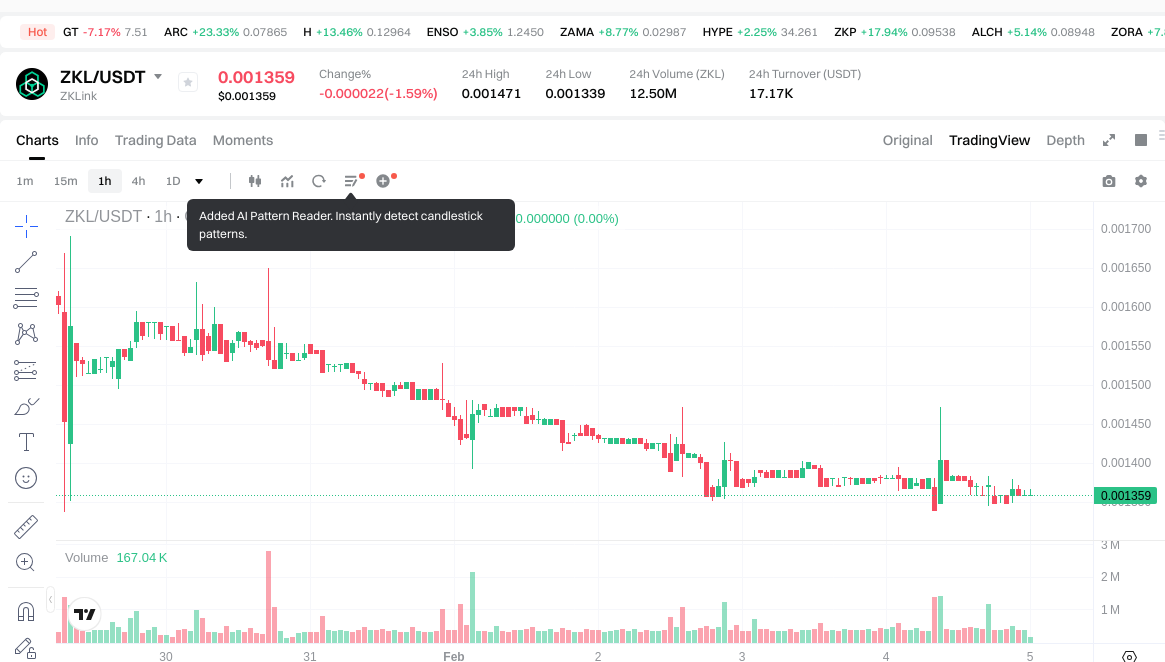
ZKL is a notable asset in the cryptocurrency sector, launched in July 2024 as part of the zkLink ecosystem focused on multi-chain liquidity aggregation infrastructure. As of February 05, 2026, ZKL has a market capitalization of approximately $633,871, with a circulating supply of around 466,424,603 tokens, and the current price hovers around $0.001359. Positioned as a zero-knowledge technology solution provider, ZKL has gradually become a focal point for investors discussing "Is zkLink (ZKL) a good investment?" The project operates through two core solutions: zkLink Nova, a Layer-3 network integrating assets and liquidity from Ethereum L2s, and zkLink X, a rollup middleware serving multi-chain dApp deployment. With deployment contracts on both zkLink Nova and Ethereum networks, ZKL addresses liquidity fragmentation across different blockchain networks. This article will comprehensively analyze ZKL's investment characteristics, historical price movements, future price projections, and associated investment risks, providing reference information for investors.
I. zkLink (ZKL) Price History Review and Current Investment Value
- July 2024: zkLink (ZKL) was launched on Gate.com with a publish price of $0.15, marking its entry into the public trading market.
- July 2024: ZKL price reached a notable level of $0.76698 during its early trading period, reflecting initial market enthusiasm.
- January 2026: The token experienced a price level near $0.001337, showing a decline from earlier levels during market adjustments.
- Recent Period: As of February 2026, ZKL has shown a 24-hour change of -1.22%, with a 7-day change of -16.01% and a 30-day change of -61.94%, indicating downward pressure in the short to medium term.
Current ZKL Investment Market Status (February 2026)
- ZKL current price: $0.001359
- Market capitalization: approximately $633,871
- 24-hour trading volume: $17,126
- Circulating supply: 466,424,603 ZKL (46.64% of total supply)
- Total supply: 1,000,000,000 ZKL
- Holders: 3,431 addresses
- Market cap to fully diluted valuation ratio: 46.64%
- Market dominance: 0.000051%
Click to view real-time ZKL market price
II. Core Factors Affecting Whether ZKL is a Good Investment (Is zkLink(ZKL) a Good Investment)
Supply Mechanism and Scarcity (ZKL investment scarcity)
- Total supply: 1,000,000,000 ZKL tokens with a maximum supply cap of 1,000,000,000 ZKL
- Circulating supply: 466,424,603 ZKL (approximately 46.64% of total supply)
- Market cap to fully diluted valuation ratio stands at 46.64%, indicating significant token supply yet to enter circulation
- Investment significance: The fixed maximum supply creates a predetermined scarcity model that may influence long-term valuation dynamics
Institutional Investment and Mainstream Adoption (Institutional investment in ZKL)
- Current holder base: 3,431 addresses holding ZKL tokens
- Trading availability: Listed on 6 exchanges, providing liquidity access points for institutional and retail participants
- Market presence: ZKL maintains a market dominance of 0.000051% within the broader cryptocurrency market
Macroeconomic Environment's Impact on ZKL Investment
- As of February 2026, zkLink operates within the evolving regulatory landscape for Layer 3 solutions and zero-knowledge proof technologies
- Broader market conditions influence risk appetite for mid-cap cryptocurrency investments
- The multi-chain infrastructure sector faces competition from established Layer 2 solutions, affecting investment considerations
Technology and Ecosystem Development (Technology & Ecosystem for ZKL investment)
- zkLink Nova: A Layer 3 network aggregating assets, liquidity, and dApps from Ethereum Layer 2 networks into an EVM-compatible platform
- zkLink X: Application-specific rollup middleware designed for multi-chain dApp deployment and liquidity aggregation across Layer 1 and Layer 2 networks
- Zero-knowledge technology implementation: Core infrastructure addressing liquidity fragmentation across different blockchain networks
- Contract deployments: Active on zkLink Nova (native chain) and Ethereum mainnet, enabling cross-chain functionality
- Ecosystem focus: Targets high-performance dApp deployment with unified liquidity access across connected blockchains and rollups
III. ZKL Future Investment Forecast and Price Outlook (Is zkLink(ZKL) worth investing in 2026-2031)
Short-term Investment Forecast (2026, short-term ZKL investment outlook)
- Conservative forecast: $0.00099718 - $0.001366
- Neutral forecast: $0.001366
- Optimistic forecast: $0.001366 - $0.00199436
Mid-term Investment Outlook (2027-2029, mid-term zkLink(ZKL) investment forecast)
-
Market stage expectation: zkLink may experience moderate recovery phase following significant price correction from 2024-2025 period. The token showed substantial decline from its July 2024 all-time high of $0.76698 to current levels around $0.001359, indicating potential for stabilization.
-
Investment return forecast:
- 2027: $0.0011257206 - $0.0018818016
- 2028: $0.00097954494 - $0.001976899788
- 2029: $0.0011273671764 - $0.00276204958218
-
Key catalysts: Development progress of zkLink Nova Layer-3 network and zkLink X rollup middleware, adoption of multi-chain liquidity aggregation solutions, expansion of dApp integration across Ethereum Layer 2 ecosystems, and overall zero-knowledge technology advancement in blockchain infrastructure.
Long-term Investment Outlook (Is ZKL a good long-term investment?)
- Base scenario: $0.001879602924852 - $0.002807801900088 (assuming steady development of zkLink infrastructure and gradual market recovery)
- Optimistic scenario: $0.002807801900088 - $0.003295106362087 (assuming successful multi-chain liquidity aggregation adoption and favorable market conditions)
- Risk scenario: Below $0.001337 (under extreme market downturn or significant project development challenges)
Check ZKL long-term investment and price forecast: Price Prediction
2026-02-05 - 2031 Long-term Outlook
- Base scenario: $0.001366 - $0.002807801900088 (corresponding to steady progress and gradual mainstream application expansion)
- Optimistic scenario: $0.002807801900088 - $0.003295106362087 (corresponding to large-scale adoption and favorable market environment)
- Transformative scenario: Above $0.003295106362087 (if ecosystem achieves breakthrough development and mainstream popularization)
- 2031-12-31 predicted high: $0.003295106362087 (based on optimistic development assumptions)
Disclaimer: Price predictions are based on historical data analysis and market modeling. Cryptocurrency investments carry substantial risks. The forecasts provided are for informational purposes only and should not be considered as financial advice. Actual prices may vary significantly from predictions due to market volatility, regulatory changes, technological developments, and other unpredictable factors.
| Year |
Predicted High Price |
Predicted Average Price |
Predicted Low Price |
Price Change |
| 2026 |
0.00199436 |
0.001366 |
0.00099718 |
0 |
| 2027 |
0.0018818016 |
0.00168018 |
0.0011257206 |
23 |
| 2028 |
0.001976899788 |
0.0017809908 |
0.00097954494 |
31 |
| 2029 |
0.00276204958218 |
0.001878945294 |
0.0011273671764 |
38 |
| 2030 |
0.003295106362087 |
0.00232049743809 |
0.001879602924852 |
70 |
| 2031 |
0.003088582090097 |
0.002807801900088 |
0.001853149254058 |
106 |
IV. ZKL Investment Strategy and Risk Management (How to invest in zkLink)
Investment Strategy (ZKL investment strategy)
-
Long-term Holding (HODL ZKL): Suitable for conservative investors who believe in the long-term vision of multi-chain liquidity aggregation through zero-knowledge technology. This approach involves purchasing ZKL tokens and holding them over extended periods, minimizing transaction costs and emotional trading decisions.
-
Active Trading: Relies on technical analysis and swing trading strategies. Traders may monitor price movements, support and resistance levels, and trading volume to identify entry and exit points. Given ZKL's price volatility (with recent fluctuations showing -1.22% in 24 hours and -16.01% over 7 days), active traders should exercise caution and use stop-loss orders to manage downside risk.
Risk Management (Risk management for ZKL investment)
V. ZKL Investment Risks and Challenges (Risks of investing in zkLink)
-
Market Risk: ZKL exhibits high price volatility, with recent data showing a 61.94% decline over 30 days and a 98.99% decrease over 1 year from its peak. The token's 24-hour trading volume of approximately $17,126 suggests relatively low liquidity, which may contribute to price instability and slippage during large transactions.
-
Regulatory Risk: Cross-chain infrastructure projects face evolving regulatory frameworks across different jurisdictions. Changes in policies regarding Layer 2/Layer 3 solutions, zero-knowledge proofs, or cross-chain liquidity aggregation could impact project operations and token utility.
-
Technical Risk: As a Layer 3 infrastructure project utilizing zero-knowledge technology, zkLink faces potential technical challenges including:
- Smart contract vulnerabilities that could affect asset security
- Network upgrade complications across its multi-chain architecture
- Integration risks with connected Layer 1 and Layer 2 networks
- Competition from other liquidity aggregation solutions
VI. Conclusion: Is zkLink a Good Investment?
-
Investment Value Summary: zkLink addresses the fragmentation of liquidity across blockchain networks through its Nova and X solutions, presenting a potential use case in the evolving multi-chain ecosystem. However, the token has experienced significant price decline, with current circulation at approximately 46.64% of maximum supply.
-
Investor Recommendations:
✅ Beginners: Consider dollar-cost averaging with small, regular investments and prioritize secure wallet storage. Conduct thorough research on zkLink's technology and competitive landscape before investing.
✅ Experienced Investors: May explore swing trading opportunities based on technical analysis while maintaining strict risk management protocols. Consider ZKL as part of a diversified Layer 2/Layer 3 infrastructure portfolio.
✅ Institutional Investors: Evaluate strategic allocation based on thesis regarding multi-chain liquidity aggregation adoption, considering the project's technical roadmap and competitive positioning.
⚠️ Disclaimer: Cryptocurrency investments carry substantial risk due to market volatility, regulatory uncertainty, and technical complexities. This content is for informational purposes only and does not constitute investment advice. Conduct independent research and consult with financial advisors before making investment decisions.
VII. FAQ
Q1: What is zkLink (ZKL) and what problem does it solve?
zkLink is a multi-chain liquidity aggregation infrastructure project utilizing zero-knowledge technology to address liquidity fragmentation across different blockchain networks. The project operates through two core solutions: zkLink Nova, a Layer 3 network that integrates assets and liquidity from Ethereum Layer 2 networks into an EVM-compatible platform, and zkLink X, a rollup middleware designed for multi-chain dApp deployment. By connecting various Layer 1 and Layer 2 blockchains, zkLink enables unified liquidity access and high-performance dApp deployment across multiple chains without requiring users to manually bridge assets between different networks.
Q2: What is the current price performance of ZKL token?
As of February 2026, ZKL is trading at approximately $0.001359 with a market capitalization of around $633,871. The token has experienced significant decline from its all-time high of $0.76698 in July 2024, representing a decrease of over 98%. Recent performance shows a 24-hour change of -1.22%, a 7-day decline of -16.01%, and a 30-day decrease of -61.94%. With a circulating supply of 466,424,603 tokens (46.64% of total supply) and relatively low trading volume of approximately $17,126 over 24 hours, the token exhibits high volatility and limited liquidity characteristics.
Q3: Is zkLink a good investment for long-term holders?
The long-term investment potential of ZKL depends on multiple factors including the project's technical development progress, adoption of multi-chain liquidity solutions, and broader market conditions. Base scenario projections estimate a price range of $0.001879602924852 to $0.002807801900088 by 2030, while optimistic scenarios suggest potential growth to $0.003295106362087. However, investors should note the significant price decline from peak levels and the substantial amount of tokens yet to enter circulation (approximately 53.36% of total supply). Long-term holders should consider this a high-risk investment suitable only for a small portion of their portfolio, with conservative allocation recommendations of 1-3% for risk-averse investors.
Q4: What are the main risks associated with investing in ZKL?
ZKL investment carries several significant risks: (1) Market Risk - the token exhibits extreme price volatility with a 98.99% decline from peak and low trading volume of $17,126, which may result in substantial slippage during transactions; (2) Technical Risk - as a Layer 3 infrastructure project, zkLink faces potential smart contract vulnerabilities, network upgrade complications, and integration challenges with connected blockchains; (3) Regulatory Risk - evolving policies regarding cross-chain solutions and zero-knowledge technology could impact operations; (4) Competition Risk - the project operates in a competitive space with established Layer 2 solutions and other liquidity aggregation platforms. Investors should implement strict risk management protocols including diversification and appropriate position sizing.
Q5: How can investors purchase and securely store ZKL tokens?
ZKL tokens are currently listed on 6 cryptocurrency exchanges, providing multiple access points for purchase. Investors can acquire ZKL through these platforms by creating accounts, completing verification processes, and executing buy orders using fiat currency or other cryptocurrencies. For secure storage, long-term holders should utilize cold wallet solutions such as hardware wallets (Ledger or Trezor) to minimize exposure to online threats. Active traders may keep smaller amounts in exchange hot wallets for convenience, but should transfer larger holdings to self-custody cold storage. Institutional investors with significant positions should consider implementing multi-signature wallet configurations for enhanced security. Always verify contract addresses when interacting with zkLink tokens on either the zkLink Nova or Ethereum networks.
Q6: What is the token supply structure and distribution of ZKL?
ZKL has a fixed maximum supply of 1,000,000,000 tokens, with approximately 466,424,603 tokens currently in circulation (46.64% of total supply) as of February 2026. This means that 533,575,397 tokens (53.36%) remain to be released into the market, which could create downward price pressure as these tokens enter circulation. The market cap to fully diluted valuation ratio stands at 46.64%, indicating potential dilution concerns for investors. The token is held across 3,431 addresses, suggesting a relatively small but growing holder base. Understanding this supply dynamics is crucial for investment decisions, as future token releases could impact price performance depending on distribution schedules and market demand.
Q7: What investment strategies are most suitable for ZKL?
Investment strategies for ZKL should align with individual risk tolerance and market outlook: (1) Long-term Holding (HODL) - suitable for believers in multi-chain liquidity aggregation technology who can withstand high volatility, requiring minimal active management but strong conviction in the project's 5-10 year vision; (2) Dollar-Cost Averaging - recommended for beginners to mitigate timing risk by making regular small purchases regardless of price fluctuations; (3) Active Trading - appropriate for experienced traders who can analyze technical indicators, support/resistance levels, and utilize stop-loss orders to manage the token's significant volatility; (4) Portfolio Allocation - conservative investors should limit exposure to 1-3% of total portfolio, moderate investors to 3-7%, and aggressive investors up to 10-15%, always maintaining diversification across multiple assets including established cryptocurrencies and stablecoins.
Q8: How does zkLink compare to other Layer 2 and Layer 3 solutions?
zkLink differentiates itself through its focus on cross-chain liquidity aggregation rather than competing as a standalone scaling solution. Unlike traditional Layer 2 networks that operate on a single blockchain, zkLink's Layer 3 architecture sits atop multiple Layer 2 solutions, connecting assets and liquidity from various Ethereum L2s including Arbitrum, Optimism, and zkSync. The project's dual-product approach with zkLink Nova (for liquidity aggregation) and zkLink X (for multi-chain dApp deployment) addresses fragmentation issues that other solutions do not primarily target. However, zkLink faces competition from established bridge protocols, cross-chain communication layers, and integrated liquidity solutions offered by major Layer 2 platforms. Its success depends on achieving network effects and demonstrating superior user experience compared to alternative bridging and liquidity solutions in the market.
* The information is not intended to be and does not constitute financial advice or any other recommendation of any sort offered or endorsed by Gate.