This comprehensive comparison examines LIORA and STX as distinct enterprise solutions within the cryptocurrency ecosystem. LIORA, launched in 2025, operates as a decentralized Web3 creator platform empowering content ownership and earnings, while STX, established since 2019, functions as blockchain infrastructure enabling Bitcoin Layer-2 applications and smart contracts through Proof of Transfer consensus. The article analyzes historical price trends, market capitalization, trading volumes, tokenomics, and institutional adoption patterns. Current market status shows LIORA at $0.003158 with limited liquidity, contrasting STX's $0.2913 price with significantly higher trading volume. Detailed investment strategies accommodate varying risk profiles, from conservative to aggressive portfolios. Price projections through 2031 indicate divergent growth trajectories. Risk assessments encompass market volatility, technical development, and regulatory factors, guiding investment decisions for different investor categori
Introduction: LIORA vs STX Investment Comparison
In the cryptocurrency market, the comparison between LIORA and STX continues to be a topic of interest for investors. Both assets demonstrate notable differences in market capitalization ranking, application scenarios, and price performance, representing distinct positioning within the crypto asset landscape.
LIORA (LIORA): Launched in 2025, this decentralized Web3 platform has positioned itself around empowering creators with ownership of content, data, and earnings, challenging traditional Web2 platform constraints.
Stacks (STX): Operating since 2019, Stacks has established itself as a blockchain infrastructure project focused on bringing decentralized applications and smart contract functionality, utilizing its unique Proof of Transfer (PoX) consensus mechanism.
This article examines historical price trends, supply mechanisms, institutional adoption, technical ecosystems, and future projections to provide a comprehensive analysis of the LIORA vs STX investment value comparison, addressing the question many investors consider:
"Which represents a more suitable investment consideration at the current time?"
I. Historical Price Comparison and Current Market Status
LIORA (Coin A) and STX (Coin B) Historical Price Trends
-
2025: LIORA reached an all-time high of $0.29083 on August 12, 2025, shortly after its launch in early 2025, reflecting initial market enthusiasm for the Web3 creator platform.
-
2024: STX achieved its all-time high of $3.86 on April 1, 2024, driven by growing interest in Bitcoin Layer-2 solutions and decentralized applications built on the Bitcoin network.
-
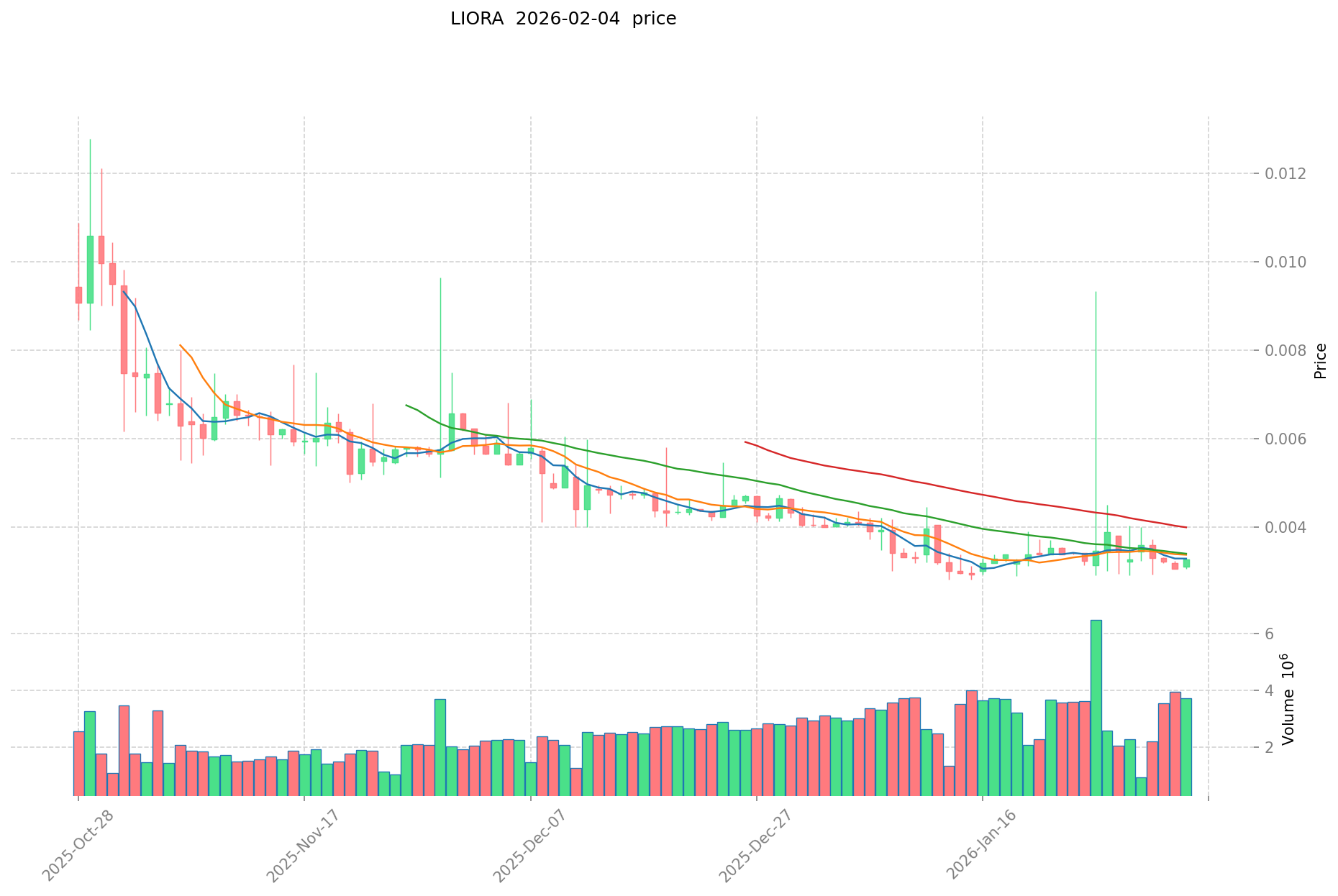
Comparative Analysis: During the recent market cycle, LIORA declined from its peak of $0.29083 to a low of $0.0028 on January 13, 2026, representing a decline of approximately 99%. Meanwhile, STX fell from its high of $3.86 to $0.04559639 (historical low recorded on March 13, 2020), though its current trading price shows a more moderate decline from recent peaks.
Current Market Status (February 4, 2026)
- LIORA Current Price: $0.003158
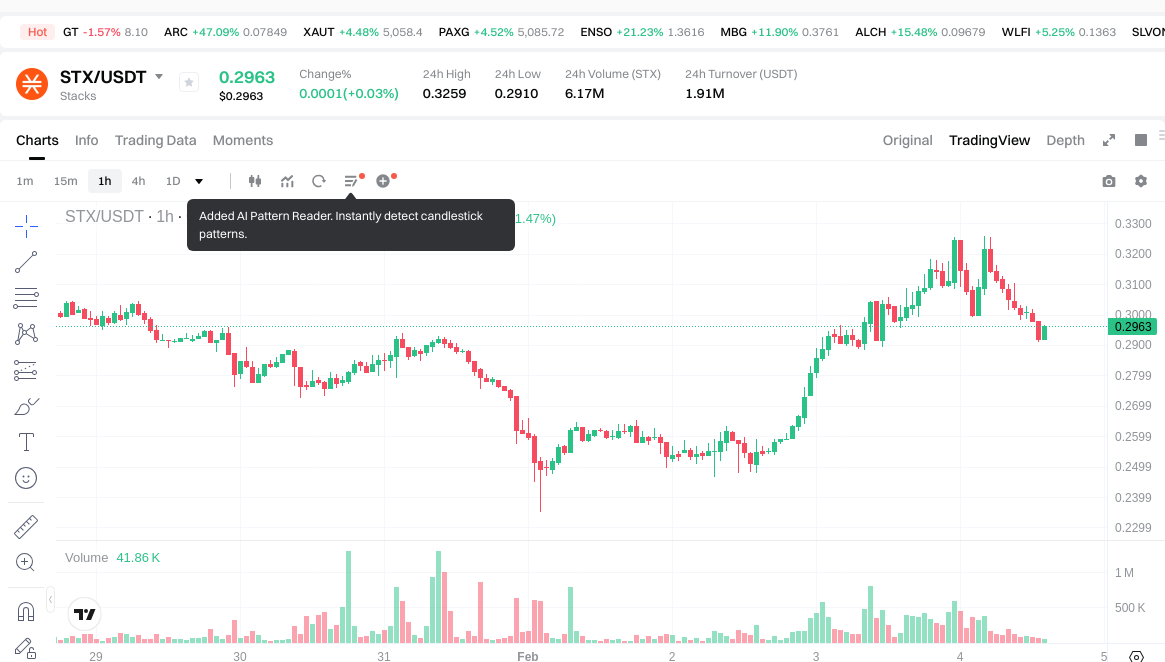
- STX Current Price: $0.2913
- 24-Hour Trading Volume: LIORA recorded $11,665.69 compared to STX's $1,908,997.49
- Market Sentiment Index (Fear & Greed Index): 14 (Extreme Fear)
View real-time prices:
II. Core Factors Influencing LIORA vs STX Investment Value
Supply Mechanism Comparison (Tokenomics)
- LIORA: The token operates with a circulating supply of 100 billion tokens, currently trading at approximately $0.0031743 with a market capitalization of $317.43 million. The supply structure represents the available tokens in the market, which influences price dynamics through supply-demand interactions.
- STX: Information regarding STX's specific supply mechanism was not detailed in the available materials.
- 📌 Historical Pattern: Supply mechanisms play a role in shaping price cycles by affecting token availability and market liquidity over time.
Institutional Adoption and Market Application
- Institutional Holdings: The materials do not provide specific data on institutional preference between the two assets.
- Enterprise Adoption: Information on the application of LIORA or STX in cross-border payments, settlements, or investment portfolios was not detailed in the reference materials.
- National Policies: Regulatory approaches across different jurisdictions toward these assets were not covered in the available data.
Technical Development and Ecosystem Building
- LIORA Technical Progress: LIORA Nuclear Beam operates as a digital asset on blockchain infrastructure. The token has shown recent performance relative to the broader cryptocurrency market, with trading activity across multiple exchanges and markets.
- STX Technical Development: The reference materials note that STX's value relates to its blockchain technology and adoption rate, though specific technical details were not elaborated.
- Ecosystem Comparison: Specific information regarding DeFi, NFT, payment systems, or smart contract implementations for either asset was not provided in the materials.
Macroeconomic Environment and Market Cycles
- Performance in Inflationary Environments: The materials do not contain comparative analysis of inflation-hedging characteristics for either asset.
- Macroeconomic Monetary Policy: The influence of interest rates and dollar index movements on these tokens was not addressed in the reference materials.
- Geopolitical Factors: Data on cross-border transaction demand or international situation impacts was not available in the provided sources.
III. 2026-2031 Price Prediction: LIORA vs STX
Short-term Forecast (2026)
- LIORA: Conservative $0.0023 - $0.0033 | Optimistic $0.0033 - $0.0040
- STX: Conservative $0.15 - $0.30 | Optimistic $0.30 - $0.36
Medium-term Forecast (2028-2029)
- LIORA may enter a gradual accumulation phase, with projected price range of $0.0030 - $0.0060
- STX may enter an expansion phase, with projected price range of $0.30 - $0.70
- Key drivers: institutional capital inflows, ETF developments, ecosystem growth
Long-term Forecast (2030-2031)
- LIORA: Baseline scenario $0.0040 - $0.0063 | Optimistic scenario $0.0063 - $0.0088
- STX: Baseline scenario $0.32 - $0.74 | Optimistic scenario $0.74 - $0.87
View detailed price predictions for LIORA and STX
Disclaimer: Price predictions are based on historical data analysis and market trend modeling. Cryptocurrency markets are highly volatile and subject to various unpredictable factors. These forecasts should not be considered as investment advice. Users should conduct independent research and consult professional advisors before making investment decisions.
LIORA:
| Year |
Predicted High Price |
Predicted Average Price |
Predicted Low Price |
Price Change |
| 2026 |
0.00400365 |
0.003255 |
0.0022785 |
3 |
| 2027 |
0.00446406975 |
0.003629325 |
0.00308492625 |
14 |
| 2028 |
0.005989112115 |
0.004046697375 |
0.0029945560575 |
28 |
| 2029 |
0.00697488759555 |
0.005017904745 |
0.0027096685623 |
58 |
| 2030 |
0.006596035787302 |
0.005996396170275 |
0.003957621472381 |
89 |
| 2031 |
0.008751740210516 |
0.006296215978788 |
0.003211070149182 |
99 |
STX:
| Year |
Predicted High Price |
Predicted Average Price |
Predicted Low Price |
Price Change |
| 2026 |
0.364941 |
0.2967 |
0.154284 |
1 |
| 2027 |
0.48299793 |
0.3308205 |
0.221649735 |
13 |
| 2028 |
0.59815654605 |
0.406909215 |
0.3011128191 |
39 |
| 2029 |
0.69852070392975 |
0.502532880525 |
0.422127619641 |
72 |
| 2030 |
0.870763848729693 |
0.600526792227375 |
0.318279199880508 |
106 |
| 2031 |
0.779784039707246 |
0.735645320478534 |
0.684150148045036 |
152 |
IV. Investment Strategy Comparison: LIORA vs STX
Long-term vs Short-term Investment Strategies
- LIORA: May appeal to investors interested in emerging Web3 creator economy platforms and high-risk, speculative opportunities with significant volatility characteristics
- STX: May appeal to investors focused on established blockchain infrastructure projects with longer operational history and Bitcoin-related ecosystem development
Risk Management and Asset Allocation
- Conservative Investors: LIORA 10-20% vs STX 80-90%
- Aggressive Investors: LIORA 40-50% vs STX 50-60%
- Hedging Tools: stablecoin allocation, options strategies, cross-asset portfolio diversification
V. Potential Risk Comparison
Market Risk
- LIORA: Demonstrates substantial price volatility with historical decline patterns, limited trading volume of $11,665.69, and relatively recent market presence since 2025
- STX: Shows price fluctuation patterns with 24-hour trading volume of $1,908,997.49, reflecting more established market liquidity compared to LIORA
Technical Risk
- LIORA: scalability considerations, network stability factors in early-stage development
- STX: infrastructure maturity considerations, consensus mechanism dependencies
Regulatory Risk
- Global regulatory policy developments may affect both assets differently based on their respective classifications, operational structures, and jurisdictional presence
VI. Conclusion: Which Is the Better Buy?
📌 Investment Value Summary:
- LIORA Characteristics: represents an early-stage Web3 creator platform with higher volatility profile, lower current price point, and speculative growth potential
- STX Characteristics: demonstrates longer operational track record since 2019, established blockchain infrastructure positioning, and relatively higher current market price with greater trading volume
✅ Investment Considerations:
- Beginner Investors: may consider starting with more established assets with higher liquidity and longer operational history, maintaining diversified portfolio approach
- Experienced Investors: may evaluate portfolio allocation based on risk tolerance, market analysis, and technical research across both assets
- Institutional Investors: may assess both assets within broader portfolio strategy considering liquidity requirements, risk management frameworks, and regulatory compliance factors
⚠️ Risk Disclosure: Cryptocurrency markets exhibit significant volatility. This content does not constitute investment advice.
VII. FAQ
Q1: What are the main differences in market maturity between LIORA and STX?
STX demonstrates significantly greater market maturity, having operated since 2019 with a current trading volume of $1,908,997.49, while LIORA launched in 2025 with a substantially lower trading volume of $11,665.69. STX has established itself as a blockchain infrastructure project with a longer operational track record, whereas LIORA represents an early-stage Web3 creator platform still in its developmental phase. The maturity difference is reflected in liquidity levels, price stability, and market recognition, with STX showing more established trading patterns and broader market participation.
Q2: How do the historical price declines compare between LIORA and STX?
LIORA experienced a dramatic decline of approximately 99% from its peak of $0.29083 (August 12, 2025) to $0.0028 (January 13, 2026), demonstrating extreme volatility characteristic of newly launched tokens. STX, while also experiencing significant price fluctuations from its all-time high of $3.86 (April 1, 2024), has shown more moderate decline patterns relative to recent peaks, reflecting greater market stability associated with established blockchain projects. These divergent decline patterns indicate substantially different risk profiles between the two assets.
Q3: What is the recommended asset allocation strategy for different investor types?
For conservative investors, the suggested allocation is 10-20% LIORA versus 80-90% STX, prioritizing the more established asset with higher liquidity. Aggressive investors may consider 40-50% LIORA versus 50-60% STX, accepting higher volatility exposure for potential growth opportunities. Beginner investors should consider starting with more established assets like STX that demonstrate higher liquidity and longer operational history, while experienced investors can evaluate portfolio allocation based on individual risk tolerance and technical research capabilities.
Q4: What are the projected price ranges for LIORA and STX through 2031?
For 2026, LIORA projections range from conservative estimates of $0.0023-$0.0033 to optimistic scenarios of $0.0033-$0.0040, while STX forecasts range from $0.15-$0.30 (conservative) to $0.30-$0.36 (optimistic). By 2031, LIORA baseline scenarios project $0.0040-$0.0063 with optimistic potential of $0.0063-$0.0088, whereas STX baseline projections suggest $0.32-$0.74 with optimistic scenarios reaching $0.74-$0.87. These forecasts indicate STX maintains substantially higher absolute price levels throughout the projection period, though both assets show potential for growth under favorable market conditions.
Q5: What are the primary risk factors investors should consider for each asset?
LIORA presents substantial market risk through extreme price volatility, limited trading volume, and early-stage operational status, combined with technical risks related to scalability and network stability in its developmental phase. STX exhibits more moderate market risk with established liquidity patterns but faces technical considerations regarding infrastructure maturity and consensus mechanism dependencies. Both assets face regulatory risk exposure, though potentially different impacts based on their respective classifications, operational structures, and jurisdictional presence, requiring investors to monitor evolving global cryptocurrency regulatory developments.
Q6: How does the current market sentiment affect investment decisions for LIORA versus STX?
As of February 4, 2026, the market sentiment index stands at 14 (Extreme Fear), indicating widespread caution across cryptocurrency markets. This sentiment environment typically amplifies volatility for early-stage assets like LIORA, which may experience exaggerated price movements during fear-driven market conditions. STX, with its more established market presence, may demonstrate relatively greater resilience during extreme sentiment periods, though both assets remain subject to broader market psychology. Investors should consider this sentiment context when evaluating entry timing and position sizing for either asset.
Q7: What distinguishes the core value propositions of LIORA and STX?
LIORA positions itself as a decentralized Web3 platform focused on empowering creators with ownership of content, data, and earnings, challenging traditional Web2 platform constraints and targeting the emerging creator economy sector. STX operates as blockchain infrastructure focused on bringing decentralized applications and smart contract functionality, utilizing its unique Proof of Transfer (PoX) consensus mechanism. These fundamentally different value propositions mean LIORA targets content creator and Web3 adoption scenarios, while STX focuses on Bitcoin Layer-2 solutions and decentralized application infrastructure, representing distinct segments within the broader cryptocurrency ecosystem.
* The information is not intended to be and does not constitute financial advice or any other recommendation of any sort offered or endorsed by Gate.