This comprehensive analysis compares MIRAI and THETA, two distinct blockchain platforms shaping decentralized finance. MIRAI, launched in 2025, focuses on AI-powered virtual identity within Web3 ecosystems, while THETA, established in 2017, operates as a decentralized video streaming platform leveraging blockchain for bandwidth incentivization. Both assets experienced significant price corrections—MIRAI declined 98.48% from May 2025 peak to current $0.0005364, while THETA fell 98.67% from 2021 highs to $0.2084. The article examines critical investment factors including historical price trends, supply mechanisms, institutional adoption, technological ecosystems, and 2026-2031 price predictions. Through risk analysis and investment strategy recommendations, this guide helps investors evaluate which platform better aligns with their risk tolerance and portfolio objectives on Gate exchange.
Introduction: Investment Comparison Between MIRAI and THETA
In the cryptocurrency market, the comparison between MIRAI vs THETA has become a topic that investors cannot ignore. The two differ significantly in market cap ranking, application scenarios, and price performance, representing distinct crypto asset positioning.
MIRAI (MIRAI): Launched in 2025, this project has gained attention through its positioning in decentralized character creation and AI-powered virtual identity within Web3 ecosystems.
THETA (THETA): Since its launch in 2017, it has been recognized as a decentralized video streaming platform, utilizing blockchain technology to incentivize bandwidth sharing and reduce content delivery costs.
This article will comprehensively analyze the investment value comparison of MIRAI vs THETA through historical price trends, supply mechanisms, institutional adoption, technological ecosystems, and future predictions, attempting to answer the question investors care about most:
"Which is the better buy right now?"
I. Historical Price Comparison and Current Market Conditions
MIRAI (Coin A) and THETA (Coin B) Historical Price Trends
- 2025: MIRAI reached a peak price of $0.035301 on May 17, 2025, following its initial deployment.
- 2021: THETA experienced significant appreciation, reaching an all-time high of $15.72 on April 16, 2021, driven by growing interest in decentralized video streaming solutions.
- 2020: THETA recorded its historical low of $0.04039979 on March 13, 2020, during broader market volatility.
- 2026: MIRAI declined to a historical low of $0.0005041 on February 4, 2026, reflecting substantial price correction.
- Comparative Analysis: During the 2021-2026 market cycle, THETA declined from its peak of $15.72 to $0.2084, representing a decrease of approximately 98.67%, while MIRAI experienced a decline of approximately 98.48% from its May 2025 high of $0.035301 to its current level.
Current Market Conditions (February 5, 2026)
- MIRAI current price: $0.0005364
- THETA current price: $0.2084
- 24-hour trading volume: MIRAI $16,128.40 vs THETA $347,027.05
- Market sentiment index (Fear & Greed Index): 12 (Extreme Fear)
View real-time prices:
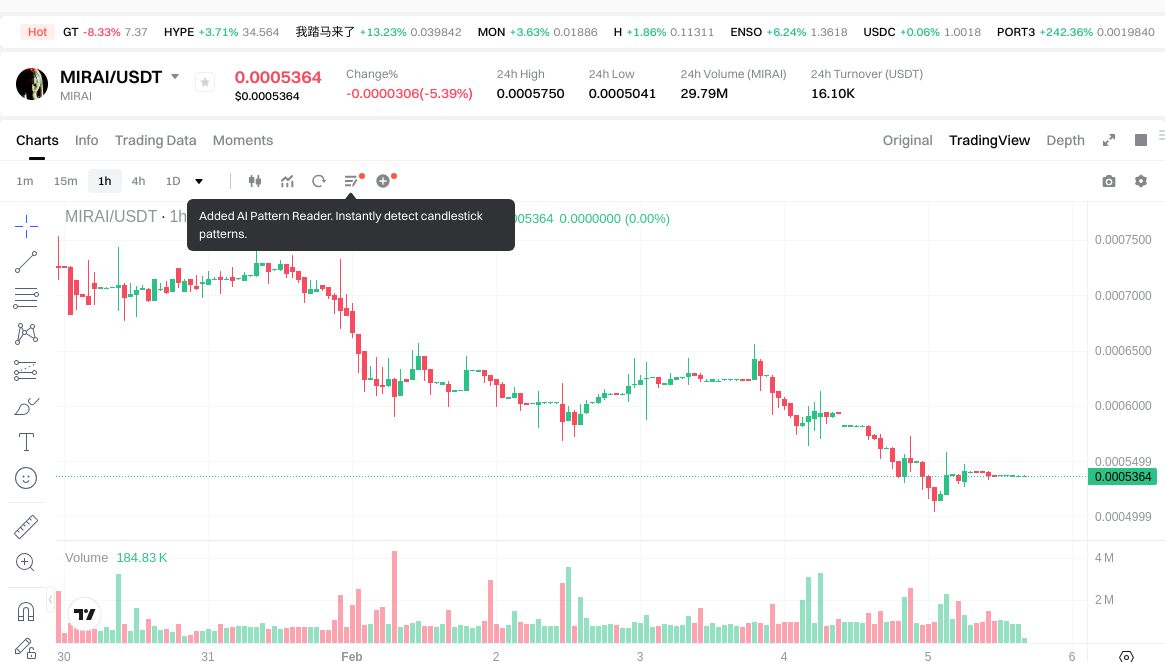
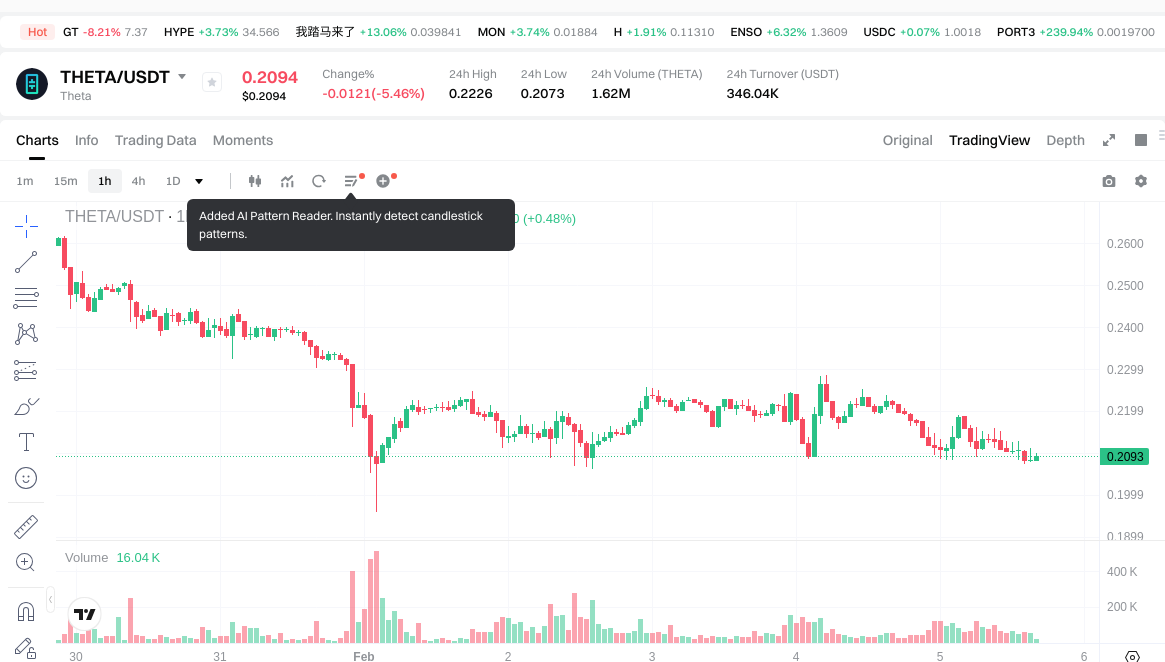
II. Core Factors Influencing MIRAI vs THETA Investment Value
Supply Mechanism Comparison (Tokenomics)
- MIRAI: The reference materials do not provide specific information regarding MIRAI's supply mechanism, distribution model, or tokenomics structure.
- THETA: The reference materials do not contain detailed information about THETA's supply mechanism, issuance model, or token distribution strategy.
- 📌 Historical Pattern: Supply mechanisms can influence price cycles through factors such as scarcity dynamics, emission schedules, and market circulation adjustments, though specific historical data for these assets is not available in the provided materials.
Institutional Adoption and Market Application
- Institutional Holdings: The reference materials do not provide comparative data on institutional preferences or holdings for MIRAI versus THETA.
- Enterprise Adoption: Information regarding the application of MIRAI or THETA in cross-border payments, settlement systems, or institutional investment portfolios is not present in the provided materials.
- National Policies: The reference materials do not contain specific information about regulatory attitudes or policy frameworks from different countries toward MIRAI or THETA.
Technological Development and Ecosystem Building
- MIRAI Technical Upgrades: While the materials mention MIRAI in the context of graphic encoding changes in January 2022, these references do not provide substantive information about blockchain technology upgrades, protocol improvements, or their potential market impact.
- THETA Technical Development: The reference materials do not contain specific information regarding THETA's technological roadmap, protocol enhancements, or development milestones.
- Ecosystem Comparison: Information comparing DeFi integration, NFT functionality, payment infrastructure, or smart contract implementation between MIRAI and THETA is not available in the provided materials.
Macroeconomic Environment and Market Cycles
- Performance in Inflationary Environment: The reference materials do not provide data or analysis comparing the anti-inflation properties or performance characteristics of MIRAI versus THETA during different economic conditions.
- Macroeconomic Monetary Policy: Specific analysis of how interest rate changes, US dollar index movements, or monetary policy shifts affect MIRAI and THETA is not present in the provided materials.
- Geopolitical Factors: The materials do not contain information regarding how cross-border transaction demand, international relations, or geopolitical developments influence the adoption or valuation of these assets.
III. 2026-2031 Price Prediction: MIRAI vs THETA
Short-term Prediction (2026)
- MIRAI: Conservative $0.000300 - $0.000536 | Optimistic $0.000536 - $0.000649
- THETA: Conservative $0.197 - $0.209 | Optimistic $0.209 - $0.304
Mid-term Prediction (2028-2029)
- MIRAI may enter a gradual growth phase, with estimated price range of $0.000354 - $0.000835
- THETA may enter a consolidation phase, with estimated price range of $0.136 - $0.406
- Key drivers: institutional capital inflows, ETF developments, ecosystem expansion
Long-term Prediction (2030-2031)
- MIRAI: Baseline scenario $0.000541 - $0.000850 | Optimistic scenario $0.000917 - $0.001097
- THETA: Baseline scenario $0.228 - $0.367 | Optimistic scenario $0.374 - $0.496
View detailed price predictions for MIRAI and THETA
Disclaimer
MIRAI:
| Year |
Predicted High Price |
Predicted Average Price |
Predicted Low Price |
Price Change |
| 2026 |
0.000649044 |
0.0005364 |
0.000300384 |
0 |
| 2027 |
0.0007705386 |
0.000592722 |
0.00040305096 |
10 |
| 2028 |
0.000783874845 |
0.0006816303 |
0.000354447756 |
27 |
| 2029 |
0.00083533793265 |
0.0007327525725 |
0.000637494738075 |
36 |
| 2030 |
0.000917332945512 |
0.000784045252575 |
0.000540991224276 |
46 |
| 2031 |
0.001097388937766 |
0.000850689099043 |
0.000765620189139 |
58 |
THETA:
| Year |
Predicted High Price |
Predicted Average Price |
Predicted Low Price |
Price Change |
| 2026 |
0.30363 |
0.2094 |
0.196836 |
0 |
| 2027 |
0.3539907 |
0.256515 |
0.13595295 |
22 |
| 2028 |
0.323568021 |
0.30525285 |
0.2533598655 |
46 |
| 2029 |
0.405589461795 |
0.3144104355 |
0.254672452755 |
50 |
| 2030 |
0.3743999465934 |
0.3599999486475 |
0.241199965593825 |
72 |
| 2031 |
0.495719929287607 |
0.36719994762045 |
0.227663967524679 |
75 |
IV. Investment Strategy Comparison: MIRAI vs THETA
Long-term vs Short-term Investment Strategies
- MIRAI: May be suitable for investors with higher risk tolerance interested in emerging Web3 and AI-powered virtual identity projects, though its recent price volatility suggests significant uncertainty
- THETA: May appeal to investors seeking exposure to decentralized video streaming infrastructure, though it has experienced substantial decline from previous price levels
Risk Management and Asset Allocation
- Conservative investors: MIRAI 5-10% vs THETA 10-20% (as part of a diversified crypto portfolio)
- Aggressive investors: MIRAI 15-25% vs THETA 20-30% (within speculative allocation)
- Hedging tools: stablecoin allocation, options strategies, cross-asset portfolio diversification
V. Potential Risk Comparison
Market Risk
- MIRAI: Exhibits substantial price volatility with a decline of approximately 98.48% from its May 2025 peak, accompanied by relatively low 24-hour trading volume of $16,128.40, indicating liquidity concerns
- THETA: Has experienced a decline of approximately 98.67% from its April 2021 peak of $15.72 to current levels, with 24-hour trading volume of $347,027.05, reflecting reduced market participation compared to previous cycles
Technical Risk
- MIRAI: Limited information available regarding network scalability, protocol stability, or technical infrastructure maturity
- THETA: Potential considerations include network performance optimization, protocol development continuity, and infrastructure scalability
Regulatory Risk
- Global regulatory developments may affect both assets differently based on their respective use cases, with decentralized video streaming and AI-powered virtual identity platforms potentially facing distinct compliance frameworks across jurisdictions
VI. Conclusion: Which Is the Better Buy?
📌 Investment Value Summary:
- MIRAI advantages: Represents exposure to emerging Web3 and AI-powered virtual identity sectors, though with limited market history and substantial recent price correction
- THETA advantages: Established presence since 2017 in decentralized video streaming infrastructure, with longer operational track record despite significant price decline from previous peaks
✅ Investment Recommendations:
- Novice investors: Consider gaining foundational knowledge of cryptocurrency markets and risk management principles before allocating capital to volatile assets; if pursuing exposure, maintain strict position sizing limits
- Experienced investors: May evaluate these assets within a diversified portfolio context, conducting thorough due diligence on project fundamentals, development activity, and ecosystem growth metrics
- Institutional investors: Should assess alignment with investment mandates, conduct comprehensive risk analysis, and consider liquidity constraints when evaluating position sizes
⚠️ Risk Disclosure: Cryptocurrency markets exhibit extreme volatility. This content does not constitute investment advice. Investors should conduct independent research and consult qualified financial advisors before making investment decisions.
VII. FAQ
Q1: What are the main differences between MIRAI and THETA in terms of their use cases?
MIRAI focuses on decentralized character creation and AI-powered virtual identity within Web3 ecosystems (launched 2025), while THETA operates as a decentralized video streaming platform utilizing blockchain to incentivize bandwidth sharing (launched 2017). MIRAI represents an emerging sector targeting AI-powered digital identity solutions, whereas THETA addresses content delivery infrastructure challenges through decentralized video streaming technology. The fundamental distinction lies in THETA's longer operational history and established position in decentralized media infrastructure, compared to MIRAI's recent entry into the AI-powered virtual identity space.
Q2: How do the price performances of MIRAI and THETA compare since their respective launches?
Both assets have experienced substantial corrections—MIRAI declined approximately 98.48% from its May 2025 peak of $0.035301 to $0.0005364 (February 2026), while THETA declined approximately 98.67% from its April 2021 high of $15.72 to $0.2084 (February 2026). Despite different launch dates and market cycles, both assets demonstrate extreme volatility patterns characteristic of cryptocurrency markets. THETA's decline occurred over a longer timeframe (2021-2026) compared to MIRAI's rapid correction within approximately 9 months, reflecting different market maturity stages and investor sentiment cycles.
Q3: What is the current trading volume comparison between MIRAI and THETA?
As of February 5, 2026, THETA's 24-hour trading volume stands at $347,027.05, significantly exceeding MIRAI's $16,128.40. This represents approximately 21.5x higher trading volume for THETA compared to MIRAI. The substantial difference in trading volumes indicates considerably greater market liquidity and participant engagement for THETA, which is critical for investors concerned about position entry/exit efficiency. Lower trading volume for MIRAI suggests potential liquidity constraints that could impact price stability and execution quality during portfolio adjustments.
Q4: Are there any institutional adoption indicators available for MIRAI versus THETA?
The reference materials do not provide comparative data on institutional holdings, enterprise adoption patterns, or investment portfolio integration for either MIRAI or THETA. Absence of documented institutional participation data represents an information gap that investors should acknowledge when conducting due diligence. Potential investors should independently research corporate partnerships, institutional custody arrangements, regulatory filings, and public announcements from asset managers to assess institutional adoption levels before making allocation decisions.
Q5: What are the predicted price ranges for MIRAI and THETA in 2030?
For 2030, MIRAI's baseline scenario predicts a range of $0.000541-$0.000850, with an optimistic scenario of $0.000917-$0.001097, while THETA's baseline scenario estimates $0.228-$0.367, with an optimistic scenario of $0.374-$0.496. These projections represent potential increases from current levels of approximately 0.8-1.7x for MIRAI and 1.1-2.4x for THETA under optimistic conditions. However, cryptocurrency price predictions carry significant uncertainty due to market volatility, technological developments, regulatory changes, and macroeconomic factors that cannot be precisely forecasted over multi-year horizons.
Q6: What percentage allocation is recommended for conservative versus aggressive investors?
Conservative investors might consider MIRAI allocation of 5-10% and THETA allocation of 10-20% within a diversified cryptocurrency portfolio, while aggressive investors could evaluate MIRAI allocation of 15-25% and THETA allocation of 20-30% within speculative allocations. These ranges reflect MIRAI's emerging project status and higher risk profile compared to THETA's longer operational history. All percentage allocations assume cryptocurrency holdings represent only a portion of overall investment portfolios, with appropriate risk management through stablecoin reserves, traditional assets, and hedging instruments based on individual risk tolerance and financial circumstances.
Q7: What are the primary risk factors investors should consider when comparing MIRAI and THETA?
Primary risk factors include extreme price volatility (both assets declined >98% from peaks), liquidity concerns (particularly for MIRAI with $16,128 daily volume), limited technical infrastructure information, regulatory uncertainty affecting AI virtual identity and decentralized streaming platforms, and market sentiment (current Fear & Greed Index at 12 indicating "Extreme Fear"). Additionally, MIRAI's limited operational history since 2025 contrasts with THETA's established presence since 2017, creating different risk profiles regarding project sustainability, development continuity, and ecosystem maturity that require distinct evaluation frameworks for investment decision-making.
Q8: How does the current market sentiment affect investment decisions for MIRAI versus THETA?
The current market sentiment index of 12 (Extreme Fear) as of February 5, 2026, suggests widespread pessimism across cryptocurrency markets, which historically has preceded both extended downturns and eventual market recoveries. During extreme fear periods, quality assets may trade below intrinsic value due to capitulation selling, potentially creating accumulation opportunities for long-term investors with sufficient risk capital. However, extreme fear conditions also indicate heightened risk of further price declines, requiring disciplined position sizing, dollar-cost averaging strategies, and comprehensive risk management rather than concentrated positions based solely on contrarian sentiment indicators.
* The information is not intended to be and does not constitute financial advice or any other recommendation of any sort offered or endorsed by Gate.