MP vs MANA: Understanding the Key Differences Between Magic Points and Mana in Gaming


Introduction: Investment Comparison Between MP and MANA
In the cryptocurrency market, the comparison between MP vs MANA has been a topic that investors cannot avoid. The two not only show significant differences in market cap ranking, application scenarios, and price performance, but also represent different positioning in the crypto asset landscape.
MP (MerlinSwap): Launched in 2024, it has gained market recognition as the leading decentralized exchange in the Bitcoin ecosystem, positioning itself as the liquidity hub for BTC and Bitcoin eco-assets across Bitcoin Layer 2.
MANA (Decentraland): Since its launch in 2017, it has been regarded as a pioneer in blockchain-based virtual world platforms, eliminating intermediary fees and enabling direct value transfer between content creators and users.
This article will comprehensively analyze the investment value comparison between MP vs MANA around historical price trends, supply mechanisms, institutional adoption, technical ecosystem, and future predictions, and attempt to answer the question that investors are most concerned about:
"Which is the better buy right now?"
I. Historical Price Comparison and Current Market Status
MP (Coin A) and MANA (Coin B) Historical Price Trends
- 2024: MP experienced a notable price decline from its all-time high of $0.009488 recorded on April 8, 2024, reflecting broader market corrections in the Bitcoin ecosystem.
- 2021: MANA benefited from the metaverse boom, with its price surging to an all-time high of $5.85 on November 25, 2021, driven by increased interest in virtual reality platforms.
- Comparative Analysis: During the recent market cycle, MP has declined from its peak of $0.009488 to its current level of $0.000147, representing a significant drawdown, while MANA has experienced a similar trend, dropping from $5.85 to $0.097.
Current Market Status (February 6, 2026)
- MP Current Price: $0.000147
- MANA Current Price: $0.097
- 24-Hour Trading Volume: MP recorded $20,027.58 compared to MANA's $201,145.42
- Market Sentiment Index (Fear & Greed Index): 12 (Extreme Fear)
View real-time prices:
- Check MP current price Market Price
- Check MANA current price Market Price
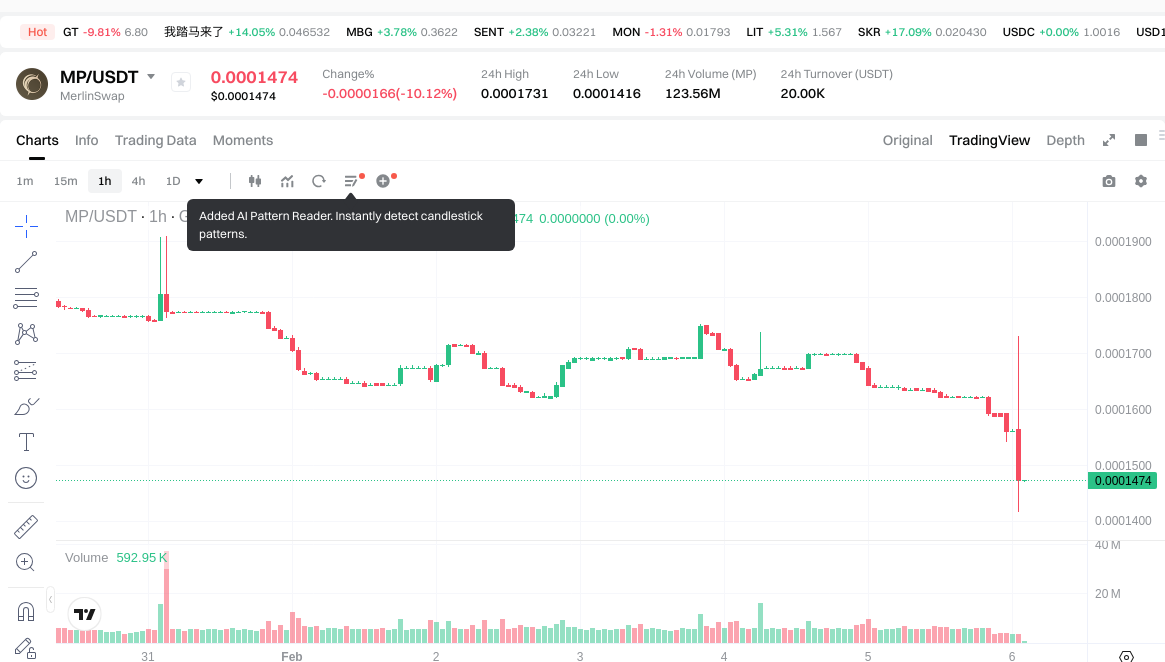
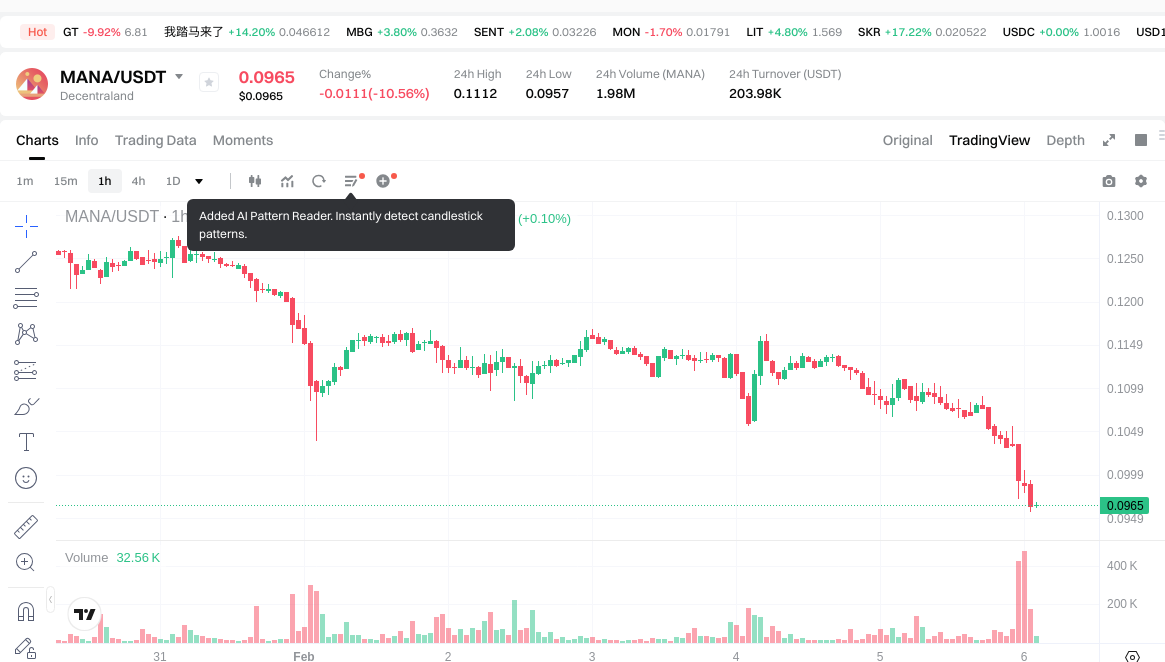
II. Core Factors Influencing MP vs MANA Investment Value
Supply Mechanism Comparison (Tokenomics)
- MP: The supply mechanism details are not specified in the available materials.
- MANA: The supply mechanism details are not specified in the available materials.
- 📌 Historical Pattern: Supply mechanisms can influence price cycle dynamics through scarcity effects and emission schedules, though specific historical data for these assets is not provided in the reference materials.
Institutional Adoption and Market Application
- Institutional Holdings: The reference materials indicate that institutional investor engagement represents a significant factor in asset valuation, with research showing that institutional participation can enhance corporate governance and value creation. However, specific institutional preference data for MP versus MANA is not available.
- Enterprise Adoption: Application scenarios in cross-border payments, settlements, and investment portfolios are not detailed in the provided materials for either asset.
- National Policies: Regulatory attitudes vary across jurisdictions, with materials noting that regulatory environment constitutes a core consideration for investment value assessment. Specific policy stances toward MP or MANA are not documented in the reference sources.
Technology Development and Ecosystem Construction
- MP Technology Upgrades: Technical development information is not available in the provided materials.
- MANA Technology Development: Technical evolution details are not specified in the reference materials.
- Ecosystem Comparison: The materials reference metaverse-related applications and consumer product considerations, suggesting potential relevance to virtual environment platforms. However, specific implementation status in DeFi, NFT, payment systems, or smart contracts for either asset is not documented.
Macroeconomic Environment and Market Cycles
- Performance in Inflationary Environments: The reference materials discuss investment value considerations and market trend dependencies but do not provide comparative inflation-hedge characteristics for these specific assets.
- Macroeconomic Monetary Policy: Research indicates that interest rates, currency indices, and capital market conditions influence investment valuations. Transaction costs and information friction in capital markets may provide arbitrage opportunities that affect investor focus on short-term versus long-term returns.
- Geopolitical Factors: Cross-border transaction demand and international developments represent relevant considerations for asset valuation, though specific impacts on MP or MANA are not detailed in the available materials.
III. 2026-2031 Price Prediction: MP vs MANA
Short-term Prediction (2026)
- MP: Conservative $0.000143 - $0.0001474 | Optimistic $0.0001474 - $0.000212
- MANA: Conservative $0.0559 - $0.0964 | Optimistic $0.0964 - $0.1436
Mid-term Prediction (2028-2029)
- MP may enter a growth phase with projected price range of $0.0001745 - $0.0003242
- MANA may enter an expansion phase with projected price range of $0.0828 - $0.2109
- Key drivers: institutional capital inflows, ETF developments, ecosystem growth
Long-term Prediction (2030-2031)
- MP: Baseline scenario $0.0002195 - $0.0003251 | Optimistic scenario $0.0002774 - $0.0003890
- MANA: Baseline scenario $0.1197 - $0.2412 | Optimistic scenario $0.1479 - $0.3063
Disclaimer
MP:
| Year | Predicted High Price | Predicted Average Price | Predicted Low Price | Price Change |
|---|---|---|---|---|
| 2026 | 0.000212256 | 0.0001474 | 0.000142978 | 0 |
| 2027 | 0.00022118844 | 0.000179828 | 0.00012767788 | 22 |
| 2028 | 0.0002626657682 | 0.00020050822 | 0.0001744421514 | 36 |
| 2029 | 0.00032422179174 | 0.0002315869941 | 0.000127372846755 | 57 |
| 2030 | 0.000325148139716 | 0.00027790439292 | 0.000219544470406 | 89 |
| 2031 | 0.00038896888355 | 0.000301526266318 | 0.000277404165012 | 105 |
MANA:
| Year | Predicted High Price | Predicted Average Price | Predicted Low Price | Price Change |
|---|---|---|---|---|
| 2026 | 0.143636 | 0.0964 | 0.055912 | 0 |
| 2027 | 0.13081962 | 0.120018 | 0.10921638 | 23 |
| 2028 | 0.1780947102 | 0.12541881 | 0.0827764146 | 29 |
| 2029 | 0.210941896539 | 0.1517567601 | 0.116852705277 | 56 |
| 2030 | 0.241194606664935 | 0.1813493283195 | 0.11969055669087 | 86 |
| 2031 | 0.306344352863715 | 0.211271967492217 | 0.147890377244552 | 117 |
IV. Investment Strategy Comparison: MP vs MANA
Long-term vs Short-term Investment Strategies
-
MP: May suit investors focused on Bitcoin ecosystem infrastructure development and decentralized exchange utility within Layer 2 environments. The asset's positioning as a liquidity hub suggests potential relevance for those monitoring Bitcoin-adjacent protocol evolution.
-
MANA: May appeal to investors interested in virtual world platform development and metaverse-related applications. The asset's historical connection to blockchain-based virtual environments suggests potential alignment with digital real estate and content creation trends.
Risk Management and Asset Allocation
-
Conservative Investors: A balanced approach might involve limited exposure to either asset given current market conditions, with consideration for MP: 20-30% and MANA: 70-80% allocation within a diversified crypto portfolio, reflecting MANA's longer market presence.
-
Aggressive Investors: Higher-risk tolerance portfolios might explore MP: 40-50% and MANA: 50-60% allocations, acknowledging both assets' speculative characteristics and potential for volatility.
-
Hedging Tools: Portfolio protection strategies may include stablecoin allocations for liquidity preservation, options instruments where available for downside protection, and cross-asset diversification to mitigate concentration risk.
V. Potential Risk Comparison
Market Risk
-
MP: The asset exhibits substantial price volatility, having declined considerably from its April 2024 peak. Current trading volumes of $20,027.58 suggest relatively limited liquidity, which may amplify price swings during periods of market stress. The asset's shorter market history provides limited data for volatility modeling.
-
MANA: Historical price data shows significant drawdown from the November 2021 peak of $5.85 to current levels around $0.097. Trading volume of $201,145.42 indicates moderate market activity. The asset remains subject to broader metaverse sector sentiment shifts and speculative interest cycles.
Technical Risk
-
MP: Considerations include decentralized exchange operational stability, liquidity provision mechanisms, and Layer 2 infrastructure dependencies. Smart contract security and cross-chain bridge integrity represent ongoing technical considerations.
-
MANA: Platform scalability requirements, virtual environment hosting infrastructure, and user experience optimization present technical challenges. Network performance during high-activity periods and integration with evolving blockchain standards constitute relevant risk factors.
Regulatory Risk
- Different jurisdictions maintain varying approaches toward decentralized exchange protocols and virtual world platforms. Regulatory clarity around token classification, securities law application, and cross-border transaction frameworks continues to evolve. Both assets may face distinct compliance requirements based on their respective utility models and operational structures.
VI. Conclusion: Which Is the Better Buy?
📌 Investment Value Summary:
-
MP Considerations: Positioning within the Bitcoin Layer 2 ecosystem may offer exposure to Bitcoin infrastructure development trends. The asset's role as a decentralized exchange suggests utility beyond speculative value, though limited historical data and lower trading volumes present evaluation challenges.
-
MANA Considerations: Longer market presence since 2017 provides more extensive price history for analysis. Connection to metaverse development and virtual world applications offers exposure to digital environment evolution, though platform adoption rates and competitive dynamics remain uncertain.
✅ Investment Considerations:
-
Newer Investors: Given the current Extreme Fear market sentiment (index: 12) and substantial price declines from historical peaks for both assets, building foundational understanding of crypto market dynamics and limiting position sizes relative to overall portfolio may be appropriate. Education on wallet security, transaction mechanics, and market cycle characteristics should precede capital allocation.
-
Experienced Investors: Those with established crypto portfolios might evaluate both assets within broader sector allocation frameworks. Consideration of Bitcoin ecosystem exposure (MP) versus metaverse sector positioning (MANA) should align with existing holdings and risk tolerance parameters. Technical analysis of support levels and volume trends may inform entry timing.
-
Institutional Investors: Portfolio managers may assess both assets in context of emerging sector exposures and client mandates. Due diligence on operational structures, custody solutions, liquidity characteristics, and regulatory classification should precede any allocation decisions. Position sizing should reflect volatility expectations and correlation with existing holdings.
⚠️ Risk Disclosure: Cryptocurrency markets demonstrate substantial volatility characteristics. Historical performance does not indicate future results. This analysis does not constitute investment advice, and readers should conduct independent research and consult qualified financial professionals before making investment decisions.
VII. FAQ
Q1: What are the primary differences between MP and MANA in terms of their fundamental use cases?
MP functions as a decentralized exchange focused on providing liquidity for Bitcoin and Bitcoin Layer 2 ecosystem assets, while MANA serves as the utility token for Decentraland, a blockchain-based virtual world platform. MP's value proposition centers on Bitcoin infrastructure and cross-chain liquidity provision, whereas MANA's utility derives from virtual land ownership, content creation, and metaverse commerce. The fundamental distinction lies in infrastructure utility (MP) versus virtual environment applications (MANA).
Q2: How do the current trading volumes of MP and MANA reflect their market liquidity?
MANA demonstrates significantly higher trading volume at $201,145.42 compared to MP's $20,027.58. This tenfold difference indicates that MANA offers substantially greater liquidity, allowing investors to execute larger transactions with potentially less price slippage. Higher trading volume generally suggests broader market participation and more efficient price discovery mechanisms, which may reduce execution risk for position entry and exit.
Q3: What factors contributed to the substantial price declines both assets have experienced from their peaks?
MP declined from its April 2024 peak of $0.009488 to current levels of $0.000147, while MANA dropped from its November 2021 high of $5.85 to approximately $0.097. Contributing factors include broader cryptocurrency market corrections, reduced speculative interest following initial hype cycles (metaverse narrative for MANA, Bitcoin Layer 2 emergence for MP), macroeconomic headwinds affecting risk assets, and sector-specific challenges including competition and adoption uncertainty.
Q4: How should investors interpret the current Extreme Fear market sentiment index of 12?
The Fear & Greed Index reading of 12 indicates Extreme Fear conditions, suggesting widespread negative sentiment and risk aversion in cryptocurrency markets. Historically, such readings have occasionally preceded market recoveries as capitulation creates potential accumulation opportunities, though they can also persist during extended downtrends. Investors should consider that extreme sentiment readings may signal oversold conditions but do not guarantee immediate price reversals or establish specific entry timing.
Q5: What distinguishes the investment risk profiles between MP and MANA?
MP presents higher liquidity risk due to lower trading volumes and shorter market history, limiting historical performance data for risk modeling. Its concentration within the Bitcoin Layer 2 ecosystem creates specific technical dependencies and competition exposure. MANA carries sector-specific risks tied to metaverse adoption rates and virtual world platform competition, with longer price history providing more data points for volatility assessment. Both assets exhibit substantial volatility characteristics, though MANA's established market presence offers marginally more trading history for risk evaluation.
Q6: How do regulatory considerations differ between decentralized exchange tokens and metaverse platform tokens?
Decentralized exchange tokens like MP may face scrutiny related to securities regulations, exchange operation frameworks, and cross-border transaction compliance requirements. Metaverse platform tokens such as MANA encounter potential regulatory questions regarding virtual asset ownership, digital property rights, and content moderation obligations. Jurisdictional approaches vary significantly, with some regulators examining utility token classifications while others focus on functional analysis of token economics. Both asset categories operate within evolving regulatory landscapes that may impact operational structures and market access.
Q7: What allocation strategies might conservative versus aggressive investors consider for these assets?
Conservative investors might limit combined exposure to 20-30% MP and 70-80% MANA within a dedicated cryptocurrency allocation, reflecting MANA's longer operational history and higher liquidity. This approach prioritizes established market presence while maintaining modest exposure to newer Bitcoin ecosystem infrastructure. Aggressive investors with higher risk tolerance might explore more balanced 40-50% MP and 50-60% MANA allocations, accepting greater volatility exposure in exchange for potential upside from emerging sector developments. Both strategies should represent only a portion of broader diversified portfolios.
Q8: What technological developments might influence the future value propositions of MP versus MANA?
MP's value trajectory may depend on Bitcoin Layer 2 adoption rates, cross-chain bridge security implementations, liquidity aggregation innovations, and decentralized exchange technological improvements. MANA's evolution likely correlates with virtual reality hardware advancement, blockchain scalability solutions enabling richer metaverse experiences, interoperability standards for virtual assets, and user interface improvements reducing adoption barriers. Competitive dynamics within respective sectors—Bitcoin DeFi infrastructure and virtual world platforms—will influence both assets' technological relevance and market positioning over time.
Share
Content
Introduction: Investment Comparison Between MP and MANA
I. Historical Price Comparison and Current Market Status
II. Core Factors Influencing MP vs MANA Investment Value
III. 2026-2031 Price Prediction: MP vs MANA
IV. Investment Strategy Comparison: MP vs MANA
V. Potential Risk Comparison
VI. Conclusion: Which Is the Better Buy?
VII. FAQ
How to Buy Cryptocurrency


Trending Cryptocurrencies



What will be the market capitalization of USDC in 2025? Analysis of the stablecoin market landscape.
How is DeFi different from Bitcoin?

What is DeFi: Understanding Decentralized Finance in 2025

USDC stablecoin 2025 Latest Analysis: Principles, Advantages, and Web3 Eco-Applications

Development of Decentralized Finance Ecosystem in 2025: Integration of Decentralized Finance Applications with Web3

2025 USDT USD Complete Guide: A Must-Read for Newbie Investors

What is an IOU in Crypto?

What is Consensus Mechanism and What Types of Consensus Systems Exist

Top 10 Enterprise Blockchain Solutions from Global Leaders

Comprehensive Guide to Leverage Trading

What is ROI? How to Calculate Return on Investment and What is a Good ROI?