OWN vs IMX: A Comprehensive Comparison of Two Leading Blockchain Platforms


Introduction: Investment Comparison Between OWN and IMX
In the cryptocurrency market, the comparison between OWN vs IMX has become an increasingly relevant topic for investors. Both assets exhibit significant differences in market capitalization ranking, application scenarios, and price performance, representing distinct positioning within the crypto asset landscape.
Otherworld (OWN): Launched in 2024, this Web3 social protocol has gained attention through its integration of social media functionality with digital asset ownership and immersive entertainment experiences leveraging intellectual property from top entertainment properties.
Immutable (IMX): Operating since its inception as a Layer-2 scaling solution for NFTs on Ethereum, it has established itself as a significant player in the NFT ecosystem, offering instant transactions and zero gas fees for minting and trading.
This article will comprehensively analyze the investment value comparison between OWN vs IMX across multiple dimensions including historical price trends, supply mechanisms, institutional adoption, technological ecosystems, and future projections, attempting to address the question most investors care about:
"Which is the better buy right now?"
I. Historical Price Comparison and Current Market Status
OWN (Coin A) and IMX (Coin B) Historical Price Trends
- 2021: IMX experienced notable price movement during its early market phase, with price activity following its launch period.
- 2024: OWN entered the market in mid-2024, beginning trading activity from June 2024 onwards.
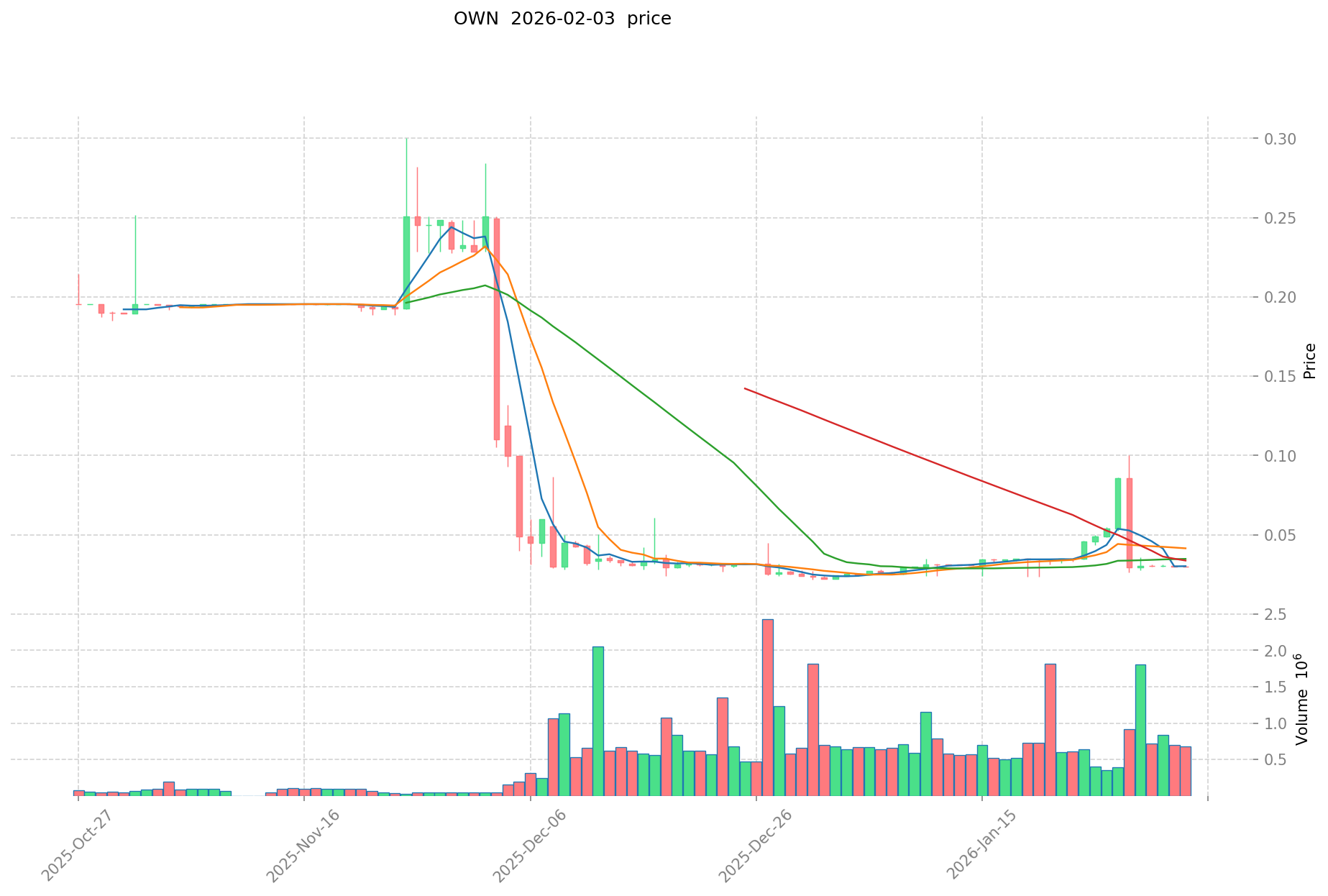
- Comparative Analysis: During their respective market cycles, OWN recorded a peak of $2.33 on January 16, 2025, before declining to its current level, while IMX previously reached a high of $9.52 in November 2021 and has since adjusted to lower price ranges.
Current Market Status (February 03, 2026)
- OWN current price: $0.02986
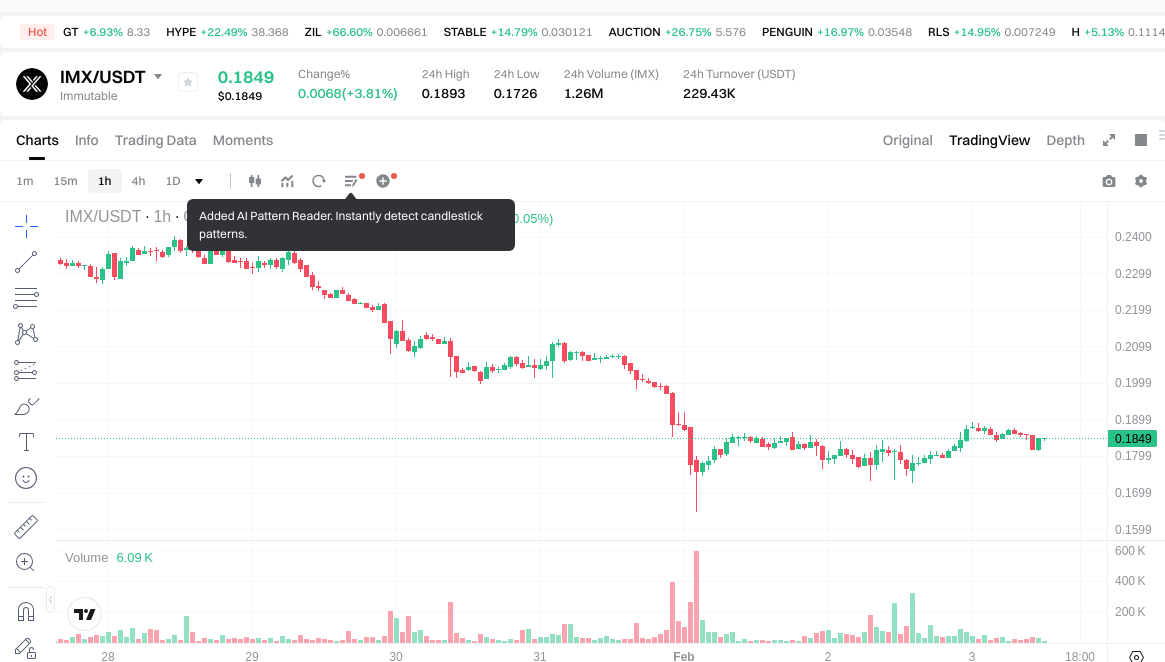
- IMX current price: $0.1849
- 24-hour trading volume: OWN $20,332.96 vs IMX $230,333.87
- Market Sentiment Index (Fear & Greed Index): 17 (Extreme Fear)
View real-time prices:
- View OWN current price Market Price
- View IMX current price Market Price
II. Core Factors Affecting OWN vs IMX Investment Value
Supply Mechanism Comparison (Tokenomics)
- IMX: According to reference materials, IMX operates within the Web3 technology and blockchain gaming ecosystem. The tokenomics structure supports NFT transactions and gaming applications, though specific supply mechanisms require further verification.
- OWN: Detailed supply mechanism information is not available in the provided materials.
- 📌 Historical Pattern: Supply mechanisms typically influence price cycles through scarcity dynamics and emission schedules, though specific historical data for these tokens requires additional research.
Institutional Adoption and Market Application
- Institutional Holdings: Reference materials indicate IMX has attracted attention in the blockchain gaming and NFT sectors, suggesting potential institutional interest in Web3 infrastructure projects.
- Enterprise Adoption: IMX demonstrates application potential in blockchain gaming, NFT marketplaces, and digital asset trading platforms. Materials mention IMX's value proposition in securing long-term partnerships within the blockchain domain.
- Regulatory Environment: Investment decisions for both IMX and similar assets should consider individual risk preferences, capital conditions, market analysis, and timing considerations. Different jurisdictions maintain varying regulatory approaches toward digital assets.
Technology Development and Ecosystem Construction
- IMX Technology Development: Materials reference IMX's positioning within Web3 technology transformation, with growing adoption in blockchain gaming and NFT sectors. The platform appears to focus on scalability solutions for digital asset transactions.
- Ecosystem Comparison: IMX shows activity in gaming applications and NFT infrastructure. Reference materials mention the broader GameFi sector transformation from farm-to-dump models toward play-to-own paradigms, which may provide context for projects like IMX. DeFi integration, payment solutions, and smart contract implementations vary across projects.
Macroeconomic Environment and Market Cycles
- Performance Under Inflation: Digital assets generally demonstrate varied responses to inflationary environments depending on their utility, adoption rates, and market positioning. Specific comparative performance data requires market-specific analysis.
- Macroeconomic Monetary Policy: Interest rate adjustments, dollar index movements, and liquidity conditions influence digital asset valuations. Materials suggest monitoring timing considerations for investment decisions.
- Geopolitical Factors: Cross-border transaction demand and international regulatory developments affect market dynamics. Reference materials emphasize the importance of understanding regulatory policy trends and technological innovation progress when evaluating investment prospects.
III. 2026-2031 Price Prediction: OWN vs IMX
Short-term Prediction (2026)
- OWN: Conservative $0.0281-$0.0299 | Optimistic $0.0299-$0.0340
- IMX: Conservative $0.1016-$0.1848 | Optimistic $0.1848-$0.2162
Mid-term Prediction (2028-2029)
- OWN may enter a consolidation phase, with projected price range of $0.0272-$0.0465
- IMX may enter an expansion phase, with projected price range of $0.1565-$0.3255
- Key drivers: institutional capital inflows, ETF developments, ecosystem growth
Long-term Prediction (2030-2031)
- OWN: Baseline scenario $0.0244-$0.0451 | Optimistic scenario $0.0262-$0.0580
- IMX: Baseline scenario $0.1684-$0.3958 | Optimistic scenario $0.2266-$0.4532
Disclaimer
OWN:
| Year | Predicted High Price | Predicted Average Price | Predicted Low Price | Price Change |
|---|---|---|---|---|
| 2026 | 0.0340404 | 0.02986 | 0.0280684 | 0 |
| 2027 | 0.037381734 | 0.0319502 | 0.03035269 | 7 |
| 2028 | 0.04090584106 | 0.034665967 | 0.03293266865 | 16 |
| 2029 | 0.0464766619569 | 0.03778590403 | 0.0272058509016 | 26 |
| 2030 | 0.045080472802991 | 0.04213128299345 | 0.024436144136201 | 41 |
| 2031 | 0.057995817604633 | 0.04360587789822 | 0.026163526738932 | 46 |
IMX:
| Year | Predicted High Price | Predicted Average Price | Predicted Low Price | Price Change |
|---|---|---|---|---|
| 2026 | 0.216216 | 0.1848 | 0.10164 | 0 |
| 2027 | 0.24662484 | 0.200508 | 0.11428956 | 8 |
| 2028 | 0.2481587262 | 0.22356642 | 0.156496494 | 20 |
| 2029 | 0.325490350878 | 0.2358625731 | 0.191048684211 | 27 |
| 2030 | 0.39575381140449 | 0.280676461989 | 0.1684058771934 | 51 |
| 2031 | 0.453208283173638 | 0.338215136696745 | 0.226604141586819 | 82 |
IV. Investment Strategy Comparison: OWN vs IMX
Long-term vs Short-term Investment Strategies
- OWN: May suit investors focused on emerging Web3 social protocols and entertainment-focused digital asset ecosystems, with consideration for early-stage project dynamics and associated volatility patterns.
- IMX: May appeal to investors interested in established NFT infrastructure and Layer-2 scaling solutions, with focus on blockchain gaming sector development and digital asset transaction platforms.
Risk Management and Asset Allocation
- Conservative Investors: Suggested allocation framework could consider IMX at higher weighting given its established market position, while limiting OWN exposure due to its early-stage characteristics. Actual allocation should reflect individual risk tolerance and investment objectives.
- Aggressive Investors: May allocate increased exposure to both assets depending on conviction in Web3 infrastructure growth, while maintaining diversification principles across multiple digital asset categories.
- Hedging Instruments: Stablecoin reserves for portfolio stability, options strategies for downside protection, cross-asset diversification across different blockchain ecosystems and use cases.
V. Potential Risk Comparison
Market Risks
- OWN: Limited trading volume ($20,332.96 in 24-hour period) may present liquidity constraints, price discovery challenges, and increased volatility sensitivity. Early-stage market positioning requires consideration of adoption trajectory uncertainties.
- IMX: Market performance correlation with broader NFT sector trends and blockchain gaming adoption cycles. Trading volume of $230,333.87 indicates relatively higher liquidity compared to OWN, though still subject to digital asset market volatility.
Technical Risks
- OWN: Scalability considerations for social protocol infrastructure, network stability during adoption phases, smart contract security in entertainment-focused applications.
- IMX: Layer-2 solution dependencies, network performance during high transaction volumes, integration complexities with Ethereum mainnet, potential technical challenges in NFT marketplace operations.
Regulatory Risks
- Global Regulatory Environment: Different jurisdictions maintain varying approaches toward NFT platforms, social tokens, and Layer-2 solutions. Regulatory developments in major markets could impact adoption trajectories differently for entertainment-focused protocols versus NFT infrastructure platforms. Cross-border transaction frameworks and digital asset classification standards remain evolving considerations for both assets.
VI. Conclusion: Which Is the Better Buy?
📌 Investment Value Summary
- OWN Characteristics: Early-stage Web3 social protocol with entertainment IP integration, launched in 2024 with subsequent price adjustment from peak levels. Current trading activity reflects emerging market positioning with limited liquidity depth.
- IMX Characteristics: Established Layer-2 NFT infrastructure with operational history since 2021, demonstrated application in blockchain gaming and digital asset marketplaces. Price performance shows adjustment from previous cycle peaks while maintaining relatively higher trading volumes.
✅ Investment Considerations
- Emerging Market Participants: Consider starting with established infrastructure projects demonstrating clearer use cases and higher liquidity profiles. Thorough research into tokenomics, team backgrounds, and ecosystem development remains essential before allocation decisions.
- Experienced Market Participants: May evaluate both assets within broader portfolio diversification frameworks, considering correlation patterns, sector exposure balance, and individual conviction levels regarding Web3 social protocols versus NFT infrastructure development trajectories.
- Institutional Participants: Assessment frameworks should incorporate due diligence on regulatory compliance, custody solutions, liquidity depth analysis, and alignment with investment mandates. Infrastructure maturity, partnership quality, and ecosystem sustainability metrics warrant detailed evaluation.
⚠️ Risk Disclosure: Cryptocurrency markets demonstrate elevated volatility characteristics with potential for significant value fluctuations. This analysis does not constitute investment advice, financial recommendations, or solicitation to buy or sell digital assets. Individuals should conduct independent research, assess personal risk tolerance, consult qualified financial advisors, and only allocate capital they can afford to lose. Past performance does not indicate future results. Regulatory environments remain subject to change across jurisdictions.
VII. FAQ
Q1: What are the main differences between OWN and IMX in terms of their core functionality?
OWN is a Web3 social protocol focused on integrating social media with digital asset ownership and entertainment IP, while IMX is a Layer-2 scaling solution specifically designed for NFT transactions on Ethereum. OWN launched in 2024 targeting immersive entertainment experiences, whereas IMX has operated since 2021 as established NFT infrastructure offering instant transactions and zero gas fees for minting and trading. The fundamental distinction lies in their use cases: OWN emphasizes social engagement and entertainment, while IMX prioritizes NFT marketplace efficiency and blockchain gaming applications.
Q2: How does the liquidity comparison between OWN and IMX affect investment decisions?
IMX demonstrates significantly higher liquidity with 24-hour trading volume of $230,333.87 compared to OWN's $20,332.96, representing approximately 11 times greater trading activity. This liquidity differential directly impacts price discovery mechanisms, execution quality, and volatility patterns. Lower liquidity in OWN may result in wider bid-ask spreads, increased slippage during transactions, and heightened price sensitivity to modest order flows. Investors requiring frequent position adjustments or larger allocation sizes should prioritize the enhanced liquidity profile that IMX provides.
Q3: What are the projected price trajectories for OWN and IMX through 2031?
Conservative projections for OWN suggest a range of $0.0244-$0.0451 by 2030-2031, representing potential 46% growth from current levels, while IMX forecasts indicate $0.1684-$0.3958, suggesting up to 82% appreciation. Short-term 2026 predictions position OWN at $0.0281-$0.0340 and IMX at $0.1016-$0.2162. These projections incorporate factors including institutional adoption rates, ecosystem development progress, and broader market cycle dynamics. However, actual performance depends on execution of technological roadmaps, regulatory developments, and competitive positioning within respective sectors.
Q4: Which asset presents lower risk for conservative investors?
IMX generally presents a more conservative risk profile due to its established operational history since 2021, proven use cases in NFT infrastructure, and substantially higher trading liquidity. The project demonstrates clearer revenue models through transaction fees and established partnerships within blockchain gaming ecosystems. OWN, as an early-stage protocol launched in 2024, carries elevated risks associated with adoption uncertainty, limited liquidity depth, and unproven market fit for its Web3 social protocol model. Conservative investors typically favor established infrastructure projects with demonstrated utility over emerging protocols requiring adoption validation.
Q5: How do regulatory considerations differ between OWN and IMX?
Both assets face regulatory scrutiny, but through different lenses. IMX's positioning as NFT infrastructure and Layer-2 scaling solution places it within frameworks addressing digital collectibles, gaming assets, and blockchain technology services. Regulatory developments around NFT classification, securities laws application to gaming tokens, and cross-border transaction compliance directly impact IMX operations. OWN's social protocol model faces uncertainties regarding social token regulation, content moderation requirements, and entertainment IP licensing frameworks across jurisdictions. Investors should monitor regulatory policy evolution in their specific jurisdictions, particularly regarding NFT platforms and social token protocols.
Q6: What portfolio allocation strategy balances exposure to both assets?
A balanced approach might allocate higher weighting toward IMX (60-70%) given its established market position and superior liquidity, with limited OWN exposure (10-20%) for those seeking early-stage protocol participation, reserving remaining allocation (20-30%) for stablecoin reserves or diversified digital assets. Aggressive investors with higher risk tolerance might increase OWN allocation to 30-40% based on conviction regarding Web3 social protocol growth potential. Critical considerations include maintaining adequate liquidity reserves, diversification across multiple blockchain ecosystems, and alignment with individual investment timeframes and risk tolerance levels.
Q7: What key metrics should investors monitor for evaluating OWN vs IMX performance?
Essential metrics include trading volume trends indicating liquidity evolution, active address growth reflecting adoption rates, and transaction count demonstrating actual usage patterns. For IMX, monitor NFT marketplace integration announcements, blockchain gaming partnerships, and Layer-2 transaction throughput metrics. For OWN, track social engagement metrics, entertainment IP partnership developments, and user acquisition rates within the social protocol. Additionally, observe developer activity through GitHub commits, ecosystem funding announcements, token unlock schedules affecting supply dynamics, and comparative performance against sector benchmarks during different market conditions.
Share
Content
Introduction: Investment Comparison Between OWN and IMX
I. Historical Price Comparison and Current Market Status
II. Core Factors Affecting OWN vs IMX Investment Value
III. 2026-2031 Price Prediction: OWN vs IMX
IV. Investment Strategy Comparison: OWN vs IMX
V. Potential Risk Comparison
VI. Conclusion: Which Is the Better Buy?
VII. FAQ
How to Buy Cryptocurrency


Trending Cryptocurrencies



Treasure NFT Marketplace: A 2025 Guide for Web3 Gamers and Investors

What are the new trends in the NFT market in 2025?

NFT Treasure Hunting: Top Strategies for Web3 Collectors in 2025

How to Create and Sell NFTs: A Step-by-Step Guide for Beginners

The technical principles and application scenarios of 2025 NFTs

How to Create an NFT in 2025: A Step-by-Step Guide

What is Leverage Trading? A Cryptocurrency Investment Strategy to Maximize Returns

A Complete Guide to the 1inch Swap
Understanding the Stock-to-Flow Model: Bitcoin's Scarcity and Price Relationship

Top Stablecoin Interest Rate Solutions for Passive Income

Top 7 Solutions to Survive Cryptocurrency Bear Markets