P00LS vs UNI: A Comprehensive Comparison of Two Leading Decentralized Finance Protocols

Introduction: Investment Comparison Between P00LS and UNI
In the cryptocurrency market, the comparison between P00LS and UNI has become a topic of interest for investors. The two assets exhibit notable differences in market capitalization ranking, application scenarios, and price performance, representing distinct positioning within the crypto asset landscape.
P00LS (P00LS): Launched in July 2023, this token serves as the official token of the P00LS ecosystem, a decentralized protocol for fan tokens and creator cryptocurrencies. It enables artists, creators, and brands to launch their own tokens and distribute them to their communities on Ethereum.
UNI (UNI): Since its launch in September 2020, UNI has been recognized as a governance token for Uniswap, the pioneering automated market-making protocol built on the Ethereum blockchain.
This article will provide a comprehensive analysis of the investment value comparison between P00LS and UNI, covering historical price trends, supply mechanisms, institutional adoption, technological ecosystems, and future predictions. It aims to address the question that concerns investors most:
"Which asset presents a more compelling investment case based on current market dynamics?"
I. Historical Price Comparison and Current Market Status
P00LS and UNI Historical Price Trends
- 2022: P00LS reached a notable price level of $0.980104 in October 2022, representing a period of relatively stronger valuation during its early trading phase.
- 2021: UNI experienced significant market attention with its price reaching $44.92 in May 2021, reflecting substantial growth during the broader cryptocurrency market expansion.
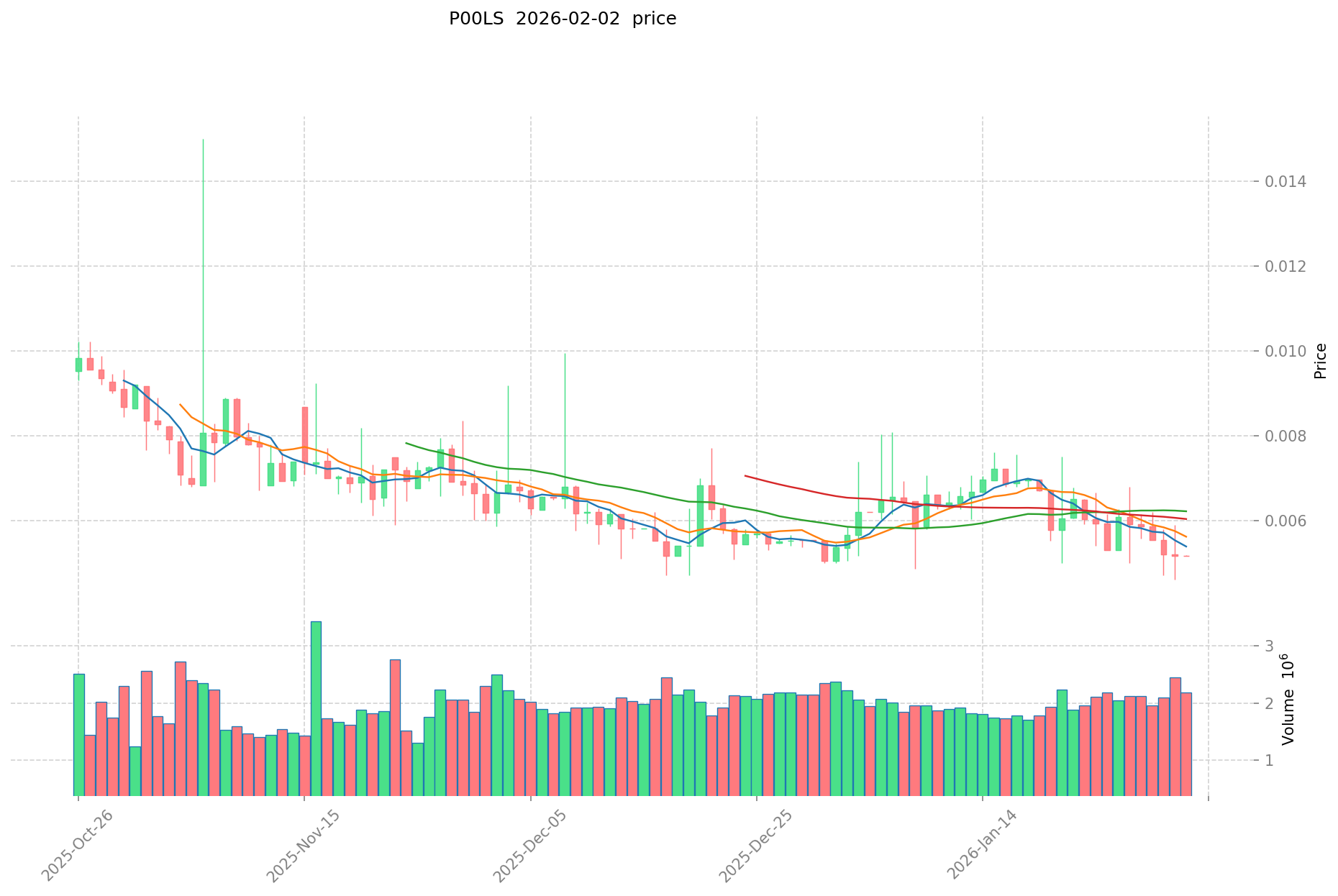
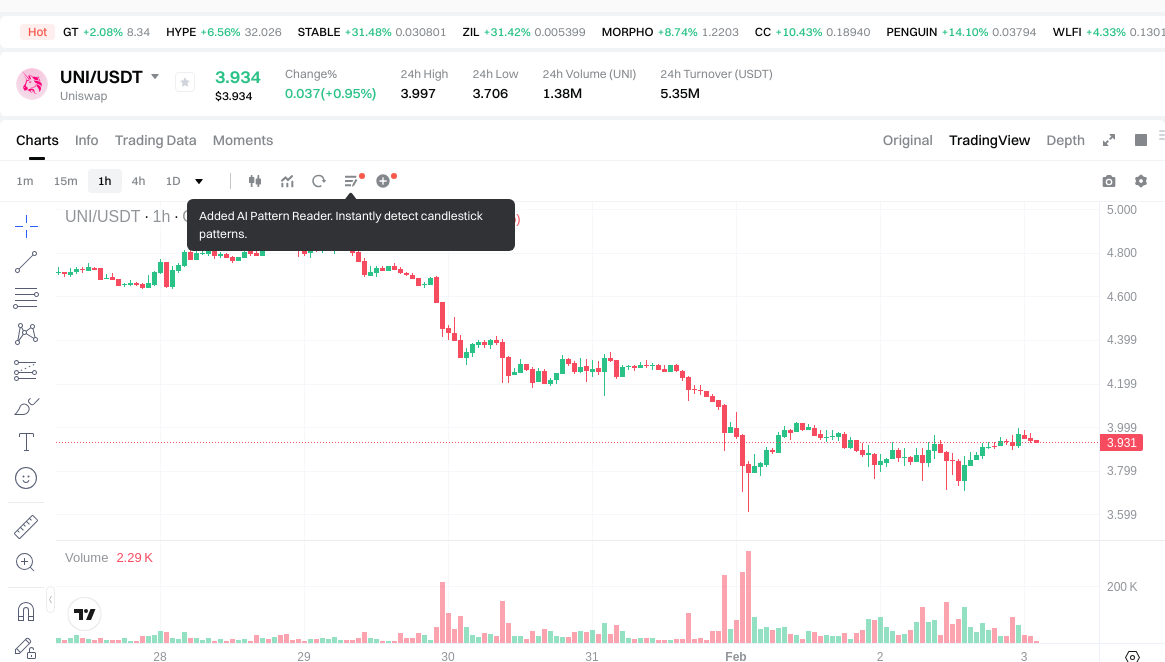
- Comparative Analysis: During the subsequent market cycle, P00LS declined from its peak of $0.980104 to a lower range, with recent pricing around $0.005192, while UNI similarly experienced considerable downward movement from its historical high of $44.92 to approximately $3.941.
Current Market Status (2026-02-03)
- P00LS Current Price: $0.005192
- UNI Current Price: $3.941
- 24-Hour Trading Volume: P00LS recorded $13,088.60 compared to UNI's $5,384,801.88
- Market Sentiment Index (Fear & Greed Index): 14 (Extreme Fear)
View real-time prices:
- Check P00LS current price Market Price
- Check UNI current price Market Price
II. Core Factors Influencing P00LS vs UNI Investment Value
Supply Mechanism Comparison (Tokenomics)
- P00LS: The reference materials do not provide specific information regarding P00LS supply mechanism or tokenomics structure.
- UNI: The reference materials do not provide specific information regarding UNI supply mechanism or tokenomics structure.
- 📌 Historical Pattern: Supply mechanisms can influence price cycles through scarcity dynamics and distribution models, though specific data for P00LS and UNI is not available in the provided materials.
Institutional Adoption and Market Application
- Institutional Holdings: The reference materials do not contain comparative data on institutional preference between P00LS and UNI.
- Enterprise Adoption: Specific applications of P00LS and UNI in cross-border payments, settlements, or investment portfolios are not detailed in the provided materials.
- National Policies: Regulatory attitudes toward P00LS and UNI across different jurisdictions are not covered in the reference materials.
Technological Development and Ecosystem Building
- P00LS Technical Upgrades: The reference materials do not provide information on P00LS technical developments or their potential impacts.
- UNI Technical Development: The reference materials do not provide information on UNI technical developments or their potential impacts.
- Ecosystem Comparison: The reference materials do not contain comparative data on DeFi, NFT, payment systems, or smart contract implementations for P00LS and UNI.
Macroeconomic Environment and Market Cycles
- Performance Under Inflation: The reference materials do not provide comparative analysis of P00LS and UNI performance in inflationary environments or their respective inflation-hedging properties.
- Macroeconomic Monetary Policy: The reference materials do not detail how interest rates or the US Dollar Index specifically affect P00LS and UNI.
- Geopolitical Factors: The reference materials do not address how cross-border transaction demand or international situations impact P00LS and UNI investment value.
III. 2026-2031 Price Prediction: P00LS vs UNI
Short-term Forecast (2026)
- P00LS: Conservative $0.00286 - $0.00520 | Optimistic $0.00520 - $0.00609
- UNI: Conservative $3.46 - $3.93 | Optimistic $3.93 - $5.31
Mid-term Forecast (2028-2029)
- P00LS may enter a gradual accumulation phase, with estimated price range of $0.00551 - $0.00833 in 2028, potentially reaching $0.00693 - $0.01068 by 2029
- UNI may enter a moderate expansion phase, with estimated price range of $4.54 - $6.81 in 2028, potentially reaching $3.36 - $8.31 by 2029
- Key drivers: institutional capital flows, ETF developments, ecosystem expansion
Long-term Forecast (2030-2031)
- P00LS: Baseline scenario $0.00496 - $0.01020 | Optimistic scenario $0.00644 - $0.01038
- UNI: Baseline scenario $4.11 - $10.02 | Optimistic scenario $6.03 - $9.74
Disclaimer
P00LS:
| Year | Predicted High Price | Predicted Average Price | Predicted Low Price | Price Change |
|---|---|---|---|---|
| 2026 | 0.00608751 | 0.005203 | 0.00286165 | 0 |
| 2027 | 0.00716947385 | 0.005645255 | 0.00389522595 | 8 |
| 2028 | 0.0083295737525 | 0.006407364425 | 0.0055103334055 | 23 |
| 2029 | 0.010684280178687 | 0.00736846908875 | 0.006926360943425 | 41 |
| 2030 | 0.010199803336102 | 0.009026374633718 | 0.004964506048545 | 73 |
| 2031 | 0.010382136103703 | 0.00961308898491 | 0.00644076961989 | 85 |
UNI:
| Year | Predicted High Price | Predicted Average Price | Predicted Low Price | Price Change |
|---|---|---|---|---|
| 2026 | 5.3109 | 3.934 | 3.46192 | 0 |
| 2027 | 6.194083 | 4.62245 | 2.4498985 | 17 |
| 2028 | 6.81441579 | 5.4082665 | 4.54294386 | 37 |
| 2029 | 8.3114239572 | 6.111341145 | 3.36123762975 | 55 |
| 2030 | 10.023821746029 | 7.2113825511 | 4.110488054127 | 82 |
| 2031 | 9.737890427877885 | 8.6176021485645 | 6.03232150399515 | 118 |
IV. Investment Strategy Comparison: P00LS vs UNI
Long-term vs Short-term Investment Strategies
- P00LS: May appeal to investors interested in creator economy exposure and community-driven token models, though its lower liquidity suggests a focus on longer accumulation phases
- UNI: May suit investors seeking established DeFi infrastructure exposure and governance participation in a widely-adopted decentralized exchange protocol
Risk Management and Asset Allocation
- Conservative Investors: P00LS 10-15% vs UNI 85-90%
- Aggressive Investors: P00LS 25-30% vs UNI 70-75%
- Hedging Tools: stablecoin allocation, options strategies, cross-asset portfolio diversification
V. Potential Risk Comparison
Market Risk
- P00LS: Lower trading volume of $13,088.60 indicates reduced liquidity, which may result in higher price volatility and execution challenges during market stress periods
- UNI: Higher trading volume of $5,384,801.88 provides better liquidity, though still subject to broader cryptocurrency market cycles and sentiment shifts
Technical Risk
- P00LS: scalability considerations, network stability factors
- UNI: smart contract vulnerabilities, protocol upgrade execution risks
Regulatory Risk
- Global regulatory developments may affect both assets differently, with governance tokens and creator tokens potentially facing distinct compliance frameworks across jurisdictions
VI. Conclusion: Which Is the Better Buy?
📌 Investment Value Summary:
- P00LS Advantages: exposure to creator economy sector, community engagement model
- UNI Advantages: established DeFi infrastructure, higher liquidity, broader institutional recognition
✅ Investment Recommendations:
- Beginner Investors: consider UNI for its established market presence and higher liquidity, which may provide more stable entry and exit opportunities
- Experienced Investors: evaluate portfolio diversification by weighing UNI's established ecosystem against P00LS's creator economy positioning, based on risk tolerance and sector preferences
- Institutional Investors: UNI may offer more suitable liquidity depth and governance participation opportunities within the DeFi infrastructure landscape
⚠️ Risk Disclosure: Cryptocurrency markets exhibit substantial volatility. This content does not constitute investment advice.
VII. FAQ
Q1: What are the main differences in market positioning between P00LS and UNI?
P00LS focuses on the creator economy and fan token ecosystem, while UNI serves as the governance token for Uniswap's established decentralized exchange infrastructure. P00LS, launched in July 2023, enables artists, creators, and brands to launch their own tokens and distribute them to their communities on Ethereum. In contrast, UNI, launched in September 2020, has established itself as a core component of DeFi infrastructure with significantly higher liquidity—UNI's 24-hour trading volume of $5,384,801.88 vastly exceeds P00LS's $13,088.60, indicating UNI's broader market adoption and more robust trading environment.
Q2: How do the historical price performances of P00LS and UNI compare?
Both assets have experienced substantial declines from their historical peaks, though at different scales. P00LS reached $0.980104 in October 2022 and has since declined to approximately $0.005192, representing a significant downward movement. UNI peaked at $44.92 in May 2021 during the broader cryptocurrency expansion and has adjusted to around $3.941. While both assets reflect the cyclical nature of cryptocurrency markets, UNI's higher absolute price level and substantially greater trading volume suggest more established market support and institutional participation compared to P00LS's emerging position in the creator token sector.
Q3: What are the price predictions for P00LS and UNI through 2031?
For 2026, P00LS is projected to trade between $0.00286-$0.00609, while UNI is forecasted in the $3.46-$5.31 range. By 2029, P00LS may reach $0.00693-$0.01068, while UNI could expand to $3.36-$8.31. Long-term projections for 2031 suggest P00LS may trade between $0.00644-$0.01038, while UNI could reach $6.03-$9.74. These forecasts indicate that UNI may experience more substantial absolute price growth, though P00LS shows higher percentage growth potential from its current lower base. Key drivers include institutional capital flows, ETF developments, and ecosystem expansion for both assets.
Q4: Which asset presents lower risk for beginner investors?
UNI presents relatively lower risk for beginner investors due to its established market presence and significantly higher liquidity. With 24-hour trading volume of $5,384,801.88 compared to P00LS's $13,088.60, UNI offers more stable entry and exit opportunities with reduced execution challenges during market volatility. UNI's position as governance token for Uniswap—a pioneering automated market-making protocol—provides exposure to established DeFi infrastructure rather than the emerging creator economy sector. However, both assets remain subject to substantial cryptocurrency market volatility, and neither should be considered low-risk investments.
Q5: How should investors allocate between P00LS and UNI based on risk tolerance?
Conservative investors might consider a 10-15% allocation to P00LS versus 85-90% to UNI, prioritizing UNI's higher liquidity and established ecosystem. Aggressive investors could explore 25-30% P00LS versus 70-75% UNI to gain greater exposure to the creator economy sector while maintaining substantial holdings in established DeFi infrastructure. This allocation strategy reflects UNI's advantages in liquidity depth, institutional recognition, and proven protocol performance, while allowing exposure to P00LS's positioning in the emerging creator token landscape. Risk management tools such as stablecoin allocation, options strategies, and cross-asset portfolio diversification should complement any allocation strategy.
Q6: What specific risks distinguish P00LS from UNI?
P00LS faces liquidity risk due to its lower trading volume of $13,088.60, which may result in higher price volatility and execution challenges during market stress. Its position in the emerging creator economy sector also exposes it to adoption risks as the fan token model seeks broader acceptance. UNI, despite higher liquidity at $5,384,801.88, faces smart contract vulnerabilities and protocol upgrade execution risks inherent to DeFi infrastructure. Both assets face regulatory risk, though potentially under different frameworks—creator tokens and governance tokens may be subject to distinct compliance requirements across jurisdictions. The current market sentiment index of 14 (Extreme Fear) indicates challenging conditions affecting both assets.
Q7: What role do institutional investors play in the P00LS versus UNI comparison?
UNI appears more suitable for institutional investors due to its higher liquidity depth and governance participation opportunities within the DeFi infrastructure landscape. The substantial difference in trading volumes—UNI's $5,384,801.88 versus P00LS's $13,088.60—suggests that UNI can accommodate larger institutional order sizes with reduced market impact. While specific institutional holdings data is not available in the reference materials, UNI's established position since September 2020 and its role in the pioneering Uniswap protocol indicate broader institutional recognition. P00LS, as a newer entrant focused on creator tokens, may attract specialized institutional interest in the creator economy sector but currently lacks the liquidity infrastructure for substantial institutional deployment.
Q8: How might ecosystem development affect the long-term value proposition of P00LS versus UNI?
Ecosystem expansion represents a key driver for both assets through 2031, though in different domains. UNI's value proposition ties to continued DeFi infrastructure development, protocol upgrades, and potential ETF developments that could enhance institutional accessibility. P00LS's long-term value depends on adoption of its decentralized protocol for fan tokens and creator cryptocurrencies, requiring growth in artist, creator, and brand participation. While specific ecosystem metrics are not detailed in the reference materials, the projected price growth—P00LS potentially reaching $0.00644-$0.01038 and UNI reaching $6.03-$9.74 by 2031—suggests market expectations for continued development in both the creator economy and DeFi infrastructure sectors.
Share
Content
Introduction: Investment Comparison Between P00LS and UNI
I. Historical Price Comparison and Current Market Status
II. Core Factors Influencing P00LS vs UNI Investment Value
III. 2026-2031 Price Prediction: P00LS vs UNI
IV. Investment Strategy Comparison: P00LS vs UNI
V. Potential Risk Comparison
VI. Conclusion: Which Is the Better Buy?
VII. FAQ
How to Buy Cryptocurrency


Trending Cryptocurrencies



2025 SUI coin: price, buying guide, and Staking rewards

How to Buy Crypto: A Step-by-Step Guide with Gate.com

HNT Price in 2025: Helium Network Token Value and Market Analysis

What is SwissCheese (SWCH) and How Does It Democratize Investment?

Cardano (ADA) Price Analysis and Outlook for 2025
How to Invest in Metaverse Crypto
Comprehensive Guide to Private Keys in Cryptocurrency

Best Crypto Exchange for Beginners: Top 10 Options

Sybil attack in cryptocurrency: explained simply

Top 7 Metaverse Games to Explore

Mempool explained: what it is and how it works in plain language