RFD vs LRC: A Comprehensive Comparison of Two Popular Distributed Storage Solutions

Introduction: RFD vs LRC Investment Comparison
In the cryptocurrency market, the comparison between RFD vs LRC remains a topic of ongoing interest among investors. The two assets exhibit notable differences in market capitalization ranking, application scenarios, and price performance, representing distinct positioning within the crypto asset landscape. RFD (Refund): Launched in 2023, this meme token has attracted attention within its niche community. LRC (Loopring): Introduced in 2017, this token has established itself as a decentralized exchange protocol built on ERC20 and smart contracts, enabling asset trading without custody requirements or fund freezing. This article examines historical price trends, supply mechanisms, institutional adoption, technological ecosystems, and future projections to provide a comprehensive analysis of the RFD vs LRC investment value comparison, attempting to address the question investors frequently ask:
"Which is the better buy right now?"
I. Historical Price Comparison and Current Market Status
RFD and LRC Historical Price Trends
- 2023: RFD experienced significant price volatility, reaching an all-time high of $0.0001436 on May 23, 2023, following its launch period.
- 2021: LRC saw substantial growth during the DeFi boom, achieving an all-time high of $3.75 on November 10, 2021, driven by increased adoption of Layer 2 solutions.
- Comparative Analysis: During the 2021-2024 market cycle, RFD declined from its peak of $0.0001436 to a low of $0.0000005 recorded on November 14, 2024, representing a substantial correction. In contrast, LRC dropped from its high of $3.75 to $0.01963893 on December 18, 2019, followed by partial recovery phases.
Current Market Status (February 2, 2026)
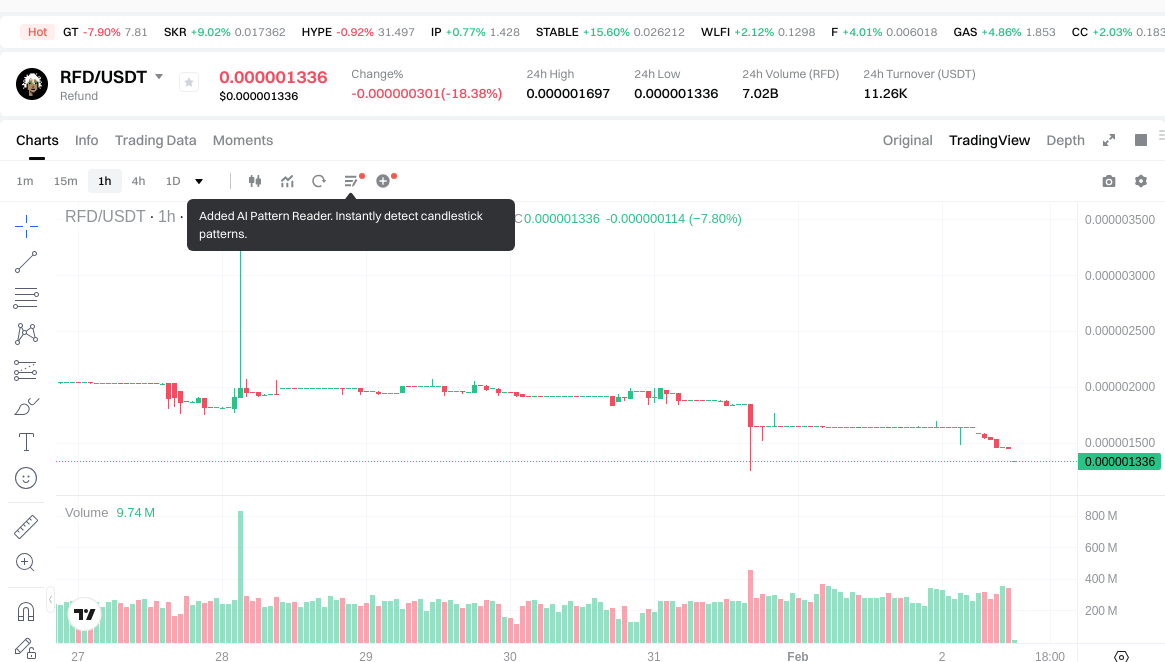
- RFD Current Price: $0.00000146
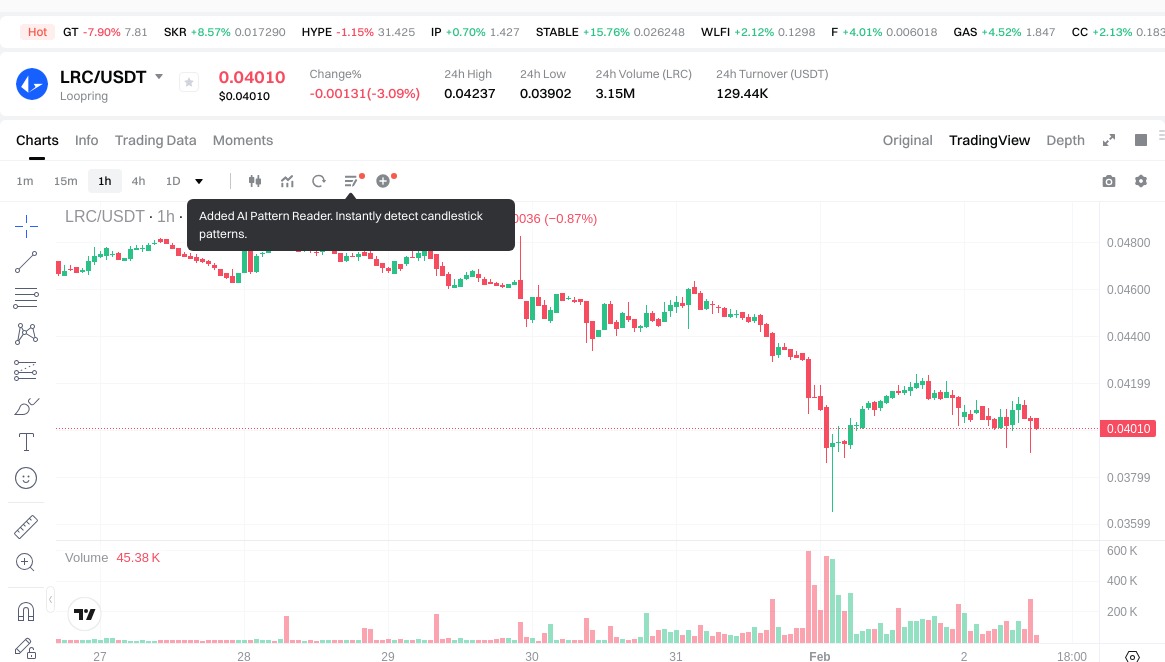
- LRC Current Price: $0.04034
- 24-Hour Trading Volume: RFD recorded $11,324.96 compared to LRC's $128,052.36
- Market Sentiment Index (Fear & Greed Index): 14 (Extreme Fear)
View Real-Time Prices:
- View RFD Current Price Market Price
- View LRC Current Price Market Price
II. Core Factors Influencing RFD vs LRC Investment Value
Supply Mechanism Comparison (Tokenomics)
The tokenomics structure of digital assets can influence their long-term value trajectory. Supply mechanisms, whether fixed, inflationary, or deflationary, interact with market demand to shape price dynamics over time.
- RFD: Information regarding RFD's supply mechanism is not available in the provided materials.
- LRC: Information regarding LRC's supply mechanism is not available in the provided materials.
Institutional Adoption and Market Application
Institutional participation and real-world use cases can affect the market positioning of digital assets. Cross-border payment solutions, settlement systems, and integration into investment portfolios represent potential areas of application.
- Institutional Holdings: Information on institutional preference between RFD and LRC is not available in the provided materials.
- Enterprise Adoption: Information on enterprise-level adoption of RFD or LRC in cross-border payments, settlement, or investment portfolios is not available in the provided materials.
- National Policies: Information on regulatory attitudes toward RFD and LRC across different jurisdictions is not available in the provided materials.
Technological Development and Ecosystem Building
Technological progress and ecosystem expansion may contribute to the utility and adoption of digital assets. Development activity in areas such as DeFi, NFTs, payment infrastructure, and smart contract deployment can influence market perception.
- RFD Technological Upgrades: Information on RFD's technological developments is not available in the provided materials.
- LRC Technological Development: Information on LRC's technological advancements is not available in the provided materials.
- Ecosystem Comparison: Information on DeFi, NFT, payment, and smart contract implementation for RFD and LRC is not available in the provided materials.
Macroeconomic Conditions and Market Cycles
Broader economic conditions, including inflation trends, monetary policy shifts, and geopolitical developments, can influence digital asset markets. Dollar liquidity conditions have been noted as a relevant factor in investment activity.
- Performance in Inflationary Environments: Information on the comparative performance of RFD and LRC under inflationary conditions is not available in the provided materials.
- Macroeconomic Monetary Policy: Reference materials indicate that dollar liquidity constraints can affect investment flows in digital assets. Interest rates and dollar index movements may influence market dynamics, though specific impacts on RFD and LRC are not detailed.
- Geopolitical Factors: Information on how cross-border transaction demand or international developments specifically affect RFD and LRC is not available in the provided materials.
III. 2026-2031 Price Forecast: RFD vs LRC
Short-term Forecast (2026)
- RFD: Conservative $0.00000112224 - $0.000001336 | Optimistic $0.000001336 - $0.00000181696
- LRC: Conservative $0.0277242 - $0.04018 | Optimistic $0.04018 - $0.0494214
Mid-term Forecast (2028-2029)
- RFD may enter a growth phase, with estimated price range of $0.000001647263952 - $0.000002739055176 in 2028, expanding to $0.000001908336134 - $0.000003327952038 in 2029
- LRC may enter a consolidation phase, with estimated price range of $0.02503911123 - $0.06306146532 in 2028, followed by $0.0399420192843 - $0.0705824724339 in 2029
- Key drivers: institutional capital inflows, ETF developments, ecosystem expansion
Long-term Forecast (2030-2031)
- RFD: Baseline scenario $0.000002233800534 - $0.000002827595613 (2030) | Optimistic scenario $0.000003071899874 - $0.000004497008063 (2031)
- LRC: Baseline scenario $0.040721709386767 - $0.06264878367195 (2030) | Optimistic scenario $0.05308857928361 - $0.083824072553069 (2031)
Disclaimer
RFD:
| Year | Predicted High Price | Predicted Average Price | Predicted Low Price | Price Change |
|---|---|---|---|---|
| 2026 | 0.00000181696 | 0.000001336 | 0.00000112224 | -8 |
| 2027 | 0.0000022543664 | 0.00000157648 | 0.0000011193008 | 7 |
| 2028 | 0.000002739055176 | 0.0000019154232 | 0.000001647263952 | 31 |
| 2029 | 0.000003327952038 | 0.000002327239188 | 0.000001908336134 | 59 |
| 2030 | 0.00000350621856 | 0.000002827595613 | 0.000002233800534 | 93 |
| 2031 | 0.000004497008063 | 0.000003166907087 | 0.000003071899874 | 116 |
LRC:
| Year | Predicted High Price | Predicted Average Price | Predicted Low Price | Price Change |
|---|---|---|---|---|
| 2026 | 0.0494214 | 0.04018 | 0.0277242 | 0 |
| 2027 | 0.047936749 | 0.0448007 | 0.037632588 | 11 |
| 2028 | 0.06306146532 | 0.0463687245 | 0.02503911123 | 14 |
| 2029 | 0.0705824724339 | 0.05471509491 | 0.0399420192843 | 35 |
| 2030 | 0.077058003916498 | 0.06264878367195 | 0.040721709386767 | 55 |
| 2031 | 0.083824072553069 | 0.069853393794224 | 0.05308857928361 | 73 |
IV. Investment Strategy Comparison: RFD vs LRC
Long-term vs Short-term Investment Strategies
-
RFD: May attract investors with higher risk tolerance seeking potential growth opportunities in emerging meme token segments. The asset's volatility patterns suggest suitability for speculative short-term positioning rather than long-term holding strategies.
-
LRC: May appeal to investors interested in decentralized exchange infrastructure and Layer 2 scaling solutions. The established protocol history since 2017 suggests potential consideration for mid-to-long-term portfolio allocation among those focusing on DeFi ecosystem development.
Risk Management and Asset Allocation
-
Conservative Investors: A potential allocation framework might consider RFD: 5-10% vs LRC: 15-25%, with the remainder in stablecoins and established digital assets to manage volatility exposure.
-
Aggressive Investors: A higher-risk allocation structure could explore RFD: 20-30% vs LRC: 30-40%, acknowledging increased exposure to price fluctuations and market sentiment shifts.
-
Hedging Tools: Stablecoin reserves for liquidity management, options instruments where available, and cross-asset diversification across multiple protocols can serve as risk mitigation mechanisms.
V. Potential Risk Comparison
Market Risk
-
RFD: The asset experienced substantial price correction from its peak of $0.0001436 to $0.00000146 as of February 2, 2026. Low trading volume of $11,324.96 in 24 hours indicates limited liquidity conditions. The current Fear & Greed Index at 14 (Extreme Fear) reflects challenging market sentiment.
-
LRC: Price declined from $3.75 in November 2021 to $0.04034 as of February 2, 2026, demonstrating sensitivity to broader market cycles. Trading volume of $128,052.36 indicates relatively more active market participation compared to RFD, though liquidity constraints remain a consideration during volatile periods.
Technical Risk
-
RFD: Limited information available regarding network architecture, scalability solutions, and ongoing development activity presents uncertainty regarding technical sustainability and upgrade pathways.
-
LRC: As a decentralized exchange protocol utilizing smart contracts, potential vulnerabilities include smart contract security considerations, network congestion during high-activity periods, and dependency on underlying blockchain infrastructure performance.
Regulatory Risk
Evolving regulatory frameworks across jurisdictions may affect both assets differently. Decentralized exchange protocols like LRC face ongoing scrutiny regarding compliance requirements, while meme tokens such as RFD may encounter classification challenges under securities regulations. Cross-border transaction protocols and custody-free trading mechanisms continue to attract regulatory attention, potentially impacting operational parameters and market access.
VI. Conclusion: Which Is the Better Buy?
📌 Investment Value Summary:
-
RFD Characteristics: Represents a higher-risk, higher-volatility asset with limited historical data since 2023. Price forecast models suggest potential growth scenarios ranging from conservative estimates of $0.00000112224 to optimistic projections of $0.000004497008063 by 2031, though these remain speculative given market uncertainties.
-
LRC Characteristics: Established protocol with operational history dating to 2017, focused on decentralized exchange infrastructure. Forecast models indicate potential price range from $0.0277242 (conservative 2026) to $0.083824072553069 (optimistic 2031), reflecting more moderate growth expectations compared to RFD's percentage projections.
✅ Investment Considerations:
-
Novice Investors: Consider prioritizing educational resources and understanding risk tolerance before allocation. If exploring these assets, starting with small positions in more established protocols like LRC while maintaining substantial stablecoin reserves may align with learning objectives.
-
Experienced Investors: May evaluate portfolio diversification strategies that balance higher-risk exposure in emerging tokens like RFD with more established infrastructure plays like LRC, adjusting allocations based on market cycle positioning and risk management frameworks.
-
Institutional Participants: Comprehensive due diligence regarding regulatory compliance, custody solutions, and liquidity infrastructure remains essential. LRC's decentralized exchange protocol may align with institutional interest in DeFi infrastructure, while RFD's meme token classification may present additional compliance considerations.
⚠️ Risk Disclosure: Cryptocurrency markets exhibit significant volatility and uncertainty. This analysis does not constitute investment advice, financial guidance, or recommendations to buy, sell, or hold any digital assets. Individuals should conduct independent research, assess personal risk tolerance, and consult qualified financial advisors before making investment decisions.
VII. FAQ
Q1: What are the main differences between RFD and LRC in terms of their market positioning?
RFD is a meme token launched in 2023 with higher volatility and speculative characteristics, while LRC is an established decentralized exchange protocol operational since 2017 focused on Layer 2 infrastructure. RFD represents a newer, community-driven asset with limited historical data and lower liquidity ($11,324.96 in 24-hour volume), whereas LRC has demonstrated longer market presence with relatively higher trading activity ($128,052.36 in 24-hour volume) and established use cases in decentralized exchange infrastructure.
Q2: Which asset shows better price stability based on historical performance?
LRC demonstrates relatively better price stability compared to RFD. While LRC experienced significant decline from its $3.75 peak in November 2021 to $0.04034 as of February 2026, this represents cyclical market movement within an established asset class. RFD, by contrast, showed more extreme volatility with a drop from $0.0001436 to $0.00000146 over a shorter timeframe, reflecting the higher risk profile typical of meme tokens with limited market history.
Q3: What is the projected long-term growth potential for RFD versus LRC through 2031?
According to forecast models, RFD shows higher percentage growth projections, with optimistic scenarios reaching $0.000004497008063 by 2031 from current levels, representing a potential 208% increase from 2026 baseline. LRC's projections indicate more moderate growth to $0.083824072553069 by 2031 under optimistic scenarios, representing approximately 108% increase from 2026 levels. However, percentage gains should be evaluated alongside absolute price levels and associated risk factors.
Q4: What allocation strategy should different investor types consider for RFD vs LRC?
Conservative investors might consider a cautious allocation of 5-10% RFD and 15-25% LRC within their cryptocurrency portfolio, maintaining majority positions in stablecoins and established assets. Aggressive investors with higher risk tolerance could explore 20-30% RFD and 30-40% LRC allocations, acknowledging increased volatility exposure. Both strategies should incorporate risk management tools including stablecoin reserves, diversification across multiple protocols, and regular portfolio rebalancing based on market conditions.
Q5: What are the primary regulatory risks affecting RFD and LRC?
Both assets face evolving regulatory frameworks across different jurisdictions. LRC, as a decentralized exchange protocol utilizing smart contracts, encounters scrutiny regarding compliance requirements for trading platforms and custody-free transaction mechanisms. RFD faces potential classification challenges under securities regulations common to meme tokens, along with questions regarding investor protection standards. Cross-border transaction protocols continue attracting regulatory attention, which may impact operational parameters, market access, and listing availability on centralized exchanges.
Q6: How does current market sentiment affect investment decisions between RFD and LRC?
The current Fear & Greed Index reading of 14 (Extreme Fear) as of February 2, 2026, indicates challenging market conditions affecting both assets. This environment historically correlates with compressed valuations and potential accumulation opportunities for long-term investors, though it also signals heightened risk of further downside volatility. RFD's lower liquidity makes it more susceptible to sentiment-driven price swings, while LRC's relatively higher trading volume may provide somewhat better price discovery during fearful market phases. Investors should consider whether current sentiment presents strategic entry points aligned with their risk tolerance and investment timeline.
Q7: What technological factors should investors evaluate when comparing RFD and LRC?
LRC's technological foundation as a decentralized exchange protocol built on ERC20 standards and smart contracts provides transparency regarding its infrastructure, though smart contract security and network congestion remain considerations. RFD presents greater technological uncertainty due to limited available information regarding network architecture, scalability solutions, and ongoing development activity. Investors should assess whether the technological maturity and documentation of LRC's Layer 2 solutions align better with their due diligence requirements compared to RFD's less transparent technical framework.
Share
Content
Introduction: RFD vs LRC Investment Comparison
I. Historical Price Comparison and Current Market Status
II. Core Factors Influencing RFD vs LRC Investment Value
III. 2026-2031 Price Forecast: RFD vs LRC
IV. Investment Strategy Comparison: RFD vs LRC
V. Potential Risk Comparison
VI. Conclusion: Which Is the Better Buy?
VII. FAQ
How to Buy Cryptocurrency


Trending Cryptocurrencies



2025 SUI coin: price, buying guide, and Staking rewards

How to Buy Crypto: A Step-by-Step Guide with Gate.com

HNT Price in 2025: Helium Network Token Value and Market Analysis
What is SwissCheese (SWCH) and How Does It Democratize Investment?

Cardano (ADA) Price Analysis and Outlook for 2025
How to Invest in Metaverse Crypto
MMT Surge Behind Market Mania to Longterm Test
What is Web3 Marketing: Everything You Need to Know

Satoshi Nakamoto Bitcoin Founder Technology and Mystery

A Complete Guide to the 1inch Swap

Free Money for App Registration: Crypto Platform Welcome Bonuses