RTF vs RUNE: A Comprehensive Comparison of Two Distinct Digital Asset Ecosystems


Introduction: RTF vs RUNE Investment Comparison
In the cryptocurrency market, the comparison between RTF vs RUNE has always been a topic that investors cannot avoid. The two not only have significant differences in market cap ranking, application scenarios and price performance, but also represent different crypto asset positioning.
RTF (Ready to Fight): Launched in 2024, it has gained market recognition by leveraging blockchain technology and SocialFi principles to transform the professional fighting industry, creating a unified ecosystem for fighters, coaches, fans, and promoters.
RUNE (THORChain): Since 2019, it has been recognized as a multi-chain protocol, ranking among the top cryptocurrencies globally with its cross-chain liquidity solutions and decentralized exchange capabilities.
This article will comprehensively analyze the investment value comparison of RTF vs RUNE around historical price trends, supply mechanisms, institutional adoption, technical ecosystems and future predictions, and attempt to answer the question that investors are most concerned about:
"Which is the better buy right now?"
I. Historical Price Comparison and Current Market Status
RTF (Coin A) and RUNE (Coin B) Historical Price Trends
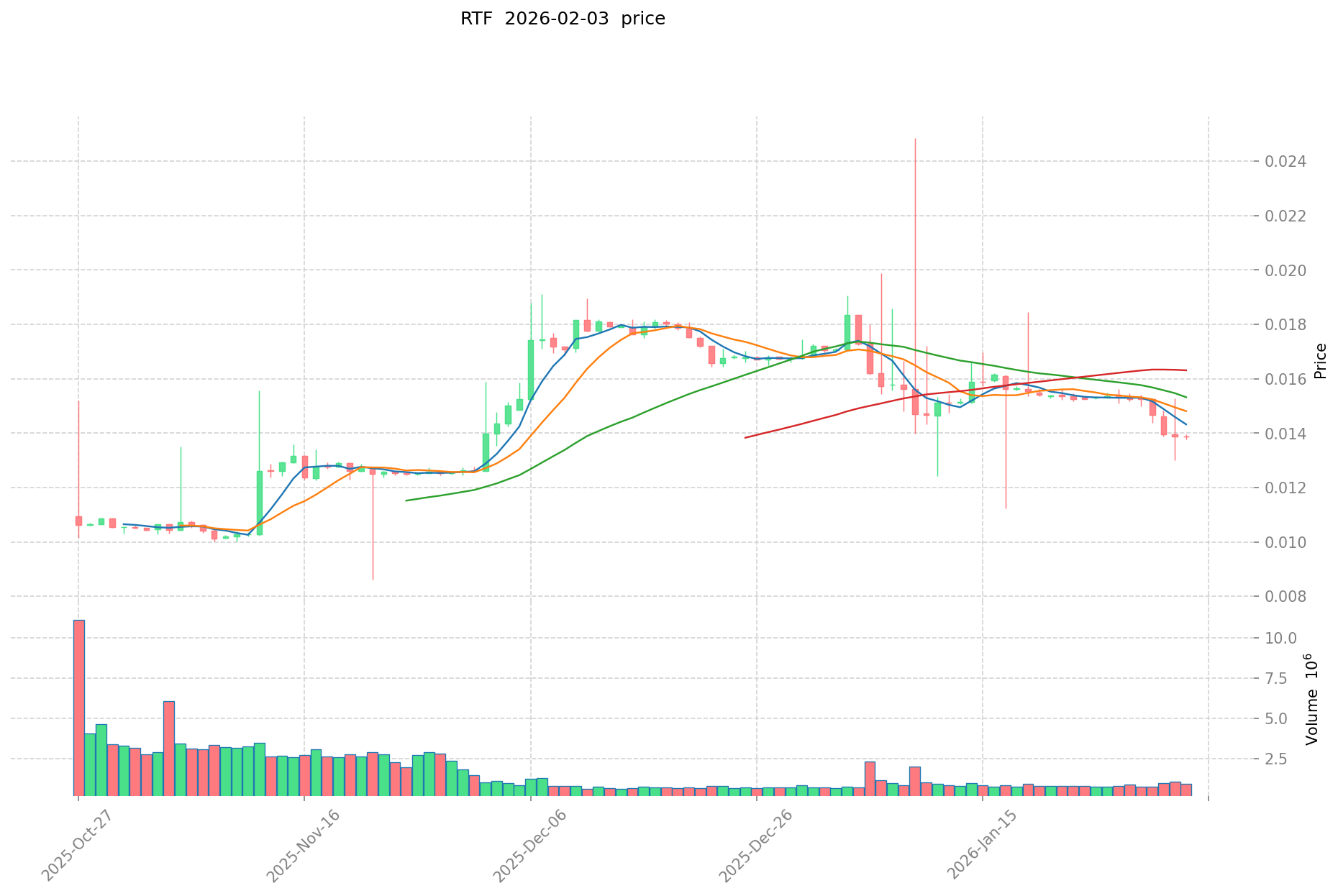
- 2024: RTF experienced significant price movement following its launch in April 2024, with the token reaching a peak of $0.356 on April 24, 2024. Following this early-stage appreciation, the token entered a prolonged correction phase.
- 2021: RUNE saw a notable surge driven by increased adoption of cross-chain liquidity protocols, with the price reaching an all-time high of $20.87 on May 19, 2021. Subsequently, the token underwent substantial depreciation amid broader market corrections.
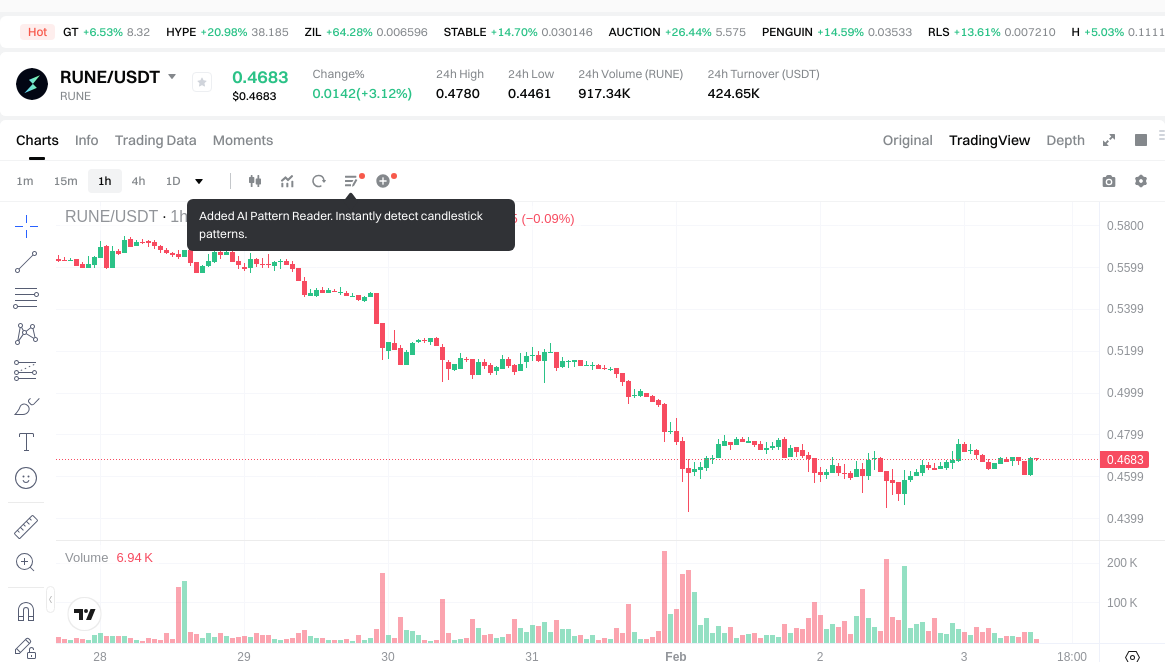
- Comparative analysis: During the 2024-2025 market cycle, RTF declined from its peak of $0.356 to a low of $0.00861 recorded on November 22, 2025, representing a correction exceeding 97%. Meanwhile, RUNE experienced a decline from its 2021 peak of $20.87 to approximately $0.4691 as of February 3, 2026, reflecting a drawdown of approximately 97.7% from its historical high.
Current Market Status (2026-02-03)
- RTF current price: $0.01383
- RUNE current price: $0.4691
- 24-hour trading volume: RTF recorded $13,097.67 compared to RUNE's $426,363.98
- Market sentiment index (Fear & Greed Index): 17 (Extreme Fear)
View real-time prices:
- Check RTF current price Market Price
- Check RUNE current price Market Price
II. Core Factors Influencing RTF vs RUNE Investment Value
Tokenomics Comparison
- RTF: The supply mechanism remains subject to blockchain infrastructure and SocialFi ecosystem dynamics, with token distribution potentially influenced by platform engagement metrics and community governance structures.
- RUNE: Token economics may incorporate airdrop mechanisms and Web3 value distribution models, though specific supply parameters require further verification.
- 📌 Historical Pattern: Supply mechanisms have historically influenced price cycles through scarcity dynamics and distribution schedules, though each project's unique structure creates distinct market behaviors.
Institutional Adoption and Market Application
- Institutional Holdings: Current institutional preference data between RTF and RUNE requires comprehensive analysis across multiple market indicators.
- Enterprise Adoption: Both tokens operate within evolving application scenarios spanning blockchain ecosystems, though specific deployment in cross-border payments, settlement systems, or institutional portfolios varies by use case.
- Regulatory Landscape: Jurisdictional approaches toward both assets continue to develop as regulatory frameworks mature globally.
Technical Development and Ecosystem Building
- RTF Technical Evolution: Development trajectory centers on blockchain infrastructure advancement and SocialFi integration, with ecosystem growth potentially tied to social engagement protocols.
- RUNE Technical Progress: Technical roadmap appears connected to Web3 value frameworks and token distribution systems, though detailed upgrade schedules require project-specific documentation.
- Ecosystem Comparison: Both projects occupy distinct positions within the broader crypto landscape, with varying degrees of integration across DeFi protocols, NFT platforms, payment systems, and smart contract infrastructure.
Macroeconomic Environment and Market Cycles
- Performance During Inflation: Each asset's inflation-hedging characteristics depend on adoption rates, liquidity depth, and correlation with traditional financial markets.
- Monetary Policy Impact: Interest rate fluctuations, dollar index movements, and central bank policies create varying effects on crypto assets based on their market positioning and use cases.
- Geopolitical Factors: Cross-border transaction demand and international developments influence crypto adoption patterns, though specific impacts vary by token utility and geographic distribution.
III. 2026-2031 Price Forecast: RTF vs RUNE
Short-term Forecast (2026)
- RTF: Conservative $0.0105-$0.0138 | Optimistic $0.0138-$0.0191
- RUNE: Conservative $0.342-$0.468 | Optimistic $0.468-$0.487
Mid-term Forecast (2028-2029)
- RTF may enter a consolidation phase, with estimated price range of $0.0128-$0.0243 in 2028, potentially adjusting to $0.0179-$0.0216 by 2029
- RUNE may enter a growth phase, with estimated price range of $0.466-$0.663 in 2028, potentially expanding to $0.357-$0.713 by 2029
- Key drivers: institutional capital flows, ETF developments, ecosystem expansion
Long-term Forecast (2031)
- RTF: Baseline scenario $0.0199-$0.0255 | Optimistic scenario $0.0255-$0.0283
- RUNE: Baseline scenario $0.704-$0.792 | Optimistic scenario $0.792-$1.077
Disclaimer: Price predictions are based on historical data analysis and market trends. Cryptocurrency markets are highly volatile and subject to various risks. This information should not be considered as investment advice.
RTF:
| Year | Predicted High Price | Predicted Average Price | Predicted Low Price | Price Change |
|---|---|---|---|---|
| 2026 | 0.0190854 | 0.01383 | 0.0105108 | 0 |
| 2027 | 0.017116008 | 0.0164577 | 0.015305661 | 19 |
| 2028 | 0.0243409383 | 0.016786854 | 0.01275800904 | 21 |
| 2029 | 0.0215920909575 | 0.02056389615 | 0.0178905896505 | 48 |
| 2030 | 0.029930750846325 | 0.02107799355375 | 0.014543815552087 | 52 |
| 2031 | 0.028309853142041 | 0.025504372200037 | 0.019893410316029 | 84 |
RUNE:
| Year | Predicted High Price | Predicted Average Price | Predicted Low Price | Price Change |
|---|---|---|---|---|
| 2026 | 0.486824 | 0.4681 | 0.341713 | 0 |
| 2027 | 0.53475744 | 0.477462 | 0.3580965 | 1 |
| 2028 | 0.6630037332 | 0.50610972 | 0.4656209424 | 7 |
| 2029 | 0.713159206452 | 0.5845567266 | 0.356579603226 | 24 |
| 2030 | 0.93435547179744 | 0.648857966526 | 0.5190863732208 | 38 |
| 2031 | 1.076585138059939 | 0.79160671916172 | 0.70452998005393 | 68 |
IV. Investment Strategy Comparison: RTF vs RUNE
Long-term vs Short-term Investment Strategies
- RTF: May appeal to investors focused on emerging SocialFi ecosystems and early-stage blockchain infrastructure projects, with consideration for higher volatility and developmental stage positioning
- RUNE: May appeal to investors seeking exposure to cross-chain liquidity protocols and established multi-chain infrastructure, with consideration for mature ecosystem dynamics
Risk Management and Asset Allocation
- Conservative investors: RTF 20-30% vs RUNE 70-80% (weighted toward established protocol infrastructure)
- Aggressive investors: RTF 40-50% vs RUNE 50-60% (balanced exposure to emerging and established ecosystems)
- Hedging instruments: stablecoin allocation, options strategies, cross-asset portfolio diversification
V. Potential Risk Comparison
Market Risk
- RTF: Market risk factors include early-stage adoption uncertainties, limited trading volume ($13,097.67 as of February 3, 2026), and substantial price corrections exceeding 97% from peak levels
- RUNE: Market risk factors include historical volatility patterns, drawdown of approximately 97.7% from all-time highs, and correlation with broader cross-chain protocol adoption trends
Technical Risk
- RTF: Scalability considerations, network stability during ecosystem expansion phases, and infrastructure maturation requirements
- RUNE: Cross-chain protocol complexity, network security considerations, and multi-chain coordination challenges
Regulatory Risk
- Global regulatory frameworks continue evolving, with varying approaches toward SocialFi platforms and cross-chain liquidity protocols across jurisdictions. Compliance requirements and policy developments may create distinct impacts based on each token's use case classification and geographic distribution.
VI. Conclusion: Which Is the Better Buy?
📌 Investment Value Summary:
- RTF advantages: Early-stage positioning in SocialFi sector integration, blockchain infrastructure development trajectory, potential ecosystem expansion opportunities
- RUNE advantages: Established cross-chain protocol infrastructure, mature liquidity ecosystem, historical recognition as multi-chain solution provider
✅ Investment Recommendations:
- Novice investors: Consider prioritizing established protocols with demonstrated ecosystem adoption while maintaining diversified exposure across asset classes. Thorough research into tokenomics, use cases, and market dynamics recommended before allocation decisions.
- Experienced investors: Portfolio construction may incorporate strategic allocation across both emerging infrastructure projects and established protocols, with risk-adjusted positioning based on individual risk tolerance and market cycle analysis.
- Institutional investors: Comprehensive due diligence frameworks incorporating liquidity analysis, custody considerations, regulatory compliance requirements, and long-term ecosystem viability assessments recommended for allocation decisions.
⚠️ Risk Disclosure: Cryptocurrency markets exhibit extreme volatility characteristics. This analysis does not constitute investment advice. Market participants should conduct independent research and consult qualified financial advisors before making investment decisions.
VII. FAQ
Q1: What are the main differences between RTF and RUNE in terms of use cases?
RTF focuses on SocialFi integration within the professional fighting industry ecosystem, while RUNE operates as a cross-chain liquidity protocol. RTF, launched in 2024, aims to create a unified platform connecting fighters, coaches, fans, and promoters through blockchain technology. RUNE, established in 2019, provides decentralized cross-chain exchange capabilities and liquidity solutions across multiple blockchain networks. The fundamental distinction lies in RTF's social engagement and industry-specific application versus RUNE's infrastructure-level cross-chain functionality.
Q2: How do the historical price performances of RTF and RUNE compare?
Both tokens have experienced significant corrections from their peak values. RTF declined approximately 97% from its April 2024 peak of $0.356 to a low of $0.00861 in November 2025, while RUNE dropped approximately 97.7% from its May 2021 all-time high of $20.87 to around $0.4691 as of February 2026. Despite similar percentage declines, RUNE's drawdown occurred over a longer timeframe (2021-2026) compared to RTF's more compressed correction period (2024-2025), reflecting different market cycle positions and maturity stages.
Q3: What are the key risk factors investors should consider when comparing RTF and RUNE?
RTF faces early-stage adoption uncertainties, limited trading volume ($13,097.67 as of February 3, 2026), and infrastructure maturation challenges typical of newer blockchain projects. RUNE encounters cross-chain protocol complexity, multi-chain coordination requirements, and historical volatility patterns associated with established DeFi infrastructure. Both tokens are subject to evolving regulatory frameworks that may impact SocialFi platforms and cross-chain liquidity protocols differently across jurisdictions. Market participants should evaluate liquidity depth, ecosystem development trajectories, and technical infrastructure stability when assessing risk profiles.
Q4: How do the 2026-2031 price forecasts differ between RTF and RUNE?
Price projections suggest divergent trajectories: RTF's conservative 2026 forecast ranges from $0.0105-$0.0138, potentially reaching $0.0199-$0.0255 by 2031, indicating modest growth expectations. RUNE's conservative 2026 forecast spans $0.342-$0.468, with projections extending to $0.704-$0.792 by 2031, reflecting stronger anticipated appreciation. The baseline scenarios suggest RUNE may experience approximately 68% growth from current levels by 2031, while RTF projects approximately 84% growth over the same period. These forecasts incorporate institutional adoption patterns, ecosystem expansion dynamics, and market cycle considerations, though cryptocurrency volatility introduces substantial uncertainty.
Q5: What portfolio allocation strategies are recommended for RTF versus RUNE?
Conservative investors may consider 20-30% RTF allocation versus 70-80% RUNE weighting, emphasizing established protocol infrastructure. Aggressive investors might pursue 40-50% RTF versus 50-60% RUNE allocation, balancing exposure between emerging ecosystems and mature protocols. Allocation decisions should incorporate individual risk tolerance, investment timeframes, and portfolio diversification objectives. Complementary hedging strategies may include stablecoin reserves, options instruments, and cross-asset diversification. Market participants should conduct independent due diligence and consider consulting qualified financial advisors before implementing allocation strategies.
Q6: How does institutional adoption differ between RTF and RUNE?
Institutional preference data requires comprehensive analysis across multiple market indicators for both tokens. RUNE's longer operational history since 2019 and established position in cross-chain liquidity infrastructure may provide more extensive institutional evaluation frameworks. RTF's recent 2024 launch positions it in early-stage institutional consideration phases, with adoption potentially tied to SocialFi sector development and blockchain infrastructure maturation. Enterprise deployment scenarios vary by use case, with RUNE's cross-chain capabilities potentially facilitating institutional DeFi integration, while RTF's industry-specific application targets professional fighting ecosystem participants. Regulatory clarity and custody solution availability influence institutional allocation decisions for both assets.
Q7: What technical development factors should investors monitor for RTF and RUNE?
For RTF, key monitoring areas include blockchain infrastructure advancement, SocialFi protocol integration, ecosystem growth metrics tied to social engagement, and platform scalability during expansion phases. For RUNE, critical technical factors encompass cross-chain protocol upgrades, network security enhancements, multi-chain coordination improvements, and liquidity mechanism developments. Both projects require assessment of smart contract audit results, development team activity, ecosystem partnership announcements, and integration progress across DeFi protocols, NFT platforms, and payment systems. Technical roadmap execution, upgrade implementation success, and community governance participation serve as indicators of long-term ecosystem viability.
Q8: How do macroeconomic factors affect RTF and RUNE differently?
Macroeconomic impacts vary based on each token's market positioning and use cases. Inflation-hedging characteristics depend on adoption rates, liquidity depth, and correlation with traditional financial markets. Interest rate fluctuations and monetary policy shifts create distinct effects based on whether tokens function as infrastructure protocols (RUNE) or application-layer solutions (RTF). Dollar index movements may influence cross-border transaction demand differently for cross-chain liquidity protocols versus SocialFi platforms. Geopolitical developments affecting international crypto adoption patterns impact tokens variably based on geographic user distribution, regulatory jurisdiction exposure, and use case relevance during economic uncertainty periods.
Share
Content
Introduction: RTF vs RUNE Investment Comparison
I. Historical Price Comparison and Current Market Status
II. Core Factors Influencing RTF vs RUNE Investment Value
III. 2026-2031 Price Forecast: RTF vs RUNE
IV. Investment Strategy Comparison: RTF vs RUNE
V. Potential Risk Comparison
VI. Conclusion: Which Is the Better Buy?
VII. FAQ
How to Buy Cryptocurrency


Trending Cryptocurrencies



How to Make Money on TikTok: 10 Real Ways to Earn in 2025

How does SocialFi empower creators: monetization, tokens, and community governance
What is SocialFi? Explore the future of decentralized social media in the field of crypto assets

Top 5 SocialFi projects to watch in 2025: the intersection of crypto assets and social interaction

What Is the Correlation Between Bitcoin's Social Media Followers and Its Environmental Impact?
DDD Token: Challenging medical insurance injustice with blockchain technology

5 Easy Ways to Acquire NFTs for Free

Free Money for App Registration: Crypto Platform Bonuses

Top cryptocurrency exchanges that don't require verification: the leading choices right now

What Is CoinList? Key Facts You Need to Know About the CoinList Exchange

Gate Ventures Weekly Crypto Recap (February 2, 2026)