This article provides a comprehensive analysis comparing SCF and DOGE, two prominent meme cryptocurrencies with distinct market positioning. It examines historical price trends, current market status with real-time data from Gate, and core factors influencing investment value including supply mechanisms, institutional adoption, and technical development. The article offers price projections through 2031, presents tailored investment strategies for conservative and aggressive investors, and conducts detailed risk assessments across market, technical, and regulatory dimensions. Designed for both new and experienced crypto investors, it addresses critical questions about which asset offers better investment potential by evaluating liquidity, volatility profiles, and long-term growth scenarios. Comprehensive FAQ section clarifies key differences in market maturity, price volatility, and regulatory implications.
Introduction: Investment Comparison Between SCF and DOGE
In the cryptocurrency market, the comparison between SCF vs DOGE has consistently been a topic that investors cannot overlook. The two differ notably in market cap ranking, application scenarios, and price performance, while representing distinct crypto asset positioning.
SCF (Smoking Chicken Fish): Launched in 2021, this meme token operates on the Solana blockchain and positions itself as a community-driven cultural phenomenon.
DOGE (DogeCoin): Since its inception in 2013, it has been recognized as one of the most widely adopted cryptocurrencies globally, with significant transaction volume and market capitalization among meme-based digital assets.
This article will provide a comprehensive analysis of SCF vs DOGE investment value comparison, focusing on historical price trends, supply mechanisms, institutional adoption, technical ecosystems, and future projections, attempting to address the question most investors care about:
"Which is the better buy right now?"
I. Historical Price Comparison and Current Market Status
SCF (Coin A) and DOGE (Coin B) Historical Price Trends
- 2024: SCF reached a peak price of $0.5 in October 2024, reflecting early-stage market activity following its launch in July 2021.
- 2021: DOGE experienced notable price movements driven by social media attention and support from public figures, with its all-time high of $0.731578 recorded in May 2021.
- Comparative Analysis: During the market cycle from 2024 to early 2026, SCF declined from its high of $0.5 to a low of $0.0006261, while DOGE fell from its all-time high of $0.731578 to approximately $0.10267 during the same period.
Current Market Status (2026-02-05)
- SCF Current Price: $0.0006262
- DOGE Current Price: $0.10267
- 24-Hour Trading Volume: SCF recorded $120,771.42, while DOGE registered $29,397,301.27
- Market Sentiment Index (Fear & Greed Index): 14 (Extreme Fear)
View real-time prices:
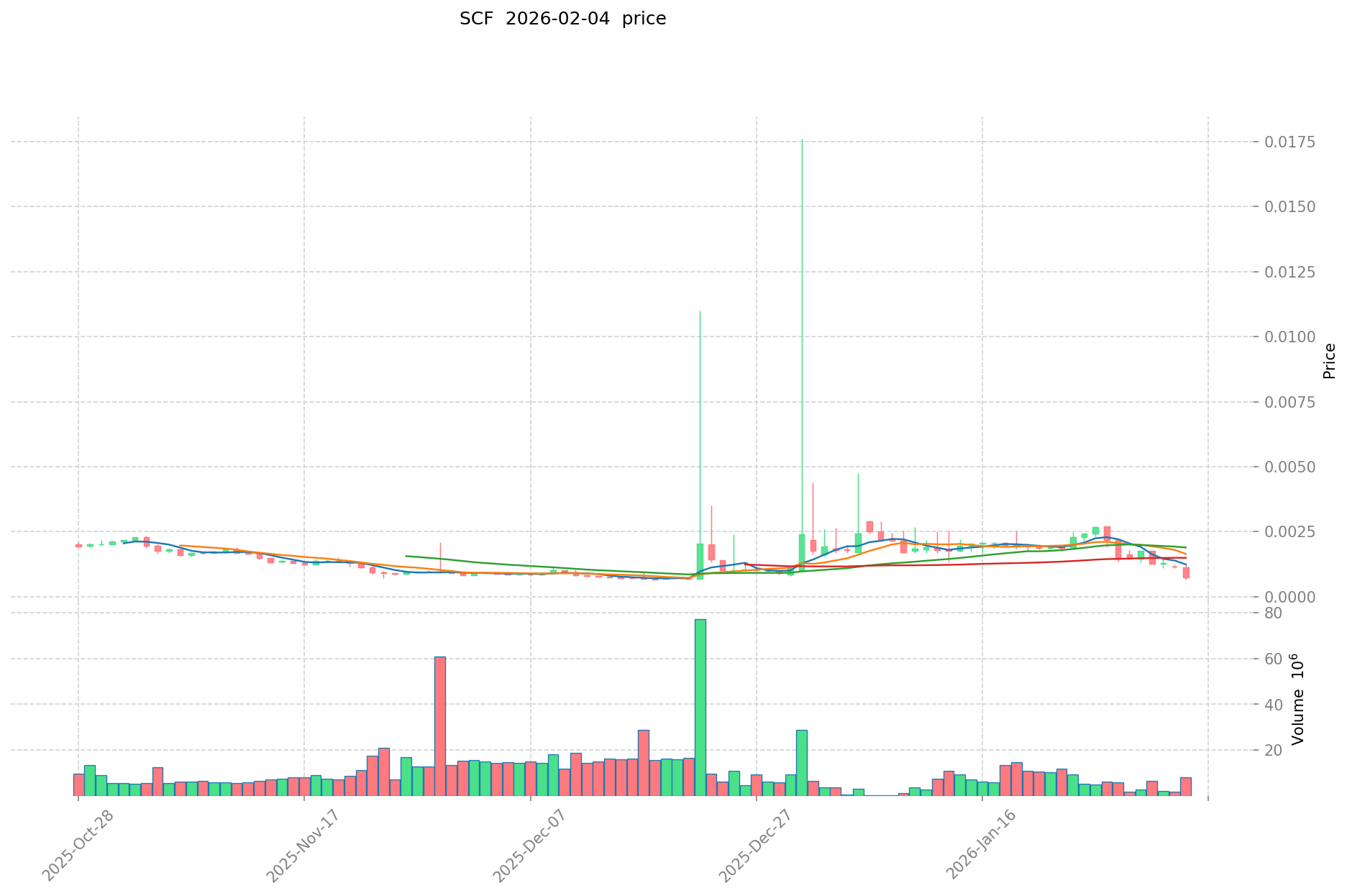
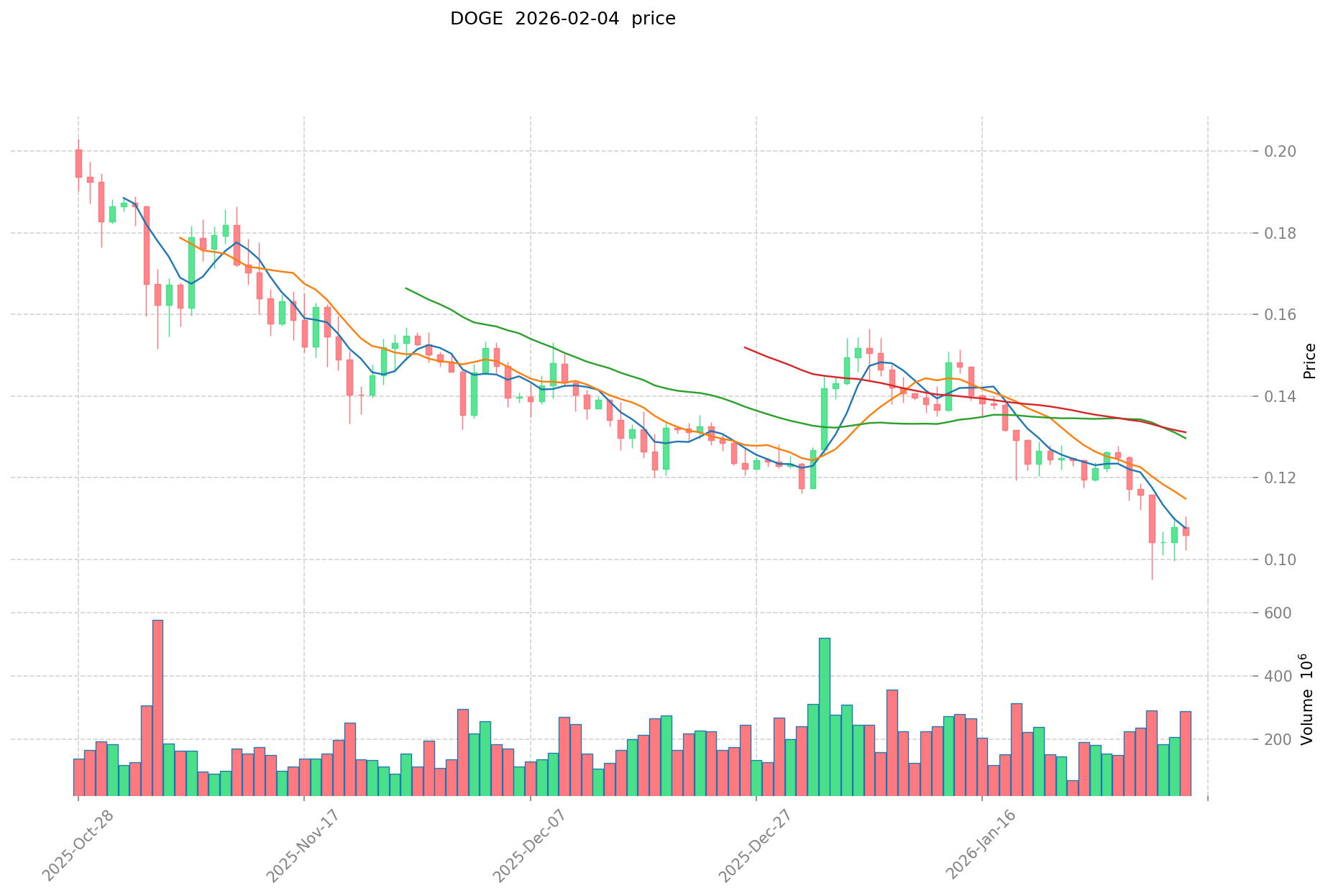
II. Core Factors Influencing SCF vs DOGE Investment Value
Supply Mechanism Comparison (Tokenomics)
- SCF: The supply mechanism information is not detailed in available materials, though the asset positions itself as a community-driven experimental token where volatility and collective narrative serve as primary value drivers.
- DOGE: Specific supply mechanism details are not covered in the provided materials.
- 📌 Historical Pattern: Supply mechanisms have historically influenced price cycles through scarcity dynamics and inflationary or deflationary pressures, though specific historical data for these assets requires further research.
Institutional Adoption and Market Application
- Institutional Holdings: Materials suggest that investors should focus attention on top 10 or top 20 tokens, with emphasis on projects that consistently enhance network adoption rates, as these tend to have higher investment value.
- Enterprise Adoption: Specific enterprise adoption cases for SCF and DOGE in cross-border payments, settlements, or investment portfolios are not detailed in available materials.
- National Policies: Regulatory attitudes toward these assets across different jurisdictions are not specified in the provided materials.
Technical Development and Ecosystem Building
- SCF Technical Development: SCF v7.0 appears to optimize funding allocation methods to encourage execution, speed, and delivery, with a phased payment structure: 10% upon initial funding grant, 20% at mid-term development milestones, 30% at advanced product readiness stage (testnet), and 40% at mainnet deployment.
- DOGE Technical Development: Technical development specifics are not covered in available materials.
- Ecosystem Comparison: Detailed comparisons of DeFi, NFT, payment solutions, and smart contract implementations between SCF and DOGE are not provided in the materials.
Macroeconomic Environment and Market Cycles
- Performance in Inflationary Environments: Materials indicate that exchange rates fluctuate based on global market supply and demand, with key drivers including interest rates and inflation. Low inflation environments tend to support currency value preservation, though specific anti-inflation characteristics of SCF versus DOGE are not detailed.
- Macroeconomic Monetary Policy: Interest rate adjustments and currency index movements can influence investment behavior, though specific impacts on SCF and DOGE require additional analysis.
- Geopolitical Factors: Cross-border transaction demand and international circumstances may influence adoption, though specific geopolitical impacts on these assets are not covered in available materials.
III. 2026-2031 Price Prediction: SCF vs DOGE
Short-term Prediction (2026)
- SCF: Conservative $0.000387 - $0.0006242 | Optimistic $0.000643
- DOGE: Conservative $0.0902 - $0.10253 | Optimistic $0.1394
Medium-term Prediction (2028-2029)
- SCF may enter a gradual growth phase, with estimated price range of $0.000565 - $0.001195
- DOGE may enter an expansion phase, with estimated price range of $0.1096 - $0.2347
- Key drivers: institutional capital inflows, ETF developments, ecosystem expansion
Long-term Prediction (2030-2031)
- SCF: Baseline scenario $0.000509 - $0.001038 | Optimistic scenario $0.001078 - $0.001173
- DOGE: Baseline scenario $0.1583 - $0.2517 | Optimistic scenario $0.3004 - $0.3750
View detailed price predictions for SCF and DOGE
Disclaimer
SCF:
| Year |
Predicted High Price |
Predicted Average Price |
Predicted Low Price |
Price Change |
| 2026 |
0.000642926 |
0.0006242 |
0.000387004 |
0 |
| 2027 |
0.00066524115 |
0.000633563 |
0.00034212402 |
1 |
| 2028 |
0.00095462105025 |
0.000649402075 |
0.00056497980525 |
3 |
| 2029 |
0.001194997228311 |
0.000802011562625 |
0.000593488556342 |
28 |
| 2030 |
0.001078384747105 |
0.000998504395468 |
0.000509237241688 |
59 |
| 2031 |
0.001173442365554 |
0.001038444571286 |
0.000674988971336 |
65 |
DOGE:
| Year |
Predicted High Price |
Predicted Average Price |
Predicted Low Price |
Price Change |
| 2026 |
0.1394408 |
0.10253 |
0.0902264 |
0 |
| 2027 |
0.171799268 |
0.1209854 |
0.076220802 |
17 |
| 2028 |
0.19616572756 |
0.146392334 |
0.12150563722 |
41 |
| 2029 |
0.2346522721686 |
0.17127903078 |
0.1096185796992 |
65 |
| 2030 |
0.300389164181964 |
0.2029656514743 |
0.158313208149954 |
96 |
| 2031 |
0.374999337663916 |
0.251677407828132 |
0.193791604027661 |
143 |
IV. Investment Strategy Comparison: SCF vs DOGE
Long-term vs Short-term Investment Strategies
-
SCF: May suit investors with higher risk tolerance who are interested in community-driven experimental tokens and willing to accept substantial volatility. The asset's relatively limited liquidity and market capitalization suggest it may be more appropriate for speculative short-term positions rather than core long-term holdings.
-
DOGE: May appeal to investors seeking exposure to established meme-based digital assets with broader market recognition and liquidity. The asset's longer operational history since 2013 and higher trading volume could make it suitable for both medium-term holding strategies and diversified portfolio allocation.
Risk Management and Asset Allocation
-
Conservative Investors: A balanced approach might consider DOGE at a higher allocation percentage within the crypto portion of a diversified portfolio, while maintaining minimal or zero exposure to SCF given its lower liquidity and higher volatility profile.
-
Aggressive Investors: Those with higher risk appetite might explore modest SCF allocation as a speculative position alongside DOGE, though position sizing should reflect the substantially different risk profiles and liquidity characteristics of each asset.
-
Hedging Tools: Investors may consider stablecoin reserves for portfolio stability, options strategies where available, and cross-asset diversification to manage exposure to individual token volatility.
V. Potential Risk Comparison
Market Risk
-
SCF: Exhibits significant price volatility, with substantial decline from $0.5 peak to current levels around $0.0006262. Limited trading volume of $120,771.42 may result in liquidity challenges and increased slippage during market stress periods.
-
DOGE: While experiencing notable price fluctuations from all-time high of $0.731578 to current price of $0.10267, the asset demonstrates considerably higher liquidity with 24-hour trading volume of $29,397,301.27, potentially offering better price stability during market movements.
Technical Risk
-
SCF: Technical development details remain limited in available materials. The asset operates on Solana blockchain, though specific network stability metrics and scalability performance data require further assessment.
-
DOGE: Specific technical infrastructure details, including network security measures and scalability capabilities, are not extensively covered in provided materials and warrant independent research.
Regulatory Risk
- Global regulatory frameworks continue evolving for crypto assets, with potential differential impacts on established tokens versus newer community-driven projects. Regulatory clarity may favor assets with longer operational histories and broader institutional recognition, though specific jurisdictional attitudes toward SCF and DOGE require monitoring as policy landscapes develop.
VI. Conclusion: Which Is the Better Buy?
📌 Investment Value Summary:
-
SCF Characteristics: Community-driven positioning, operates on Solana blockchain, demonstrates experimental token attributes with significant price volatility and limited current liquidity.
-
DOGE Characteristics: Longer operational history since 2013, substantially higher trading volume and market recognition, broader liquidity profile, established presence among meme-based digital assets.
✅ Investment Considerations:
-
New Investors: May benefit from focusing on assets with higher liquidity, longer operational track records, and more accessible market information. Thorough research into fundamental characteristics, risk profiles, and personal risk tolerance remains essential before any allocation decision.
-
Experienced Investors: Should evaluate both assets within broader portfolio context, considering correlation with existing holdings, liquidity requirements, and specific investment timeframes. Position sizing should reflect individual risk management frameworks and market outlook.
-
Institutional Investors: May prioritize assets demonstrating consistent network adoption rates, regulatory clarity, and sufficient liquidity depth for larger allocations. Comprehensive due diligence on technical infrastructure, governance mechanisms, and ecosystem development trajectories is recommended.
⚠️ Risk Disclaimer: Cryptocurrency markets exhibit extreme volatility. This content does not constitute investment advice. All investment decisions should be based on independent research, professional consultation, and individual risk assessment.
VII. FAQ
Q1: What are the main differences between SCF and DOGE in terms of market maturity?
DOGE demonstrates significantly higher market maturity with a 13-year operational history since 2013, while SCF launched in 2021 and remains in an earlier development stage. DOGE has established broader market recognition, substantially higher 24-hour trading volume ($29,397,301.27 vs SCF's $120,771.42), and greater liquidity depth. SCF operates as a community-driven experimental token on the Solana blockchain with limited historical performance data, whereas DOGE has navigated multiple market cycles and maintains a more established position among meme-based digital assets.
Q2: Which asset presents higher volatility risk for investors?
SCF presents considerably higher volatility risk based on available data. The asset declined from a peak of $0.5 in October 2024 to approximately $0.0006262, representing a substantial price contraction. Combined with limited trading volume and lower liquidity, SCF exhibits characteristics typical of higher-risk speculative tokens. While DOGE also experienced significant decline from its all-time high of $0.731578 to current levels around $0.10267, its higher trading volume and broader market adoption may provide relatively more price stability during market fluctuations.
Q3: What are the projected price ranges for SCF and DOGE through 2031?
For SCF, conservative projections estimate a range of $0.000387-$0.0006242 in 2026, gradually expanding to $0.000509-$0.001038 by 2030-2031 under baseline scenarios. Optimistic projections suggest potential upside to $0.001173 by 2031. For DOGE, conservative estimates indicate $0.0902-$0.10253 in 2026, potentially reaching $0.1583-$0.2517 by 2030-2031 in baseline scenarios, with optimistic projections extending to $0.3750 by 2031. These projections assume varying degrees of institutional adoption, ecosystem expansion, and favorable macroeconomic conditions.
Q4: How do the supply mechanisms of SCF and DOGE differ?
Detailed supply mechanism information for both assets remains limited in available materials. SCF positions itself as a community-driven experimental token where collective narrative and volatility serve as primary value drivers, though specific tokenomics parameters are not extensively documented. DOGE's supply mechanism details are similarly not comprehensively covered in the provided materials. Investors evaluating these assets should conduct independent research into inflation rates, token distribution structures, and long-term supply dynamics as these factors historically influence price cycles through scarcity dynamics and inflationary or deflationary pressures.
Q5: What investment strategy is most appropriate for SCF versus DOGE?
Investment strategy selection depends significantly on individual risk tolerance and portfolio objectives. SCF may suit investors with higher risk appetite seeking exposure to community-driven experimental tokens, potentially as speculative short-term positions rather than core holdings due to limited liquidity. DOGE may appeal to investors seeking established meme-based assets with broader recognition and liquidity, suitable for medium-term holding strategies or diversified portfolio allocation. Conservative investors might consider higher DOGE allocation percentages while minimizing or avoiding SCF exposure, whereas aggressive investors could explore modest SCF positions alongside DOGE, with position sizing reflecting substantially different risk profiles.
Q6: What regulatory risks should investors consider for these assets?
Regulatory frameworks for crypto assets continue evolving globally, with potential differential impacts on established tokens versus newer community-driven projects. Assets with longer operational histories and broader institutional recognition, such as DOGE, may benefit from greater regulatory clarity as policy landscapes develop. SCF, as a newer experimental token, faces uncertainty regarding how evolving regulations might affect community-driven projects with limited institutional adoption. Investors should monitor jurisdictional attitudes toward both assets, assess compliance with emerging regulatory standards, and consider how regulatory developments might impact market access, liquidity, and long-term viability.
Q7: How do technical development trajectories compare between SCF and DOGE?
SCF technical development appears focused on optimizing funding allocation methods through phased payment structures (10% initial funding, 20% at mid-term milestones, 30% at testnet readiness, 40% at mainnet deployment), designed to encourage execution speed and delivery. The asset operates on Solana blockchain infrastructure. DOGE technical development specifics are not extensively covered in available materials. Comprehensive comparisons of DeFi integration, NFT capabilities, payment solutions, and smart contract implementations between the two assets require additional research. Investors evaluating technical trajectories should assess network stability metrics, scalability performance, and ecosystem building initiatives independently.
Q8: What macroeconomic factors might influence SCF and DOGE performance differently?
Both assets may respond to macroeconomic conditions including interest rate adjustments, inflation dynamics, and currency index movements, though specific sensitivities require further analysis. Exchange rates fluctuate based on global market supply and demand, with low inflation environments generally supporting asset value preservation. Cross-border transaction demand and geopolitical circumstances may influence adoption patterns, potentially affecting established assets like DOGE differently than experimental tokens like SCF. DOGE's longer operational history and broader institutional recognition might provide relative stability during macroeconomic uncertainty, while SCF's community-driven positioning could exhibit more pronounced sensitivity to risk-on/risk-off market sentiment shifts.
* The information is not intended to be and does not constitute financial advice or any other recommendation of any sort offered or endorsed by Gate.













