This comprehensive guide compares SHFT and DOT, two distinct blockchain solutions with contrasting market positions and performance metrics. SHFT focuses on data trust and verification infrastructure, while DOT serves as a Layer-0 multi-chain interoperability protocol. As of February 2026, both tokens have declined over 97% from their peaks, with DOT maintaining significantly higher liquidity at $1.2M daily volume versus SHFT's $12K. The article analyzes historical price trends, supply mechanisms, institutional adoption, technical ecosystems, and risk factors to help investors make informed decisions. Through detailed 2026-2031 price forecasts and tailored investment strategies for conservative, aggressive, and institutional investors, this guide evaluates which asset better aligns with individual risk profiles. DOT may suit established protocol exposure, while SHFT appeals to specialized infrastructure investors with higher risk tolerance. The analysis emphasizes thorough research, proper asset allocation, a
Introduction: Investment Comparison Between SHFT and DOT
In the cryptocurrency market, the comparison between SHFT vs DOT has always been a topic that investors cannot ignore. The two not only show significant differences in market cap ranking, application scenarios, and price performance, but also represent different crypto asset positioning.
Shyft Network (SHFT): Since its launch in 2021, it has gained market recognition with its positioning in data trust and verification aggregation across public and private blockchain ecosystems.
Polkadot (DOT): Since its launch in 2019, it has been recognized for connecting private chains, consortium chains, public chains, and open networks, becoming one of the cryptocurrencies with significant trading volume and market capitalization globally.
This article will comprehensively analyze the investment value comparison between SHFT vs DOT around historical price trends, supply mechanisms, institutional adoption, technical ecosystems, and future predictions, and attempt to answer the question that investors are most concerned about:
"Which is the better buy right now?"
I. Historical Price Comparison and Current Market Status
Price Trend History of SHFT (Coin A) and DOT (Coin B)
-
2021: SHFT reached its all-time high of $6.34 on March 28, 2021, during the broader cryptocurrency market bull run. Following this peak, the token experienced significant downward pressure.
-
2020: DOT was launched in May 2020 as a next-generation Layer-0 protocol. The token gained substantial traction in the market, with its price rising steadily as the Polkadot ecosystem developed.
-
2021: DOT achieved its all-time high of $54.98 on November 4, 2021, driven by growing adoption of its multi-chain interoperability solutions and ecosystem expansion.
-
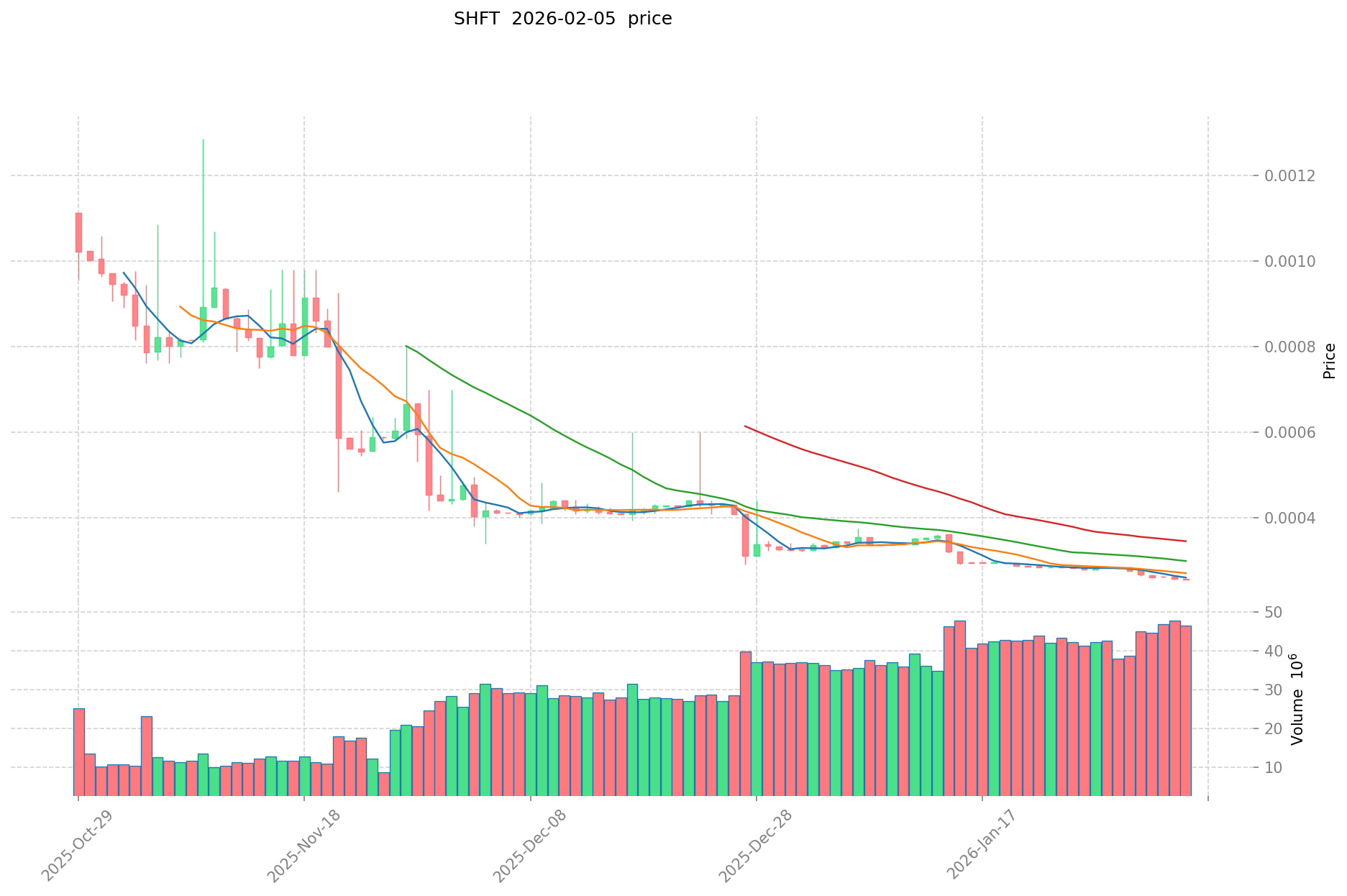
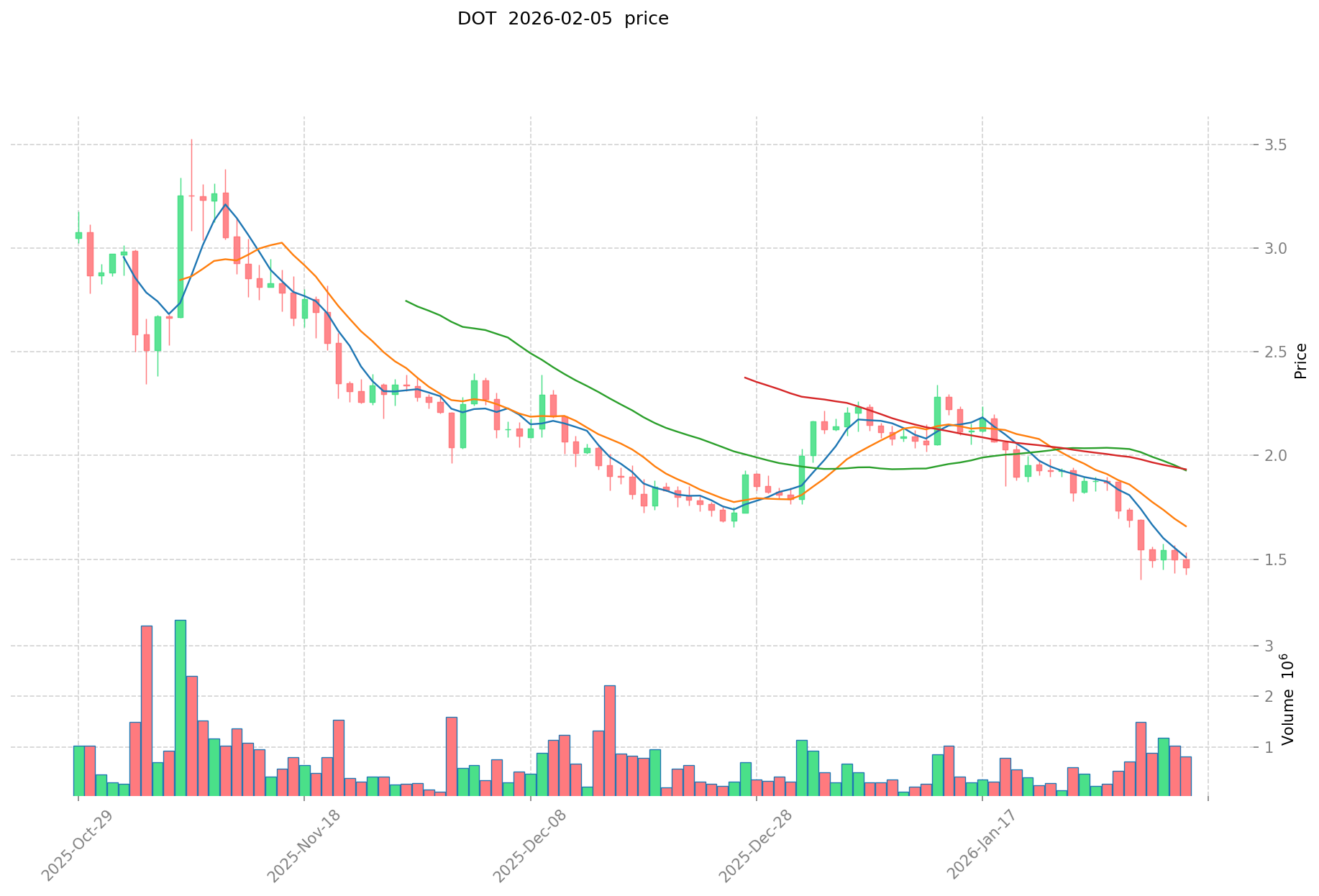
Comparative Analysis: During the crypto market downturn that began in late 2021, SHFT declined from its peak of $6.34 to approximately $0.0002564 as of February 5, 2026, representing a decline of over 99%. Meanwhile, DOT decreased from its high of $54.98 to $1.459 over the same period, reflecting a decline of approximately 97%. Both tokens experienced substantial devaluation, though SHFT's relative decline has been more pronounced in percentage terms.
Current Market Status (February 5, 2026)
- SHFT Current Price: $0.0002564
- DOT Current Price: $1.459
- 24-Hour Trading Volume: SHFT recorded $11,930.67 compared to DOT's $1,195,550.50
- Market Sentiment Index (Fear & Greed Index): 14 (Extreme Fear)
View Real-Time Prices:
II. Core Factors Influencing SHFT vs DOT Investment Value
Supply Mechanism Comparison (Tokenomics)
- SHFT: The supply mechanism details are not specified in available materials, requiring independent research for accurate characterization.
- DOT: The supply mechanism details are not specified in available materials, requiring independent research for accurate characterization.
- 📌 Historical Pattern: Supply mechanisms have historically influenced price cycles through scarcity dynamics, emission schedules, and inflation rates, though specific examples require project-specific data.
Institutional Adoption and Market Application
- Institutional Holdings: Available materials do not provide comparative data on institutional preference between SHFT and DOT.
- Enterprise Adoption: Comparative applications in cross-border payments, settlements, and investment portfolios for SHFT and DOT are not detailed in provided materials.
- National Policies: Regulatory attitudes toward these specific assets across different jurisdictions are not covered in available materials.
Technology Development and Ecosystem Construction
- SHFT Technology Upgrades: Specific technical developments and their potential impacts are not documented in available materials.
- DOT Technology Development: Specific technical developments and their potential impacts are not documented in available materials.
- Ecosystem Comparison: The deployment status of DeFi, NFT, payment systems, and smart contracts for both projects requires detailed project documentation not present in provided materials.
Macroeconomic Environment and Market Cycles
- Performance in Inflationary Environments: According to investment strategy materials, macroeconomic trends significantly influence asset valuations. Value investment principles emphasize analyzing fundamental factors including financial statements and industry competitive landscapes. However, specific anti-inflation characteristics of SHFT versus DOT require targeted analysis.
- Macroeconomic Monetary Policy: Investment outlook materials indicate that factors such as interest rates and currency indices affect market sentiment. Federal Reserve policy adjustments, including rate cut expectations and inflation forecasts, create broader market impacts that influence digital asset valuations, though asset-specific responses vary.
- Geopolitical Factors: Materials note that geopolitical tensions, particularly in regions affecting energy markets and global trade, introduce uncertainty into investment environments. Cross-border transaction demand and international situations may influence digital asset adoption, though specific impacts on SHFT and DOT require further examination.
III. 2026-2031 Price Forecast: SHFT vs DOT
Short-term Forecast (2026)
- SHFT: Conservative 0.000206-0.0002547 | Optimistic 0.0002547-0.000288
- DOT: Conservative 1.241-1.46 | Optimistic 1.46-1.533
Mid-term Forecast (2028-2029)
- SHFT may enter a gradual growth phase, with estimated price range of 0.000208-0.000444 (2028) and 0.000289-0.000447 (2029)
- DOT may enter a moderate expansion phase, with estimated price range of 1.016-2.147 (2028) and 1.363-2.233 (2029)
- Key drivers: institutional capital inflows, ETF developments, ecosystem expansion
Long-term Forecast (2030-2031)
- SHFT: Baseline scenario 0.000214-0.000411 (2030) | Optimistic scenario 0.000277-0.000577 (2031)
- DOT: Baseline scenario 1.155-2.063 (2030) | Optimistic scenario 1.967-2.897 (2031)
View detailed price predictions for SHFT and DOT
Disclaimer
SHFT:
| Year |
Predicted High Price |
Predicted Average Price |
Predicted Low Price |
Price Change |
| 2026 |
0.000287811 |
0.0002547 |
0.000206307 |
0 |
| 2027 |
0.00034178193 |
0.0002712555 |
0.00022785462 |
5 |
| 2028 |
0.00044445213675 |
0.000306518715 |
0.0002084327262 |
19 |
| 2029 |
0.000446827656791 |
0.000375485425875 |
0.000289123777923 |
46 |
| 2030 |
0.000526280372906 |
0.000411156541333 |
0.000213801401493 |
60 |
| 2031 |
0.000576523702257 |
0.000468718457119 |
0.0002765438897 |
82 |
DOT:
| Year |
Predicted High Price |
Predicted Average Price |
Predicted Low Price |
Price Change |
| 2026 |
1.533 |
1.46 |
1.241 |
0 |
| 2027 |
1.780835 |
1.4965 |
1.10741 |
2 |
| 2028 |
2.146654425 |
1.6386675 |
1.01597385 |
12 |
| 2029 |
2.23333993575 |
1.8926609625 |
1.362715893 |
29 |
| 2030 |
2.16615047158125 |
2.063000449125 |
1.15528025151 |
41 |
| 2031 |
2.896968380683781 |
2.114575460353125 |
1.966555178128406 |
44 |
IV. Investment Strategy Comparison: SHFT vs DOT
Long-term vs Short-term Investment Strategies
-
SHFT: May appeal to investors focused on emerging data trust and verification infrastructure projects with higher risk tolerance. The token's substantial decline from historical peaks suggests potential for speculative positioning, though accompanied by elevated volatility.
-
DOT: May suit investors seeking exposure to established multi-chain interoperability infrastructure with relatively broader market recognition. The project's Layer-0 positioning and ecosystem development history provide a different risk-return profile compared to smaller-cap alternatives.
Risk Management and Asset Allocation
-
Conservative Investors: A prudent approach might consider minimal exposure to high-volatility assets like SHFT (0-5%) while allocating moderately to more established projects like DOT (10-20%), with the remainder in diversified holdings.
-
Aggressive Investors: Those with higher risk appetite might consider increased allocations, such as SHFT (5-15%) and DOT (20-35%), while maintaining awareness of correlation risks during market downturns.
-
Hedging Tools: Consider stablecoin reserves for liquidity management, options strategies for downside protection, and cross-asset diversification to mitigate concentration risk.
V. Potential Risk Comparison
Market Risk
-
SHFT: The token has experienced substantial price depreciation, declining over 99% from its historical peak. Limited trading volume ($11,930.67 in 24 hours as of February 5, 2026) suggests lower liquidity, which may amplify price volatility during market stress periods.
-
DOT: While experiencing significant decline from its peak, DOT maintains considerably higher trading volume ($1,195,550.50 in 24 hours). The broader market adoption provides relatively better liquidity, though substantial volatility remains during adverse market conditions.
Technical Risk
-
SHFT: Scalability considerations and network stability aspects require ongoing evaluation as the data trust infrastructure develops.
-
DOT: Network architecture complexity and potential security vulnerabilities inherent in multi-chain interoperability systems warrant continuous monitoring.
Regulatory Risk
- Global regulatory frameworks continue evolving, potentially affecting both projects differently. Data verification platforms and interoperability protocols may face distinct regulatory scrutiny depending on jurisdictional interpretations of their functional classifications.
VI. Conclusion: Which Is the Better Buy?
📌 Investment Value Summary:
-
SHFT Characteristics: Positioning in data trust and verification infrastructure represents a specialized niche. However, substantial price decline and limited liquidity present elevated risk factors that require careful consideration.
-
DOT Characteristics: Established presence in multi-chain interoperability infrastructure with broader market recognition and significantly higher trading volumes. The project's Layer-0 positioning provides exposure to cross-chain ecosystem development.
✅ Investment Considerations:
-
New Investors: Consider beginning with smaller allocations to more established projects with higher liquidity. Thorough research into tokenomics, project fundamentals, and risk tolerance assessment remains essential before any position establishment.
-
Experienced Investors: May evaluate both assets within diversified portfolio contexts, weighing specialized infrastructure exposure (SHFT) against established multi-chain protocols (DOT) based on individual risk-return objectives and market cycle positioning.
-
Institutional Investors: Require comprehensive due diligence on governance structures, regulatory compliance frameworks, and liquidity depth. Established projects with demonstrated ecosystem development may align better with institutional risk management requirements.
⚠️ Risk Disclosure: Cryptocurrency markets exhibit extreme volatility. Historical performance does not guarantee future results. This analysis does not constitute investment advice. Conduct independent research and consult qualified financial professionals before making investment decisions.
VII. FAQ
Q1: What are the main differences between SHFT and DOT in terms of market positioning?
SHFT focuses on data trust and verification aggregation across blockchain ecosystems, while DOT serves as a Layer-0 protocol for multi-chain interoperability. SHFT operates in a specialized niche of data verification infrastructure, targeting trust mechanisms across public and private chains since its 2021 launch. In contrast, DOT, launched in 2019, positions itself as a foundational protocol connecting diverse blockchain networks including private chains, consortium chains, and public networks, enabling cross-chain communication and shared security.
Q2: How do the current price levels compare to their historical peaks?
Both tokens have declined over 97% from their all-time highs, with SHFT experiencing a more severe decline. SHFT reached its peak of $6.34 on March 28, 2021, and has declined over 99% to approximately $0.0002564 as of February 5, 2026. DOT achieved its all-time high of $54.98 on November 4, 2021, declining approximately 97% to $1.459 over the same period. These substantial declines reflect both project-specific challenges and broader cryptocurrency market corrections that began in late 2021.
Q3: What is the liquidity difference between SHFT and DOT?
DOT demonstrates significantly higher liquidity compared to SHFT based on 24-hour trading volumes. As of February 5, 2026, SHFT recorded a 24-hour trading volume of $11,930.67, while DOT's volume reached $1,195,550.50—approximately 100 times higher. This substantial difference in trading volume indicates that DOT offers better liquidity for entering and exiting positions, potentially reducing slippage and providing more stable price discovery during both normal and volatile market conditions.
Q4: What are the projected price ranges for 2026?
Conservative and optimistic scenarios suggest different trajectories for both tokens in 2026. For SHFT, the conservative forecast ranges from $0.000206 to $0.0002547, while the optimistic scenario extends from $0.0002547 to $0.000288. DOT's conservative projection ranges from $1.241 to $1.46, with the optimistic scenario spanning $1.46 to $1.533. These projections reflect current market conditions including the Fear & Greed Index at 14 (Extreme Fear) and assume varying degrees of market recovery and ecosystem development.
Q5: Which token is more suitable for conservative investors?
DOT may be more appropriate for conservative investors seeking cryptocurrency exposure. Conservative allocation strategies might consider minimal exposure to high-volatility assets like SHFT (0-5%) while allocating moderately to more established projects like DOT (10-20%). DOT's higher liquidity, broader market recognition, and established multi-chain infrastructure provide a different risk-return profile. However, even conservative investors should maintain diversified holdings with the remainder in other assets and implement appropriate risk management tools including stablecoin reserves and hedging strategies.
Q6: What are the primary risks associated with investing in SHFT versus DOT?
Both tokens face distinct risk profiles requiring careful evaluation. SHFT presents elevated risks due to its substantial price depreciation (over 99% decline), limited trading volume, and positioning in a specialized data trust niche that may face scalability and adoption challenges. DOT, while experiencing significant decline from its peak, maintains better liquidity but faces technical risks related to network architecture complexity and security vulnerabilities inherent in multi-chain interoperability systems. Both projects face evolving regulatory frameworks that may affect data verification platforms and interoperability protocols differently depending on jurisdictional interpretations.
Q7: How might macroeconomic factors influence these investments?
Macroeconomic conditions significantly impact digital asset valuations through multiple channels. Federal Reserve monetary policy adjustments, including interest rate decisions and inflation forecasts, create broader market sentiment effects that influence cryptocurrency prices. Geopolitical tensions affecting energy markets and global trade introduce additional uncertainty into investment environments. While both SHFT and DOT are subject to these macroeconomic influences, their specific responses may vary based on their respective use cases—data verification infrastructure versus multi-chain interoperability. Cross-border transaction demand and international regulatory developments may also affect adoption patterns differently for each project.
Q8: What should new investors prioritize when comparing these two assets?
New investors should prioritize fundamental research and risk assessment before establishing positions in either asset. Key considerations include understanding each project's tokenomics, examining trading volumes and liquidity depth, evaluating ecosystem development progress, and assessing personal risk tolerance. Beginning with smaller allocations to more established projects with higher liquidity is generally advisable. New investors should conduct independent research into governance structures, regulatory compliance frameworks, and technological fundamentals rather than relying solely on price forecasts. Consulting qualified financial professionals and understanding that historical performance does not guarantee future results remains essential before making any investment decisions.
* The information is not intended to be and does not constitute financial advice or any other recommendation of any sort offered or endorsed by Gate.