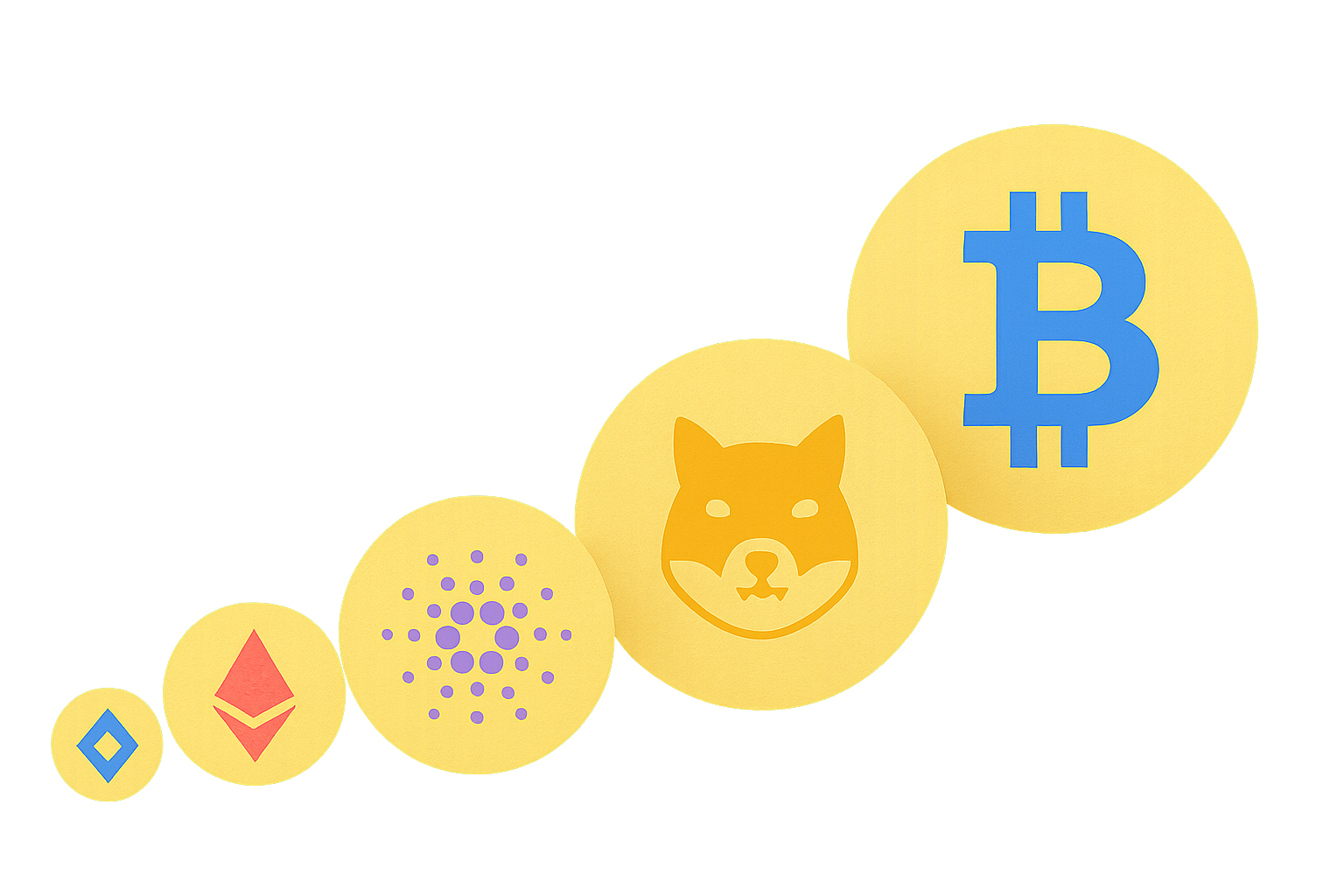
A comprehensive guide to six Bitcoin-related tokens that have achieved over 1,000x growth from 2009 to 2025. This article offers beginner-friendly insights into selecting high-potential cryptocurrencies such as BTC, ETH, ADA, DOGE, and SHIB, detailing the primary factors behind their remarkable growth. It also covers how to invest using reliable platforms like Gate.
Overview of Growth for Six Major Tokens (Initial Price, All-Time High, and Multiples)
Over the past decade, the crypto asset market has posted astonishing growth, with many tokens soaring hundreds or even thousands of times from their original prices. Bitcoin alone has risen by at least 1,000,000x from its starting value—and by some estimates, tens of millions of times. But aside from Bitcoin, which other assets have achieved more than 1,000x gains?
This article spotlights six leading crypto assets that grew by over 1,000x between 2009 and 2025, providing an in-depth analysis of each. Their extraordinary performance stems from factors such as technological breakthroughs, market maturation, and strong community support.
First, the table below summarizes the six tokens covered in this article, presenting their launch year, initial price (at the start of trading), all-time high (historical peak), and approximate maximum multiple from launch. This snapshot gives a clear sense of each token’s explosive growth.
| Token (Ticker) |
Launch Year |
Initial Price |
All-Time High (Date) |
Maximum Multiple (from Launch) |
| Bitcoin (BTC) |
2009 |
$0.0008 (2010 est.) |
$109,350 (Jan 20, 2025) |
Approx. 136,687,500x |
| Ethereum (ETH) |
2015 |
$0.31 (2014 ICO price) |
$4,878 (Nov 2021) |
Approx. 15,736x |
| Platform Token (Major Exchanges) |
2017 |
$0.15 (2017 ICO price) |
$690 (May 2021) |
Approx. 4,600x |
| Cardano (ADA) |
2017 |
$0.0024 (2015–17 ICO price) |
$3.10 (Sep 2021) |
Approx. 1,291x |
| Dogecoin (DOGE) |
2013 |
$0.0004 (Dec 2013 launch) |
$0.74 (May 2021) |
Approx. 1,850x |
| Shiba Inu (SHIB) |
2020 |
$0.00000000051 (Aug 2020 launch) |
$0.0000885 (Oct 2021) |
Approx. 173,529x |
Each of these tokens has distinctive attributes and growth drivers. Below, we examine the details of each asset.
Bitcoin (BTC)
Bitcoin, launched in January 2009 by Satoshi Nakamoto, is the world’s first cryptocurrency. It serves as the market’s benchmark and is often dubbed “digital gold.” With a capped supply of 21 million BTC and a secure, decentralized network, Bitcoin is widely recognized as a long-term store of value.
Bitcoin’s launch triggered a revolution in finance. As a decentralized currency beyond the reach of central banks and governments, it provided a new monetary alternative globally. Its blockchain technology—balancing transparency and security—has influenced industries far beyond crypto.
Price Trends (Initial Price, All-Time High) and Multiples
At inception, Bitcoin was practically worthless: exchanges didn’t exist in 2009, so it had no monetary price. The first USD exchange rate was set in October 2009, when 5,050 BTC sold for about $5—roughly $0.0009 per BTC. When exchanges launched in July 2010, Bitcoin began trading at around $0.0008 to $0.08.
By late 2010, the price climbed to about $0.5. In 2011, Bitcoin broke above $1 for the first time, then spiked to roughly $29.6 in June amid wild volatility. These swings reflected both early investor enthusiasm and the market’s immaturity.
Bitcoin’s four-year cycle continued, breaking $1,000 in late 2013 and reaching about $19,000 in December 2017. The 2017 bull run overlapped with a broader crypto boom, attracting many new investors. The latest all-time high was set on January 20, 2025, at $109,350. From the initial exchange prices ($0.0008–$0.08), Bitcoin’s rise to its peak represents at least a millionfold gain, and possibly tens of millions of times the original price.
Key Factors Driving Bitcoin’s Growth
Several critical drivers have fueled Bitcoin’s remarkable ascent. Below, we detail each.
Market Maturity and Reserve Status
As the world’s pioneering cryptocurrency, Bitcoin has always occupied a central role. Institutional investors and corporations consistently choose it as a primary asset, and Bitcoin has long accounted for over half of total crypto market capitalization. Its reserve status is a core foundation of its value.
Most exchanges use Bitcoin as a trading pair for other assets, reinforcing its role as the market’s base currency and sustaining strong demand.
Supply Constraints and Halving Events
Bitcoin’s protocol halves its new issuance about every four years—a process occurring in 2012, 2016, and 2020—keeping inflation low. The third halving in 2020, coinciding with global monetary easing, sharply boosted Bitcoin’s reputation as an “inflation hedge.”
This halving mechanism increases scarcity, supporting long-term price appreciation: as supply drops and demand rises, upward pressure mounts.
Macroeconomic Shifts and Risk-Aversion Appeal
Post-COVID fiscal and monetary stimulus triggered rapid capital flows into Bitcoin. In early 2021, Bitcoin drew attention alongside equities and real estate as a risk asset, surging from $29,000 at the end of 2020 to over $64,000 within months.
This period cemented Bitcoin’s “digital gold” identity and drove demand as an inflation hedge. With unique properties not found in traditional financial assets, Bitcoin became a compelling diversification tool for investors.
Institutional and Corporate Adoption
From 2020, major companies began accumulating large amounts of BTC, with some announcing $1.5 billion in purchases in 2021. Leading payment providers and US banks also rolled out crypto services, ushering traditional financial institutions into the market.
Institutional participation has transformed Bitcoin from a speculative instrument to a legitimate investment asset, boosting liquidity and stabilizing prices.
National-Level Legal Tender Recognition
In 2021, a Central American country adopted Bitcoin as legal tender, distributing wallets to all citizens—an unprecedented move at the national level. This expanded Bitcoin’s practical payment use beyond speculation.
National-level adoption is a key indicator of Bitcoin’s long-term promise and could influence other countries.
Global Recognition as Digital Gold
Bitcoin’s “digital gold” narrative has gone mainstream worldwide. In 2021, its market cap briefly surpassed $1 trillion, rivaling the scale of the gold market. Its capped supply and decentralization only enhance its appeal for long-term holders.
Bitcoin is now regarded as a scarce store of value—a status comparable to gold—cementing its place among long-term investments.
Policy Developments and Price Correlation
In April 2025, the US government suggested adding BTC to its foreign reserves, citing “maintaining dollar hegemony” and countering other nations’ digital asset initiatives. Bitcoin hit a new all-time high after the announcement, reaffirming the link between policy moves and price action.
Such policy signals remain a crucial factor underpinning Bitcoin’s value and will continue to merit close attention.
Ethereum (ETH)
Ethereum, launched in July 2015, is a blockchain platform second in scale only to Bitcoin. If Bitcoin is “digital gold,” Ethereum is “the protocol for a decentralized internet,” serving as the foundation for smart contracts and DApps (decentralized applications).
Ethereum’s core innovation is the implementation of smart contracts, enabling anyone to create custom tokens or applications. Since 2016, countless projects have launched on Ethereum, putting it at the center of DeFi and NFT trends and making it the platform for a wide array of projects and tokens.
Price Trends (Initial Price, All-Time High) and Multiples
Ethereum’s 2014 ICO sold ETH at roughly $0.31 per token, raising about $18 million. When the mainnet launched in July 2015, ETH began trading at a few dollars per token.
The 2017 ICO boom sparked explosive demand, sending ETH to an all-time high of nearly $1,400 in January 2018. The price crashed to the $80 range by year-end, underscoring the market’s volatility. Ethereum regained momentum from 2020 onward, as the expansion of DeFi and NFTs sent prices to a historic $4,878.26 on November 10, 2021. This marks a more than 15,000x gain from the ICO price—testament to Ethereum’s extraordinary ascent.
Key Factors Driving Ethereum’s Growth
Several critical drivers have fueled Ethereum’s growth, as outlined below.
Smart Contract and DApp Innovation
Ethereum’s defining feature is its support for smart contracts, enabling anyone to build custom tokens or applications. This capability drove the ICO boom and the proliferation of new projects after 2016.
Smart contracts—self-executing agreements—have potential applications in finance, real estate, supply chain management, and more. This innovation has established Ethereum not just as a cryptocurrency but as the backbone of decentralized applications.
The Rise of DeFi (Decentralized Finance)
From around 2020, DeFi protocols built on Ethereum—such as decentralized exchanges and lending platforms—grew rapidly. Yield farming locked up ETH, becoming a major price driver, and Ethereum cemented its role as the “financial infrastructure” of DeFi.
DeFi’s rise has offered alternatives to traditional finance, attracting users to Ethereum-based protocols and greatly increasing ETH demand.
NFT Boom and Demand Surge
Early 2021 saw a rapid expansion of NFT marketplaces. ETH became the currency for digital art and collectibles, bringing in a flood of new users. Soaring gas fees reflected this increased network activity, driving ETH prices higher.
NFTs introduced a new paradigm for digital ownership, with many artists and creators issuing NFTs on Ethereum. This boom dramatically increased Ethereum’s utility and price.
Technical Evolution: Transition to Ethereum 2.0
The London upgrade in August 2021 introduced EIP-1559, burning a portion of transaction fees. September 2022’s “The Merge” shifted Ethereum from PoW to PoS, greatly improving energy efficiency and boosting long-term investor confidence.
These upgrades have strengthened Ethereum’s scalability and security, providing a robust foundation for future growth. The move to PoS was especially important for sustainability and network stability.
Enterprise Adoption and Ecosystem Expansion
Ethereum has become the “next investment of choice” after Bitcoin. The Enterprise Ethereum Alliance (EEA) launched in 2017 with major corporate members. Since 2020, ETH futures and custody services have expanded institutional access.
These developments have broadened Ethereum’s appeal to enterprises and institutions. As the ecosystem grows, so do Ethereum’s long-term prospects.
Platform Tokens (Major Exchanges)
Platform tokens issued by major exchanges serve as native tokens for the world’s largest trading platforms. Launched via ICO in July 2017 alongside the exchange’s debut, these tokens started as ERC-20 assets before migrating to proprietary blockchains. They have evolved into utility tokens used throughout the ecosystem, including for fee discounts and gas payments.
The value of these tokens has grown in tandem with their exchanges’ success, making them attractive investments. As user numbers rise, so does token demand, fueling price appreciation.
Price Trends (Initial Price, All-Time High) and Multiples
This token was sold at $0.15 per token in the ICO, with about 100 million tokens offered. Initially trading for a few dollars, it surged in early 2021 to a record $690.93 on May 10, a 4,605x gain from the ICO price.
In 2024, the expansion of the exchange’s ecosystem and regulatory tailwinds drove a new high of $705 on November 15, marking a 7,016x increase from the ICO price. More recently, the token has traded in the $500–$700 range as the market stabilizes.
Key Factors Driving Platform Token Growth
The token’s growth is driven by several major factors, detailed below.
Rapid Exchange Growth and User Expansion
Since 2018, the leading exchange has maintained the world’s highest trading volume. Users who pay fees with the token receive discounts, ensuring steady demand. Since 2019, scandals at other exchanges have accelerated capital inflow to this platform.
User growth directly increases token demand and boosts price. The exchange’s reliability and service quality are key foundations for token value.
Fee Discounts and Expanding Use Cases
Beyond spot trading discounts, the token is used for IEOs, staking, lending, and more. Holding the token is required for Launchpad IEOs, fueling price growth. As user numbers grow, so does the token’s utility.
This broadening of use cases transforms the token into a core asset within the ecosystem, not just a discount tool.
Success of Proprietary Blockchain
The exchange launched its own blockchain in 2019, making the token its native asset. In 2020, an Ethereum-compatible smart chain debuted, attracting a boom in DeFi and gaming apps thanks to low gas fees. The platform now hosts numerous dApps, second only to Ethereum as a smart contract hub.
This blockchain success has greatly amplified the token’s value and driven ecosystem growth.
Deflationary Impact from Regular Token Burns
The token’s supply will ultimately be capped at 100 million. The exchange conducts quarterly buybacks and burns, reducing circulation and creating holder-friendly tokenomics.
This deflationary effect increases scarcity and supports long-term value appreciation.
Brand Strength and Community Support
Charismatic leadership and user-focused marketing have won global support. The token is widely used for airdrops and IEOs, fostering long-term holders. Strong operational reliability, including hack compensation, also boosts investor confidence.
Community strength forms a key foundation for the token’s value and sustained growth.
Cardano (ADA)
Cardano, launched in 2017, is a third-generation blockchain platform (ticker: ADA) supporting smart contracts and DApps. Developed under the guidance of an Ethereum co-founder, Cardano follows a rigorous academic, peer-reviewed approach with formal methods.
Its consensus protocol is Ouroboros (proof-of-stake), and the platform has evolved through phased upgrades (Byron, Shelley, Goguen, etc.). Cardano’s design prioritizes security and sustainability, supporting long-term growth potential.
Price Trends (Initial Price, All-Time High) and Multiples
In January 2017, ADA’s ICO (mainly in Japan and Korea) was priced at about $0.0024. The mainnet launched in October 2017 amid an altcoin boom that briefly sent prices near $1.
Despite a prolonged slump during the 2018 crypto winter, ADA rebounded in 2020–2021. The Shelley upgrade (staking) and Alonzo upgrade (smart contracts) drove renewed attention, peaking at $3.10 on September 2, 2021—over 1,300x its ICO price.
Key Factors Driving Cardano’s Growth
Cardano’s growth is powered by several key factors, detailed below.
Milestone Upgrades and Catalysts
The 2020 Shelley upgrade enabled decentralization and staking; 2021’s Alonzo added smart contracts. Each milestone became a price catalyst. The 2023 Hydra upgrade dramatically improved scalability, enabling thousands of transactions per second and accelerating DeFi and NFT adoption.
These upgrades highlight Cardano’s technical strengths and inspire investor confidence.
Academic Development and Reliability
Cardano’s theory-driven, peer-reviewed design has earned long-term support for its focus on safety and stability. The project continues to integrate the latest cryptography. Its strong community and long-term investor base underpin stable value.
This academic approach distinguishes Cardano and is central to its appeal.
Position as an Alternative Blockchain
Cardano offers lower energy use, lower fees, and higher security than Ethereum. It attracted attention as an alternative during Ethereum’s gas fee spikes in early 2021. With Ethereum still facing scaling issues, Cardano’s Hydra upgrade has further strengthened its alternative status. In Japan, ADA (known as “Ada Coin”) has benefited from high brand recognition and domestic listings.
This role as an alternative chain draws significant investor interest and supports growth.
Emergence of Real-World Use Cases
Cardano partnered with a national government to provide digital IDs and academic records for over five million students, later expanding to more than ten million nationwide. Cardano has also moved into agricultural traceability, educational certification, and notarization—making national-scale adoption increasingly realistic.
These real-world use cases demonstrate Cardano’s practical value beyond speculation.
Staking Incentives for Long-Term Holding
ADA holders can earn several percent annual yield through PoS staking. As of recent years, about 75% of ADA is staked (up from 70%), reducing liquidity in the market.
Staking reinforces long-term holding and price stability.
Dogecoin (DOGE)
Dogecoin is a meme-based crypto asset created in 2013 as a joke. Engineers Billy Markus and Jackson Palmer launched the project inspired by the Shiba Inu “Kabosu” meme, with no clear purpose or technical innovation—simply as an “infinitely issued joke coin.”
Its approachable logo and playful culture quickly captivated the community. By 2021, Dogecoin had become a top-five asset by market cap, evolving from a meme to a mainstream contender.
Price Trends (Initial Price, All-Time High) and Multiples
DOGE was released in December 2013 at around $0.0004, soaring over 300% in days due to Reddit buzz. It hit an all-time low of $0.000086 in 2015 but rebounded in the 2017–2018 altcoin boom.
In 2021, celebrity endorsements and retail enthusiasm drove DOGE to a $0.74 peak on May 8—a 1,850x (185,000%) increase. In December 2024, anticipation of adoption in related projects sparked another rally to $1.23 (December 15, 2024), setting a new all-time high—a 3,075x gain. Recently, DOGE has traded between $0.80 and $1.00 as the market consolidates.
Key Factors Driving Dogecoin’s Growth
Several factors have driven Dogecoin’s rise, detailed below.
Meme Culture and Strong Community
The Shiba Inu mascot and friendly tone make DOGE accessible to newcomers. Dogecoin became popular for tipping and donations—especially on Reddit—and established itself as the “currency for fun.” The “No highs, no lows, only Doge” mantra and lasting meme popularity have fostered a strong, cohesive community that underpins price.
This meme culture sets Dogecoin apart from other crypto assets.
Celebrity and Influencer Support
Celebrity influence has been pivotal—one celebrity dubbed himself the “Dogefather” and drove up prices with payment adoption in 2024. Other prominent figures also voiced support, and their social media influence fueled the 2021 and late-2024 rallies. Recently, major investment fund DOGE ETF filings have gained traction, amplified by celebrity backing.
Such endorsements have played a vital role in Dogecoin’s widespread appeal.
Alignment with Retail Investor Movements
In January 2021, grassroots investor campaigns rallied around Dogecoin. The “To the Moon” slogan inspired mass buying, and on April 20 (“Doge Day”), DOGE briefly overtook other major coins by market cap. Renewed ETF optimism has recently rekindled buying, keeping DOGE in the top 10 by market cap.
This retail investor momentum forms a key foundation for DOGE’s price support.
Expansion of Trading Platforms
Listings on major services have greatly improved access, especially for younger investors. DOGE’s popularity has even caused temporary outages on some platforms. ETF filings and more exchange listings have also encouraged institutional entry.
These developments have increased DOGE’s liquidity and accessibility.
Virality as Brand Identity
Dogecoin’s appeal persists even without strong fundamentals or technical innovation—many hold it simply “for fun.” In 2023, a celebrity changed a social media platform’s logo to a Shiba Inu, sparking renewed interest. Trial payment adoption in December 2024 drove DOGE to $1.23, while recent ETF approvals have added further buzz. Viral statements like “make Dogecoin the currency of Mars” continue to sustain speculative excitement.
This built-in virality makes Dogecoin uniquely attention-grabbing.
Shiba Inu (SHIB)
Shiba Inu, launched in August 2020 by the anonymous “Ryoshi,” is a meme coin inspired by Dogecoin and marketed as the “Dogecoin Killer.” Issued as an ERC-20 token on Ethereum, SHIB features an ultra-low price and huge supply, allowing anyone to own millions of tokens.
The meme coin boom of 2021 brought SHIB global fame and produced a wave of overnight millionaires—a “dream coin” for many.
Price Trends (Initial Price, All-Time High) and Multiples
SHIB began trading on decentralized exchanges in 2020 at just $0.00000000051 per token. Initially obscure, SHIB gained rapid attention after major exchange listings in May 2021 and hit an all-time high of $0.00008845 in October. This marks an increase of more than 500,000x from launch.
After a correction phase, SHIB has recently traded between $0.00001 and $0.00003—still exponentially higher than its initial price.
Key Factors Driving SHIB’s Growth
Several factors have driven SHIB’s rise, as detailed below.
Meme Appeal and Social Marketing
SHIB leveraged the Shiba Inu breed to position itself as “the next Dogecoin.” The viral notion—“if it hits 1 cent, you’ll be a millionaire”—drove explosive rallies in spring and fall 2021. Meme activity remains vibrant, with SHIB posting annual gains of 150% and FOMO amplifying speculation.
This meme-driven appeal distinguishes SHIB and draws investor interest.
Fervent Community and Hype
The “SHIB Army” has been central to spreading the word. Celebrity tweets and massive token burns (up to 90%) have drawn attention, with price swings closely following celebrity involvement. Recent large-scale burns have also helped support the price.
This community enthusiasm is the backbone of SHIB’s price support.
Rapid Listings on Major Exchanges
In 2021, SHIB was listed on multiple major exchanges in quick succession, expanding its liquidity and transforming its image from “microcap” to “mainstream.” As an easy-to-buy meme coin, SHIB attracted scores of new investors. Now listed on over 100 exchanges, its liquidity has only grown.
Listing on major platforms has made SHIB widely accessible.
Lottery-Like Appeal Due to Low Price
The ability to buy millions of tokens with just a few dollars has fueled buying. The dream of “what if it hits $1” and viral stories of small fortunes have driven FOMO. As of now, at $0.00001252 per token, $100 buys about 8 million SHIB, keeping speculation alive.
This lottery-like allure is a unique driver of SHIB’s popularity.
Project Evolution and Expanding Utility
In 2021, SHIB launched its decentralized exchange; from 2022, it announced layer-2 development and metaverse plans. New utilities and burn mechanisms are being rolled out to further support the price.
These advances show SHIB’s efforts to move beyond mere speculation toward practical utility.
Summary and Outlook
Reviewing the six tokens (BTC, ETH, platform token, ADA, DOGE, SHIB) that grew more than 1,000x between 2009 and 2025, it’s clear that technological innovation, macro trends, and social media have all played major roles. Each asset has distinct features and growth drivers, highlighting the crypto market’s diversity.
While similar trends could repeat, past success is no guarantee of future results. The market remains highly volatile, and prices could swing sharply as regulations and technology evolve. Investors should maintain a cool head, a long-term perspective, and strict risk management.
The crypto market is entering a maturation phase, with institutional entry and regulatory clarity improving stability—but also possibly dampening short-term rallies. Investors should monitor technical and market trends closely and craft investment strategies with care.
Ultimately, the market’s future will be shaped by innovation, regulation, macroeconomic shifts, and more. Investors must weigh these factors and make decisions with a long-term view.
FAQ
What are the key characteristics of cryptocurrencies that have grown more than 1,000x?
They offer clear use cases, innovative tech, and credible development teams. Projects distinguished by smart contracts, DeFi, or AI integration tend to show strong early-stage growth potential.
What are the risks or considerations when investing in high-growth cryptocurrencies?
High-growth tokens come with very high volatility and the risk of sharp price drops. In immature markets, prices can swing wildly in response to news or large trades. Security and complex tax obligations are also key concerns. Use surplus funds, set stop-loss rules, and practice careful risk management.
Can past 1,000x tokens repeat this level of growth?
1,000x growth is rare and unlikely to repeat, but innovative projects and shifting market conditions can still offer substantial returns. Rigorous selection and market analysis are crucial.
What indicators or factors should you check when evaluating crypto asset growth?
Review on-chain data like market cap, trading volume, network hash rate, and active addresses. Also check team track record, white paper, roadmap, and the competitive landscape.
What’s the safest way for beginners to start investing in crypto?
Choose a licensed, reputable platform and start with spot trading. Begin with small amounts, build basic knowledge, stay alert for scams, and always provide identity verification when opening an account.
How do 1,000x tokens differ from ordinary tokens?
1,000x tokens feature innovative technology, strong communities, and strategic partnerships, while ordinary tokens have less recognition and limited adoption. High-growth tokens offer much greater early-stage upside.
* The information is not intended to be and does not constitute financial advice or any other recommendation of any sort offered or endorsed by Gate.