This comprehensive investment comparison analyzes STRM versus XRP digital assets for 2024-2026. StreamCoin (STRM), launched in 2022, targets blockchain-based live streaming ecosystems, currently trading at $0.0006687 with limited liquidity. Ripple (XRP), established in 2011, dominates cross-border payment infrastructure through institutional partnerships, trading at $1.615 with $97M daily volume. The article examines historical price performance, supply mechanisms, institutional adoption levels, and technology ecosystems. STRM presents emerging-market volatility (7.42% daily decline) and developmental risks, while XRP demonstrates established market presence but regulatory sensitivity. Conservative investors should allocate 85-90% to XRP for stability; aggressive investors may incorporate 30-40% STRM exposure. Price predictions through 2031 suggest XRP reaching $2.481 and STRM reaching $0.001272. The comparison reveals XRP suits institutional investors prioritizing proven infrastructure, while STRM appeals to
Introduction: STRM vs XRP Investment Comparison
In the cryptocurrency market, the comparison between STRM vs XRP has become a topic that investors cannot avoid. The two differ significantly in market cap ranking, application scenarios, and price performance, representing distinct crypto asset positioning.
StreamCoin (STRM): Launched in 2022, it aims to connect streamers and viewers directly through blockchain technology, focusing on live streaming ecosystems and reducing intermediary fees.
XRP (XRP): Since its launch in 2011, it has been recognized for its focus on cross-border payment efficiency and is one of the cryptocurrencies with substantial global trading volume and market capitalization.
This article will comprehensively analyze the investment value comparison between STRM vs XRP, covering historical price trends, supply mechanisms, institutional adoption, technical ecosystems, and future predictions, attempting to answer the question investors care about most:
"Which is the better buy right now?"
I. Historical Price Comparison and Current Market Status
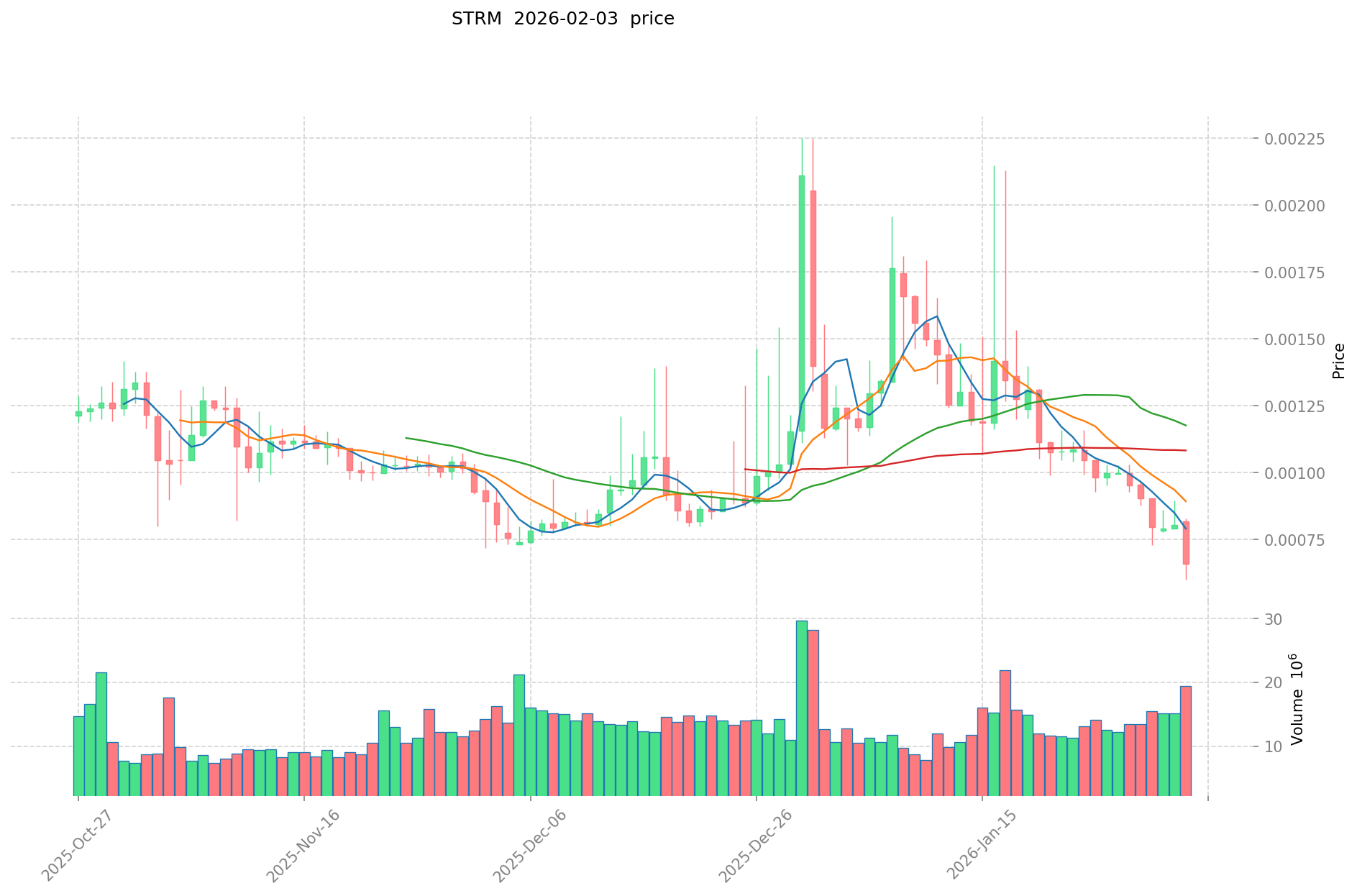
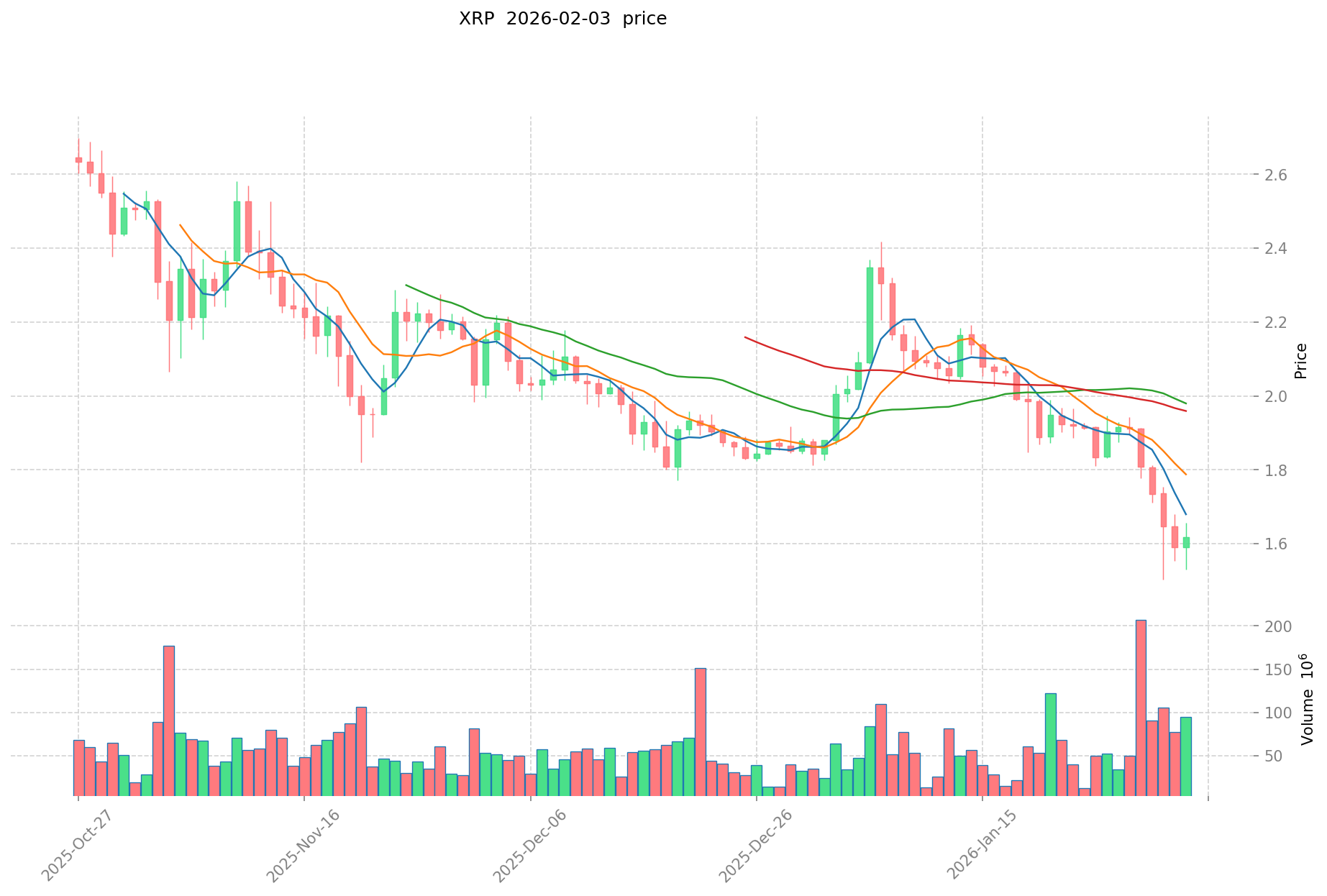
STRM (StreamCoin) and XRP (Ripple) Historical Price Trends
- 2022: STRM recorded its all-time high of $0.30332 on May 6, 2022, reflecting early-stage interest in blockchain-based live streaming solutions.
- 2025: STRM reached its all-time low of $0.00053723 on January 22, 2025, demonstrating significant price contraction amid broader market volatility.
- 2025: XRP achieved its all-time high of $3.65 on July 18, 2025, supported by increased institutional interest and regulatory developments in the digital payments sector.
- Comparative Analysis: During the 2022-2025 market cycle, STRM declined from its peak of $0.30332 to its lowest point of $0.00053723, representing a substantial decrease. In contrast, XRP demonstrated relative resilience during certain periods, though it also experienced corrections from its peak levels.
Current Market Situation (February 03, 2026)
- STRM Current Price: $0.0006687
- XRP Current Price: $1.615
- 24-Hour Trading Volume: STRM recorded $13,150.62 compared to XRP's $97,203,679.57
- 24-Hour Price Change: STRM decreased by 7.42%, while XRP increased by 2.08%
- Market Sentiment Index (Fear & Greed Index): 17 (Extreme Fear)
View real-time prices:
- Check STRM current price Market Price
- Check XRP current price Market Price
II. Core Factors Influencing STRM vs XRP Investment Value
Supply Mechanism Comparison (Tokenomics)
- STRM: The supply mechanism details are not extensively documented in available materials, though the token exhibits characteristics of emerging projects with potential volatility in tokenomics.
- XRP: Features a pre-mined supply structure with periodic releases managed by Ripple Labs, influencing market liquidity and price dynamics over time.
- 📌 Historical Pattern: Supply mechanisms play a role in shaping price cycles, with controlled release schedules potentially affecting market sentiment and price trajectories.
Institutional Adoption and Market Application
- Institutional Holdings: XRP has garnered attention from financial institutions due to its association with cross-border payment solutions, while STRM remains in earlier stages of institutional recognition.
- Enterprise Adoption: XRP demonstrates applications in cross-border payments and settlement systems through RippleNet infrastructure. STRM's enterprise adoption remains limited in documented use cases.
- Regulatory Landscape: Regulatory clarity varies across jurisdictions, with XRP's regulatory environment being a significant factor in its market performance. Different countries maintain varying stances on both digital assets.
Technology Development and Ecosystem Building
- STRM Technology Development: As an emerging project, STRM continues to develop its technical infrastructure, though specific upgrade details are limited in available documentation.
- XRP Technology Evolution: XRP's underlying technology supports payment processing capabilities, with ongoing developments tied to RippleNet expansion and On-Demand Liquidity (ODL) adoption.
- Ecosystem Comparison: XRP maintains established presence in payment solutions and financial settlement systems. STRM's ecosystem participation in DeFi, NFT, and smart contract applications remains in developmental phases.
Macroeconomic Environment and Market Cycles
- Performance Under Inflation: The relationship between inflation environments and performance characteristics requires consideration of broader market trends and economic conditions.
- Macroeconomic Monetary Policy: Interest rate adjustments, central bank policies, and currency index movements influence market behavior for both assets.
- Geopolitical Factors: Cross-border transaction demand and international developments affect market dynamics, particularly for assets positioned in payment and settlement sectors.
III. 2026-2031 Price Prediction: STRM vs XRP
Short-term Forecast (2026)
- STRM: Conservative $0.000475 - $0.000669 | Optimistic $0.000669 - $0.000963
- XRP: Conservative $1.456 - $1.618 | Optimistic $1.618 - $1.893
Mid-term Forecast (2028-2029)
- STRM may enter a gradual expansion phase, with anticipated price range of $0.000701 - $0.001413
- XRP may enter a consolidation phase, with anticipated price range of $1.657 - $2.040
- Key drivers: institutional capital inflows, ETF developments, ecosystem expansion
Long-term Forecast (2030-2031)
- STRM: Baseline scenario $0.000701 - $0.001229 | Optimistic scenario $0.000980 - $0.001374
- XRP: Baseline scenario $1.801 - $2.481 | Optimistic scenario $2.233 - $2.730
View detailed price predictions for STRM and XRP
Disclaimer
STRM:
| Year |
Predicted High Price |
Predicted Average Price |
Predicted Low Price |
Price Change |
| 2026 |
0.000962928 |
0.0006687 |
0.000474777 |
0 |
| 2027 |
0.00103608378 |
0.000815814 |
0.00043238142 |
22 |
| 2028 |
0.0011666956014 |
0.00092594889 |
0.000833354001 |
38 |
| 2029 |
0.001412535031695 |
0.0010463222457 |
0.000701035904619 |
56 |
| 2030 |
0.001315488643406 |
0.001229428638697 |
0.000700774324057 |
83 |
| 2031 |
0.001374255332336 |
0.001272458641051 |
0.000979793153609 |
90 |
XRP:
| Year |
Predicted High Price |
Predicted Average Price |
Predicted Low Price |
Price Change |
| 2026 |
1.89306 |
1.618 |
1.4562 |
0 |
| 2027 |
2.0539701 |
1.75553 |
1.4922005 |
8 |
| 2028 |
2.019035053 |
1.90475005 |
1.6571325435 |
17 |
| 2029 |
2.04036825356 |
1.9618925515 |
1.903035774955 |
21 |
| 2030 |
2.9616729957444 |
2.00113040253 |
1.801017362277 |
23 |
| 2031 |
2.72954186905092 |
2.4814016991372 |
2.23326152922348 |
53 |
IV. Investment Strategy Comparison: STRM vs XRP
Long-term vs Short-term Investment Strategies
- STRM: May suit investors interested in emerging blockchain applications within live streaming ecosystems, with awareness of higher volatility characteristics typical of early-stage projects.
- XRP: May suit investors focused on established payment infrastructure and cross-border settlement applications, with consideration of regulatory developments affecting market dynamics.
Risk Management and Asset Allocation
- Conservative Investors: STRM 10-15% vs XRP 85-90% - emphasizing established market presence and institutional recognition
- Aggressive Investors: STRM 30-40% vs XRP 60-70% - incorporating exposure to emerging sectors while maintaining core holdings in established assets
- Hedging Tools: Stablecoin allocation, options strategies, cross-asset portfolio diversification
V. Potential Risk Comparison
Market Risks
- STRM: Higher volatility exposure with 24-hour price fluctuation of 7.42%, limited liquidity evidenced by $13,150.62 daily trading volume, susceptibility to broader market sentiment shifts
- XRP: Price sensitivity to regulatory developments, institutional adoption pace, and macroeconomic conditions; 24-hour trading volume of $97,203,679.57 indicates established market presence
Technical Risks
- STRM: Scalability considerations in developmental phase, network infrastructure maturity, ecosystem expansion uncertainties
- XRP: Technology evolution tied to RippleNet adoption, payment processing infrastructure dependencies, ongoing technical development requirements
Regulatory Risks
- Global regulatory frameworks affect both assets differently, with varying approaches across jurisdictions. XRP's regulatory environment remains a significant consideration in market performance, while STRM's regulatory positioning continues to develop alongside the broader digital asset landscape.
VI. Conclusion: Which Is the Better Buy?
📌 Investment Value Summary:
- STRM Characteristics: Participation in emerging blockchain applications for live streaming, early-stage market positioning with corresponding risk-reward profile, potential for ecosystem development
- XRP Characteristics: Established presence in cross-border payment solutions, institutional recognition in financial settlement infrastructure, demonstrated market liquidity and trading volume
✅ Investment Considerations:
- New Investors: Consider starting with assets demonstrating established market presence, liquidity depth, and institutional recognition before exploring emerging projects
- Experienced Investors: Evaluate portfolio diversification strategies incorporating both established payment infrastructure assets and emerging sector exposure, aligned with individual risk tolerance
- Institutional Investors: Assess regulatory compliance frameworks, liquidity requirements, and strategic alignment with established payment infrastructure versus emerging blockchain applications
⚠️ Risk Disclosure: Cryptocurrency markets exhibit high volatility. This content does not constitute investment advice. Conduct thorough research and consult qualified financial professionals before making investment decisions.
VII. FAQ
Q1: What are the key differences between STRM and XRP in terms of market positioning?
STRM focuses on blockchain-based live streaming ecosystems, while XRP specializes in cross-border payment solutions. STRM, launched in 2022, aims to connect streamers and viewers directly by reducing intermediary fees through blockchain technology. XRP, established in 2011, has developed a robust presence in the financial payment infrastructure sector, partnering with institutions for cross-border settlement through RippleNet. The fundamental difference lies in their target markets: STRM addresses content creator monetization and live streaming engagement, whereas XRP targets institutional payment processing and international money transfers.
Q2: How do the current trading volumes compare between STRM and XRP?
XRP demonstrates significantly higher liquidity with a 24-hour trading volume of $97,203,679.57, compared to STRM's $13,150.62. This substantial difference reflects XRP's established market presence and institutional adoption since 2011, while STRM remains in earlier developmental stages. Higher trading volume typically indicates better price discovery, easier entry and exit positions, and lower slippage for investors. The limited trading volume for STRM suggests higher volatility risk and potential liquidity constraints, particularly for larger transactions.
Q3: What are the price predictions for STRM and XRP through 2031?
For STRM, conservative estimates suggest a range of $0.000475 - $0.001374 by 2031, with the predicted average price reaching $0.001272 in 2031, representing a 90% increase from current levels. For XRP, predictions range from $1.456 - $2.730 by 2031, with the predicted average price of $2.481 in 2031, indicating a 53% increase. However, these predictions assume various market conditions including institutional adoption rates, regulatory developments, and broader cryptocurrency market cycles. Investors should note that cryptocurrency price predictions carry significant uncertainty and should not be the sole basis for investment decisions.
Q4: Which asset is more suitable for conservative investors?
XRP appears more suitable for conservative investors due to its established market presence, institutional recognition, and significantly higher liquidity. A conservative portfolio allocation might consist of 85-90% XRP and 10-15% STRM, emphasizing stability and proven infrastructure. XRP's association with cross-border payment solutions and financial institutions provides a more predictable risk profile compared to STRM's emerging live streaming ecosystem positioning. Conservative investors should prioritize assets with demonstrated trading volume, regulatory clarity, and institutional adoption when entering the cryptocurrency market.
Q5: What are the primary risks associated with investing in STRM versus XRP?
STRM presents higher volatility risk with a 7.42% 24-hour price decrease and limited liquidity ($13,150.62 daily volume), typical of early-stage projects. Its ecosystem remains in developmental phases with limited documented enterprise adoption. XRP faces regulatory uncertainty across different jurisdictions, though it benefits from established infrastructure and institutional relationships. XRP's price sensitivity to regulatory developments and broader macroeconomic conditions remains significant. Both assets are subject to cryptocurrency market volatility, but STRM carries additional risks related to project maturity, ecosystem expansion uncertainties, and scalability considerations.
Q6: How does institutional adoption differ between STRM and XRP?
XRP demonstrates substantial institutional adoption through RippleNet partnerships with financial institutions for cross-border payments and settlement systems. Its On-Demand Liquidity (ODL) solution has gained traction in international money transfer corridors. STRM, as an emerging project launched in 2022, remains in earlier stages of institutional recognition with limited documented enterprise use cases. The institutional adoption gap reflects XRP's decade-long market presence versus STRM's recent entry into the blockchain space. For investors prioritizing institutional validation and established use cases, XRP currently demonstrates clearer institutional engagement compared to STRM's developmental positioning.
Q7: What role do supply mechanisms play in the investment comparison?
XRP features a pre-mined supply structure with periodic releases managed by Ripple Labs, providing a degree of predictability in token distribution and market liquidity dynamics. This controlled release schedule influences long-term price trajectories and market sentiment. STRM's supply mechanism details remain less extensively documented, which introduces additional uncertainty for investors conducting tokenomics analysis. Supply mechanisms affect inflation rates, holder incentives, and long-term value preservation. Understanding these dynamics helps investors assess potential dilution risks and token value sustainability over extended holding periods.
Q8: What investment strategy suits aggressive versus conservative risk profiles?
Conservative investors should consider a portfolio weighted 85-90% toward XRP and 10-15% toward STRM, emphasizing established market infrastructure and institutional recognition while maintaining limited exposure to emerging sectors. Aggressive investors might allocate 60-70% to XRP and 30-40% to STRM, incorporating higher exposure to potential growth in the live streaming blockchain sector while maintaining core holdings in proven payment infrastructure. Both strategies should include hedging tools such as stablecoin reserves, proper position sizing, and regular portfolio rebalancing. Risk management should account for individual financial situations, investment timelines, and tolerance for volatility inherent in cryptocurrency markets.
* The information is not intended to be and does not constitute financial advice or any other recommendation of any sort offered or endorsed by Gate.