This comprehensive guide compares SWAP and CRO, two leading cryptocurrency exchange tokens with distinct market positioning. SWAP, launched in 2020, focuses on DeFi protocol applications with current price at $0.04678, while CRO, established in 2018, serves as Crypto.com's native token at $0.08981. The article analyzes historical price trends, tokenomics, institutional adoption, and technical ecosystems to address investor concerns. SWAP appeals to experienced investors seeking DeFi exposure with higher volatility, while CRO suits conservative investors preferring established infrastructure and larger market capitalization. Through 2031 price forecasts and detailed risk management strategies, this analysis helps investors determine optimal allocation between these distinct cryptocurrency assets based on individual risk profiles and investment objectives.
Introduction: Investment Comparison Between SWAP and CRO
In the cryptocurrency market, the comparison between SWAP and CRO has consistently been a topic that investors cannot overlook. The two differ notably in market capitalization ranking, application scenarios, and price performance, representing distinct positioning within the crypto asset landscape.
TrustSwap (SWAP): Launched in 2020, it has gained market recognition through its positioning as a payment platform designed to facilitate secure and reliable fund exchanges with automated delivery systems.
Cronos (CRO): Since its launch in 2018, it has been recognized as a leading blockchain ecosystem, partnering with Crypto.com and representing an addressable user base of over 100 million people globally, focusing on decentralized finance and gaming.
This article will comprehensively analyze the investment value comparison between SWAP and CRO through historical price trends, supply mechanisms, institutional adoption, technical ecosystems, and future predictions, attempting to address the question investors care about most:
"Which is the better buy right now?"
I. Historical Price Comparison and Current Market Status
Historical Price Trends of SWAP (Coin A) and CRO (Coin B)
- 2021: SWAP reached its all-time high of $5.00 on April 16, 2021, during the broader cryptocurrency market rally.
- 2020: SWAP hit its historical low of $0.03124961 on July 10, 2020, shortly after its launch in July 2020.
- 2021: CRO achieved its all-time high of $0.965407 on November 24, 2021, benefiting from increased adoption and ecosystem expansion.
- 2019: CRO recorded its historical low of $0.0121196 on February 8, 2019, in the early stages of its market presence.
- Comparative Analysis: During the 2021-2022 market cycle, SWAP declined from its peak of $5.00 to significantly lower levels, experiencing a substantial correction. In contrast, CRO demonstrated relatively more resilient price action, dropping from $0.965407 but maintaining a stronger market capitalization position.
Current Market Status (2026-01-29)
- SWAP Current Price: $0.04678
- CRO Current Price: $0.08981
- 24-Hour Trading Volume: SWAP recorded $13,445.11 compared to CRO's $895,874.34
- Market Sentiment Index (Fear & Greed Index): 26 (Fear)
View Real-Time Prices:
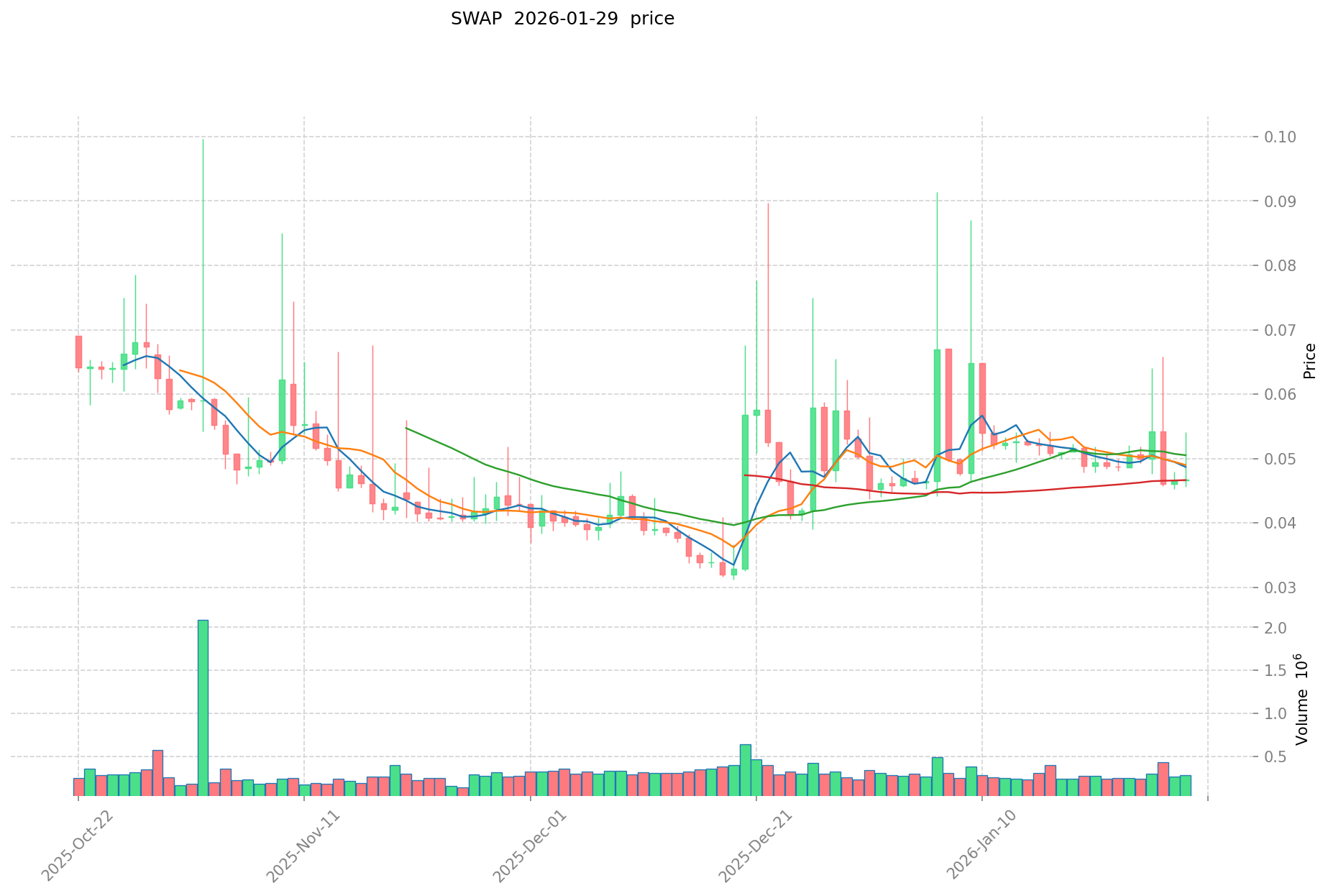
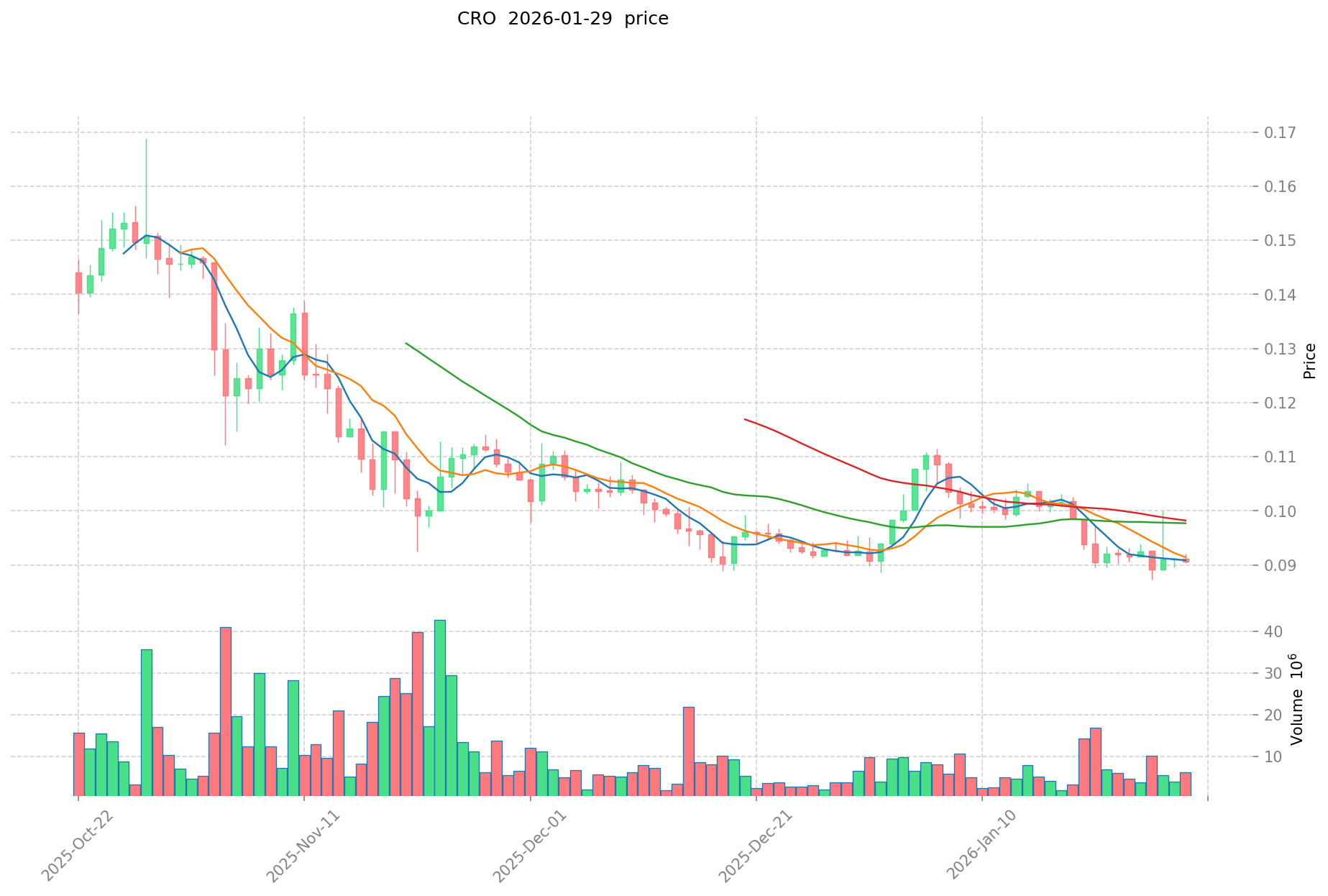
II. Core Factors Influencing SWAP vs CRO Investment Value
Supply Mechanism Comparison (Tokenomics)
- CRO: Features a token burn mechanism where a portion of transaction fees is permanently removed from circulation, creating potential deflationary pressure over time.
- SWAP: Operates with a fixed maximum supply structure designed to support its DeFi ecosystem services.
- 📌 Historical Pattern: Supply mechanisms have historically influenced price cycles, with deflationary models potentially supporting long-term value appreciation during periods of increasing demand.
Institutional Adoption and Market Applications
- Institutional Holdings: CRO has attracted attention from institutional participants, particularly following developments related to ETF applications in 2025.
- Enterprise Adoption: CRO serves as the native token for Crypto.com's ecosystem, facilitating payment solutions and platform services, while SWAP focuses on decentralized financial applications within its protocol framework.
- Regulatory Environment: Different jurisdictions maintain varying approaches toward cryptocurrency regulation, with some regions showing more favorable stances toward established payment-focused tokens.
Technology Development and Ecosystem Building
- CRO Technical Evolution: The Cronos network continues to integrate open-source blockchain technology, aiming to position digital currencies as viable payment alternatives alongside traditional fiat currencies.
- SWAP Technical Development: Development focuses on enhancing its DeFi protocol capabilities and expanding application scenarios within decentralized finance.
- Ecosystem Comparison: CRO demonstrates broader integration across payment systems and exchange infrastructure, while SWAP concentrates on DeFi-specific use cases including token swaps and liquidity provision.
Macroeconomic Environment and Market Cycles
- Performance During Inflation: Digital assets demonstrate varying responses to inflationary environments, with established tokens potentially serving as alternative stores of value.
- Macroeconomic Monetary Policy: Interest rate adjustments and currency strength fluctuations influence investor appetite for cryptocurrency assets across both tokens.
- Geopolitical Factors: Cross-border transaction demand and international developments continue to shape adoption patterns and market sentiment for digital payment solutions.
III. 2026-2031 Price Prediction: SWAP vs CRO
Short-term Forecast (2026)
- SWAP: Conservative $0.0384 - $0.0468 | Optimistic $0.0468 - $0.0515
- CRO: Conservative $0.0746 - $0.0898 | Optimistic $0.0898 - $0.0952
Mid-term Forecast (2028-2029)
- SWAP may enter a consolidation phase, with estimated price range of $0.0323 - $0.0607
- CRO may enter an expansion phase, with estimated price range of $0.0658 - $0.148
- Key drivers: institutional capital inflows, ETF developments, ecosystem growth
Long-term Forecast (2030-2031)
- SWAP: Baseline scenario $0.0340 - $0.0596 | Optimistic scenario $0.0429 - $0.0614
- CRO: Baseline scenario $0.0709 - $0.140 | Optimistic scenario $0.112 - $0.153
View detailed price predictions for SWAP and CRO
Disclaimer
SWAP:
| Year |
Predicted High Price |
Predicted Average Price |
Predicted Low Price |
Price Change |
| 2026 |
0.051458 |
0.04678 |
0.0383596 |
0 |
| 2027 |
0.05353971 |
0.049119 |
0.04076877 |
5 |
| 2028 |
0.06210851955 |
0.051329355 |
0.03233749365 |
9 |
| 2029 |
0.06068926288425 |
0.056718937275 |
0.04594233919275 |
21 |
| 2030 |
0.060465223082013 |
0.058704100079625 |
0.034048378046182 |
25 |
| 2031 |
0.061372201428243 |
0.059584661580819 |
0.042900956338189 |
27 |
CRO:
| Year |
Predicted High Price |
Predicted Average Price |
Predicted Low Price |
Price Change |
| 2026 |
0.0952304 |
0.08984 |
0.0745672 |
0 |
| 2027 |
0.126773224 |
0.0925352 |
0.051819712 |
3 |
| 2028 |
0.14035739136 |
0.109654212 |
0.0657925272 |
22 |
| 2029 |
0.1475068459824 |
0.12500580168 |
0.1200055696128 |
39 |
| 2030 |
0.144431703261072 |
0.1362563238312 |
0.070853288392224 |
51 |
| 2031 |
0.152974974765288 |
0.140344013546136 |
0.112275210836908 |
56 |
IV. Investment Strategy Comparison: SWAP vs CRO
Long-term vs Short-term Investment Strategies
- SWAP: May appeal to investors focused on DeFi protocol development and decentralized financial applications, with consideration for higher volatility profiles
- CRO: May suit investors seeking exposure to established payment ecosystems and broader institutional adoption pathways, with relatively larger market capitalization positioning
Risk Management and Asset Allocation
- Conservative Investors: SWAP 20-30% vs CRO 70-80%
- Aggressive Investors: SWAP 40-50% vs CRO 50-60%
- Hedging Tools: stablecoin allocation, options strategies, cross-asset portfolio construction
V. Potential Risk Comparison
Market Risk
- SWAP: Lower liquidity with 24-hour trading volume of $13,445.11 may result in higher price volatility during market fluctuations
- CRO: Higher liquidity with 24-hour trading volume of $895,874.34 provides relatively more stable trading conditions, though still subject to broader market cycles
Technical Risk
- SWAP: Scalability considerations and network stability factors related to DeFi protocol infrastructure
- CRO: Network performance dependencies and security considerations within the broader Cronos blockchain ecosystem
Regulatory Risk
- Global regulatory developments may impact both tokens differently, with payment-focused tokens potentially facing distinct compliance requirements compared to DeFi-specific protocols across various jurisdictions
VI. Conclusion: Which Is the Better Buy?
📌 Investment Value Summary:
- SWAP Characteristics: Focuses on DeFi protocol applications with specialized use cases in decentralized finance, operating at lower price points with higher volatility potential
- CRO Characteristics: Benefits from established ecosystem integration with Crypto.com infrastructure, broader institutional recognition, and larger market capitalization positioning
✅ Investment Considerations:
- Beginning Investors: May consider starting with CRO given its larger market capitalization, higher liquidity, and established ecosystem partnerships
- Experienced Investors: Could evaluate portfolio diversification across both tokens based on risk tolerance, with consideration for distinct use case profiles and market positioning
- Institutional Participants: May focus on CRO given institutional adoption trends and ETF-related developments, while monitoring regulatory clarity developments
⚠️ Risk Disclaimer: Cryptocurrency markets exhibit substantial volatility. This content does not constitute investment advice.
VII. FAQ
Q1: What is the main difference between SWAP and CRO in terms of their use cases?
SWAP primarily focuses on DeFi protocol applications and decentralized financial services, while CRO serves as the native token for the broader Cronos ecosystem and Crypto.com payment infrastructure. SWAP was launched in 2020 as a payment platform designed to facilitate secure fund exchanges with automated delivery systems, concentrating on specialized DeFi applications including token swaps and liquidity provision. In contrast, CRO, launched in 2018, operates within a more comprehensive blockchain ecosystem partnering with Crypto.com, targeting an addressable user base of over 100 million people globally with emphasis on payment solutions, decentralized finance, and gaming applications.
Q2: Which token has higher liquidity and what does this mean for investors?
CRO demonstrates significantly higher liquidity with a 24-hour trading volume of $895,874.34 compared to SWAP's $13,445.11 as of January 29, 2026. This substantial liquidity difference means that CRO typically offers more stable trading conditions, tighter bid-ask spreads, and easier entry/exit positions for investors. Lower liquidity in SWAP may result in higher price volatility during market fluctuations and potentially larger slippage when executing trades, which represents an important consideration for both short-term traders and long-term holders when managing position sizes.
Q3: How do the historical price performances of SWAP and CRO compare?
SWAP reached its all-time high of $5.00 on April 16, 2021, but declined substantially to its current price of $0.04678, representing a significant correction from peak levels. CRO achieved its all-time high of $0.965407 on November 24, 2021, and currently trades at $0.08981, demonstrating relatively more resilient price action compared to SWAP. During the 2021-2022 market cycle, both tokens experienced corrections, but CRO maintained a stronger market capitalization position and demonstrated comparatively better price stability, likely attributed to its broader ecosystem integration and higher institutional adoption.
Q4: What are the price predictions for SWAP and CRO through 2031?
According to current forecasts, SWAP is projected to trade within a range of $0.0384-$0.0515 in 2026, potentially reaching $0.0429-$0.0614 by 2031 under optimistic scenarios. CRO shows stronger growth projections, with estimates of $0.0746-$0.0952 for 2026 and potentially reaching $0.112-$0.153 by 2031 in optimistic scenarios. The mid-term forecast (2028-2029) suggests SWAP may enter a consolidation phase ($0.0323-$0.0607), while CRO could experience an expansion phase ($0.0658-$0.148), driven by factors including institutional capital inflows, ETF developments, and ecosystem growth. These predictions reflect CRO's larger market capitalization and broader adoption potential.
Q5: What type of investor profile suits each token?
Beginning investors may find CRO more suitable given its larger market capitalization, higher liquidity, and established ecosystem partnerships with Crypto.com, offering relatively more stable trading conditions. Experienced investors with higher risk tolerance could evaluate SWAP for portfolio diversification, considering its specialized DeFi protocol focus and higher volatility potential. Conservative investors might allocate 70-80% to CRO versus 20-30% to SWAP, while aggressive investors could consider a more balanced 50-60% CRO and 40-50% SWAP allocation. Institutional participants may focus primarily on CRO given institutional adoption trends and ETF-related developments.
Q6: What are the key risks associated with investing in SWAP versus CRO?
SWAP's primary risks include lower liquidity leading to higher price volatility, scalability considerations related to DeFi protocol infrastructure, and network stability factors. With a 24-hour trading volume of only $13,445.11, SWAP investors face potential challenges with position entry/exit and increased slippage during market fluctuations. CRO's risks involve network performance dependencies within the Cronos blockchain ecosystem and security considerations related to its broader infrastructure. Both tokens face regulatory risk, though payment-focused tokens like CRO may encounter distinct compliance requirements compared to DeFi-specific protocols like SWAP across various jurisdictions. The current market sentiment index of 26 (Fear) indicates overall cautious market conditions affecting both assets.
Q7: How do the tokenomics and supply mechanisms differ between SWAP and CRO?
CRO features a token burn mechanism where a portion of transaction fees is permanently removed from circulation, creating potential deflationary pressure over time that may support long-term value appreciation during periods of increasing demand. SWAP operates with a fixed maximum supply structure designed to support its DeFi ecosystem services without an active burn mechanism. Historical patterns suggest that deflationary models like CRO's can potentially influence price cycles positively, though actual market performance depends on multiple factors including demand, adoption rates, and broader market conditions. These distinct supply mechanisms represent fundamental differences in how each token approaches long-term value proposition and scarcity dynamics.
Q8: What role does institutional adoption play in the investment comparison between SWAP and CRO?
Institutional adoption represents a significant differentiating factor between the two tokens. CRO has attracted attention from institutional participants, particularly following developments related to ETF applications in 2025, and benefits from its integration with Crypto.com's established infrastructure serving over 100 million users globally. This institutional recognition provides CRO with potentially greater legitimacy, liquidity support, and mainstream adoption pathways. SWAP, focusing on decentralized financial applications within its protocol framework, has not demonstrated the same level of institutional engagement. For investors prioritizing institutional validation and mainstream adoption potential as investment criteria, CRO's positioning offers distinct advantages in ecosystem partnerships, enterprise adoption, and regulatory engagement compared to SWAP's more specialized DeFi focus.
* The information is not intended to be and does not constitute financial advice or any other recommendation of any sort offered or endorsed by Gate.