TMAI vs ICP: Comparing Two Leading Internet Computer Protocol Solutions for Decentralized Applications
Introduction: Investment Comparison Between TMAI and ICP
In the cryptocurrency market, the comparison between TMAI vs ICP has become a topic of interest for investors exploring different segments of the crypto ecosystem. These two projects exhibit notable differences in market capitalization ranking, application scenarios, and price performance, representing distinct positioning within the digital asset landscape.
Token Metrics AI (TMAI): Launched in December 2024, this project positions itself as an AI-powered tool provider for the crypto community, offering automated trading bots compatible with both centralized and decentralized exchanges.
Internet Computer (ICP): Since its inception in 2019, ICP has established itself as a decentralized cloud blockchain designed to host secure applications, websites, and enterprise systems while enabling trustless multi-chain interactions.
This article will provide a comprehensive analysis of TMAI vs ICP investment value comparison, examining historical price trends, supply mechanisms, institutional adoption, technical ecosystems, and future projections. We aim to address investors' most pressing question:
"Which presents a more compelling investment opportunity at this stage?"
I. Historical Price Comparison and Current Market Status
Token Metrics AI (TMAI) and Internet Computer (ICP) Historical Price Trends
-
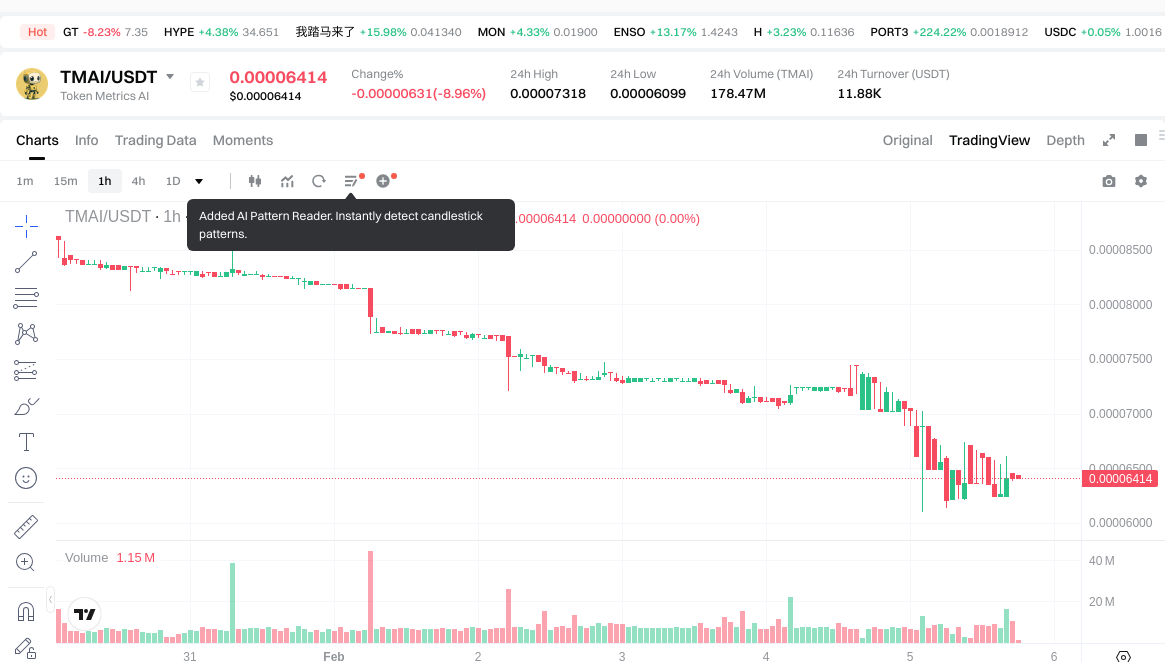
December 2024: TMAI reached a notable price level of $0.017747 on December 17, 2024, representing a significant early trading peak following its market launch on December 3, 2024.
-
May 2021: ICP experienced substantial market activity, with price levels reaching $700.65 on May 11, 2021, during a period of heightened interest in blockchain infrastructure projects.
-
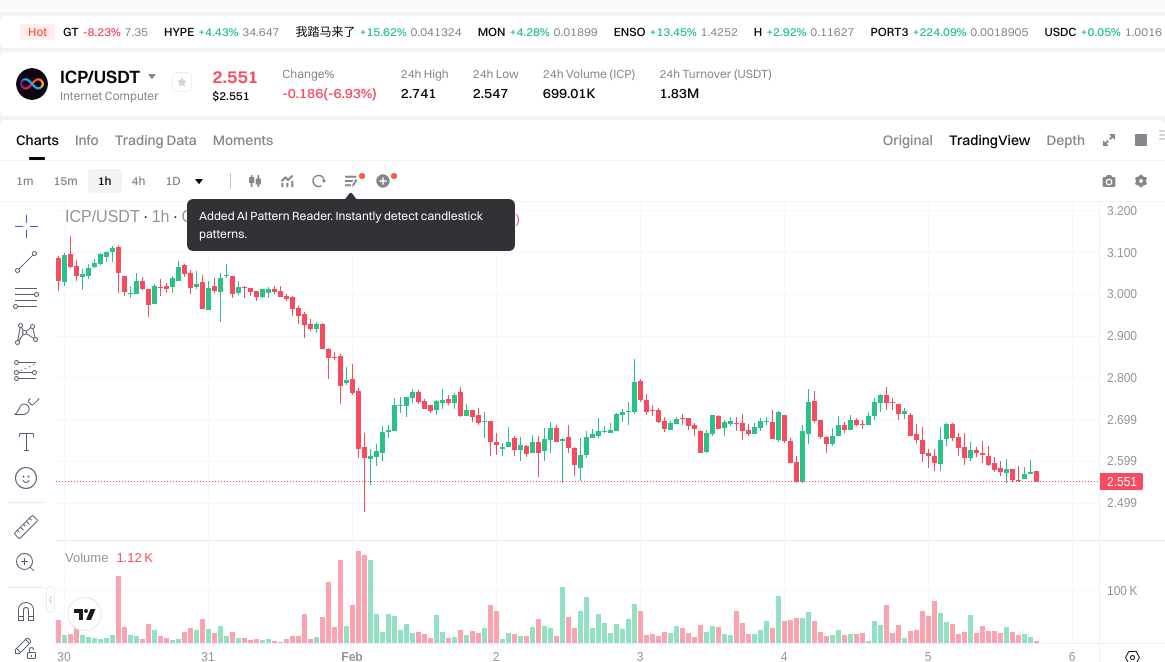
October 2025: ICP recorded a lower price point of $2.23 on October 11, 2025, reflecting broader market adjustments.
-
Comparative Analysis: During recent market cycles, TMAI has shown price movement from its December 2024 peak of $0.017747 to lower levels around $0.00006099 by February 2026, while ICP has experienced a decline from historical levels above $700 to a range near $2.557 during the same period.
Current Market Status (February 05, 2026)
- TMAI Current Price: $0.00006442
- ICP Current Price: $2.557
- 24-Hour Trading Volume: TMAI recorded $11,907.87 compared to ICP's $1,839,407.13
- Market Sentiment Index (Fear & Greed Index): 12 (Extreme Fear)
View real-time prices:
- Check TMAI current price Market Price
- Check ICP current price Market Price
II. Core Factors Influencing TMAI vs ICP Investment Value
Supply Mechanism Comparison (Tokenomics)
- TMAI: The investment value is influenced by supply-demand dynamics that fluctuate with market activity. Scarcity and limited supply characteristics play a role in value determination.
- ICP: Value is shaped by its supply mechanisms and distribution model, which affect token availability and market circulation.
- 📌 Historical patterns: Supply mechanisms influence price cycles through scarcity effects and distribution schedules, though specific mechanisms vary between tokens.
Institutional Adoption and Market Application
- Institutional holdings: Both tokens compete for institutional attention, with adoption influenced by technical capabilities and regulatory clarity.
- Enterprise adoption: ICP demonstrates applications in cross-border payments and enterprise use cases, while TMAI's institutional adoption patterns relate to its specific use case positioning.
- National policies: Regulatory attitudes toward both tokens vary across jurisdictions, affecting their adoption trajectories and market accessibility.
Technology Development and Ecosystem Building
- TMAI technology: Development focuses on its core value proposition, with ecosystem growth dependent on market dynamics and investor sentiment.
- ICP technology: Technical ecosystem encompasses various blockchain applications, with infrastructure supporting decentralized services and enterprise solutions.
- Ecosystem comparison: Both tokens operate in different technological niches, with varying degrees of DeFi integration, smart contract capabilities, and practical application scenarios.
Macroeconomic Environment and Market Cycles
- Performance in inflationary environments: Both tokens respond to macroeconomic conditions, though their inflation-hedging properties depend on multiple factors including adoption rates and market perception.
- Macroeconomic monetary policy: Interest rates and currency fluctuations influence crypto asset valuations, affecting both TMAI and ICP through market liquidity and risk appetite changes.
- Geopolitical factors: Cross-border transaction demand and international developments create varying impacts on digital asset adoption and valuation across different tokens.
III. 2026-2031 Price Forecast: TMAI vs ICP
Short-term Forecast (2026)
- TMAI: Conservative 0.0000551604 - 0.00006414 | Optimistic 0.00006414 - 0.0000718368
- ICP: Conservative 1.8615 - 2.55 | Optimistic 2.55 - 3.1875
Mid-term Forecast (2028-2029)
- TMAI may enter a consolidation phase with projected price range of 0.0000418808544 - 0.00008528464896, showing potential volatility with price change variations between 18% and 25%
- ICP may enter a growth phase with projected price range of 3.1749890625 - 5.136463884375, reflecting steady expansion with price change variations between 30% and 42%
- Key drivers: institutional capital inflows, ETF developments, ecosystem expansion
Long-term Forecast (2030-2031)
- TMAI: Baseline scenario 0.000059277704435 - 0.000082330145049 | Optimistic scenario 0.000118555408871 - 0.000128566754509
- ICP: Baseline scenario 3.906809001984375 - 4.3896730359375 | Optimistic scenario 5.135917452046875 - 6.048749959870078
Disclaimer
The price forecasts presented are based on historical data analysis and market trend projections. Cryptocurrency markets are highly volatile and subject to numerous unpredictable factors including regulatory changes, technological developments, and macroeconomic conditions. These projections should not be construed as investment advice or guarantees of future performance. Users should conduct their own research and consult with financial professionals before making any investment decisions.
TMAI:
| Year | Predicted High Price | Predicted Average Price | Predicted Low Price | Price Change |
|---|---|---|---|---|
| 2026 | 0.0000718368 | 0.00006414 | 0.0000551604 | 0 |
| 2027 | 0.000084305616 | 0.0000679884 | 0.00005779014 | 5 |
| 2028 | 0.00008528464896 | 0.000076147008 | 0.0000418808544 | 18 |
| 2029 | 0.000083944461619 | 0.00008071582848 | 0.000068608454208 | 25 |
| 2030 | 0.000118555408871 | 0.000082330145049 | 0.000059277704435 | 27 |
| 2031 | 0.000128566754509 | 0.00010044277696 | 0.000079349793798 | 55 |
ICP:
| Year | Predicted High Price | Predicted Average Price | Predicted Low Price | Price Change |
|---|---|---|---|---|
| 2026 | 3.1875 | 2.55 | 1.8615 | 0 |
| 2027 | 3.8154375 | 2.86875 | 2.6105625 | 12 |
| 2028 | 3.943670625 | 3.34209375 | 3.1749890625 | 30 |
| 2029 | 5.136463884375 | 3.6428821875 | 3.205736325 | 42 |
| 2030 | 5.135917452046875 | 4.3896730359375 | 3.906809001984375 | 71 |
| 2031 | 6.048749959870078 | 4.762795243992187 | 4.33414367203289 | 86 |
IV. Investment Strategy Comparison: TMAI vs ICP
Long-term vs Short-term Investment Strategies
-
TMAI: May appeal to investors exploring early-stage technology tools with exposure to AI-powered trading applications. The token's recent market entry and lower price point position it as a speculative opportunity with corresponding volatility characteristics.
-
ICP: May suit investors interested in decentralized cloud infrastructure and enterprise blockchain solutions. The project's established operational history since 2019 and technical ecosystem development provide a different risk-return profile compared to newer market entrants.
Risk Management and Asset Allocation
-
Conservative investors: A portfolio approach might consider TMAI: 10-20% vs ICP: 30-40%, with remaining allocation to established cryptocurrencies and stablecoins to manage overall portfolio volatility.
-
Aggressive investors: Portfolio construction could explore TMAI: 30-40% vs ICP: 40-50%, accepting higher volatility in pursuit of potential returns, while maintaining diversification across different cryptocurrency segments.
-
Hedging tools: Risk management strategies may include stablecoin allocations for liquidity preservation, options instruments for downside protection, and cross-asset diversification to mitigate concentration risk.
V. Potential Risk Comparison
Market Risks
-
TMAI: The token faces market risks associated with limited trading history, lower liquidity levels (24-hour volume of $11,907.87), and price sensitivity to market sentiment shifts. New market entrants typically experience elevated volatility during early trading phases.
-
ICP: Market risks include price fluctuations influenced by broader cryptocurrency market cycles, competitive pressures from alternative blockchain infrastructure projects, and sentiment changes affecting layer-1 protocols.
Technical Risks
-
TMAI: Technical considerations relate to the operational performance of its trading bot infrastructure, integration reliability across multiple exchange platforms, and the effectiveness of its AI-powered mechanisms under varying market conditions.
-
ICP: Technical factors include network scalability challenges, potential vulnerabilities in smart contract implementations, and the complexity of maintaining decentralized cloud infrastructure across distributed nodes.
Regulatory Risks
- Global regulatory developments affect both tokens differently based on their functional characteristics. TMAI's positioning as an AI trading tool may face scrutiny related to automated trading regulations, while ICP's infrastructure role intersects with data sovereignty and cross-border service provision frameworks. Regulatory clarity varies significantly across jurisdictions, creating compliance uncertainties for both projects.
VI. Conclusion: Which Is the Better Buy?
📌 Investment Value Summary:
-
TMAI advantages: Early-stage entry point with exposure to AI-powered cryptocurrency trading tools; lower absolute price providing accessibility for smaller capital allocations; potential for ecosystem development as the project matures.
-
ICP advantages: Established technical infrastructure with operational history since 2019; developed ecosystem supporting decentralized applications and enterprise solutions; higher trading liquidity facilitating position management.
✅ Investment Considerations:
-
New investors: Consider starting with established cryptocurrencies before exploring tokens like TMAI and ICP. If allocating to these assets, diversification across multiple projects and maintaining position sizing appropriate to risk tolerance remains important.
-
Experienced investors: Portfolio construction may involve comparative analysis of TMAI's growth potential versus ICP's infrastructure positioning. Technical due diligence, ecosystem monitoring, and regular rebalancing can support informed decision-making.
-
Institutional investors: Evaluation criteria may emphasize regulatory compliance frameworks, liquidity depth for larger position sizes, custody solutions, and alignment with institutional investment mandates. Both tokens present different considerations regarding these factors.
⚠️ Risk Disclosure: Cryptocurrency markets exhibit extreme volatility and involve substantial risk of loss. This content does not constitute investment advice, financial guidance, or trading recommendations. Investors should conduct independent research and consult qualified financial professionals before making investment decisions.
VII. FAQ
Q1: What are the main differences between TMAI and ICP in terms of project positioning?
TMAI is an AI-powered trading tool provider for cryptocurrency markets, while ICP is a decentralized cloud blockchain infrastructure platform. TMAI launched in December 2024 focuses on automated trading bots compatible with centralized and decentralized exchanges, targeting traders seeking algorithmic solutions. ICP, operational since 2019, provides blockchain infrastructure for hosting secure applications, websites, and enterprise systems with trustless multi-chain capabilities, positioning itself as a decentralized alternative to traditional cloud computing services.
Q2: How do the current market capitalizations and trading volumes compare between TMAI and ICP?
As of February 05, 2026, ICP demonstrates significantly higher market liquidity and established trading presence compared to TMAI. ICP's 24-hour trading volume stands at $1,839,407.13 with a current price of $2.557, while TMAI shows a 24-hour volume of $11,907.87 at a price of $0.00006442. This substantial difference in trading activity reflects ICP's longer market presence and broader adoption, whereas TMAI represents an early-stage project with lower liquidity characteristics typical of recent market entrants.
Q3: What are the projected price ranges for TMAI and ICP by 2031?
According to baseline forecasts, TMAI projects a price range of $0.000059277704435 to $0.000082330145049 by 2030, with optimistic scenarios reaching $0.000118555408871 to $0.000128566754509 by 2031. ICP forecasts indicate a baseline range of $3.906809001984375 to $4.3896730359375 by 2030, with optimistic projections of $5.135917452046875 to $6.048749959870078 by 2031. These forecasts suggest ICP maintains higher absolute price levels while TMAI shows potential percentage growth from its lower base, though both projections carry significant uncertainty given cryptocurrency market volatility.
Q4: What are the primary risk factors investors should consider for each token?
TMAI faces risks associated with limited trading history, lower liquidity levels, early-stage project execution challenges, and regulatory uncertainty surrounding automated trading tools. ICP encounters risks including competition from alternative blockchain infrastructure projects, technical scalability challenges, smart contract vulnerabilities, and regulatory considerations related to decentralized cloud services and data sovereignty. Both tokens are subject to broader cryptocurrency market volatility, macroeconomic conditions, and evolving regulatory frameworks across different jurisdictions.
Q5: How do institutional adoption patterns differ between TMAI and ICP?
ICP demonstrates more established institutional engagement through its enterprise-focused blockchain infrastructure, supporting cross-border payments and decentralized application hosting for business use cases. The project's longer operational history since 2019 has allowed development of partnerships and enterprise adoption patterns. TMAI, as a December 2024 launch, remains in early stages of institutional adoption, with its value proposition centered on AI-powered trading tools rather than infrastructure services. Institutional interest in TMAI would likely depend on demonstrated performance of its trading mechanisms and regulatory clarity around automated trading services.
Q6: What portfolio allocation strategies might suit different investor profiles for TMAI vs ICP?
Conservative investors might consider TMAI allocation of 10-20% versus ICP allocation of 30-40%, with remaining portfolio in established cryptocurrencies and stablecoins to manage volatility. Aggressive investors could explore TMAI allocation of 30-40% versus ICP allocation of 40-50%, accepting higher risk for potential returns while maintaining diversification. These strategies reflect TMAI's higher-risk, early-stage characteristics compared to ICP's more established infrastructure positioning. All allocation decisions should align with individual risk tolerance, investment timeframes, and broader portfolio objectives.
Q7: How do supply mechanisms affect the investment value of TMAI versus ICP?
Both tokens utilize supply mechanisms that influence value through scarcity effects and distribution schedules, though specific tokenomics differ between projects. TMAI's value responds to supply-demand dynamics that fluctuate with market activity and limited supply characteristics. ICP's value is shaped by its distribution model affecting token availability and market circulation. Historical patterns suggest supply mechanisms influence price cycles through controlled release schedules and scarcity effects, though the impact varies based on market conditions, adoption rates, and overall cryptocurrency market cycles.
Q8: What technical considerations distinguish TMAI from ICP for potential investors?
TMAI's technical focus centers on AI-powered trading bot performance, reliability of integrations across multiple exchange platforms, and effectiveness of automated trading mechanisms under varying market conditions. ICP's technical considerations involve blockchain infrastructure scalability, smart contract security, decentralized cloud computing capabilities, and network node distribution. These technical differences reflect fundamentally different use cases - TMAI as an application-layer trading tool versus ICP as infrastructure-layer blockchain platform - creating distinct technical risk profiles and evaluation criteria for investors assessing long-term viability.
Share
Content
Introduction: Investment Comparison Between TMAI and ICP
I. Historical Price Comparison and Current Market Status
II. Core Factors Influencing TMAI vs ICP Investment Value
III. 2026-2031 Price Forecast: TMAI vs ICP
IV. Investment Strategy Comparison: TMAI vs ICP
V. Potential Risk Comparison
VI. Conclusion: Which Is the Better Buy?
VII. FAQ
How to Buy Cryptocurrency


Trending Cryptocurrencies



2025 SUI coin: price, buying guide, and Staking rewards

How to Buy Crypto: A Step-by-Step Guide with Gate.com

HNT Price in 2025: Helium Network Token Value and Market Analysis

What is SwissCheese (SWCH) and How Does It Democratize Investment?
Cardano (ADA) Price Analysis and Outlook for 2025
How to Invest in Metaverse Crypto
Cryptocurrency for Beginners: Which Coin Should You Invest In
A Comprehensive Overview of the Future Potential and Types of Altcoins
Comprehensive Guide to Decentralized Finance (DeFi)
Mining Calculator: How to Calculate Cryptocurrency Mining Profitability
What is Polygon?