Big Data Protocol (BDP) is a decentralized data tokenization platform launched in 2021 to monetize commercial data for DeFi participants. This comprehensive guide explores BDP's architecture, market dynamics, and ecosystem applications. Operating on Ethereum, BDP enables data providers, curators, and users to collaborate in a transparent marketplace where data tokens are traded and compensated fairly. The guide covers token economics, blockchain security mechanisms, price performance metrics, and active community engagement. With 9,980 token holders and trading capabilities on Gate and decentralized exchanges, BDP addresses critical data inefficiencies while presenting both opportunities and challenges. Discover how to participate, evaluate risks, and understand BDP's role in shaping the decentralized data economy.
Big Data Protocol's Position and Significance
In 2021, the Big Data Protocol team launched Big Data Protocol (BDP), aiming to address the inefficiencies in data monetization and the lack of accessible commercial data for DeFi participants.
As a data tokenization platform connecting professional data providers with DeFi users, Big Data Protocol plays a key role in the intersection of data markets and decentralized finance.
As of 2026, Big Data Protocol continues to operate within the data and DeFi ecosystem, with 9,980 token holders and an active presence on the Ethereum blockchain.
This article will provide an in-depth analysis of its technical architecture, market performance, and future potential.
Origin and Development History
Background
Big Data Protocol was created by its founding team in 2021, aiming to solve the challenges of bringing commercially valuable data into the DeFi ecosystem and enabling fair compensation for data providers.
It emerged during the DeFi boom, with the goal of tokenizing valuable datasets and creating liquid markets for data on decentralized exchanges to change the status quo.
The launch of Big Data Protocol brought new possibilities to data providers, curators, and DeFi participants seeking actionable market intelligence.
Key Milestones
- 2021: Protocol launch on Ethereum mainnet, establishing a network of data providers and enabling data token liquidity on Uniswap.
- The project introduced a burn mechanism for BDP tokens to access protocol features, incentivizing token holders with exclusive data access and airdrops.
- The platform grew to include data submission capabilities for providers and curation services, building an ecosystem around tokenized data.
With support from its community and token holders, Big Data Protocol has continued to refine its approach to data tokenization and market creation.
How Big Data Protocol Works?
Decentralized Data Marketplace
Big Data Protocol operates on the Ethereum blockchain, functioning without centralized control over data distribution or pricing.
The network of data providers, curators, and users collaborates to validate and monetize data assets, ensuring transparency in data provenance and fair compensation for contributors.
Blockchain Foundation
Big Data Protocol's operations are recorded on the Ethereum blockchain, an immutable public ledger that tracks all data token creations, transactions, and protocol interactions.
Transactions are grouped into blocks and cryptographically linked, creating a secure and verifiable record.
Anyone can verify the history of data tokens and their liquidity provision, establishing trust without intermediaries.
The protocol leverages Ethereum's smart contract capabilities to automate data tokenization and distribution mechanisms.
Token Economics and Access
Big Data Protocol uses BDP tokens as the utility token for accessing protocol features and services.
Users must burn BDP tokens to access the protocol and pay fees for data submission, curation services, and marketplace transactions.
Token holders who maintain certain BDP balances unlock additional benefits, including access to exclusive datasets and eligibility for data token airdrops.
This deflationary mechanism creates scarcity while incentivizing long-term participation in the ecosystem.
Secure Data Tokenization
Big Data Protocol employs Ethereum's cryptographic infrastructure to secure data token transactions:
- Private keys enable data providers and curators to authorize submissions and manage their assets
- Public addresses verify ownership and transaction authenticity on-chain
This mechanism ensures that data tokens remain secure and transactions maintain pseudonymous privacy consistent with Ethereum standards.
The protocol's smart contracts govern the creation, distribution, and trading of data tokens, automating trust in a permissionless environment.
Circulation Overview
As of February 7, 2026, Big Data Protocol's circulating supply stands at 24,159,174.39 BDP tokens, with a total supply of 64,923,252.85 tokens and a maximum supply capped at 80,000,000 tokens. The circulating supply represents approximately 30.2% of the total supply, indicating a controlled token release strategy. The protocol operates on the Ethereum blockchain through smart contracts, with tokens distributed across various stakeholders including data providers, curators, and the community.
Price Volatility
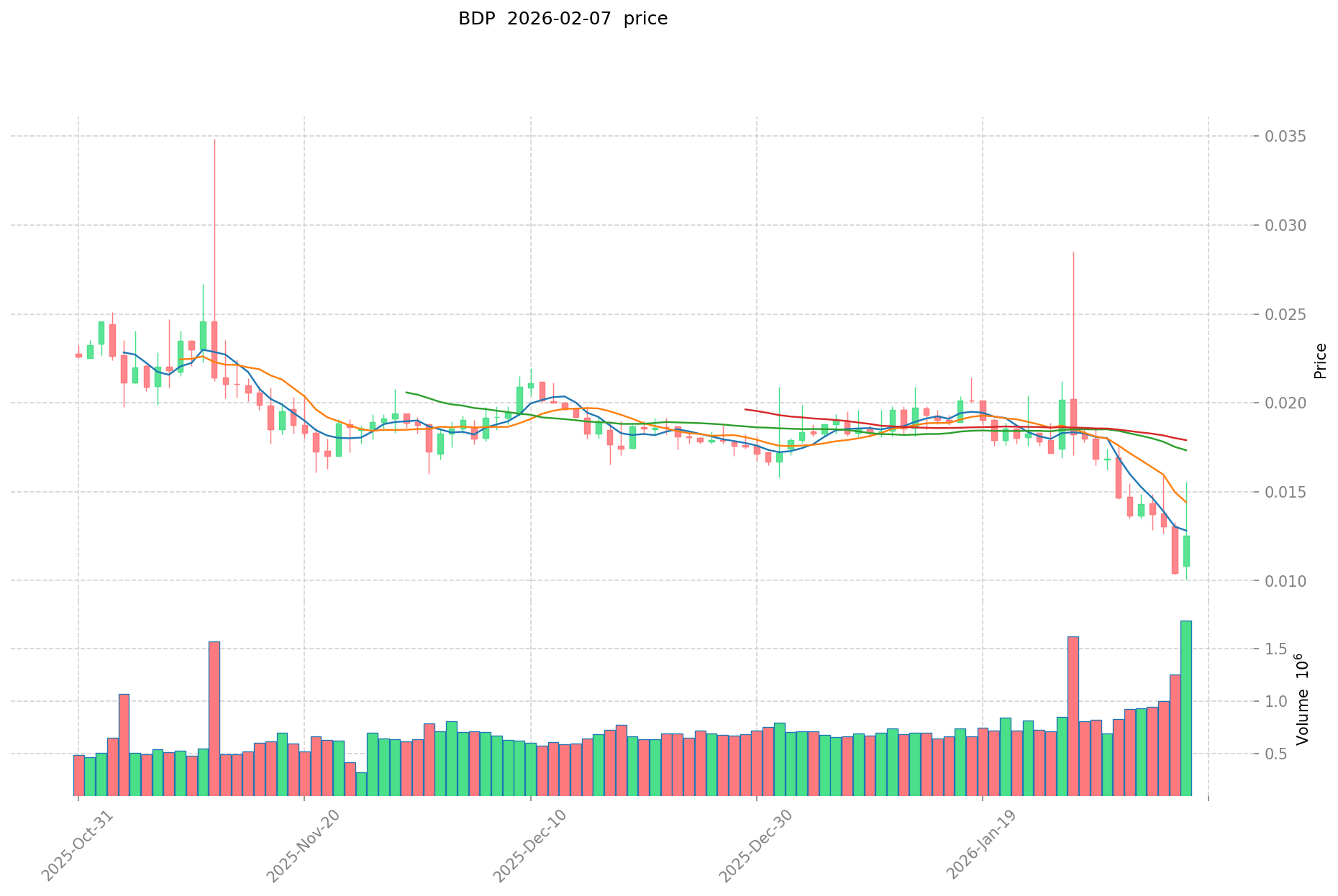
Big Data Protocol reached its peak price of $14.93 on March 7, 2021, during a period of heightened interest in decentralized data solutions and the broader cryptocurrency market expansion. The token's lowest recorded price was $0.01059811 on February 6, 2026, reflecting market corrections and evolving sentiment in the data tokenization sector. Currently trading at $0.01269, the token has experienced significant price movements with a 12.76% increase over the past 24 hours, though it remains down 24.69% over the past week and 32.12% over the past month. The one-year performance shows a decline of 81.04%, highlighting the volatility inherent in the cryptocurrency markets and shifts in investor interest.
Click to view the current BDP market price
On-chain Metrics
- 24-hour Trading Volume: Approximately $22,122.31 in trading volume, demonstrating active market participation
- Token Holders: 9,980 addresses currently hold BDP tokens, reflecting the distributed nature of token ownership
- Market Capitalization: The current market cap stands at $306,579.92, with a fully diluted valuation of $823,876.08
- Market Dominance: BDP represents 0.000033% of the total cryptocurrency market capitalization
Big Data Protocol Ecosystem Applications and Partners
Core Use Cases
Big Data Protocol's ecosystem supports multiple applications:
- Data Monetization: Uniswap integration, providing decentralized trading of data tokens.
- Data Curation: Professional data providers and curators, driving commercially valuable data tokenization and liquidity provision.
Strategic Partnerships
Big Data Protocol has established collaboration with professional data providers through a network of 14,141 participants, enhancing its data aggregation capabilities and market influence.
These partnerships provide a solid foundation for BDP's ecosystem expansion.
Challenges and Controversies
Big Data Protocol faces the following challenges:
- Market Volatility: Significant price fluctuations with recent declines
- Limited Exchange Availability: Currently available on a limited number of trading platforms
- Competitive Pressure: Competition from other data-related blockchain projects in the Web3 space
These issues have sparked discussions within the community and market, while also driving BDP's continuous innovation.
Big Data Protocol's community maintains active participation, with approximately 9,980 holders.
On X platform, related posts and hashtags (such as #BDP) generate regular engagement.
Price movements and protocol updates ignite community enthusiasm.
Sentiment on X shows mixed perspectives:
- Supporters praise BDP's data tokenization approach and decentralized data marketplace features, considering it a valuable innovation in the data economy.
- Critics focus on price volatility and limited exchange availability.
Recent trends reflect cautious sentiment amid market adjustments.
Hot Topics
X users actively discuss BDP's data tokenization model, liquidity mechanisms, and market performance,
showcasing both its transformative potential and challenges in achieving mainstream adoption.
- Official Website: Visit Big Data Protocol Official Website for features, use cases, and latest updates.
- X Updates: On X platform, Big Data Protocol maintains an active presence using @bigdataprotocol,
with posts covering protocol updates, community activities, and data marketplace developments, generating regular engagement from the community.
- Blockchain Explorer: Track BDP transactions on Etherscan.
- GitHub Repository: Access technical documentation and smart contracts at BDP GitHub.
Big Data Protocol Future Roadmap
- Ongoing Development: Enhancement of data tokenization infrastructure and curator network expansion, improving data quality and marketplace liquidity
- Ecosystem Goals: Expand data provider network and increase adoption of data tokens
- Long-term Vision: Become a leading decentralized data marketplace infrastructure
How to Participate in Big Data Protocol?
- Purchase Channels: Buy BDP on Gate.com
- Storage Solutions: Use hardware wallets or compatible Ethereum wallets for secure storage
- Participate in Ecosystem: Hold BDP tokens to unlock features including access to exclusive data sets and airdrops
- Build Ecosystem: Visit developer documentation to contribute to the data marketplace or develop applications
Conclusion
Big Data Protocol redefines data monetization through blockchain technology, providing transparency, decentralization, and efficient data trading mechanisms.
Its active community, comprehensive resources, and innovative approach position it uniquely in the cryptocurrency space.
Despite facing market volatility and adoption challenges, BDP's innovative model and clear value proposition give it an important role in the future of decentralized data economy.
Whether you are a newcomer or experienced participant, Big Data Protocol deserves attention and engagement.
FAQ
What is BDP and how does it work in the crypto ecosystem?
BDP is a token on the Big Data Protocol that tokenizes commercially valuable data assets. It enables users to monetize data contributions through decentralized networks, facilitating secure data trading and compensation for data providers in the DeFi ecosystem.
What are the main use cases and features of BDP?
BDP streamlines data workflows and reduces manual effort across retail, finance, and healthcare sectors. Key features include automated data processing, improved accuracy, and enhanced decision-making capabilities for enterprise operations.
How can I buy or acquire BDP tokens?
You can acquire BDP tokens through multiple cryptocurrency platforms including decentralized exchanges like Uniswap V2 on Ethereum, as well as centralized platforms. Simply connect your wallet, search for BDP, and complete your purchase transaction.
What are the risks and security considerations associated with BDP?
BDP security risks include smart contract vulnerabilities, private key management challenges, and market volatility. Users should enable multi-signature wallets, use hardware wallets for storage, and verify contract audits before participation.
How does BDP compare to other similar cryptocurrency projects?
BDP distinguishes itself through advanced big data analytics and decentralized infrastructure. With competitive market positioning and growing transaction volume, BDP offers superior scalability and real-time data aggregation capabilities compared to traditional blockchain projects, positioning it for significant growth in the Web3 ecosystem.
* The information is not intended to be and does not constitute financial advice or any other recommendation of any sort offered or endorsed by Gate.