What is BDP: A Comprehensive Guide to Business Data Platform and Its Applications in Modern Enterprise

Big Data Protocol's Positioning and Significance
In 2021, the Big Data Protocol team launched Big Data Protocol (BDP), aiming to address inefficiencies in commercial data monetization and accessibility. As a data tokenization platform leveraging decentralized networks, Big Data Protocol plays a key role in data markets and DeFi liquidity provision.
As of 2026, Big Data Protocol has established itself as a niche player in the data tokenization space, with a network of professional data providers and an active community of data curators. This article will provide an in-depth analysis of its technical architecture, market performance, and future potential.
Origin and Development History
Background
Big Data Protocol was created by its founding team in 2021, aiming to solve the challenge of making commercially valuable data accessible and tradable in decentralized markets. It emerged during the DeFi boom and growing interest in data-driven applications, with the goal of enabling data providers to monetize their assets while allowing users to access exclusive datasets through liquidity provision. The launch of Big Data Protocol brought new possibilities to data markets and decentralized finance participants.
Key Milestones
- 2021: Protocol launch on Ethereum, introducing data tokenization through Uniswap liquidity pools.
- 2021: Established a network of professional data providers, enabling commercial data to be tokenized and traded.
- 2021-2026: Continuous ecosystem development with features including BDP token burning mechanisms for protocol access and exclusive dataset unlocking through token holding.
With support from its community and data provider network, Big Data Protocol continues to refine its approach to data monetization and accessibility.
How Big Data Protocol Works?
Decentralized Data Network
Big Data Protocol operates through a network of professional data providers distributed globally, removing reliance on centralized data monopolies. These providers collaborate to submit and curate datasets, ensuring system transparency and data quality through community governance mechanisms. This structure empowers data creators with monetization opportunities while maintaining network resilience.
Blockchain Foundation
Big Data Protocol's infrastructure is built on Ethereum blockchain, providing a transparent and immutable record of data token transactions. Data tokens circulate on Uniswap, enabling liquid markets for commercially valuable datasets. The protocol leverages smart contracts to automate data access rights and payment distribution. Anyone can verify token ownership and transaction history without intermediaries.
Token Economics
Big Data Protocol uses BDP token burning and holding mechanisms to regulate access and incentivize participation. Users must burn BDP tokens to access the protocol for submitting datasets, providing curation services, and participating in data markets. Holding specific amounts of BDP unlocks functions and benefits, including access to exclusive datasets and airdrops of data tokens. This economic model aligns incentives between data providers, curators, and consumers.
Secure Transactions
Big Data Protocol uses cryptographic standards on Ethereum to protect transactions:
- Private keys (similar to secret passwords) are used to sign transactions
- Public keys (similar to account numbers) are used to verify ownership
This mechanism ensures fund security while maintaining transaction transparency on the blockchain. The protocol's smart contracts enforce access rules and payment distribution automatically, reducing counterparty risk in data transactions.
Big Data Protocol (BDP) Market Performance
Circulation Overview
As of February 07, 2026, Big Data Protocol has a circulating supply of 24,159,174.39 BDP tokens, with a total supply of 64,923,252.85 tokens. The maximum supply is capped at 80,000,000 tokens, representing a fixed supply model.
The current circulating supply accounts for approximately 30.2% of the total supply. Tokens enter the market through the protocol's tokenization mechanism, where commercially valuable data is tokenized via a network of professional data providers, and data tokens circulate on Uniswap. Users must hold a certain amount of BDP to unlock features and benefits, including access to exclusive datasets and airdropped data tokens.
Price Fluctuations
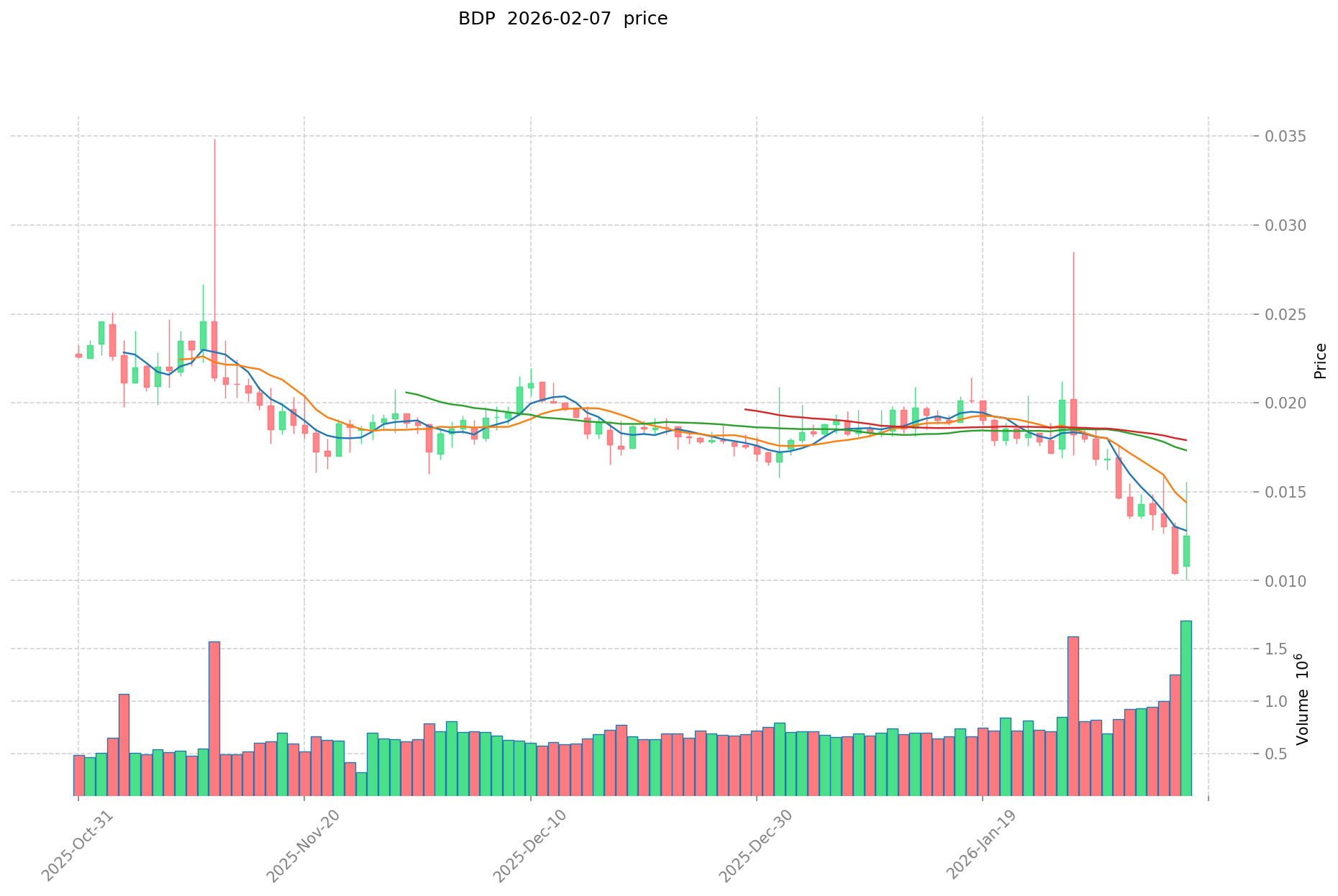
Big Data Protocol reached a notable price level of $14.93 on March 07, 2021, during a period of broader market activity in the cryptocurrency sector.
The token experienced a lower price point of $0.01059811 on February 06, 2026, reflecting market dynamics and trading conditions during that period.
Recent price movements show varied performance across different timeframes: a 11.14% change over 24 hours, a -25.09% change over 7 days, a -33.32% change over 30 days, and a -81.71% change over 1 year. These fluctuations reflect evolving market sentiment, adoption trends, and various external factors affecting the cryptocurrency market.
Click to view the current BDP market price
On-Chain Metrics
- Holder Count: Approximately 9,980 addresses hold BDP tokens (indicating community distribution)
- Market Capitalization: $296,433.07 based on circulating supply (reflecting current market valuation)
- Fully Diluted Market Cap: $796,608.31 based on maximum supply (representing potential full valuation)
Big Data Protocol Ecosystem Applications and Partners
Core Use Cases
Big Data Protocol's ecosystem supports multiple applications:
- Data Tokenization: Through a network of professional data providers, BDP tokenizes commercially valuable data and enables data token circulation on Uniswap, providing decentralized data trading.
- Liquidity Mining: Users can earn data tokens by providing liquidity for data tokens, driving community-driven data economics.
Strategic Partnerships
Big Data Protocol has established its position in the data tokenization space through integration with DeFi platforms like Uniswap. These partnerships provide a solid foundation for BDP's ecosystem expansion.
Controversies and Challenges
Big Data Protocol faces the following challenges:
- Technical Difficulties: Ensuring data quality and verification mechanisms in a decentralized environment
- Regulatory Risks: Potential compliance issues related to data privacy and tokenization regulations
- Competitive Pressure: Competition from other data-focused blockchain projects in the emerging data economy sector
These issues have sparked discussions within the community and market, while also driving BDP's continuous innovation.
Big Data Protocol Community and Social Media Atmosphere
Fan Enthusiasm
Big Data Protocol's community maintains steady engagement with approximately 9,980 token holders. On X platform, discussions around data tokenization and the project's utility token mechanism generate regular community interaction.
Social Media Sentiment
Sentiment on X shows mixed perspectives:
- Supporters praise BDP's innovative approach to data monetization and decentralized data markets, viewing it as "infrastructure for the data economy".
- Critics focus on price volatility and the complexity of the data tokenization model.
Recent trends show community interest remains focused on the project's core data tokenization functionality.
Hot Topics
X users actively discuss BDP's burn mechanism for protocol access, data provider network expansion, and liquidity incentive programs, showcasing both its transformative potential and the challenges in achieving mainstream data market adoption.
Big Data Protocol Additional Information Sources
- Official Website: Visit Big Data Protocol Official Website for features, use cases, and latest updates.
- X Updates: On X platform, Big Data Protocol is active through @bigdataprotocol, with posts covering protocol updates, data tokenization developments, and community activities.
- Technical Documentation: Visit the project's GitHub repository to explore smart contracts and technical implementations.
Big Data Protocol Future Roadmap
- Ecosystem Goals: Expand the data provider network and increase the variety of tokenized data sets
- Long-term Vision: Establish itself as a leading protocol for decentralized data monetization and distribution
How to Participate in Big Data Protocol?
- Purchase Channels: Acquire BDP on Gate.com
- Storage Solutions: Use compatible Ethereum wallets like MetaMask to securely store BDP tokens
- Participate in Governance: Hold BDP tokens to unlock platform features and access exclusive data sets
- Build Ecosystem: Data providers can submit datasets, curators can provide curation services through the protocol
Summary
Big Data Protocol is redefining data monetization through blockchain technology, providing transparency, decentralization, and efficient data token distribution. Its unique data tokenization model and integration with DeFi infrastructure position it distinctively in the cryptocurrency space. Despite facing regulatory uncertainties and market challenges, BDP's innovative approach to data economics gives it an important role in the future of decentralized data markets. Whether you are a newcomer or an experienced participant, Big Data Protocol deserves attention and engagement.
FAQ
What is Crypto BDP? What are its basic definition and core functions?
Crypto BDP is a market analysis tool that provides visual screening charts to help traders quickly identify market opportunities and trends. Its core function enables traders to efficiently filter and analyze trading volume data for better investment decision-making.
What distinguishes Crypto BDP from other cryptocurrency projects?
Crypto BDP focuses on big data services and blockchain scalability, offering unique value propositions. It emphasizes long-term growth potential in decentralized data infrastructure, enabling risk diversification for investors seeking exposure beyond traditional cryptocurrency projects.
How to buy and hold Crypto BDP? What wallet or exchange do I need?
To purchase Crypto BDP, use your credit or debit card on supported platforms. Store your BDP tokens in a compatible wallet like MetaMask or Trust Wallet. Ensure the platform supports BDP trading before proceeding with your purchase.
What are the risks of Crypto BDP? Is it safe to invest?
Crypto BDP carries high volatility risks with potential price fluctuations causing losses. Investors must assume full responsibility for their investment decisions. Independent risk assessment is essential before investing.
Crypto BDP的未来发展前景和路线图是怎样的?
Crypto BDP的未来前景广阔,将专注于全球扩展、增强安全性和降低交易延迟。通过多语言支持和合规节点布局,BDP将扩大全球影响力,同时减少访问延迟和合规摩擦,实现更高的采用率和市场价值增长。
What is the total supply of Crypto BDP? How is the tokenomics designed?
Crypto BDP's total supply details depend on specific project specifications. Tokenomics typically includes supply mechanisms, distribution schedules, and liquidity provisions designed to ensure long-term value sustainability and ecosystem development.
Share
Content
Big Data Protocol's Positioning and Significance
Origin and Development History
How Big Data Protocol Works?
Big Data Protocol (BDP) Market Performance
Big Data Protocol Ecosystem Applications and Partners
Controversies and Challenges
Big Data Protocol Community and Social Media Atmosphere
Big Data Protocol Additional Information Sources
Big Data Protocol Future Roadmap
How to Participate in Big Data Protocol?
Summary
FAQ
How to Buy Cryptocurrency


Trending Cryptocurrencies



What will be the market capitalization of USDC in 2025? Analysis of the stablecoin market landscape.

How is DeFi different from Bitcoin?

What is DeFi: Understanding Decentralized Finance in 2025

USDC stablecoin 2025 Latest Analysis: Principles, Advantages, and Web3 Eco-Applications

Development of Decentralized Finance Ecosystem in 2025: Integration of Decentralized Finance Applications with Web3

2025 USDT USD Complete Guide: A Must-Read for Newbie Investors
Which Are the Best Altcoins To Invest In

Cryptocurrency theft surpassed $2 billion in 2025—it's time to reconsider how we store digital assets

What is crypto arbitrage and how can you profit from it?

What Is Tokenomics? The Economics of Crypto Asset Tokens

What Is Slippage? How To Avoid It While Trading Cryptocurrencies?