What is BUZ: A Comprehensive Guide to Understanding the Latest Blockchain Utility Token


BUZ Economy's Positioning and Significance
In 2024, the development team launched BUZ Economy (BUZ), aiming to address the lack of efficient token launch infrastructure on the Base network.
As the first LaunchPad platform on Base, BUZ Economy plays a key role in token distribution and project incubation.
As of 2026, BUZ Economy has established itself as an emerging project in the Base ecosystem, with over 61,000 token holders and an active community.
This article will provide an in-depth analysis of its technical architecture, market performance, and future potential.
Origin and Development History
Background
BUZ Economy was created by its development team in 2024, aiming to solve the challenge of efficient and secure token launches within the Base network ecosystem.
It emerged during the rapid expansion of Layer 2 solutions and Base network adoption, with the goal of providing a trusted launchpad platform for emerging projects to facilitate growth.
The launch of BUZ Economy brought new possibilities for project teams and investors on Base.
Key Milestones
- August 2024: Token launch with initial trading on Gate.com, establishing market presence.
- 2024-2025: Platform development and ecosystem expansion, attracting multiple project launches.
- 2026: Community growth reaching over 61,000 holders, demonstrating sustained user engagement.
With community and platform development support, BUZ Economy continues to optimize its functionality, security, and real-world applications.
How BUZ Economy Operates
Decentralized Infrastructure
BUZ Economy operates on the Base network, a Layer 2 solution built on Ethereum, leveraging a decentralized infrastructure of nodes distributed globally.
These nodes collaborate to validate transactions, ensuring system transparency and attack resistance, providing users with greater autonomy and enhancing network resilience.
Blockchain Foundation
BUZ Economy's token operates on the Base blockchain, which maintains a public, immutable digital ledger recording all transactions.
Transactions are grouped into blocks and linked through cryptographic hashing to form a secure chain.
Anyone can view these records, establishing trust without intermediaries.
Base's optimistic rollup technology further enhances performance by processing transactions off-chain while maintaining Ethereum-level security.
Network Validation
BUZ Economy relies on Base network's consensus mechanism derived from Ethereum's Proof of Stake (PoS) to validate transactions and prevent fraudulent activities such as double-spending.
Validators maintain network security through staking and validation activities on the Ethereum mainchain, earning rewards.
The innovation includes significantly lower transaction costs and faster confirmation times compared to Ethereum Layer 1.
Secure Transactions
BUZ Economy utilizes public-private key cryptography to protect transactions:
- Private keys (similar to secret passwords) are used to sign transactions
- Public keys (similar to account numbers) are used to verify ownership
This mechanism ensures fund security while maintaining pseudonymous transaction privacy.
The Base network infrastructure provides additional security through Ethereum's established validator network and battle-tested security model.
BUZ Market Performance
Circulating Supply Overview
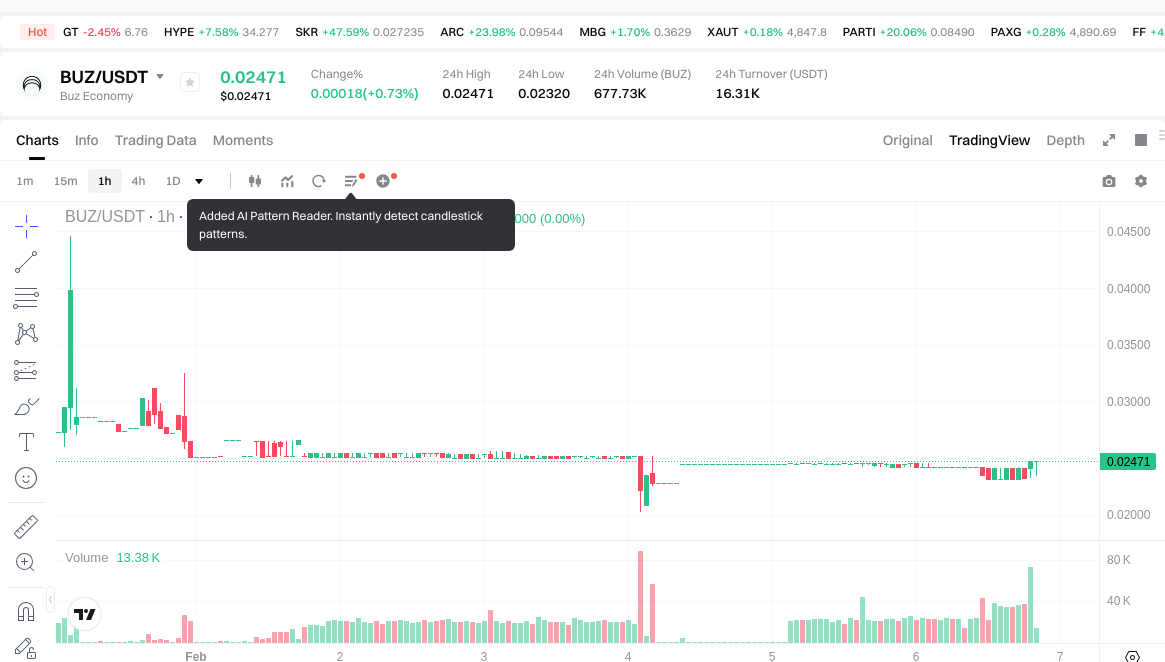
As of February 6, 2026, the circulating supply of BUZ stands at 15,000,000 tokens, with a total supply of 15,000,000 tokens, representing a fixed supply model.
Price Volatility
BUZ reached its all-time high price of $0.7645 on August 28, 2024. Its lowest price was $0.01906, recorded on January 19, 2026. These fluctuations reflect market sentiment, adoption trends, and external factors affecting the cryptocurrency ecosystem.
Click to view the current BUZ market price
On-chain Metrics
- Holder Addresses: 61,174 addresses (reflecting user participation)
- 24-hour Trading Volume: $16,296.81 (indicating network activity levels)
Buz Economy Ecosystem Applications and Partners
Core Use Cases
Buz Economy's ecosystem supports multiple applications:
- LaunchPad Services: As the first LaunchPad on Base, Buz Economy provides token launch and fundraising infrastructure for emerging blockchain projects.
- Community Building: The platform facilitates token distribution and community engagement mechanisms for Base ecosystem projects.
Strategic Partnerships
Buz Economy operates on the Base blockchain, leveraging its Layer 2 infrastructure to provide efficient and cost-effective services. These foundational relationships support Buz Economy's ecosystem expansion within the Base network.
Challenges and Discussions
Buz Economy faces several challenges:
- Market Volatility: The token has experienced price fluctuations, with a 28.04% decline over 30 days
- Competition Pressure: As more LaunchPad platforms emerge across different blockchain ecosystems, maintaining differentiation remains crucial
- Market Cap Scale: With a current market cap of approximately $370,650, expanding market presence and liquidity represents an ongoing challenge
These issues have sparked community and market discussions while driving Buz Economy's continued innovation.
Buz Economy Community and Social Media Atmosphere
Community Engagement
Buz Economy's community demonstrates solid growth, with 61,174 holders participating in the ecosystem. On X platform, the project maintains active engagement through its official handle, fostering discussions about LaunchPad opportunities and Base ecosystem developments. New project launches and platform updates generate community enthusiasm.
Social Media Sentiment
Sentiment on X shows varied perspectives:
- Supporters praise Buz Economy's position as Base's pioneering LaunchPad, viewing it as essential infrastructure for Base ecosystem growth.
- Critics focus on price volatility and market cap concerns.
Recent trends reflect cautious optimism as the Base ecosystem continues expanding.
Hot Topics
X users actively discuss Buz Economy's role in Base ecosystem development, token launch mechanisms, and competitive positioning, showcasing both its infrastructure potential and challenges in achieving broader market recognition.
More Information Sources for Buz Economy
- Official Website: Visit Buz Economy Official Site for features, use cases, and latest updates.
- X Updates: On X platform, Buz Economy maintains an active presence through @BuzEconomy, posting content about platform developments, project launches, and community activities, generating engagement from the Base ecosystem community.
- Blockchain Explorer: Track BUZ token activity on BaseScan for transparent transaction data.
Buz Economy Future Roadmap
- Ongoing Development: Expansion of LaunchPad services and integration features, enhancing project onboarding efficiency and user experience
- Ecosystem Goals: Supporting emerging projects on Base and contributing to the network's DeFi and application layer growth
- Long-term Vision: Establishing itself as Base's premier token launch infrastructure
How to Participate in Buz Economy?
- Purchase Channels: Acquire BUZ on Gate.com and other supporting platforms
- Storage Solutions: Securely store tokens using Base-compatible wallets such as MetaMask
- Participate in Ecosystem: Engage with launched projects through the Buz Economy platform
- Community Engagement: Follow official channels and participate in discussions about upcoming launches
Summary
Buz Economy serves as pioneering LaunchPad infrastructure on Base, providing transparent, efficient token launch services for emerging blockchain projects. Its active community, Base network integration, and specialized positioning distinguish it within the cryptocurrency landscape. Despite facing market volatility and competitive pressures, Buz Economy's infrastructure focus and ecosystem role position it as a noteworthy component of Base's development. Whether you're new to crypto or an experienced participant, Buz Economy's contribution to Base ecosystem growth merits attention.
FAQ
What is BUZ cryptocurrency? What are its main functions and uses?
BUZ is a community-driven decentralized cryptocurrency designed to provide long-term value through market activity and adoption. It enables free global transactions without government or financial institution control, offering users true financial sovereignty and peer-to-peer exchange capabilities.
How to acquire BUZ tokens? Which exchanges can I buy them on?
BUZ tokens can be purchased on centralized and decentralized exchanges. You can trade BUZ on major platforms through various trading pairs. Visit the official BUZ channels for current exchange listings and real-time trading information.
What is the team background and technical strength of the BUZ project?
BUZ team possesses deep expertise in AI and blockchain technology, providing intelligent DeFi services that enable ordinary users to easily participate in DeFi markets without requiring extensive technical knowledge.
What are the risks of investing in BUZ? What security issues should I pay attention to?
BUZ investment involves market volatility, liquidity, and credit risks. Secure your wallet with strong passwords, enable two-factor authentication, verify addresses before transactions, and stay informed on market conditions. Always conduct thorough research before investing.
What is the difference between BUZ and mainstream cryptocurrencies like Bitcoin and Ethereum?
BUZ differs through its consensus mechanism, transaction speed, and fees. Unlike Bitcoin's energy-intensive PoW and Ethereum's PoS, BUZ employs DPoS for greater efficiency, faster transactions, and lower fees.
What is the total supply of BUZ? What is the tokenomics model?
BUZ has a total supply of 1 billion tokens. The tokenomics allocates 37% for ecosystem development, 32.20% for community incentives, 20% for team, and 10.80% for investors. Team and investor allocations are locked in the first year, then linearly vested over 24 months thereafter.
Share
Content
BUZ Economy's Positioning and Significance
Origin and Development History
How BUZ Economy Operates
BUZ Market Performance
Buz Economy Ecosystem Applications and Partners
Challenges and Discussions
Buz Economy Community and Social Media Atmosphere
More Information Sources for Buz Economy
Buz Economy Future Roadmap
How to Participate in Buz Economy?
Summary
FAQ
How to Buy Cryptocurrency


Trending Cryptocurrencies



XZXX: A Comprehensive Guide to the BRC-20 Meme Token in 2025

Survey Note: Detailed Analysis of the Best AI in 2025

Detailed Analysis of the Best 10 GameFi Projects to Play and Earn in 2025

Kaspa’s Journey: From BlockDAG Innovation to Market Buzz
Best Crypto Wallets 2025: How to Choose and Secure Your Digital Assets

Popular GameFi Games in 2025

Is Taxa Network (TXT) a good investment?: A Comprehensive Analysis of Market Potential, Risk Factors, and Future Prospects

Is 3KDS (3KDS) a good investment?: A Comprehensive Analysis of Price Potential, Market Trends, and Risk Factors in 2024

Digital Rupee: A Comprehensive Guide to India's CBDC
Bitcoin Dominance Chart: What Is It and Why Is It Important?

What Is a Crypto Paper Wallet?