What is CREO: A Comprehensive Guide to Parametric 3D Design Software


Creo Engine's Positioning and Significance
In 2022, the Creo Engine team launched Creo Engine (CREO), aiming to address fragmentation in the web3 gaming ecosystem and inefficient user experiences across multiple gaming platforms.
As a unified web3 gaming ecosystem hub, Creo Engine plays a key role in blockchain gaming and GameFi.
As of 2026, Creo Engine has established itself within the web3 gaming space, with approximately 18,149 holders and an active community. The platform operates on the BSC chain and continues to develop its gaming ecosystem.
This article will provide an in-depth analysis of its technical architecture, market performance, and future potential.
Origin and Development History
Background of Creation
Creo Engine was created by its founding team in 2022, aiming to solve the disconnected nature of web3 gaming experiences and the lack of a centralized platform to connect various gaming worlds.
It emerged during the rapid expansion of blockchain gaming and the GameFi movement, with the goal of providing a comprehensive gaming hub that enhances user benefits and streamlines the web3 gaming experience.
Creo Engine's launch brought new possibilities to web3 gamers and blockchain gaming enthusiasts.
Important Milestones
- May 2022: CREO token officially launched, establishing the foundation for the gaming ecosystem.
- 2024: The platform experienced significant ecosystem development, expanding its gaming portfolio and user base.
- 2026: As of February, the ecosystem maintains 18,149 holders and continues to evolve its gaming hub infrastructure.
With support from its development team and gaming community, Creo Engine continues to optimize its platform, security features, and real-world gaming applications.
How Creo Engine Works?
Decentralized Infrastructure
Creo Engine operates on the BSC (Binance Smart Chain) network, utilizing a decentralized infrastructure that removes reliance on centralized gaming platforms.
The network's nodes collaborate to validate transactions and maintain the ecosystem, ensuring transparency and resistance to single points of failure, while empowering users with greater control over their gaming assets.
Blockchain Foundation
Creo Engine's blockchain foundation leverages BSC's public, immutable digital ledger that records all transactions involving CREO tokens and gaming activities.
Transactions are grouped into blocks and linked through cryptographic hashing to form a secure chain.
Anyone can view the transaction records, establishing trust without intermediaries.
The BSC infrastructure provides enhanced performance for gaming applications with faster transaction speeds and lower fees.
Network Security
Creo Engine utilizes BEP-20 token standard on BSC, which operates on a Proof of Staked Authority (PoSA) consensus mechanism to validate transactions and prevent fraudulent activities.
Validators maintain network security through staking and block validation, receiving rewards for their participation.
The innovation includes efficient transaction processing optimized for gaming applications and reduced gas fees.
Secure Transactions
Creo Engine employs public-private key cryptography to protect transactions:
- Private keys (similar to secret passwords) are used to sign transactions
- Public keys (similar to account numbers) are used to verify ownership
This mechanism ensures fund security while maintaining pseudonymous transaction privacy.
The BEP-20 standard on BSC provides additional security features including smart contract functionality for gaming asset management.
CREO's Market Performance
Circulation Overview
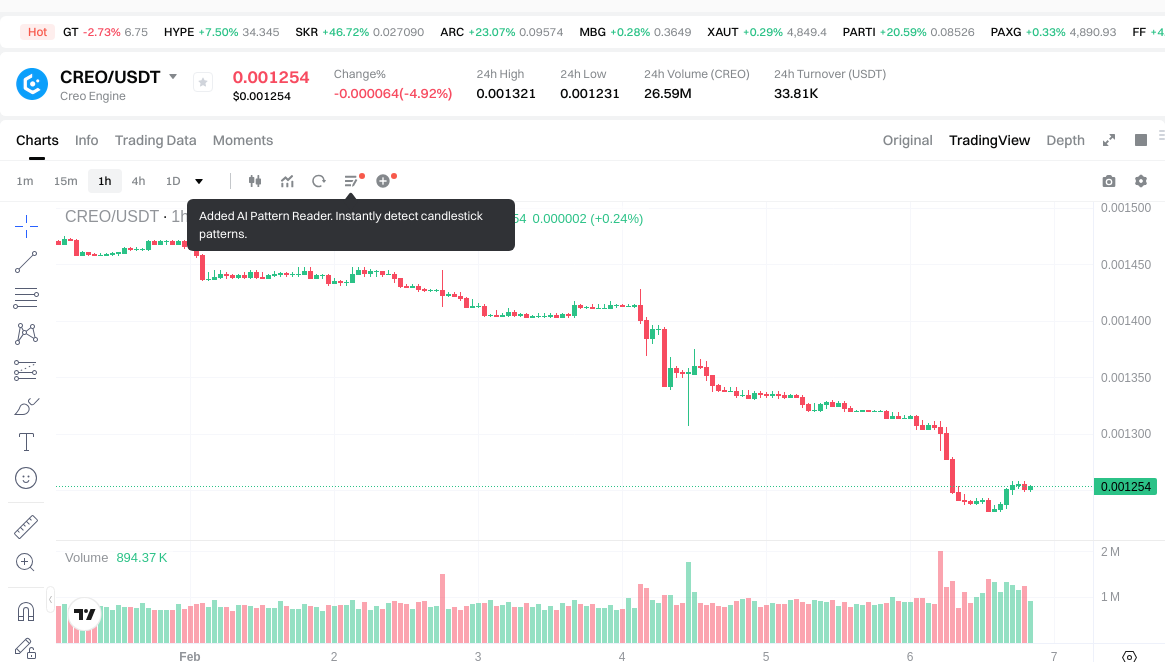
As of February 6, 2026, CREO's circulating supply stands at 290,296,616 tokens, with a total supply of 788,886,709 tokens and a maximum supply capped at 1,000,000,000 tokens. The current circulation ratio is approximately 29.03% of the total supply.
Price Volatility
CREO reached its historical high price of $0.26 on March 13, 2024. The token experienced its lowest price of $0.001231 on February 6, 2026, reflecting significant market fluctuations over this period.
Recent price trends show mixed performance across different timeframes:
- 1-hour change: +0.08%
- 24-hour change: -5.08%
- 7-day change: -14.57%
- 30-day change: -32.42%
- 1-year change: -90.83%
These fluctuations reflect market sentiment, adoption trends, and various external factors affecting the Web3 gaming sector.
Click to view the current CREO market price
On-Chain Metrics
- Holder Count: 18,149 addresses (indicating user participation level)
- 24-Hour Trading Volume: $33,660.25 (reflecting current market activity)
- Market Capitalization: $364,322.25 (representing the token's market valuation)
- Fully Diluted Valuation: $990,052.82 (potential maximum market cap at full token circulation)
Creo Engine Ecosystem Applications and Partners
Core Use Cases
Creo Engine's ecosystem supports multiple applications:
- Web3 Gaming: The platform provides a unified gaming hub that connects various game worlds, offering players an enhanced web3 gaming experience with seamless integration across different gaming environments.
- Gaming Infrastructure: Creo Engine serves as a foundational layer for web3 game development, enabling developers to build and deploy blockchain-based gaming applications.
Strategic Collaborations
Creo Engine continues to expand its ecosystem through strategic partnerships within the web3 gaming space. These collaborations aim to strengthen its technical capabilities and broaden its market presence in the blockchain gaming industry.
Challenges and Considerations
Creo Engine faces several challenges:
- Market Volatility: The token has experienced notable price fluctuations, with a decline of approximately 32.42% over the past 30 days and 90.83% over the past year.
- Competition: The web3 gaming sector is increasingly competitive, with numerous platforms vying for market share and user adoption.
- Market Adoption: Building and maintaining an active user base in the evolving web3 gaming landscape requires continuous innovation and community engagement.
These factors continue to shape discussions within the community and drive the project's ongoing development efforts.
Creo Engine Community and Social Media Presence
Community Engagement
Creo Engine maintains an active community with approximately 18,149 token holders. The project operates on the BSC network, utilizing the BEP-20 standard for its token infrastructure.
Social Media Activity
The project maintains its presence on X platform through its official account, where it shares updates about platform developments and gaming ecosystem news. Community discussions often revolve around platform features, gaming experiences, and ecosystem expansion.
Key Discussion Topics
Community members actively discuss topics related to web3 gaming innovations, platform utility, and the broader integration of blockchain technology in gaming experiences.
More Information About Creo Engine
- Official Website: Visit Creo Engine's official website to explore platform features, gaming hub capabilities, and latest updates.
- Whitepaper: The Creo Engine Whitepaper details its technical architecture, gaming ecosystem vision, and development roadmap.
- X Platform: Creo Engine maintains an active presence on X at @creo_engine, sharing updates about platform developments, gaming features, and community activities.
- Blockchain Explorer: Track transactions and smart contract activity via BSCScan.
How to Participate in Creo Engine?
- Purchase Options: CREO tokens are available on Gate.com and other cryptocurrency exchanges
- Storage Solutions: Store CREO tokens securely in BSC-compatible wallets that support BEP-20 tokens
- Ecosystem Participation: Engage with the web3 gaming hub to explore various gaming worlds and experiences
- Community Involvement: Follow official channels to stay updated on platform developments and gaming ecosystem expansions
Summary
Creo Engine represents an initiative in web3 gaming infrastructure, offering a unified gaming hub that connects various game worlds. With its BEP-20 token on BSC, the platform aims to enhance the web3 gaming experience for players and developers alike.
Despite facing market challenges including price volatility and competitive pressures, Creo Engine continues to develop its gaming ecosystem. The project maintains an active community of approximately 18,149 holders and operates with a circulating supply of 290,296,616 CREO tokens out of a maximum supply of 1,000,000,000.
Whether you are exploring web3 gaming opportunities or interested in blockchain-based gaming infrastructure, Creo Engine offers a platform worth monitoring as the web3 gaming sector continues to evolve.
FAQ
What is CREO? What are its functions and features?
CREO is a blockchain-based utility token designed for decentralized ecosystem participation. It features fast transaction processing, low fees, smart contract functionality, and community governance mechanisms. CREO enables seamless value transfer across Web3 applications while maintaining security and transparency through distributed ledger technology.
How to buy and hold CREO cryptocurrency?
Purchase CREO on crypto exchanges using bank cards or other payment methods. After buying, transfer your CREO to a secure wallet for safe storage. Consider hardware wallets for long-term holding and maximum security.
How secure is CREO? What should I pay attention to when storing and trading?
CREO ensures security through nonce management, transaction pool protection, private relay, and time-lock mechanisms. Use TPWallet for recommended storage and trading. Ensure compatibility with multiple signature formats and token standards for optimal safety.
What is the difference between CREO and mainstream cryptocurrencies like Bitcoin and Ethereum?
CREO is designed for decentralized finance and smart contracts, while Bitcoin focuses on peer-to-peer transactions as digital currency. Ethereum also supports smart contracts but uses proof-of-stake, whereas Bitcoin uses proof-of-work. CREO emphasizes enhanced scalability and efficiency for DeFi applications.
CREO的发展前景和市场应用前景如何?
CREO possesses vast market potential as a leading design software solution. With continuous technological advancement in manufacturing and growing industry demand, CREO's adoption is expected to expand significantly across sectors, positioning it for substantial long-term growth and market penetration.
Share
Content
Creo Engine's Positioning and Significance
Origin and Development History
How Creo Engine Works?
CREO's Market Performance
Creo Engine Ecosystem Applications and Partners
Challenges and Considerations
Creo Engine Community and Social Media Presence
More Information About Creo Engine
How to Participate in Creo Engine?
Summary
FAQ
How to Buy Cryptocurrency


Trending Cryptocurrencies



2025 Vertus daily combo code: Web3 gamers rewards guide
Today's Vertus Daily Combo Code: Boost Your Web3 Gaming Rewards (April 29, 2025)

GALA Coin (GALA) – Web3 Gaming Token Overview, Price Prediction & Trading on Gate.com

What is Gaming Crypto?How Gaming Crypto Works?

Detailed analysis of the top ten encryption game coins to be launched in 2025

Top 6 Best Gaming Currencies
Games with Payouts: Top 23 Projects for Earning

What is Cronos and How Does It Work?

What is Pump & Dump? How to Avoid Becoming a Victim of Pump & Dump Schemes

What is cryptocurrency in plain language

Best Cloud Gaming Services