Crust Network (CRU) is a decentralized cloud storage infrastructure launched in 2020, addressing data privacy concerns and centralized storage vulnerabilities in the Web3 ecosystem. As a decentralized storage network supporting IPFS and multiple protocols, Crust enables distributed file storage, data privacy protection, and Web3 infrastructure development. The article explores CRU's technical architecture built on blockchain consensus mechanisms, market performance with 7,395 token holders and $594,700 market cap, and its strategic applications in decentralized storage and Web3 applications. It covers price volatility patterns, ecosystem partnerships, community sentiment, and participation pathways through Gate exchange. Despite facing scalability challenges and competitive pressure, Crust positions itself as foundational infrastructure for decentralized storage, with a roadmap focused on expanding the DePIN ecosystem and enhancing cross-chain interoperability.
Crust's Positioning and Significance
In 2020, the Crust Network team launched Crust (CRU), aiming to address data privacy concerns, centralized storage vulnerabilities, and the lack of decentralized infrastructure for Web3 applications.
As a decentralized storage network supporting multiple protocols including IPFS, Crust plays a critical role in distributed cloud storage, data privacy protection, and Web3 infrastructure.
As of 2026, Crust has established itself as a key infrastructure provider in the Web3 ecosystem, with 7,395 token holders and an active developer community focused on decentralized storage solutions.
This article will provide an in-depth analysis of its technical architecture, market performance, and future potential.
Origin and Development History
Birth Background
Crust was created by the Crust Network team in 2020, aiming to solve centralized storage limitations, data privacy risks, and the need for decentralized cloud infrastructure in the Web3 ecosystem.
It emerged during the rapid expansion of blockchain technology and growing demand for decentralized applications, with the goal of providing a distributed storage network that values data privacy and ownership.
The launch of Crust brought new possibilities to Web3 developers, dApp builders, and users seeking data sovereignty.
Important Milestones
- 2020: Mainnet launch, implementing decentralized storage capabilities with IPFS protocol support.
- 2021: Price reached $179.24 during market expansion, reflecting strong early adoption.
- 2024: Continued ecosystem development with enhanced storage layer protocols and application interfaces.
- 2026: Network maintains 7,395 holders and supports diverse storage applications across the Web3 ecosystem.
With support from the Crust Foundation and developer community, Crust continues to optimize its technology, security protocols, and real-world applications.
How Crust Works
No Central Control
Crust operates on a decentralized network of computers (nodes) distributed globally, free from control by banks or governments.
These nodes collaborate to validate storage transactions, ensuring system transparency and attack resistance, granting users greater autonomy and enhancing network resilience.
Blockchain Core
Crust's blockchain serves as a public, immutable digital ledger recording every storage transaction.
Transactions are grouped into blocks and linked through cryptographic hashes to form a secure chain.
Anyone can view the records, establishing trust without intermediaries.
The network's technical stack supports both decentralized storage and computing layers, further enhancing versatility.
Ensuring Fairness
Crust employs a consensus mechanism to validate transactions and prevent fraudulent activities.
Network participants maintain network security through node operations and storage provision, receiving CRU rewards.
The innovation includes multi-protocol storage support and application layer interfaces that enable flexible integration.
Secure Transactions
Crust uses public-private key cryptography to protect transactions:
- Private keys (like secret passwords) are used to sign transactions
- Public keys (like account numbers) are used to verify ownership
This mechanism ensures fund security while transactions maintain network integrity.
The system provides storage interfaces to the application layer, enabling secure data management across the distributed network.
Circulation Overview
As of February 05, 2026, Crust's circulating supply stands at 26,716,087.33 CRU tokens, with a total supply of 35,025,067.04 CRU. The token operates under an inflationary model with no maximum supply cap (∞), allowing for continued token generation. The initial token distribution facilitated market entry through various allocation mechanisms. The current circulating supply represents approximately 76% of the total supply, indicating a relatively mature distribution phase.
Price Volatility
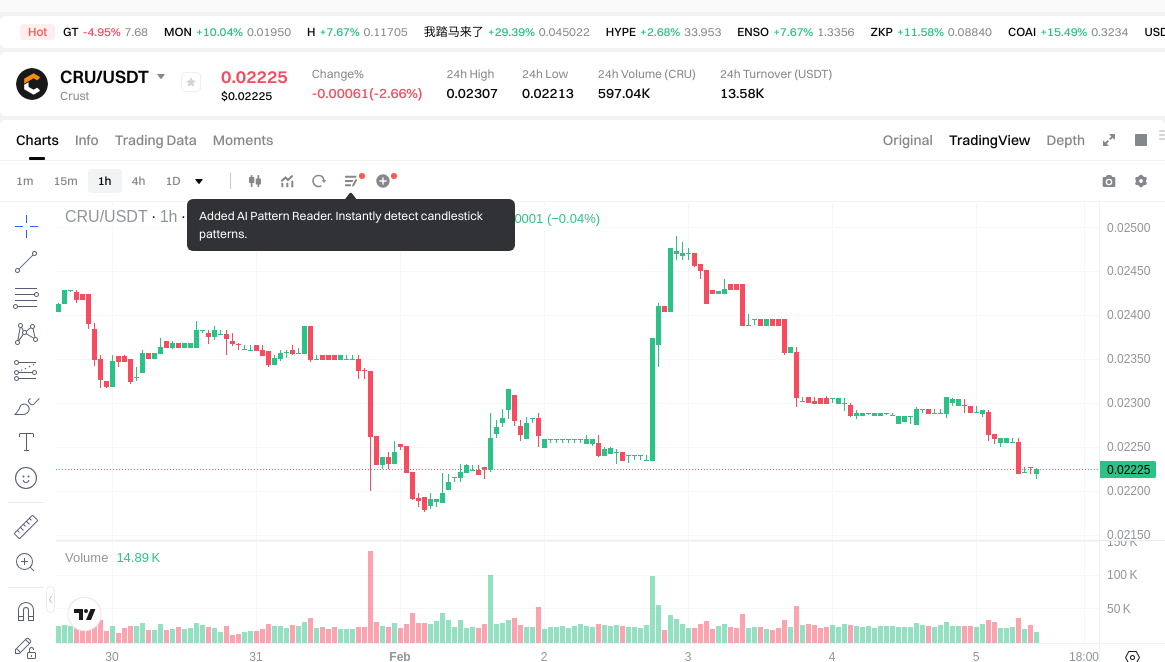
Crust reached its all-time high price of $179.24 on April 12, 2021, during a period characterized by heightened market interest in decentralized storage solutions and broader cryptocurrency market momentum. The token experienced its lowest recorded price of $0.0216 on February 01, 2026, amid challenging market conditions. As of February 05, 2026, CRU trades at $0.02226, with a 24-hour trading volume of $13,566.95. Recent price movements show a -2.7% change over 24 hours, -8.28% over 7 days, and -49.14% over 30 days, reflecting ongoing market adjustments and sentiment shifts in the decentralized storage sector.
Click to view current CRU market price
On-Chain Metrics
- Holder Count: 7,395 addresses (indicating community distribution and adoption)
- Market Capitalization: $594,700.10 (reflecting current network valuation)
- 24-Hour Trading Range: $0.02219 - $0.02307 (demonstrating intraday volatility patterns)
Crust Ecosystem Applications and Partners
Core Use Cases
Crust's ecosystem supports various applications:
- Decentralized Storage: IPFS integration, providing distributed file storage and retrieval services.
- Web3 Infrastructure: Supporting decentralized applications, enabling data privacy protection and ownership control.
Strategic Partnerships
These partnerships provide a solid foundation for Crust's ecosystem expansion.
Controversies and Challenges
Crust faces the following challenges:
- Technical Issues: Scalability bottlenecks in distributed storage networks
- Competitive Pressure: Competition from other decentralized storage solutions
These issues have sparked discussions within the community and market, while also driving Crust's continuous innovation.
Fan Enthusiasm
Crust's community demonstrates vitality, with 7,395 token holders.
On X platform, related posts and hashtags (such as #Crust) frequently trend.
Sentiment on X shows polarization:
- Supporters praise Crust's decentralized storage capabilities and data privacy features, viewing it as "the future infrastructure of Web3".
- Critics focus on price volatility and market cap challenges.
Hot Topics
X users actively discuss Crust's decentralized storage technology, data ownership, and distributed cloud ecosystem development,
showcasing both its transformative potential and obstacles toward mainstream adoption.
- Official Website: Visit Crust Official Site for features, use cases, and latest developments.
- White Paper: Crust White Paper details its technical architecture, objectives, and vision.
- X Updates: On X platform, Crust actively uses @CrustNetwork,
with posts covering technical upgrades, community events, and partnership news.
Crust Future Roadmap
- Ecosystem Goals: Expand distributed cloud ecosystem and enhance data privacy protection
- Long-term Vision: Become a foundational infrastructure for Web3 decentralized storage
How to Participate in Crust?
- Purchase Channels: Buy CRU on Gate.com
- Storage Solutions: Securely store using hardware wallets
- Participate in Governance: Engage in community decisions through governance mechanisms
- Build Ecosystem: Visit GitHub repository to develop applications or contribute code
Summary
Crust redefines decentralized storage through blockchain technology, providing transparency, security, and data ownership protection.
Its active community, rich resources, and market presence make it distinctive in the cryptocurrency space.
Despite facing regulatory uncertainties and technical challenges, Crust's innovative spirit and clear roadmap position it prominently in the future of decentralized technology.
Whether you're a newcomer or seasoned player, Crust deserves attention and participation.
FAQ
What is CRU (Crust Network) and what does it do?
CRU is the native token of Crust Network, a decentralized cloud storage provider prioritizing decentralization, privacy, and data assurance. It enables secure, private storage solutions on a distributed network while incentivizing storage providers through token rewards.
How does CRU token work and what are its main use cases?
CRU token powers Crust Network through staking for consensus, serving as collateral for nodes, paying transaction fees, purchasing storage, and enabling governance voting on protocol decisions.
Where can I buy and store CRU tokens?
You can purchase CRU tokens using debit/credit cards, bank transfers, or peer-to-peer trading. For storage, use secure wallets like hardware wallets or reputable custodial services to keep your tokens safe.
What is the total supply and tokenomics of CRU?
CRU has a maximum total supply capped at 1 billion tokens, which will never be exceeded. The circulating supply varies based on market dynamics and network activity.
How is CRU different from other storage-based cryptocurrencies?
CRU is built on Polkadot offering decentralized cloud storage for both Web 3.0 and Web 2.0 ecosystems. Unlike other storage cryptocurrencies, CRU emphasizes cross-chain interoperability and sustainable storage incentive mechanisms through its unique proof-of-storage model.
What are the risks and security considerations for CRU?
CRU faces smart contract vulnerabilities, network security threats, and regulatory risks. Key considerations include wallet security, private key management, market volatility, and liquidity risks. Users should employ cold storage solutions and verify contract audits before participation.
What is the future roadmap and development plan for Crust Network?
Crust Network is expanding its Decentralized Physical Infrastructure Networks (DePIN) focus in 2025, with plans for enhanced infrastructure, new feature releases, and strategic partnerships to drive adoption and network efficiency.
* The information is not intended to be and does not constitute financial advice or any other recommendation of any sort offered or endorsed by Gate.