What Is Dollar-Cost Averaging?
Investment Strategies
Broadly speaking, there are two main types of crypto trading: daily trading and long-term investing. Daily trading relies on short-term price swings and can be extremely stressful, requiring constant market monitoring and quick decision-making. This approach often leads to emotional trading decisions and increased transaction costs. However, a middle-ground approach called dollar-cost averaging spreads investments over time to reduce risk. This strategy combines the benefits of both approaches, allowing investors to participate in market growth while minimizing the stress and risks associated with timing the market perfectly. This article explores DCA and how it can benefit your trading strategy, providing practical insights for both novice and experienced investors.
KEY TAKEAWAYS
- Dollar-cost averaging spreads investments over time, thereby reducing the impact of market volatility and helping investors avoid the pitfalls of emotional decision-making.
- DCA minimizes long-term investment risks by avoiding market timing and consistently investing at different price levels, creating a balanced average purchase price.
- DCA can backfire if prices consistently decline, leading to potential losses over a prolonged period, making asset selection and fundamental analysis crucial.
What Is Dollar-Cost Averaging?
Dollar-cost averaging is an investment strategy where you invest a fixed amount at regular intervals, regardless of the market's performance. This approach helps reduce the impact of volatility by spreading your investment over time. Unlike lump-sum investing, where you commit all your capital at once, DCA allows you to build your position gradually. This method is particularly valuable in markets characterized by unpredictable price movements, as it eliminates the need to predict market tops and bottoms. By maintaining a consistent investment schedule, investors can focus on long-term wealth accumulation rather than short-term market fluctuations.
Crypto Market Volatility
Cryptocurrencies are known for their high volatility, much like penny stocks in the traditional market. These assets react strongly to large trades, particularly those with small market capitalizations. Understanding this volatility is essential for developing effective investment strategies in the crypto space.
Larger market cap assets usually require much bigger trades to influence the market. For example, Bitcoin and Ethereum, with market capitalizations in the hundreds of billions, are relatively stable compared to smaller cryptocurrencies. However, small-cap cryptocurrencies (market caps under $2 billion) are more susceptible to price fluctuations caused by individual investors. These smaller assets can experience dramatic price swings within hours or even minutes, making them both opportunities and risks for investors.
A single large investor, often referred to as a "whale," can significantly impact the price of a small-cap cryptocurrency. These whales hold substantial amounts of a particular cryptocurrency and can move markets with their trading decisions. Their influence is particularly pronounced in assets with limited liquidity and trading volume.
Whales can exploit the volatility of small-cap assets by creating artificial buy or sell walls. They do this to entice other traders to join the trend before executing large buys or sells to profit from the price swings. This manipulation technique, while controversial, demonstrates the importance of understanding market dynamics and the role of large players in cryptocurrency markets.
Even mid-cap cryptocurrencies, with market caps up to $10 billion, can be influenced by these large trades. This vulnerability to whale activity extends beyond the smallest assets, affecting a significant portion of the cryptocurrency market.
Cryptocurrencies don't inherently have the same value metrics as conventional assets do. Conventional assets, such as the stocks of a company, are valued based on products, production costs, and market demand. These traditional valuation methods rely on tangible metrics like revenue, earnings, and growth projections. Cryptocurrencies, on the other hand, derive their value from speculation and their potential to replace or enhance traditional financial systems. This fundamental difference in valuation creates unique challenges and opportunities for investors.
For instance, Bitcoin's decentralized nature and capped supply of 21 million coins offer an alternative to central banking systems, where inflationary pressures can erode the value of fiat currency. This scarcity model, combined with growing adoption and institutional interest, forms the basis of Bitcoin's value proposition.
DCA Beats Volatility
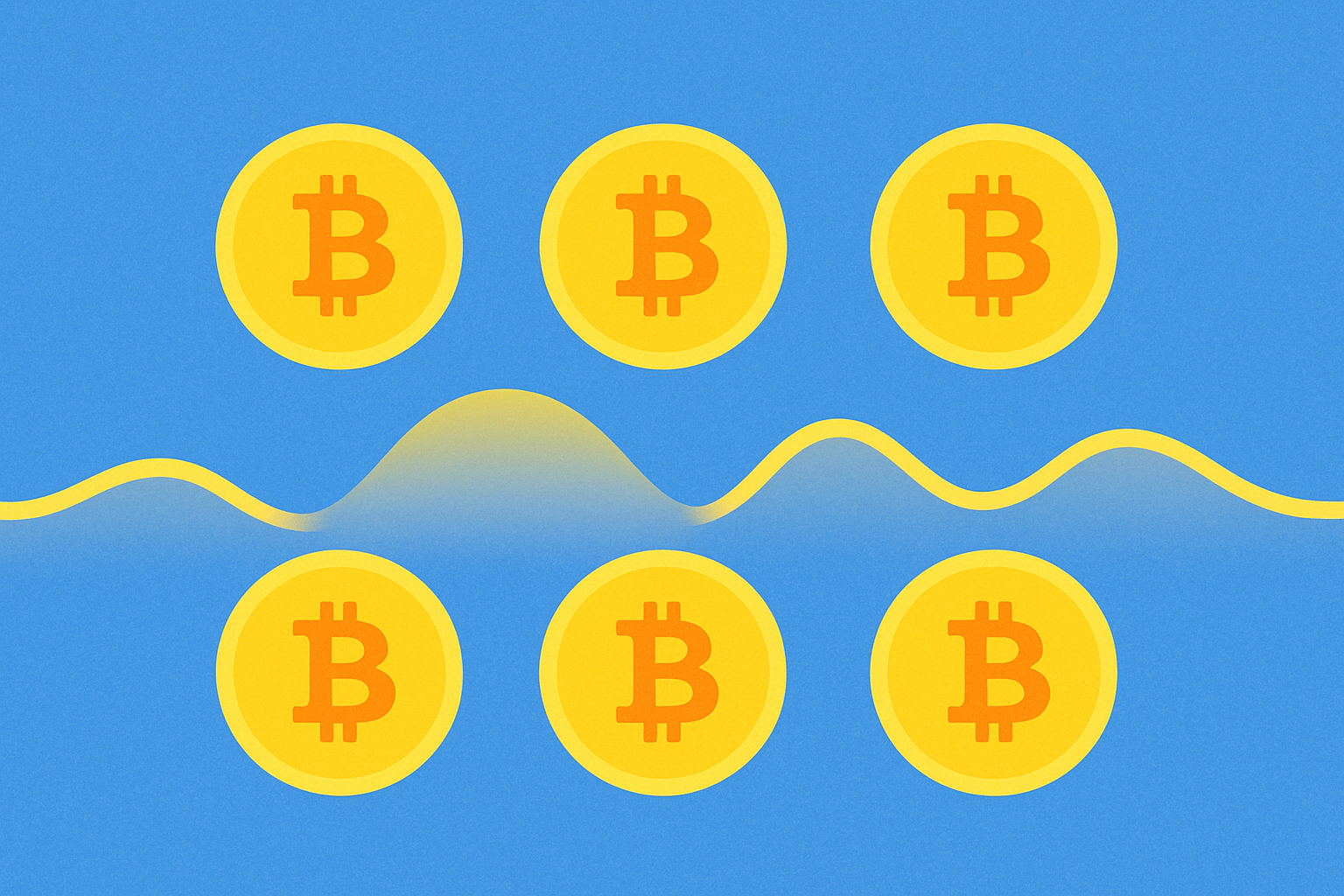
With DCA, the investor takes advantage of market volatility by distributing the risk. For instance, in recent periods, we have seen the BTC price hovering in a range with significant fluctuations over 30-day periods. These price movements create opportunities for strategic investors to accumulate assets at various price points.
Therefore, instead of going all in with a sum of hypothetical $20k to invest in, an investor would use DCA to invest $20k in multiple smaller fractions daily at a regular interval. This approach might involve investing $66.67 daily over 300 days, or $285.71 weekly over 70 weeks, depending on the investor's preference and market conditions. Otherwise, if the investor decided to invest the entire $20k immediately, they may do so at a higher price hill point. In this case, the overall gains would be much less than if investment increments all took place at low valley points. By spreading investments across different price levels, DCA creates a balanced average purchase price that smooths out the impact of volatility.
With that said, the DCA investing strategy:
- Can also be used in all investment ranges, including $10, $100, $500, $1,000, $10,000, and so on. What might be considered a small investment for one person could be a significant sum for another. The strategy is scalable and accessible to investors at all levels, from beginners testing the waters to experienced traders managing substantial portfolios.
- Is applicable irrespective of whether the market is bearish or bullish so long as the investment distribution is consistent over time. This consistency is the cornerstone of DCA's effectiveness, as it removes emotional decision-making from the investment process.
For this reason, an investor engaging in DCA must be certain of the asset's fundamentals. After all, the core of the dollar-cost averaging strategy is to invest fixed amounts in regular intervals. This requires confidence that the chosen asset has long-term viability and growth potential. Thorough research into the project's technology, team, use case, and market position is essential before committing to a DCA strategy.
In a nutshell, dollar-cost averaging is dividing the risk by dividing the money allocated for investing over a prolonged period of time. This requires discipline and resistance to market FUD (fear, uncertainty, doubt). Successful DCA investors maintain their investment schedule regardless of short-term market sentiment, trusting in their long-term analysis and strategy.
Real-Life Example of DCA
Let's say you allocate $10 to invest daily in Bitcoin over a two-year period. At the end of the period, you would have invested a total of $7,310. So, what would you get in return? This hypothetical scenario demonstrates the potential power of consistent, disciplined investing in a volatile asset class.
By using a DCA calculator, you would have gained $22,965, which represents a 214.16% profit margin. This impressive return illustrates how DCA can capitalize on market volatility while maintaining a conservative, risk-managed approach. The calculation accounts for the varying Bitcoin prices at which each $10 increment was invested, resulting in an average purchase price that benefited from periodic market dips.
The difference between your total investment of $7,310, by $10 daily increments, and Bitcoin's appreciation over two years, is the space where you gain profits. This profit margin results from the combination of Bitcoin's overall upward trend and the strategic accumulation of assets at various price points throughout the investment period.
While predicting Bitcoin's future price is speculative, its historical chart shows a consistent upward trend. This means that even during the worst bear markets, Bitcoin's new lows have always been higher than its previous lows. This pattern of higher lows and higher highs is a bullish indicator that has characterized Bitcoin's price action throughout its history, though past performance does not guarantee future results.
This is understandable given that Bitcoin's supply is eternally limited. There will only ever be so much BTC in existence. Then, if more people want to buy it, the remaining Bitcoins will appreciate in value. In short, it is a matter of supply and demand, the fundamental law of economics. This scarcity mechanism, combined with increasing adoption and institutional interest, creates a favorable long-term outlook for Bitcoin as an asset class.
While dollar-cost averaging is a sound investment approach in any market, its advantages are more prominent in volatile markets like cryptocurrency, where price fluctuations are frequent and unpredictable. The strategy's ability to smooth out volatility makes it particularly well-suited to the crypto market's characteristic price swings.
Can DCA Backfire?
Yes, it can backfire if you are not careful enough with your investment decisions. Dollar-cost averaging is most effective when prices fluctuate over time as it allows investors to buy into an asset at different price points. Understanding the limitations of DCA is crucial for implementing the strategy effectively.
However, if prices consistently rise, those using this strategy may end up purchasing fewer coins or assets at higher prices. In a sustained bull market, a lump-sum investment at the beginning would have yielded better returns than gradually investing over time. This opportunity cost is one of the trade-offs of using DCA, as the strategy prioritizes risk management over maximum potential returns.
Similarly, during prolonged declines, investors might keep buying when holding off would make more sense financially. If an asset is fundamentally flawed or facing long-term headwinds, continuing to invest through DCA could result in accumulating a depreciating asset. This scenario underscores the importance of thorough fundamental analysis before committing to a DCA strategy.
While DCA helps manage volatility, it doesn't shield investors from potential losses in a bear market. The strategy can reduce the impact of market downturns by lowering average purchase prices, but it cannot eliminate the risk of loss if the asset's value continues to decline.
The strategy operates on the belief that, over time, prices will recover. For individual assets, especially without proper research, DCA may lead to continuing investments that should otherwise be paused or exited. This assumption of recovery is valid for fundamentally sound assets but can be problematic for projects with weak fundamentals or limited long-term viability.
For less-experienced investors, DCA is generally safer when applied to diversified assets like index funds, as opposed to, say, hype-driven, lesser-known cryptocurrencies. Diversification across multiple assets or through index funds can provide additional risk mitigation beyond what DCA alone offers.
Dollar Cost Averaging: Pros vs. Cons
| DCA Advantages | DCA Drawbacks |
|---|---|
| DCA investors focus on long-term gains and are less likely to panic-sell during price drops, maintaining their investment strategy through market turbulence. | DCA may yield lower returns during prolonged bull markets compared to a lump-sum investment, as later purchases occur at higher prices. |
| It encourages disciplined investing by allocating small amounts regularly, preventing emotional overtrading and impulsive decisions based on market sentiment. | DCA requires more frequent trading, which can lead to higher transaction fees on crypto platforms, though these costs are often minimal relative to potential gains. |
| DCA allows investors to bypass unreliable technical analysis and invest steadily based on confidence in the asset, removing the need for market timing skills. | The strategy may not suit investors who can invest large sums upfront and take advantage of bull markets, as they might miss out on maximum potential returns. |
| DCA helps diversify risk across different cryptocurrencies by spreading investments over time, allowing investors to build positions in multiple assets simultaneously. | Fees from frequent trades could add up, though they are usually negligible in the long term, especially when using platforms with low transaction costs. |
DCA: Best for Volatile Markets
Dollar-cost averaging provides a steady, disciplined approach to investing in volatile markets like cryptocurrency. By investing consistently over time, you can benefit from market fluctuations without the stress of timing your entries perfectly. This strategy is particularly valuable for investors who lack the time, expertise, or emotional fortitude to engage in active trading.
While DCA may not always maximize returns in certain market conditions, it offers a balanced approach for investors looking for steady, long-term growth in an unpredictable market. The strategy's emphasis on consistency and risk management makes it an attractive option for building wealth gradually while minimizing exposure to market volatility. For many investors, the peace of mind and reduced stress that comes with DCA outweighs the potential for higher returns from more aggressive strategies.
FAQ
What is Dollar-Cost Averaging?
Dollar-Cost Averaging is an investment strategy where you invest a fixed amount of cryptocurrency at regular intervals, regardless of price fluctuations. This approach reduces the impact of market volatility and eliminates the need to time the market perfectly, making it suitable for all investors.
How to use dollar-cost averaging for investment?
Set a fixed amount to invest regularly over time, such as weekly or monthly purchases of cryptocurrencies. This strategy helps reduce timing pressure and volatility by spreading purchases across different price points, allowing you to accumulate assets steadily while minimizing emotional decision-making.
What are the advantages and disadvantages of Dollar-Cost Averaging compared to lump-sum investing?
DCA spreads investment risk over time, avoiding buying at peaks, and reducing timing pressure. However, it may increase transaction fees and is unsuitable for short-term trading. Long-term investors benefit most from DCA's systematic approach to lowering average purchase costs.
Which types of investors is dollar-cost averaging suitable for?
Dollar-cost averaging suits long-term investors seeking steady accumulation without timing market peaks. It works well for both beginners and experienced investors wanting to reduce volatility risk through consistent, periodic investments regardless of price fluctuations.
What risks should I be aware of when using dollar-cost averaging?
Dollar-cost averaging carries market volatility risk and potential losses. Extended holding periods may face inflation pressure. Regular investment doesn't guarantee profits or protect against market downturns. Careful planning is essential.
What is the difference between dollar-cost averaging and timing the market?
Dollar-cost averaging (DCA) invests fixed amounts regularly regardless of price, while market timing adjusts investments based on price movements. DCA spreads risk consistently, while timing seeks higher returns through strategic entry points.
Share
Content
How to Buy Cryptocurrency


Trending Cryptocurrencies



How to Withdraw Money from Crypto Exchanges in 2025: A Beginner's Guide

Hedera Hashgraph (HBAR): Founders, Technology, and Price Outlook to 2030

Jasmy Coin: A Japanese Crypto Tale of Ambition, Hype, and Hope
IOTA (MIOTA) – From Tangle Origins to 2025 Price Outlook

Bitcoin Price in 2025: Analysis and Market Trends

How to Trade Bitcoin in 2025: A Beginner's Guide

What is GameFi and How to Earn with Play-to-Earn
Tokenomics: Understanding Coins and Cryptocurrency Economics

What is wave analysis in cryptocurrency, and how does it work?

Top 11 Highest-Paying Freelance Jobs
Exploring the Identity of Bitcoin Creator 'Satoshi Nakamoto' | 2025 Edition