GATA is a decentralized AI infrastructure platform designed to optimize GPU resource utilization and facilitate large-scale AI model training and inference across globally distributed networks. Launched in February 2025 on Gate.com, GATA addresses centralization challenges in AI computing by leveraging blockchain technology and BEP20 standards on BSC. With 4,619 token holders and a circulating supply of 245 million tokens, GATA has demonstrated market traction, reaching an all-time high of $0.09911. The platform enables decentralized AI inference, collaborative model training, and secure resource coordination through cryptographic mechanisms. Despite facing regulatory uncertainty and market volatility, GATA's innovative approach to distributed computing positions it as a transformative force in the decentralized AI landscape, appealing to AI developers, researchers, and GPU resource providers seeking transparent, efficient computational solutions.
Gata's Positioning and Significance
In 2025, Gata was launched to address the inefficiencies in AI model training and inference infrastructure, particularly the underutilization of globally distributed GPU resources.
As a decentralized AI infrastructure platform, Gata plays a key role in artificial intelligence and decentralized computing.
As of 2026, Gata has developed into an emerging player in the decentralized AI infrastructure space, with 4,619 token holders and an active development community.
This article provides an in-depth analysis of its technical architecture, market performance, and future potential.
Origin and Development History
Background
Gata was created to solve the centralization and resource allocation challenges in AI model training and inference.
It emerged during the rapid expansion of AI technology and growing demand for decentralized computing solutions, aiming to enable efficient collaboration of large-scale AI models across globally distributed GPUs.
Gata's launch brought new possibilities for AI developers, researchers, and GPU resource providers.
Key Milestones
- February 2025: Token officially launched on Gate.com, establishing market presence.
- September 2025: Reached all-time high price of $0.09911, reflecting strong early market interest.
- 2025-2026: Continued development of decentralized AI inference and training technologies.
With the support of its development team and growing community, Gata continues to optimize its technology, security, and real-world applications.
How Does Gata Work?
No Central Control
Gata operates on a decentralized network of globally distributed computing resources, eliminating reliance on centralized cloud providers or single entities.
These distributed nodes collaborate to facilitate AI model training and inference, ensuring system transparency and attack resistance, granting users greater autonomy and enhancing network resilience.
Blockchain Foundation
Gata's blockchain serves as a public, immutable digital ledger recording transactions and network activities.
Transactions are grouped into blocks and linked through cryptographic hashing to form a secure chain.
Anyone can view the records, establishing trust without intermediaries.
Ensuring Fairness
Gata operates on BEP20 standard on the BSC (Binance Smart Chain), utilizing the underlying consensus mechanism to validate transactions and prevent fraudulent activities.
Network participants maintain system security and receive rewards.
Its innovation includes enabling efficient coordination of distributed GPU resources for AI workloads.
Secure Transactions
Gata employs public-private key cryptography to protect transactions:
- Private keys (similar to secret passwords) are used to sign transactions
- Public keys (similar to account numbers) are used to verify ownership
This mechanism ensures fund security while maintaining transaction integrity.
The platform's architecture supports secure coordination between distributed computing resources and AI model operations.
Circulation Overview
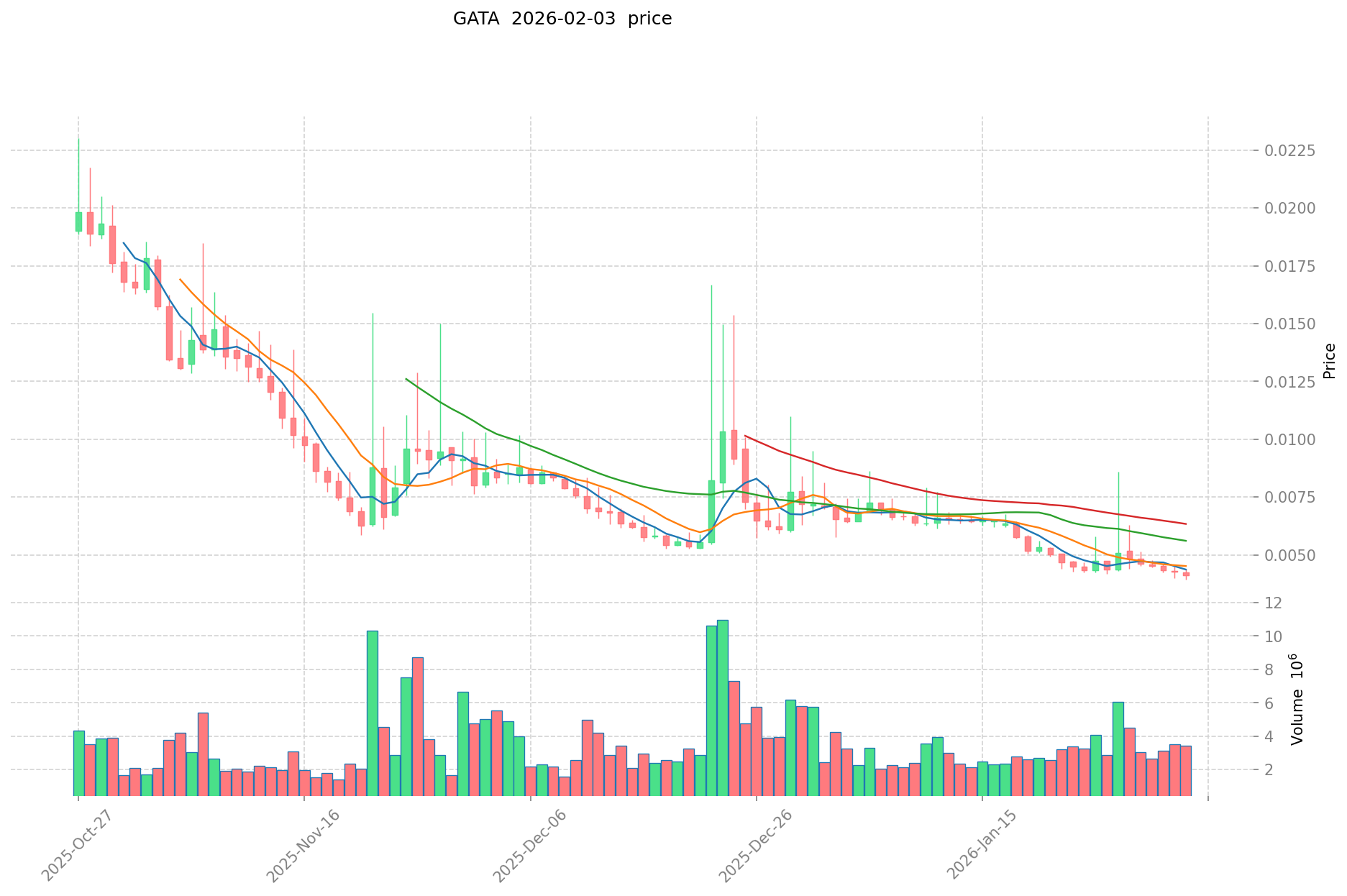
As of February 03, 2026, GATA's circulating supply stands at 245,000,000 tokens, with a total supply of 1,000,000,000 tokens, representing a circulating ratio of 24.5%. The maximum supply is capped at 1,000,000,000 tokens, indicating a fixed supply model.
Price Volatility
GATA reached its all-time high of $0.09911 on September 24, 2025, reflecting positive market dynamics during that period. The token experienced its lowest price of $0.003927 on February 02, 2026, marking significant price volatility. These fluctuations demonstrate the influence of market sentiment and trading activities on the token's valuation.
Click to view current GATA market price
On-Chain Metrics
- Holders: 4,619 addresses hold GATA tokens, indicating the current level of token distribution
- 24-Hour Trading Volume: $13,057.63, reflecting recent market activity
- Market Capitalization: $983,185, representing the token's current market valuation
Gata Ecosystem Applications and Partners
Core Use Cases
Gata's ecosystem supports multiple applications:
- Decentralized AI Inference: Gata enables large-scale AI models to perform inference tasks across globally distributed GPUs, providing efficient computational resource allocation.
- AI Model Training: The platform facilitates collaborative training of AI models, pushing forward innovations in distributed machine learning.
Strategic Partnerships
While specific partnership details are not extensively documented in available materials, Gata's technical infrastructure is designed to collaborate with various stakeholders in the AI and blockchain sectors.
These potential partnerships could provide a solid foundation for Gata's ecosystem expansion.
Controversies and Challenges
Gata faces the following challenges:
- Technical Complexity: Coordinating large-scale AI computations across distributed GPU networks presents architectural challenges
- Regulatory Uncertainty: The intersection of AI technology and blockchain may face evolving regulatory frameworks
- Market Competition: Competition from established blockchain AI platforms and traditional centralized AI infrastructure providers
These issues have sparked discussions within the community and market, also driving Gata's continuous innovation.
Gata's community demonstrates growing engagement, with 4,619 holders as of the latest data.
On X platform, relevant posts and hashtags (such as #GATA) generate regular discussions.
Factors such as platform development milestones and technology updates have ignited community enthusiasm.
Sentiment on X shows mixed perspectives:
- Supporters praise Gata's innovative approach to decentralized AI infrastructure, viewing it as a foundation for democratized AI computing.
- Critics focus on price volatility and market performance concerns.
Recent trends indicate cautious optimism as the project continues development.
Trending Topics
X users actively discuss Gata's technical roadmap, tokenomics, and position in the decentralized AI landscape,
showcasing both its transformative potential and the obstacles toward mainstream adoption.
- Official Website: Visit Gata Official Website for features, use cases, and latest updates.
- Documentation: Gata Documentation details its technical architecture, objectives, and vision.
- X Updates: On X platform, Gata maintains an active presence through @Gata_xyz,
with posts covering technical developments, community activities, and ecosystem updates, generating engagement from the community.
Gata Future Roadmap
- Technical Development: Advancing decentralized AI inference and training technologies, enhancing scalability and efficiency
- Ecosystem Goals: Expanding the distributed GPU network and building a comprehensive AI computation platform
- Long-term Vision: Becoming a leading infrastructure for decentralized AI model deployment and training
How to Participate in Gata?
- Purchase Options: Buy GATA on Gate.com and other supported exchanges
- Storage Solutions: Securely store GATA tokens using compatible BEP20 wallets
- Community Engagement: Follow official channels to stay updated on project developments
- Ecosystem Building: Visit developer documentation to explore integration opportunities
Summary
Gata is redefining AI infrastructure through blockchain technology, providing decentralized, transparent, and efficient AI computation solutions.
Its growing community, clear technical focus, and innovative approach position it uniquely in the cryptocurrency and AI sectors.
Despite facing market volatility and competitive pressures, Gata's commitment to decentralized AI infrastructure and its development roadmap suggest an important role in the future of distributed computing.
Whether you are a newcomer or an experienced participant, Gata deserves attention and engagement.
FAQ
What is GATA crypto and what is its purpose in the blockchain ecosystem?
GATA crypto facilitates seamless transactions in decentralized finance. It enhances user understanding of blockchain concepts and simplifies complex terminology, supporting ecosystem adoption and accessibility for participants.
How can I buy and store GATA tokens?
Create an account on a crypto platform, select your preferred payment method, and purchase GATA tokens. Transfer them to a secure personal wallet for safe storage and full control of your assets.
What is the tokenomics and total supply of GATA?
GATA has a fixed total supply of 1 billion tokens with no inflation mechanism. Tokens serve as utility for platform fees and validator staking operations.
What are the risks and security considerations when investing in GATA?
GATA investment risks include market volatility, regulatory changes, and economic uncertainties. Security considerations involve smart contract audits, wallet security, and data protection. Diversification and proper due diligence help reduce exposure.
What is the difference between GATA and other similar cryptocurrency projects?
GATA distinguishes itself through its unique blockchain architecture and decentralized finance focus. Unlike similar projects, GATA offers enhanced transaction efficiency, innovative governance mechanisms, and stronger community-driven development. Its distinct tokenomics and technological stack provide superior utility and long-term value potential compared to competing projects.
* The information is not intended to be and does not constitute financial advice or any other recommendation of any sort offered or endorsed by Gate.