HARD Protocol is a decentralized money market built on Kava, addressing cross-chain lending fragmentation in DeFi since its 2020 launch. The article provides comprehensive insights into HARD's technical architecture leveraging Kava's Tendermint consensus and cross-chain capabilities, enabling secure lending and borrowing across multiple blockchain assets. It examines market performance metrics showing circulating supply of 134.79 million tokens against price volatility challenges, explores core use cases in DeFi lending and liquidity mining, and analyzes governance mechanisms allowing HARD token holders to participate in protocol decisions. The guide covers ecosystem partnerships within Kava, addresses market competition and trading limitations, evaluates community sentiment on social platforms, and outlines participation pathways through exchanges like Gate.com. Designed for both DeFi newcomers and experienced participants, this resource delivers essential information on HARD Protocol's innovation, challenge
HARD Protocol's Position and Significance
In 2020, the team behind Kava launched HARD Protocol (HARD), aiming to address limitations in cross-chain lending and liquidity fragmentation across blockchain ecosystems.
As a decentralized money market built on Kava, HARD Protocol plays a key role in cross-chain DeFi lending.
As of 2026, HARD Protocol continues to operate within the Kava ecosystem with an active community. The platform supports lending and borrowing of cross-chain assets, offering users opportunities to participate in governance and liquidity mining.
This article will provide an in-depth analysis of its technical architecture, market performance, and future potential.
Origin and Development History
Birth Background
HARD Protocol was created by the Kava team in 2020, aiming to solve challenges in cross-chain asset lending and capital efficiency within decentralized finance.
It emerged during the rapid expansion of DeFi in 2020, with the goal of enabling seamless borrowing and lending of assets across different blockchains to transform the landscape.
The launch of HARD Protocol brought new possibilities for DeFi users seeking cross-chain lending solutions.
Important Milestones
- 2020: Platform launch, supporting initial deposits of BTC, XRP, BNB, BUSD, and USDX.
- 2020: Introduction of overcollateralized lending for supported assets.
- Ongoing: Implementation of liquidity mining rewards, where users earn HARD tokens through lending and borrowing activities.
- Ongoing: Governance mechanism deployment, allowing HARD token holders to vote on platform parameters and earn additional rewards.
With support from the Kava ecosystem and its community, HARD Protocol continues to refine its features, security measures, and real-world applications.
How HARD Protocol Works
No Central Control
HARD Protocol operates on a decentralized network built on the Kava blockchain, removing reliance on traditional financial intermediaries.
Network participants collaborate to validate transactions, ensuring system transparency and resistance to single points of failure, granting users greater autonomy while enhancing network resilience.
Blockchain Foundation
HARD Protocol's underlying blockchain maintains a public, immutable digital ledger recording all lending and borrowing activities.
Transactions are grouped into blocks and cryptographically linked to form a secure chain.
Anyone can verify records without requiring intermediaries, establishing trust through transparency.
The protocol leverages Kava's cross-chain capabilities to enable interoperability between different blockchain assets.
Ensuring Fairness
HARD Protocol relies on the Kava blockchain's Tendermint consensus mechanism to validate transactions and prevent fraudulent activities.
Validators maintain network security through staking and block validation, earning rewards in the process.
The platform's approach emphasizes efficiency and cross-chain compatibility.
Secure Transactions
HARD Protocol utilizes public-private key cryptography to protect user transactions:
- Private keys (similar to secret passwords) are used to authorize lending and borrowing operations
- Public keys (similar to account identifiers) are used to verify ownership
This mechanism ensures asset security while maintaining pseudonymous transaction privacy.
Additionally, the protocol implements token vesting mechanisms, where distributed HARD token rewards are subject to lockup periods, with longer lockup durations yielding higher rewards. These parameters can be adjusted through governance voting.
Circulation Overview
As of February 07, 2026, HARD's circulating supply stands at 134,791,668 tokens, with a total supply of 200,000,000 HARD tokens, representing a fixed supply model with a maximum cap of 200,000,000 tokens.
New tokens enter the market through liquidity mining rewards distributed to users who engage in lending and borrowing activities on the platform, influencing its supply-demand dynamics.
All distributed HARD token rewards undergo a vesting period, where users who choose longer lock-up periods receive proportionally more HARD tokens. The specific parameters of token reward vesting can be modified through governance voting.
Price Volatility
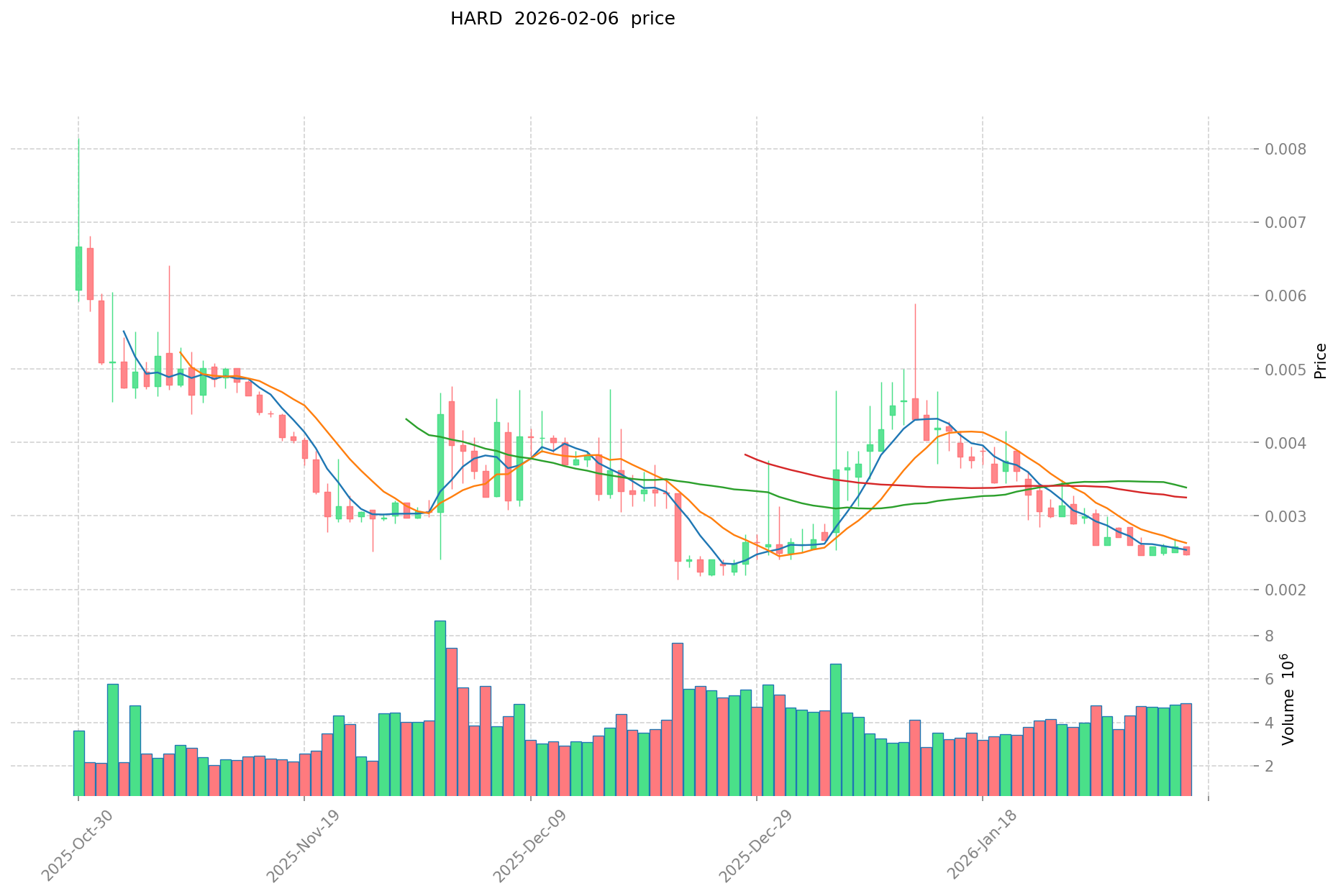
HARD reached its historical peak price of $2.97 on March 17, 2021, driven by favorable market conditions during that period.
Its lowest recorded price was $0.00206758, which occurred on September 10, 2025, reflecting broader market challenges and sentiment shifts.
These fluctuations demonstrate the impact of market sentiment, adoption trends, and external factors on the token's valuation.
Click to view current HARD market price
On-Chain Metrics
Specific on-chain metrics such as daily transaction volume, active address count, and staking rate data are not currently available for detailed analysis.
HARD Protocol Ecosystem Applications and Partners
Core Use Cases
HARD Protocol's ecosystem supports multiple applications:
- DeFi Lending & Borrowing: Built on Kava blockchain, HARD Protocol enables decentralized cross-chain asset lending, initially supporting BTC, XRP, BNB, BUSD, and USDX deposits with over-collateralized borrowing services.
- Liquidity Mining: The platform rewards users who engage in lending and borrowing activities with HARD tokens, incentivizing liquidity provision across supported assets.
Strategic Partnerships
HARD Protocol operates within the Kava ecosystem, leveraging Kava's cross-chain infrastructure to enhance its technical capabilities and market reach.
This integration with Kava provides HARD Protocol with a solid foundation for ecosystem expansion and interoperability.
Controversies and Challenges
HARD Protocol faces several challenges:
- Market Performance Pressure: The token has experienced substantial price decline, with a one-year drop of approximately 97.57% as of February 2026
- Limited Exchange Presence: Currently listed on only 2 exchanges, which may restrict liquidity and trading accessibility
- Competition Pressure: Faces competition from other DeFi lending protocols within the broader blockchain ecosystem
These issues have sparked discussions within the community and market, while also driving HARD Protocol's continuous innovation efforts.
HARD Protocol maintains an active community presence with a circulating supply of approximately 134.79 million tokens representing 67.4% of the maximum supply.
On X platform, discussions around HARD Protocol and its governance features engage the community regularly.
Governance participation opportunities and liquidity mining rewards have contributed to community enthusiasm.
Sentiment on X displays varied perspectives:
- Supporters praise HARD Protocol's cross-chain lending capabilities and governance features, viewing it as an innovative approach to decentralized finance within the Kava ecosystem.
- Critics focus on price volatility and market performance challenges, particularly the significant decline over the past year.
Recent trends reflect cautious sentiment given current market conditions.
Hot Topics
X users actively discuss HARD Protocol's governance token utilities, vesting mechanisms, and the platform's cross-chain lending features,
showcasing both its innovative potential and the challenges it faces in gaining wider adoption.
- Official Website: Visit HARD Protocol Official Site for features, use cases, and latest updates.
- X Updates: On X platform, HARD Protocol maintains an active presence through @hard_protocol,
sharing updates on protocol developments, governance proposals, and community activities.
- Blockchain Explorer: Track HARD Protocol activity through Kava Mintscan Explorer for transparent on-chain data.
HARD Protocol Future Roadmap
- Platform Enhancement: Continued development of over-collateralized lending features for supported assets, improving user experience and security
- Ecosystem Goals: Expanding cross-chain asset support and enhancing liquidity mining incentive structures
- Long-term Vision: Establishing HARD Protocol as a leading decentralized money market within the Kava ecosystem
How to Participate in HARD Protocol?
- Purchase Channels: HARD tokens are available on Gate.com and other supporting exchanges
- Storage Solutions: Store HARD tokens securely using compatible Kava ecosystem wallets
- Participate in Governance: HARD token holders can participate in platform governance decisions and receive governance rewards through the protocol's voting mechanism
- Ecosystem Building: Engage with the Kava ecosystem to explore lending and borrowing opportunities using HARD Protocol
Summary
HARD Protocol leverages blockchain technology to redefine decentralized lending, offering cross-chain asset borrowing, governance participation, and liquidity mining rewards.
Its integration with the Kava ecosystem and innovative tokenomics structure position it within the DeFi lending space.
Despite facing market volatility and competitive pressures, HARD Protocol's governance model and clear utility design demonstrate its commitment to decentralized finance innovation.
Whether you're new to DeFi or an experienced participant, HARD Protocol presents an interesting case study in cross-chain lending protocols and governance token design.
FAQ
What is HARD? How does it work?
HARD is a cryptocurrency token designed to provide utility within the web3 ecosystem. It operates on blockchain technology, enabling decentralized transactions and smart contract functionality. Users can stake, trade, and utilize HARD tokens within supported protocols for yield generation and governance participation.
How to buy and store HARD tokens?
Register an account and complete identity verification. Deposit funds through available payment methods. Search and purchase HARD tokens on the trading page. Store them securely in a wallet or cold storage solution for long-term security.
What are the main uses and application scenarios of HARD?
HARD serves as a governance and utility token within its ecosystem, enabling community participation, voting rights, and access to platform features. It facilitates transactions, staking rewards, and incentivizes network participation while supporting decentralized operations.
What are the risks to pay attention to when investing in HARD?
HARD investment risks include company default risk and operational risk. Poor management and weak risk control can lead to significant losses. Higher returns come with higher risks. Focus on company selection and operational quality.
HARD与其他DeFi项目相比有什么优势和区别?
HARD introduces Financial NFT standards vNFT, enhances collateral types, and integrates seamlessly with existing DeFi infrastructure for superior efficiency and flexibility.
What is HARD's team background and project roadmap?
HARD's team emphasizes agile project management with a clear roadmap focused on key milestones, deliverables, and strategic timelines. The roadmap ensures stakeholder alignment and maintains project coherence through well-defined objectives and phases.
* The information is not intended to be and does not constitute financial advice or any other recommendation of any sort offered or endorsed by Gate.