This comprehensive guide explores Bware (INFRA), a decentralized blockchain API infrastructure platform launched by Bware Labs in 2023 to address Web3 infrastructure inefficiencies. The article examines Bware's technical architecture built on blockchain technology, featuring performance-based reward mechanisms and global node networks ensuring transparency and security. Market analysis reveals INFRA's circulating supply of 5,007,463 tokens with significant volatility history. The guide covers ecosystem applications including Web3 infrastructure services, strategic partnerships with leading companies, and community engagement metrics. It details how to participate through Gate.com, storage solutions, and governance opportunities. Despite facing competitive challenges, Bware positions itself as a leading decentralized API infrastructure standard, offering high-performance services with fast response times and robust security mechanisms for developers and blockchain applications.
Bware's Positioning and Significance
In 2023, Bware Labs launched Bware (INFRA), aiming to address inefficiencies in blockchain API infrastructure and the lack of reliable decentralized node services.
As a provider of high-end infrastructure and the creator of Blast Protocol, the advanced decentralized blockchain API platform, Bware plays a key role in Web3 infrastructure and development tools.
As of 2026, Bware has established itself as a significant player in decentralized API services, with its Blast Protocol offering fast response times and being utilized by numerous Web3 companies.
This article will provide an in-depth analysis of its technical architecture, market performance, and future potential.
Origin and Development History
Birth Background
Bware was created by Bware Labs in 2023, aiming to solve inefficiencies in blockchain API infrastructure and the need for faster, more reliable decentralized node services.
It emerged during the expansion of Web3 infrastructure, with the goal of providing the fastest response times and a performance-based reward system for node operators to transform the landscape.
The launch of Bware brought new possibilities for Web3 developers and blockchain applications.
Important Milestones
- February 2023: Mainnet launch, enabling decentralized API services with participation from node providers and protocol delegators.
- 2023-2026: Continuous ecosystem growth, with integration by well-known Web3 companies and expansion of node operator networks.
- Ongoing: Platform optimization focusing on performance-based rewards and maintaining high returns for operators and delegators.
With the support of Bware Labs and the community, Bware continues to optimize its technology, security, and real-world applications.
How Does Bware Work?
No Central Control
Bware operates on a decentralized network of nodes distributed globally, free from control by centralized entities.
These nodes collaborate to validate transactions and provide API services, ensuring the system remains transparent and resistant to attacks, granting users greater autonomy and enhancing network resilience.
Blockchain Core
Bware's infrastructure is built on blockchain technology, utilizing a public, immutable digital ledger that records transactions.
Transactions are grouped into blocks and linked through cryptographic hashes to form a secure chain.
Anyone can view the records, establishing trust without intermediaries.
The platform's unique architecture enables fast response times and efficient API service delivery.
Ensuring Fairness
Bware employs a performance-based reward mechanism to validate services and maintain network quality.
Node operators maintain network security through operating nodes and providing API services, earning INFRA token rewards.
Its innovation includes proportional operator rewards based on platform request volume and performance metrics.
Secure Transactions
Bware uses public-private key encryption to protect transactions:
- Private keys (similar to secret passwords) are used to sign transactions
- Public keys (similar to account numbers) are used to verify ownership
This mechanism ensures fund security while transactions maintain transparency and verifiability.
The platform's design incorporates performance monitoring and quality assurance features to maintain service reliability.
Circulation Overview
As of February 07, 2026, Bware (INFRA) has a circulating supply of 5,007,463 tokens, with a total supply of 100,000,000 tokens under a fixed supply model.
The circulating supply represents approximately 5.01% of the total supply, indicating that a significant portion of tokens remains locked or未released.
While specific distribution details are not provided in available materials, the token economics are designed to support the Blast Protocol's decentralized infrastructure.
Price Volatility
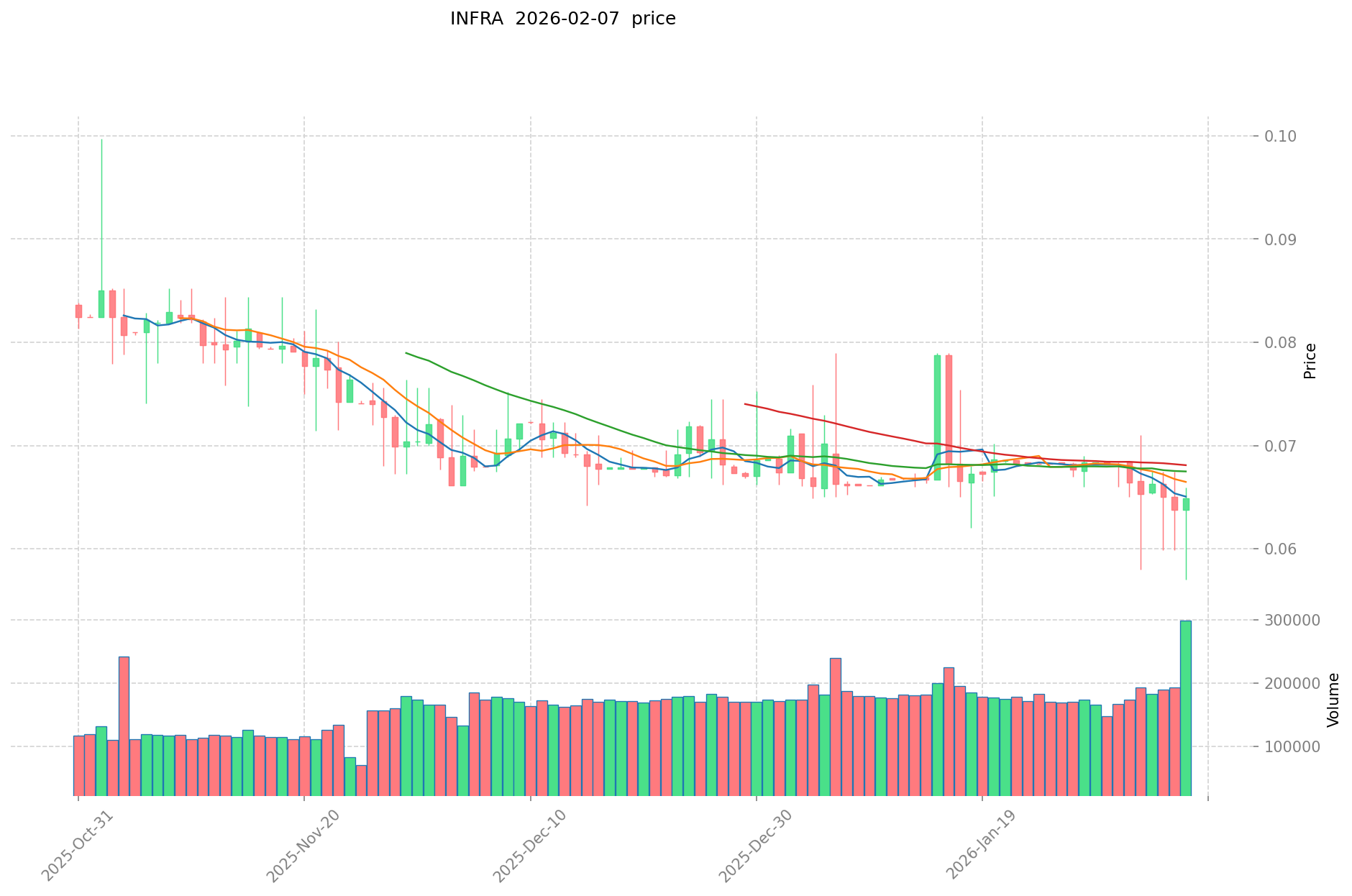
Bware (INFRA) reached a significant price level of $2.5433 on January 24, 2024, during a period of heightened interest in Web3 infrastructure solutions.
The token experienced its lowest recorded price of $0.057 on February 06, 2026, reflecting broader market corrections and shifting sentiment in the blockchain infrastructure sector.
These fluctuations demonstrate the impact of market dynamics, adoption trends, and external factors on token valuation.
Click to view current INFRA market price
On-chain Metrics
- Holder Count: Approximately 473 addresses hold INFRA tokens, indicating a relatively concentrated holder base
- Trading Volume (24h): $19,644.20, reflecting current market activity levels
- Contract Deployment: Available on Ethereum (ETH) and Avalanche C-Chain (AVAX_C), enabling cross-chain accessibility
Bware (INFRA) Ecosystem Applications and Partners
Core Use Cases
Bware's ecosystem supports multiple applications:
- Web3 Infrastructure: Blast Protocol, providing decentralized blockchain API services with the fastest response times in the Web3 infrastructure field.
- Node Operations: Node providers and protocol delegators, driving high-performance API access and rewarding participants based on performance metrics.
Strategic Collaborations
Bware has established collaborations with well-known Web3 companies, enhancing its technical capabilities and market influence.
These partnerships provide a solid foundation for Bware's ecosystem expansion.
Controversies and Challenges
Bware faces the following challenges:
- Technical Challenges: Ensuring consistent high performance as request volumes scale
- Competitive Pressure: Competition from other blockchain infrastructure providers in the evolving Web3 space
These issues have sparked discussions within the community and market, while also driving Bware's continuous innovation.
Bware's community demonstrates activity with 473 token holders.
The project maintains presence on social platforms, with engagement around infrastructure developments and protocol updates.
New feature releases and protocol improvements have energized the community.
Sentiment on social platforms shows varied perspectives:
- Supporters praise Bware's fast response times and decentralized infrastructure approach, considering it a valuable Web3 infrastructure solution.
- Critics focus on price volatility and market competition.
Recent trends reflect the project's ongoing development phase.
Trending Topics
Users discuss Bware's infrastructure performance, node operation economics, and protocol delegation mechanisms,
showcasing both its technological potential and the challenges of gaining wider mainstream adoption.
- Official Website: Visit Bware Labs official website and Blast API to learn about features, use cases, and latest updates.
- White Paper: Bware documentation details the technical architecture, goals, and vision.
- Social Media: Follow Bware Labs on X platform at @BwareLabs for updates on technical upgrades, community activities, and partnership announcements.
Bware (INFRA) Future Roadmap
- Ongoing Development: Continue enhancing API performance and decentralized infrastructure capabilities
- Ecosystem Goals: Expand node provider network and increase platform request capacity
- Long-term Vision: Become a leading decentralized blockchain API infrastructure standard
How to Participate in Bware (INFRA)?
- Purchase Channels: Buy INFRA on Gate.com
- Storage Solutions: Store securely using compatible wallets that support Ethereum and Avalanche C-Chain tokens
- Participate in Governance: Engage as a node provider or protocol delegator to contribute to the ecosystem
- Build the Ecosystem: Visit the developer documentation to explore API integration opportunities
Summary
Bware redefines Web3 infrastructure through blockchain technology, providing transparency, decentralization, and high-performance API services.
Its active community, comprehensive resources, and technical capabilities make it distinctive in the cryptocurrency infrastructure space.
Despite facing competitive and market challenges, Bware's innovative approach and clear development direction position it as an important player in the future of decentralized technology.
Whether you are a newcomer or an experienced participant, Bware deserves attention and engagement.
FAQ
What is Crypto Infrastructure (Crypto INFRA)? What are its main components?
Crypto Infrastructure encompasses the foundational systems enabling blockchain networks. Main components include Layer 0 infrastructure, consensus mechanisms, node infrastructure, wallet systems, blockchain development tools, and middleware solutions that support secure transactions and network operations.
What is the role of crypto infrastructure in the blockchain ecosystem and why is it important?
Crypto infrastructure provides the operational environment for blockchain, enhancing scalability and security. It is crucial because it enables efficient DeFi applications and supports the sustainable development of the entire blockchain ecosystem.
What specific projects and technologies does Crypto INFRA include, such as nodes, wallets, and exchanges?
Crypto infrastructure encompasses nodes, wallets, Layer 2 solutions, zero-knowledge rollups, data availability layers, DeFi protocols, and blockchain networks. Key technologies include ZK Rollup, Move programming language, parallel processing, decentralized identity (DID), data protocols, and middleware solutions supporting scalability and privacy.
How to evaluate the quality and potential of a crypto infrastructure project?
Assess the whitepaper, team credibility, and technology innovation. Analyze market cap, transaction value, and community engagement. Evaluate real-world applications and adoption potential. Strong fundamentals and active development indicate quality projects with growth prospects.
What is the difference and relationship between crypto infrastructure and Layer 2 solutions?
Crypto infrastructure is the foundational blockchain layer ensuring security and decentralization, while Layer 2 solutions operate on top to enhance scalability and reduce costs. Layer 2 solutions like rollups and sidechains leverage base infrastructure to process transactions faster without compromising security.
* The information is not intended to be and does not constitute financial advice or any other recommendation of any sort offered or endorsed by Gate.