K21 is a fractional ownership token launched by Kanon in 2021 to democratize access to high-value NFT art collections through blockchain tokenization. Built on Ethereum, K21 enables users to own portions of a curated vault containing 21 premium digital artworks while participating in collective governance decisions through a 21% consensus veto mechanism. The token distributes ownership across 3,769 global holders, with approximately half of supply allocated to art acquisition and social causes, while over 21% goes to community through mining and liquidity programs. K21 operates on a fixed supply model of 21 million tokens and supports decentralized art curation powered by a multidisciplinary team of curators, engineers, and legal experts. Available on Gate exchange, K21 addresses market demand for accessible digital art investment while presenting an alternative ownership framework combining blockchain innovation with cultural values. The project faces market volatility and liquidity constraints typical of sp
K21's Positioning and Significance
In 2021, the Kanon team launched K21 (K21), aiming to address accessibility barriers in fine art investment and NFT collection ownership.
As a fractional ownership token for curated NFT vaults, K21 plays a key role in democratizing access to high-value digital art and collectibles.
As of 2026, K21 has established itself within the NFT and fractional ownership space, with 3,769 holders and an active community focused on art curation and blockchain innovation.
This article will provide an in-depth analysis of its technical architecture, market performance, and future potential.
Origin and Development History
Background
K21 was created by the Kanon team in 2021, aiming to solve the challenge of democratizing access to valuable NFT collections and enabling fractional ownership of curated digital art.
It emerged during the NFT boom and growing interest in decentralized art curation, with the goal of allowing anyone to participate in owning and governing premium NFT vaults through tokenization.
The launch of K21 brought new possibilities to art collectors, crypto enthusiasts, and those seeking exposure to high-value digital assets.
Key Milestones
- 2021: K21 token launched on March 21, enabling fractional ownership of a curated vault containing 21 NFTs.
- 2021: Initial distribution model established, allocating approximately half of token supply to art acquisition and social causes, with over 21% distributed to the community through mining programs and liquidity pools.
- 2021: Smart contract functionality introduced, allowing token holders to vote on vault buyout proposals with a 21% consensus veto mechanism.
With support from a multidisciplinary team including curators, blockchain engineers, developers, and legal experts, K21 continues to refine its approach to fractional NFT ownership and community governance.
How K21 Works
Decentralized Ownership
K21 operates on the Ethereum blockchain, distributing ownership across a global network of token holders rather than centralizing control in a single entity.
This decentralized structure ensures transparency and resilience, giving users direct ownership stakes in the underlying NFT vault and decision-making power regarding potential buyouts.
Blockchain Foundation
K21 is built on Ethereum's blockchain, a public and immutable digital ledger that records all token transactions and smart contract interactions.
Transactions are grouped into blocks and cryptographically linked, creating a secure and transparent chain.
Anyone can verify token movements and vault activities without intermediaries, establishing trust through code rather than centralized authorities.
The use of Ethereum's infrastructure provides security and composability within the broader DeFi and NFT ecosystems.
Ensuring Fairness
K21 leverages Ethereum's Proof of Stake (PoS) consensus mechanism to validate transactions and maintain network integrity.
Validators secure the network by staking ETH and processing transactions, earning rewards for their participation.
The K21 smart contract includes a unique governance feature: token holders can collectively veto buyout proposals for the entire vault with 21% consensus, ensuring community protection against unwanted sales.
This mechanism balances potential liquidity events with holder protection.
Secure Transactions
K21 utilizes Ethereum's public-private key cryptography to protect token transfers:
- Private keys (secret passwords) authorize transactions and prove ownership
- Public keys (account addresses) enable verification and receipt of tokens
This cryptographic system ensures that only authorized holders can transfer their K21 tokens, maintaining pseudonymous transaction privacy on the Ethereum blockchain.
The dedicated smart contract governing vault buyouts adds an additional layer of programmatic security, automatically executing proportional distribution of proceeds to token holders if a buyout succeeds.
Circulation Overview
As of February 07, 2026, K21's circulating supply is 18,026,697.92 tokens, with a total supply of 21,000,000 tokens under a fixed supply model.
The token distribution includes approximately half of the supply allocated for purchasing artworks and supporting social causes, while over 21% is distributed to the community through various mechanisms including mining programs and liquidity pools with high initial K21/ETH ratio locked.
Token holders participate in vault governance through a dedicated smart contract bidding mechanism, with the ability to veto buyout bids at 21% consensus.
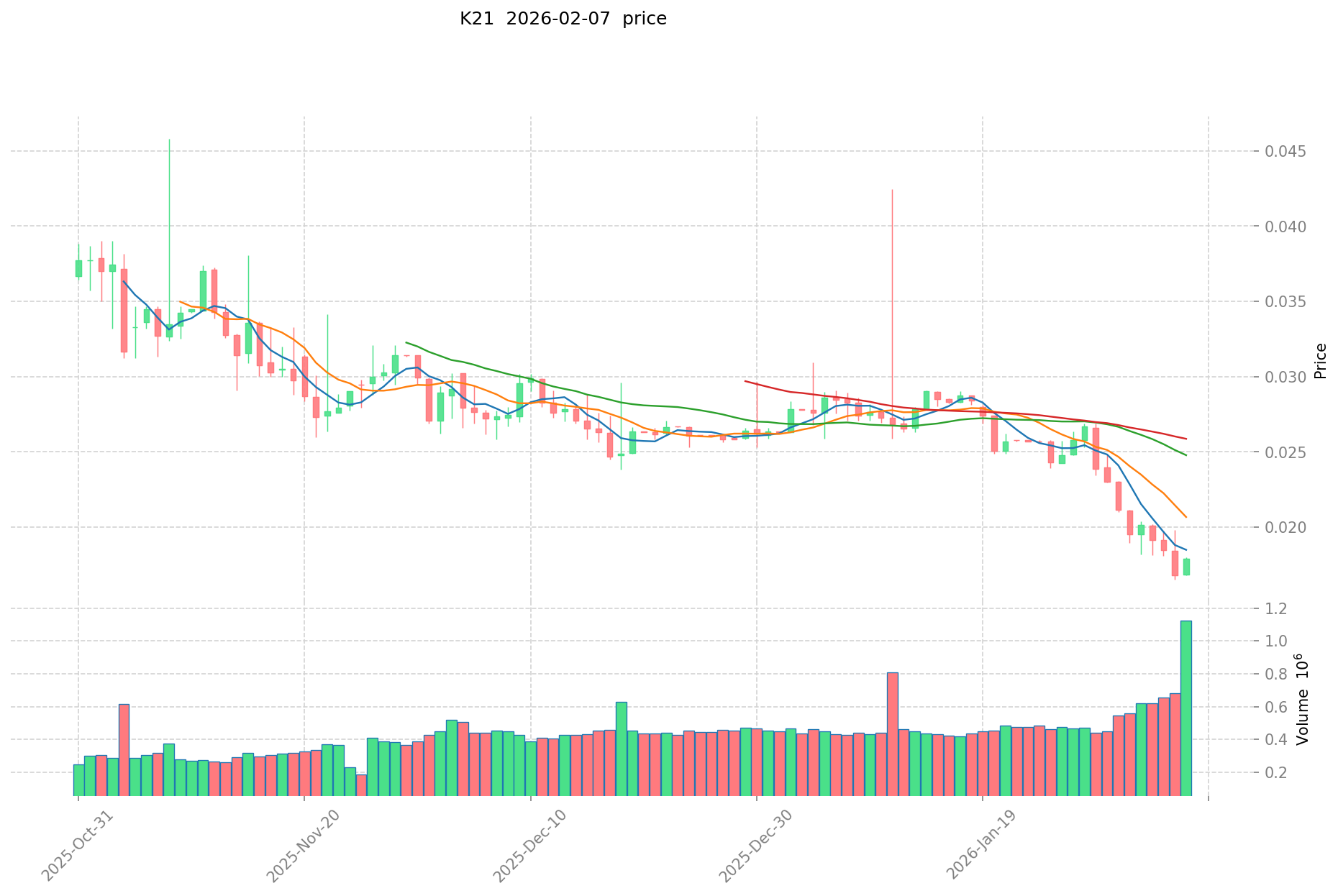
Price Fluctuations
K21 reached its peak price of 11.59 on March 27, 2021, during a period of heightened interest in NFT and art-related crypto projects.
The lowest price of 0.01649066 occurred on February 06, 2026, reflecting broader market corrections and shifting sentiment in the NFT sector.
These fluctuations demonstrate the impact of market conditions, adoption trends, and external factors on the token's valuation.
Click to view the current K21 market price
On-chain Metrics
- Token Holders: 3,769 addresses (indicating community participation levels)
- 24-hour Trading Volume: 20,309.23 (reflecting current market activity)
- Circulating Supply Ratio: 85.84% (showing the proportion of tokens in active circulation)
K21 Ecosystem Applications and Partners
Core Use Cases
K21's ecosystem centers on a distinctive application:
- NFT Art Curation: The K21 vault represents fractional ownership of a curated collection of 21 NFTs. Token holders gain exposure to digital art assets through collective ownership, enabling broader participation in the high-value NFT market.
- Community-Driven Ownership: K21 enables decentralized art collection management, where approximately half of the token supply supports art acquisition and social causes, creating a model that bridges digital art investment with community engagement.
Strategic Collaborations
K21 is developed by Kanon, which brings together experts from museum curation, blockchain engineering, full-stack development, and legal fields. This multidisciplinary team provides the project with expertise spanning art authentication, smart contract architecture, and regulatory compliance.
Controversies and Challenges
K21 faces several considerations:
- Market Volatility: The token has experienced substantial price fluctuations, with current trading levels reflecting considerable distance from previous valuations.
- Liquidity Considerations: With trading activity concentrated on limited exchanges, token holders may encounter liquidity constraints during portfolio rebalancing.
- Niche Market Focus: As a specialized art-backed token, K21 operates within a narrower market segment compared to general-purpose blockchain platforms, which may limit broader adoption momentum.
These factors shape ongoing discussions within the community regarding the project's positioning and development trajectory.
K21 maintains a dedicated holder base of 3,769 wallet addresses as of February 2026. The project's unique approach to NFT fractionalization has attracted participants interested in alternative digital asset ownership models.
On X platform, discussions around K21 often focus on the intersection of blockchain technology and art curation, with community members exploring the implications of tokenized art collections.
Sentiment on X demonstrates varied perspectives:
- Supporters highlight K21's innovative model for democratizing access to high-value NFT collections, appreciating the project's integration of art curation expertise with blockchain infrastructure.
- Observers note the challenges of valuing art-backed tokens and the complexities of collective buyout mechanisms embedded in the smart contract design.
Recent trading patterns indicate that community discussions reflect both interest in the conceptual framework and awareness of market performance considerations.
Discussion Topics
X users engage with K21's distinctive vault buyout mechanism, where token holders can veto acquisition proposals with 21% consensus. This governance feature generates discourse around decentralized decision-making in art ownership and the practical implications of fractional NFT models.
- Official Website: Visit K21 official site for detailed information about the vault collection, token mechanics, and project updates. The main Kanon platform at kanon.art provides broader context on the organization's mission.
- Blockchain Explorer: Track K21 transactions and token distribution through Etherscan, offering transparency into on-chain activity.
- X Platform: Follow @KanonDotArt for announcements regarding vault developments, community initiatives, and art ecosystem updates.
K21 Future Roadmap
Specific future milestones were not detailed in available materials. The project's ongoing focus appears centered on maintaining the integrity of its NFT vault collection and exploring mechanisms for community participation in art curation decisions through its token-based voting system.
How to Participate in K21?
- Purchase Channels: K21 tokens are available on Gate.com, providing access to the tokenized art vault.
- Storage Solutions: Store K21 securely using Ethereum-compatible wallets that support ERC-20 tokens, ensuring proper custody of your fractional vault ownership.
- Participate in Governance: Token holders can exercise voting rights through the dedicated smart contract's bidding function, enabling participation in vault buyout decisions with the 21% consensus threshold mechanism.
- Explore the Ecosystem: Review the vault's NFT composition and stay informed about potential collection developments through official Kanon channels.
Summary
K21 represents an experimental approach to NFT ownership, combining blockchain tokenization with curated digital art collections. The project offers fractional exposure to 21 NFTs through its vault structure, supported by a specialized team bridging art curation and blockchain technology.
With 3,769 token holders and a distinctive buyout voting mechanism, K21 operates within a specialized niche of the crypto ecosystem. The token's market performance reflects broader volatility in both cryptocurrency and digital art markets.
While facing challenges including limited liquidity and niche market positioning, K21's model presents an alternative framework for collective art ownership in the digital age. The project's emphasis on combining social causes with art acquisition adds a distinctive element to its value proposition.
For those interested in the intersection of blockchain technology, NFT markets, and collective ownership models, K21 offers a specialized case study in tokenized art curation. Potential participants should carefully evaluate the unique characteristics and risk factors associated with art-backed digital assets.
FAQ
What is Crypto K21 and what does it do?
Crypto K21 is a digital art investment token enabling holders to own fractions of curated high-value NFT artworks. It democratizes art ownership through blockchain technology while supporting social causes and providing exposure to the digital art market.
How can I buy or acquire K21 tokens?
To acquire K21 tokens, register on a reputable cryptocurrency exchange supporting K21, complete account verification, deposit funds, and place a buy order. Transfer your tokens to a secure hardware wallet for safekeeping.
What blockchain network does K21 operate on?
K21 operates on the Ethereum blockchain network, leveraging Ethereum's robust infrastructure and security for all token transactions and smart contract operations.
Is K21 a legitimate project and what are the security considerations?
K21 is a legitimate project with robust security measures. It implements commercially reasonable administrative, technical, and physical safeguards to protect user data and assets, ensuring reliable protection for participants.
What is the total supply and tokenomics of K21?
K21 has a total supply of 25,000,000,000 tokens with a maximum supply cap. The token uses 18 decimals for precision. Current market cap stands at $25,000,000 with 400 holders and 2,401 total transactions.
How does K21 differ from other cryptocurrencies?
K21 is a privacy-focused cryptocurrency emphasizing user anonymity and enhanced transaction security through advanced blockchain technology. It features unique consensus mechanisms and maintains limited supply, distinguishing it from conventional digital assets in the market.
What is the use case and real-world application of K21?
K21 enables DeFi trading, NFT minting, and blockchain gaming with fast, efficient transactions. It enhances scalability for digital asset applications that require high speed and low latency.
* The information is not intended to be and does not constitute financial advice or any other recommendation of any sort offered or endorsed by Gate.