What is LEVER: A Comprehensive Guide to Understanding Mechanical Advantage and Its Real-World Applications
LEVER's Positioning and Significance
In 2022, the Lever Finance team launched LEVER to address inefficiencies in DeFi asset management and limited accessibility to leveraged trading strategies. As a DeFi protocol facilitating leveraged yield farming and trading, LEVER plays a key role in the decentralized finance ecosystem.
As of 2026, LEVER has established itself within the DeFi space, serving users across multiple EVM-compatible chains with an active development community focused on seamless integration with fundamental DeFi protocols. This article will provide an in-depth analysis of its technical architecture, market performance, and future potential.
Origin and Development Timeline
Birth Background
LEVER was created by the Lever Finance team in 2022, aiming to solve limited access to sophisticated leveraged DeFi strategies and fragmented asset management tools. It emerged during the expansion of DeFi ecosystems across multiple Layer 1 and Layer 2 networks, with the goal of providing users with intuitive, powerful tools for leveraged trading integrated with core DeFi protocols. The launch of LEVER brought new possibilities to DeFi users seeking enhanced yield opportunities and efficient capital deployment.
Key Milestones
- 2022: LEVER token launched following the rebranding from RAMP DeFi, with a conversion ratio of 1 RAMP = 35 LEVER, establishing the foundation for the Lever Finance ecosystem.
- 2022: Platform deployment initiated on high-speed, low-fee EVM Layer 1 networks including Avalanche and Arbitrum, expanding accessibility and reducing transaction costs.
- 2022-2026: Continued ecosystem development with integration of additional DeFi protocols and expansion of leveraged trading capabilities.
With support from its community and development team, LEVER continues to refine its technology, security measures, and real-world applications across multiple blockchain networks.
How LEVER Works
No Central Control
LEVER operates within a decentralized network of nodes distributed globally, independent of banks or governmental oversight. These nodes collaborate to validate transactions, ensuring system transparency and attack resistance, granting users greater autonomy and enhancing network resilience.
Blockchain Foundation
LEVER is deployed on the Ethereum blockchain, utilizing a public, immutable digital ledger that records every transaction. Transactions are grouped into blocks and linked through cryptographic hashing to form a secure chain. Anyone can view these records, establishing trust without intermediaries. The token operates as an ERC-20 standard asset, leveraging Ethereum's established infrastructure for security and interoperability.
Ensuring Integrity
LEVER relies on Ethereum's Proof of Stake consensus mechanism to validate transactions and prevent fraudulent activities such as double-spending. Validators secure the Ethereum network through staking ETH and validating blocks, receiving rewards for maintaining network integrity. This mechanism provides energy efficiency and high transaction throughput compared to legacy consensus models.
Secure Transactions
LEVER utilizes public-private key cryptography to protect transactions:
- Private keys (similar to secret passwords) sign transactions
- Public keys (similar to account numbers) verify ownership
This mechanism ensures fund security while maintaining pseudonymous transaction privacy. Users maintain full control over their assets through self-custody wallets, with transactions validated and recorded immutably on the Ethereum blockchain.
LEVER Market Performance
Circulation Overview
As of February 6, 2026, the circulating supply of LEVER stands at 34,999,246,619 tokens, with a total supply of 42,000,000,000 tokens and a maximum supply of 55,786,500,000 tokens. The circulating supply represents approximately 62.74% of the total supply, indicating a substantial portion of tokens is already in circulation.
LEVER tokens entered the market through a token swap and brand upgrade from RAMP (Ramp DeFi) to LeverFi (Lever Finance), with eligible users receiving LEVER at a conversion ratio of 1 RAMP = 35 LEVER. This issuance mechanism has influenced the token's supply-demand dynamics since its launch.
Price Fluctuations
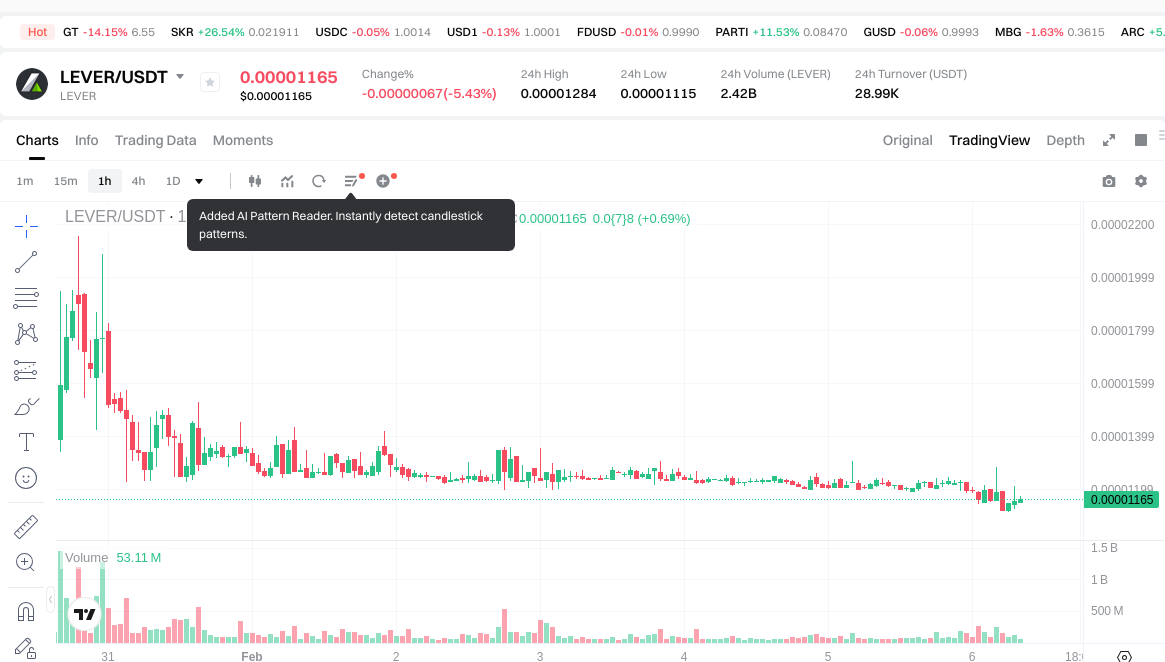
LEVER reached a notable price level of $0.00521513 on July 16, 2022, driven by broader market conditions and initial enthusiasm surrounding the platform's launch and DeFi sector growth during that period.
The token recorded its lowest price of $0.00001124 on February 6, 2026, reflecting challenging market conditions and decreased valuation. As of the latest update, LEVER trades at $0.00001169, showing recent price movements of +0.43% over 1 hour, -4.7% over 24 hours, -6.08% over 7 days, and -36.23% over 30 days. These fluctuations reflect evolving market sentiment, adoption trends, and broader cryptocurrency market dynamics.
Click to view current LEVER market price
On-Chain Metrics
- Market Capitalization: $409,141 (reflecting current valuation based on circulating supply)
- 24-Hour Trading Volume: $28,986 (indicating current market activity levels)
- Token Holders: 2,916 addresses (representing user distribution and adoption)
- Fully Diluted Valuation: $490,980 (projected valuation if maximum supply reaches circulation)
LEVER Ecosystem Applications and Partners
Core Use Cases
LEVER's ecosystem supports multiple applications:
- DeFi: Lever Finance platform provides leveraged yield farming and decentralized asset management capabilities.
- Asset Management: The platform seamlessly integrates with other basic DeFi protocols, enabling enhanced portfolio management and capital efficiency.
Strategic Cooperation
LEVER has established its presence on high-speed, low-cost EVM Layer 1 networks such as Avalanche and Arbitrum, enhancing its technical capabilities and market reach. These partnerships provide a solid foundation for LEVER's ecosystem expansion.
Controversies and Challenges
LEVER faces the following challenges:
- Technical Difficulties: Platform integration complexity and competitive pressure from established DeFi protocols
- Regulatory Risks: General regulatory uncertainty surrounding DeFi platforms and leveraged yield products
- Competitive Pressure: Competition from other DeFi platforms and asset management protocols in the blockchain space
These issues have sparked discussions within the community and market, while also driving LEVER's continuous innovation.
LEVER Community and Social Media Atmosphere
Fan Enthusiasm
LEVER's community maintains active engagement, with approximately 2,916 token holders.
On X platform, related posts and hashtags (such as #LEVER) generate regular discussions.
The platform's transition from RAMP to LeverFi and subsequent developments have maintained community interest.
Social Media Sentiment
Sentiment on X shows mixed perspectives:
- Supporters praise LEVER's DeFi innovation, asset management capabilities, and describe it as "a powerful platform for leveraged yield strategies".
- Critics focus on price volatility and market challenges.
Recent trends reflect the broader market conditions affecting DeFi tokens.
Hot Topics
X users actively discuss LEVER's platform developments, DeFi integration opportunities, and market performance, showcasing both its transformative potential and the obstacles toward mainstream adoption.
LEVER More Information Sources
- Official Website: Visit LEVER Official Website for features, use cases, and latest updates.
- Whitepaper: LEVER Documentation details its technical architecture, goals, and vision.
- X Updates: On X platform, LEVER uses @LeverFi actively, with posts covering technical upgrades, community activities, platform developments, generating engagement within the DeFi community.
LEVER Future Roadmap
- Platform Enhancement: Continued development of leveraged yield farming capabilities and integration with additional blockchain networks
- Ecosystem Goals: Expand DeFi protocol integrations and enhance user experience
- Long-term Vision: Establish itself as a leading platform for decentralized asset management and leveraged yield strategies
How to Participate in LEVER?
- Purchase Channels: Buy LEVER on Gate.com and other supported exchanges
- Storage Solutions: Securely store using compatible wallets such as MetaMask or hardware wallets
- Participate in Governance: Engage with the community through official channels and participate in platform discussions
- Build Ecosystem: Visit developer documentation to explore integration opportunities or contribute to the platform
Summary
LEVER, through blockchain technology and DeFi innovation, has redefined decentralized asset management, offering transparency, capital efficiency, and leveraged yield opportunities. Its active community, comprehensive resources, and platform capabilities make it noteworthy in the cryptocurrency space. Despite facing regulatory uncertainties and market competition, LEVER's innovative approach and development roadmap position it as a participant in the future of decentralized finance. Whether you are a newcomer or an experienced participant, LEVER merits attention and consideration.
FAQ
What is Crypto Leverage Trading?
Crypto leverage trading is a strategy where traders borrow funds to amplify their trading positions, aiming to gain higher profits from small price movements. It involves using borrowed capital through margin or futures contracts to increase potential returns.
What is the basic principle of cryptocurrency leverage trading and how does it work?
Leverage trading allows borrowing funds to trade larger positions, magnifying both profits and losses. You deposit initial margin as collateral, and must maintain minimum maintenance margin to avoid liquidation. Higher leverage increases risk of rapid losses.
What does the multiple (such as 5x, 10x) mean in leverage trading?
The multiple represents how much your initial capital is amplified. For example, 5x leverage means you can trade with 5 times your original funds, increasing both potential profits and losses proportionally.
What are the risks of crypto leverage trading? What is liquidation?
Leverage trading risks include market volatility and liquidation risk. Liquidation occurs when insufficient margin exists to maintain position, forcing the platform to forcibly close your trade, resulting in potential total loss of margin or greater losses in extreme conditions.
What is the difference between leverage trading and spot trading?
Leverage trading allows using borrowed funds to amplify trade size, while spot trading involves direct asset purchase without borrowing. Leverage trading carries higher risks including liquidation, whereas spot trading has lower risk.
How do beginners safely conduct leveraged crypto trading?
Start with small amounts and low leverage ratios. Use stop-loss orders to limit potential losses. Choose reputable platforms with strong liquidity. Maintain adequate margin reserves, diversify positions, and never risk money you cannot afford to lose. Discipline and risk management are essential for success.
Share
Content
LEVER's Positioning and Significance
Origin and Development Timeline
How LEVER Works
LEVER Market Performance
LEVER Ecosystem Applications and Partners
Controversies and Challenges
LEVER Community and Social Media Atmosphere
LEVER More Information Sources
LEVER Future Roadmap
How to Participate in LEVER?
Summary
FAQ
How to Buy Cryptocurrency


Trending Cryptocurrencies



What will be the market capitalization of USDC in 2025? Analysis of the stablecoin market landscape.

How is DeFi different from Bitcoin?
What is DeFi: Understanding Decentralized Finance in 2025

USDC stablecoin 2025 Latest Analysis: Principles, Advantages, and Web3 Eco-Applications

Development of Decentralized Finance Ecosystem in 2025: Integration of Decentralized Finance Applications with Web3
2025 USDT USD Complete Guide: A Must-Read for Newbie Investors

Comprehensive Guide to GURU Token

Comprehensive Guide to Token Generation Events

Everything About Moving Averages: The Foundation of Coin Price Analysis
Comprehensive Guide to Financial Freedom

Inside the New Product Lineup of a European Exchange: AI Trading Bots, Crypto Card, and More