Lnfi Network (LN) is next-generation financial infrastructure enabling multi-asset DeFi on Bitcoin's Lightning Network, launched in 2025 to address limitations in Lightning Network accessibility. This comprehensive guide explores how Lnfi Network operates through decentralized, blockchain-based architecture supporting Bitcoin, Taproot Assets, and RGB assets via its LightningFi platform. The article examines market performance metrics, including circulating supply of 118,250,000 tokens and current trading on Gate.com, while analyzing price fluctuations and on-chain metrics reflecting market dynamics. It covers ecosystem applications, strategic positioning within Bitcoin Layer 2 solutions, and discusses adoption challenges alongside community sentiment. Readers will discover participation methods, technical implementation details, and Lnfi Network's vision for Lightning Network expansion. Whether exploring Lightning Network DeFi or multi-asset management opportunities, this guide provides essential insights int
Lnfi Network's Positioning and Significance
In 2025, the Lnfi Network team launched Lnfi Network (LN), aiming to address limitations in multi-asset DeFi accessibility on the Lightning Network.
As a next-generation financial infrastructure enabling multi-asset DeFi on Bitcoin's Lightning Network, Lnfi Network plays a key role in DeFi and Bitcoin Layer 2 solutions.
As of 2026, Lnfi Network has established itself within the emerging Lightning Network DeFi ecosystem, supporting Bitcoin, Taproot Assets, and RGB assets through its LightningFi platform.
This article will provide an in-depth analysis of its technical architecture, market performance, and future potential.
Origin and Development History
Birth Background
Lnfi Network was created in 2025, aiming to solve the challenge of limited DeFi functionality and multi-asset support on Bitcoin's Lightning Network.
It emerged during the expansion of Bitcoin Layer 2 solutions and growing demand for Lightning Network applications, with the goal of enabling users to trade, earn, and manage multiple asset types beyond Bitcoin through LightningFi.
Lnfi Network's launch brought new possibilities to Bitcoin users and Lightning Network participants seeking DeFi capabilities.
Important Milestones
- January 2025: Token launched on Gate.com with an initial price of $0.05.
- July 2025: Price reached $0.043, representing strong initial market interest.
- 2025-2026: Continued development of the LightningFi infrastructure to support multi-asset DeFi operations.
With support from its development team and early community, Lnfi Network continues to enhance its technology, security, and real-world applications.
How Lnfi Network Operates?
No Central Control
Lnfi Network operates on a decentralized infrastructure leveraging the Lightning Network, removing reliance on traditional financial intermediaries.
The distributed architecture ensures transparency and resistance to single points of failure, granting users greater autonomy and enhancing network resilience.
Blockchain Foundation
Lnfi Network builds upon Bitcoin's blockchain and the Lightning Network's second-layer infrastructure, creating a public and immutable foundation for multi-asset DeFi operations.
Transactions and asset management activities are secured through the underlying Bitcoin blockchain while utilizing Lightning Network's efficiency for faster settlements.
Anyone can verify transactions without intermediaries, establishing trust through cryptographic verification.
The platform's integration with Taproot Assets and RGB assets extends functionality beyond standard Lightning Network capabilities.
Ensuring Fairness
Lnfi Network leverages the Lightning Network's channel-based architecture to process transactions efficiently while maintaining security.
The system relies on Bitcoin's Proof-of-Work consensus as its foundational security layer, with Lightning Network channels enabling rapid multi-asset operations.
Participants maintain network operations through running Lightning nodes and managing payment channels, with the LN token serving as the ecosystem's native asset.
Innovations include enabling DeFi functionality for Taproot Assets and RGB assets within the Lightning Network framework.
Secure Transactions
Lnfi Network employs public-private key cryptography to protect transactions:
- Private keys (similar to secret passwords) are used to authorize transactions
- Public keys (similar to account numbers) are used to verify ownership
This mechanism ensures fund security while transactions maintain pseudonymity inherited from Bitcoin and the Lightning Network.
The platform builds on Lightning Network's established security model, enabling users to manage multiple asset types with cryptographic protection.
Circulation Overview
As of February 3, 2026, the circulating supply of Lnfi Network (LN) stands at 118,250,000 tokens, with a total supply of 1,000,000,000 tokens and a maximum supply capped at 1,000,000,000 tokens, representing a fixed supply model.
The current circulation ratio is 11.82%, indicating that a significant portion of tokens remains unvested or locked. New tokens enter the market through controlled release mechanisms, which directly impact supply-demand dynamics and price stability.
Price Fluctuations
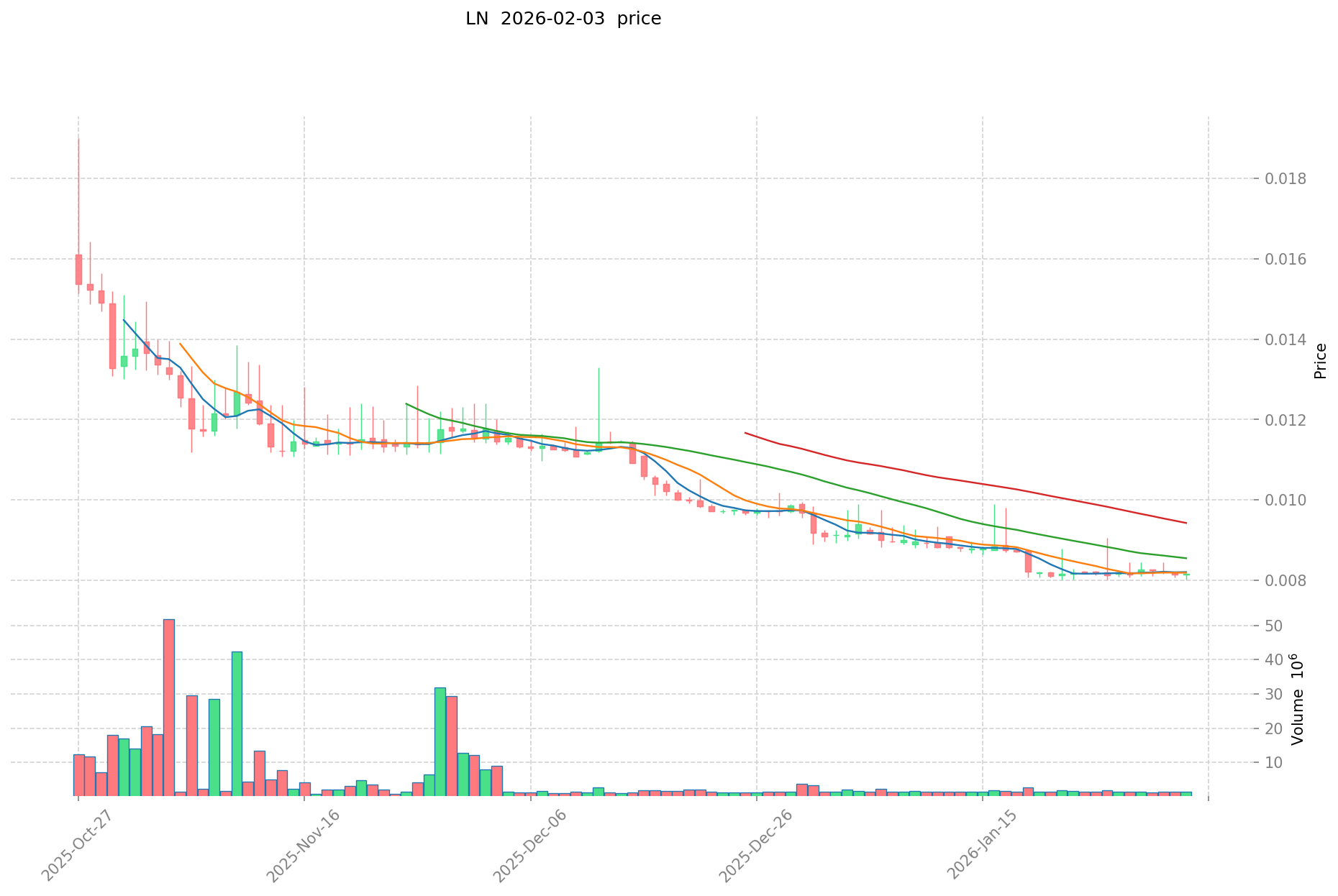
Lnfi Network (LN) reached its all-time high of $0.043 on July 25, 2025, during a period of heightened market activity and increased interest in Lightning Network-based DeFi solutions.
The token recorded its lowest price of $0.008014 on January 23, 2026, reflecting broader market corrections and reduced trading momentum. As of the latest update, LN trades at $0.008141, showing a 0.08% increase over the past 24 hours.
Price performance across different timeframes reveals:
- 1-hour change: -0.44%
- 7-day change: -1.09%
- 30-day change: -12.49%
- 1-year change: -88.12%
These fluctuations reflect evolving market sentiment, adoption trends, and external macroeconomic factors affecting the cryptocurrency sector.
Click to view the current LN market price
On-Chain Metrics
- 24-hour Trading Volume: $12,468.66 (indicating current market liquidity and trading activity)
- Market Capitalization: $962,673.25 (representing the total market value of circulating tokens)
- Fully Diluted Valuation: $8,141,000.00 (projected market cap if all tokens were in circulation)
- Holder Count: 1,152 addresses (reflecting community distribution and adoption)
- Market Dominance: 0.00029% (indicating LN's position within the broader cryptocurrency market)
Lnfi Network Ecosystem Applications and Partners
Core Use Cases
Lnfi Network's ecosystem supports multiple applications:
- DeFi: Through LightningFi, it provides decentralized trading and management of Bitcoin, Taproot Assets, and RGB assets on the Lightning Network.
- Multi-asset Infrastructure: Enables users to earn and trade various assets within the Bitcoin Lightning ecosystem.
Strategic Partnerships
While specific partnership details are not extensively documented in available materials, Lnfi Network positions itself as next-generation financial infrastructure for the Lightning Network, focusing on technical capabilities that enhance multi-asset DeFi functionality.
Challenges and Discussions
Lnfi Network faces several challenges:
- Market Performance: The token has experienced price fluctuations, with a 30-day decline of 12.49% and a one-year decrease of 88.12%.
- Market Competition: Operating in the competitive Bitcoin Layer 2 and Lightning Network space requires continuous innovation.
- Adoption Scale: With 1,152 holders and limited exchange presence (4 exchanges), expanding user base remains a priority.
These factors have prompted ongoing community discussions about the platform's growth trajectory and market positioning.
Lnfi Network maintains an active presence with 1,152 token holders and a circulating supply of 118,250,000 LN tokens.
The project engages with its community through its official X platform account, focusing on developments related to Lightning Network DeFi.
Sentiment on X presents mixed perspectives:
- Supporters highlight Lnfi Network's innovative approach to multi-asset DeFi on Lightning Network, viewing it as a bridge for Bitcoin ecosystem expansion.
- Observers note price volatility and market cap positioning, with current metrics showing a fully diluted market cap of $8,141,000.
Recent trends indicate community interest in the platform's technical development and Lightning Network integration capabilities.
Discussion Topics
X platform users discuss Lnfi Network's technical implementation, Lightning Network scalability, and multi-asset management features, reflecting both optimism about its technological approach and awareness of market challenges.
- Official Website: Visit Lnfi Network Official Site for features, use cases, and latest updates.
- Documentation: Lnfi Network Documentation provides detailed technical architecture and platform vision.
- X Updates: Lnfi Network maintains activity on X platform via @LnfiNetwork, sharing updates on technical developments, Lightning Network integration, and ecosystem expansion.
- Blockchain Explorer: Track on-chain activity via BSC Explorer.
Lnfi Network Future Roadmap
While specific timeline details are not extensively documented in available materials, Lnfi Network's focus centers on:
- Technical Enhancement: Advancing multi-asset DeFi capabilities on the Lightning Network
- Ecosystem Goals: Expanding trading and management options for Bitcoin, Taproot Assets, and RGB assets
- Long-term Vision: Establishing next-generation financial infrastructure for Lightning Network users
How to Participate in Lnfi Network?
- Purchase Channels: LN tokens are available on Gate.com and 3 other exchanges
- Storage Solutions: As a BEP-20 token, use BSC-compatible wallets for secure storage
- Contract Address: 0x6d2ebdf6d551d8408e7d896e9a1ec6f84806e193 (BSC network)
- Ecosystem Participation: Visit official documentation to learn about LightningFi platform features
Summary
Lnfi Network leverages Lightning Network technology to enable multi-asset DeFi, offering decentralized trading, earning opportunities, and management capabilities for Bitcoin and related assets.
With its focus on next-generation financial infrastructure and technical innovation, the platform addresses specific needs within the Bitcoin Lightning ecosystem.
Despite facing market volatility and adoption challenges, Lnfi Network's technical approach and Lightning Network integration position it as a noteworthy project in the decentralized finance space.
Whether you're exploring Lightning Network DeFi or interested in multi-asset management, Lnfi Network presents an option worth monitoring.
FAQ
What is the Lightning Network (LN) in cryptocurrency?
The Lightning Network is a second-layer payment protocol built on Bitcoin enabling fast, low-cost transactions through payment channels. It solves Bitcoin's scalability limitations by processing transactions off-chain while maintaining security.
What are the advantages of Lightning Network and why is it needed?
Lightning Network enables faster Bitcoin transactions with lower fees and higher throughput capacity without modifying Bitcoin's core protocol, solving blockchain scalability challenges.
What is the difference between Lightning Network and mainchain?
Lightning Network enables faster and cheaper transactions off-chain compared to mainchain. It routes payments through multiple nodes without recording each transaction on-chain, offering better privacy and scalability while maintaining security through blockchain settlement.
How to conduct transactions on the Lightning Network?
Set up a Lightning wallet and deposit Bitcoin. Create payment channels to start trading. Lightning Network enables fast, low-cost Bitcoin transactions through off-chain channels, settling on-chain when needed.
Is the Lightning Network secure? What are the risks?
Lightning Network inherits Bitcoin's security through its base layer. Main risks include counterparty risks in payment channels, potential node failures, and liquidity management issues. However, on-chain settlements provide ultimate security guarantees.
What cryptocurrencies does Lightning Network support?
Lightning Network primarily supports Bitcoin as its native cryptocurrency. It also enables fast, low-cost transactions for Bitcoin holders. Some implementations extend support to tokens on EVM-compatible blockchains through layer 2 solutions.
What is the difference between Lightning Network and other Layer 2 solutions such as Polygon and Arbitrum?
Lightning Network is Bitcoin's Layer 2 solution enabling faster transactions and lower fees, while Polygon and Arbitrum are Ethereum Layer 2 solutions. Lightning Network uses payment channels, whereas Polygon and Arbitrum use rollup technology for different blockchain ecosystems.
* The information is not intended to be and does not constitute financial advice or any other recommendation of any sort offered or endorsed by Gate.