League of Ancients (LOA) is a free-to-play, play-to-earn MOBA GameFi project built on Binance Smart Chain, addressing income inequality in the gaming industry. Launched in 2021, LOA enables players worldwide to earn cryptocurrency rewards through gameplay, democratizing esports participation for over 250 million MOBA players. The ecosystem features decentralized asset ownership via NFTs, utility token governance, and secure blockchain infrastructure. With 17,353 token holders and active community engagement, LOA offers competitive gaming mechanics combined with Web3 economics. Players can purchase LOA tokens on Gate, store assets in compatible BSC wallets, and participate in the expanding play-to-earn economy. Despite market volatility and competition, LOA's innovative approach positions it as a significant platform in decentralized gaming, appealing to gaming enthusiasts and crypto investors seeking blockchain-based esports opportunities.
League of Ancients's Positioning and Significance
In 2021, the League of Ancients team launched League of Ancients (LOA), aiming to address the lack of earning opportunities for the vast majority of MOBA game players and inefficient monetization models in traditional gaming.
As a free-to-play and play-to-earn MOBA NFT game, League of Ancients plays a key role in blockchain gaming and GameFi sectors.
As of 2026, League of Ancients has grown into an emerging GameFi project with an active community, with over 17,000 token holders and a developing player ecosystem.
This article will provide an in-depth analysis of its technical architecture, market performance, and future potential.
Origin and Development History
Birth Background
League of Ancients was created by the League of Ancients team in 2021, aiming to solve the income inequality in the e-sports industry where 99.99% of global MOBA players earn no revenue from gaming.
It emerged during the blockchain gaming boom and the rise of play-to-earn models, with the goal of democratizing e-sports income and enabling casual players to earn like professionals through mobile gaming to change the status quo.
League of Ancients's launch brought entirely new possibilities for the global MOBA gaming community of over 250 million players.
Key Milestones
- 2021: Project launched with the vision of creating a MOBA GameFi experience inspired by popular titles like Dota 2 and League of Legends.
- The project deployed on BSC (Binance Smart Chain), targeting mobile platform users on Android and iOS.
- 2025-2026: The token experienced volatility, with the community continuing to support ecosystem development.
With support from its community and development team, League of Ancients continues to optimize its gaming mechanics, tokenomics, and real-world applications.
How League of Ancients Works?
Decentralized Gaming Economy
League of Ancients operates on blockchain technology, eliminating traditional gaming companies' centralized control over in-game economies.
This decentralized approach allows players to truly own their in-game assets as NFTs and earn cryptocurrency rewards, ensuring transparency and player empowerment while reducing the risk of arbitrary platform changes.
Blockchain Foundation
League of Ancients leverages BSC (Binance Smart Chain) as its underlying infrastructure, providing a transparent and immutable record of all token transactions and NFT ownership.
Transactions are grouped into blocks and linked through cryptographic hashing to form a secure chain.
Anyone can verify records without intermediaries, establishing trust in the gaming ecosystem.
The use of BSC enables lower transaction fees and faster processing compared to some other blockchain networks.
Token Utility and Governance
LOA serves as the native utility and governance token within the League of Ancients ecosystem.
Players can earn LOA through gameplay, use it for in-game purchases, NFT transactions, and participate in protocol governance decisions.
The token follows a free-to-play model with zero entry barriers, allowing anyone to start playing and earning without initial investment, democratizing access to the play-to-earn economy.
Secure Asset Ownership
League of Ancients uses public-private key cryptography to protect player assets:
- Private keys (similar to secret passwords) are used to sign transactions and prove ownership
- Public keys (similar to account numbers) are used to verify ownership and receive assets
This mechanism ensures that in-game NFT heroes, items, and earned tokens remain secure under player control.
Players maintain true ownership of their digital assets, which can be traded on supported marketplaces, providing liquidity and real-world value to gaming achievements.
Circulation Overview
As of 06 February 2026, League of Ancients (LOA) has a circulating supply of 423,624,469.95 tokens, with a total supply of 1,000,000,000 tokens and a maximum supply capped at 1,000,000,000 tokens, representing a fixed supply model.
The circulating supply accounts for approximately 42.36% of the total supply, with tokens entering the market according to the project's tokenomics structure.
Price Volatility
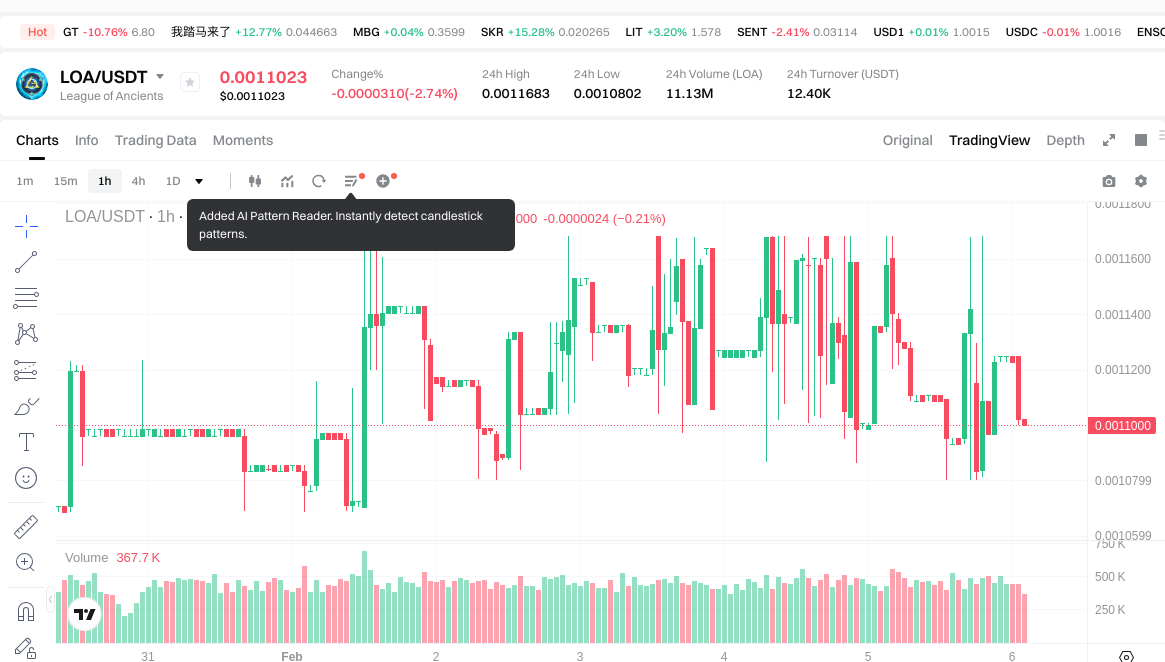
LOA reached a notable price level of $1.47 on 12 December 2021, during a period of increased interest in GameFi and MOBA-style blockchain games.
Its lowest recorded price was $0.0006714, which occurred on 16 December 2025, reflecting broader market corrections and shifting sentiment in the gaming token sector.
These fluctuations illustrate the impact of market sentiment, adoption trends, and external factors on the token's valuation.
Click to view the current LOA market price
On-Chain Metrics
- Holder Count: Approximately 17,353 addresses hold LOA tokens, indicating a distributed community base.
- 24-Hour Trading Volume: $12,399.80, reflecting current market activity and liquidity levels.
- Market Capitalization: $465,986.92, representing the token's overall market valuation based on circulating supply.
League of Ancients Ecosystem Applications and Partners
Core Use Cases
League of Ancients ecosystem supports multiple applications:
- GameFi: League of Ancients itself, providing free-to-play and play-to-earn MOBA gaming experience.
- NFT Integration: In-game NFT assets, enabling digital collectibles and character ownership.
Strategic Partnerships
League of Ancients operates on the Binance Smart Chain, leveraging BSC's infrastructure for enhanced technical capabilities and market reach.
These partnerships provide a solid foundation for LOA's ecosystem expansion.
Controversies and Challenges
League of Ancients faces the following challenges:
- Technical Issues: Ensuring smooth gameplay experience across Android and iOS platforms
- Market Competition: Competition from established MOBA games and emerging blockchain gaming projects
- Token Value Fluctuation: Price volatility affecting the play-to-earn economic model
These issues have sparked discussions within the community and market, while also driving LOA's continuous innovation.
League of Ancients community demonstrates notable activity, with 17,353 token holders.
On X platform, related posts and hashtags (such as #LOA and #LeagueOfAncients) generate engagement, driven by gaming updates and token developments.
New feature releases and gameplay improvements have ignited community enthusiasm.
Sentiment on X shows mixed perspectives:
- Supporters praise LOA's free-to-play model and innovative play-to-earn mechanics, considering it a pioneer in "mobile MOBA GameFi".
- Critics focus on price volatility and market performance concerns.
Recent trends show fluctuating sentiment correlating with token price movements and game development updates.
Trending Topics
X users actively discuss LOA's gaming mechanics, tokenomics, and competitive positioning in the GameFi sector,
showcasing both its transformative potential and the challenges in achieving mainstream adoption.
- Official Website: Visit League of Ancients Official Site for features, use cases, and latest updates.
- Whitepaper: League of Ancients Whitepaper details its technical architecture, objectives, and vision.
- X Updates: On X platform, League of Ancients maintains active presence via @LOAOfficialMOBA,
with posts covering game updates, community events, and partnership announcements, generating engagement from the gaming community.
League of Ancients Future Roadmap
- Platform Expansion: Continuous improvement of mobile gaming experience across Android and iOS platforms, enhancing gameplay performance and user experience
- Ecosystem Goals: Expanding player base and strengthening the play-to-earn economic model
- Long-term Vision: Becoming a leading mobile MOBA GameFi platform in the blockchain gaming space
How to Participate in League of Ancients?
- Purchase Channels: Buy LOA on Gate.com and other supporting exchanges
- Storage Solutions: Use compatible BSC wallets such as MetaMask or Trust Wallet for secure storage
- Join the Game: Download the game on Android or iOS to start playing and earning
- Engage with Community: Follow official social channels including YouTube, Instagram, and Facebook for updates and community activities
Summary
League of Ancients redefines mobile gaming through blockchain technology, offering free-to-play accessibility, play-to-earn opportunities, and competitive MOBA gameplay.
Its active community, comprehensive resources, and presence in the GameFi sector make it notable in the cryptocurrency space.
Despite facing market volatility and competitive challenges, LOA's innovative approach and clear development direction position it as a significant player in decentralized gaming's future.
Whether you are a gaming enthusiast or crypto investor, League of Ancients presents an interesting opportunity to explore the intersection of esports and blockchain technology.
FAQ
What is Crypto LOA? What is its specific meaning in cryptocurrency?
Crypto LOA stands for Letter of Agreement in cryptocurrency, formalizing agreements between parties in trading or investment. It outlines terms, conditions, and responsibilities ensuring clarity and legal protection in digital asset transactions.
What are the practical applications of Crypto LOA? How is it used in blockchain or crypto trading?
Crypto LOA serves as a utility token incentivizing network participation and facilitating transactions within its blockchain ecosystem. It enables decentralized applications, supports smart contract execution, and enhances transaction efficiency while providing governance rights to token holders.
What security considerations and risks should I be aware of when using Crypto LOA?
When using Crypto LOA, prioritize legal compliance and complete KYC/AML verification. Ensure your trading platform has robust security measures and privacy protection. Protect your account credentials to prevent unauthorized access. Be aware of potential capital gains tax obligations and market volatility risks associated with cryptocurrency assets.
What is the difference between Crypto LOA and traditional authorization mechanisms or other crypto authentication methods?
Crypto LOA offers superior security and anti-tampering capabilities compared to traditional authorization. It uses hardware-based encryption keys that are extremely difficult to replicate or bypass, effectively preventing software piracy and unauthorized access even when code is copied.
How to apply for or obtain Crypto LOA? What is the specific process?
Register an account on a crypto platform and complete identity verification. Deposit funds through bank transfer, credit card, or local payment methods. Search for LOA token and purchase it directly on the platform.
* The information is not intended to be and does not constitute financial advice or any other recommendation of any sort offered or endorsed by Gate.