What is LRN: A Comprehensive Guide to Learning Relationship Networks and Their Applications in Modern Technology

LRN's Positioning and Significance
In 2015, the Loopring Foundation launched LRN (Loopring NEO Token) to address inefficiencies and security risks in centralized cryptocurrency exchanges. As a decentralized exchange protocol deployed on the NEO network, LRN plays a key role in decentralized trading within the NEO ecosystem.
As of 2026, LRN continues to serve as a specialized token supporting decentralized token-to-token trading on NEO, with an active presence in the decentralized exchange space. This article will provide an in-depth analysis of its technical architecture, market performance, and future potential.
Origin and Development History
Background
LRN was created by the Loopring Foundation in 2015, aiming to solve security risks and trust issues associated with centralized cryptocurrency exchanges. It emerged during the blockchain technology boom, with the goal of providing a risk-free token exchange model through decentralization and changing the status quo. The launch of LRN brought new possibilities to NEO ecosystem users seeking secure decentralized trading.
Key Milestones
- 2018: The protocol was deployed, enabling decentralized token trading on the NEO network.
- The token has maintained its focus on supporting the NEO ecosystem's decentralized exchange capabilities.
With support from the Loopring Foundation, LRN continues to optimize its technology, security, and real-world applications.
How Does LRN Work?
No Central Control
LRN operates on a decentralized computer network (nodes) distributed globally, free from control by banks or governments. These nodes collaborate to verify transactions, ensuring system transparency and attack resistance, granting users greater autonomy and enhancing network resilience.
Blockchain Core
LRN's blockchain is a public, immutable digital ledger that records every transaction. Transactions are grouped into blocks and linked through cryptographic hashes to form a secure chain. Anyone can view the records, establishing trust without intermediaries. The Loopring protocol's unique approach includes off-chain order matching combined with on-chain settlement, further enhancing performance and reducing risks.
Ensuring Fairness
LRN operates within the Loopring protocol framework, which uses a decentralized order matching mechanism to verify transactions and prevent fraudulent activities such as double-spending. Relayers and nodes maintain network security by facilitating order matching and settlement, contributing to the protocol's efficiency. Its innovation includes allowing multiple exchanges to compete for order matching while maintaining zero-risk token custody.
Secure Transactions
LRN uses public-private key encryption technology to protect transactions:
- Private keys (similar to secret passwords) are used to sign transactions
- Public keys (similar to account numbers) are used to verify ownership
This mechanism ensures fund security while transactions maintain pseudonymous privacy. The Loopring protocol's design ensures that users retain control of their assets throughout the trading process, eliminating counterparty risk.
LRN's Market Performance
Circulation Overview
As of February 08, 2026, LRN has a circulating supply of 113,602,931 tokens, with a total supply of 139,507,605 tokens. The circulating supply represents 100% of the maximum supply, indicating full token circulation in the market. LRN serves as the Loopring protocol token issued on the NEO network, designed to support decentralized token-to-token trading within the NEO ecosystem.
Price Fluctuations
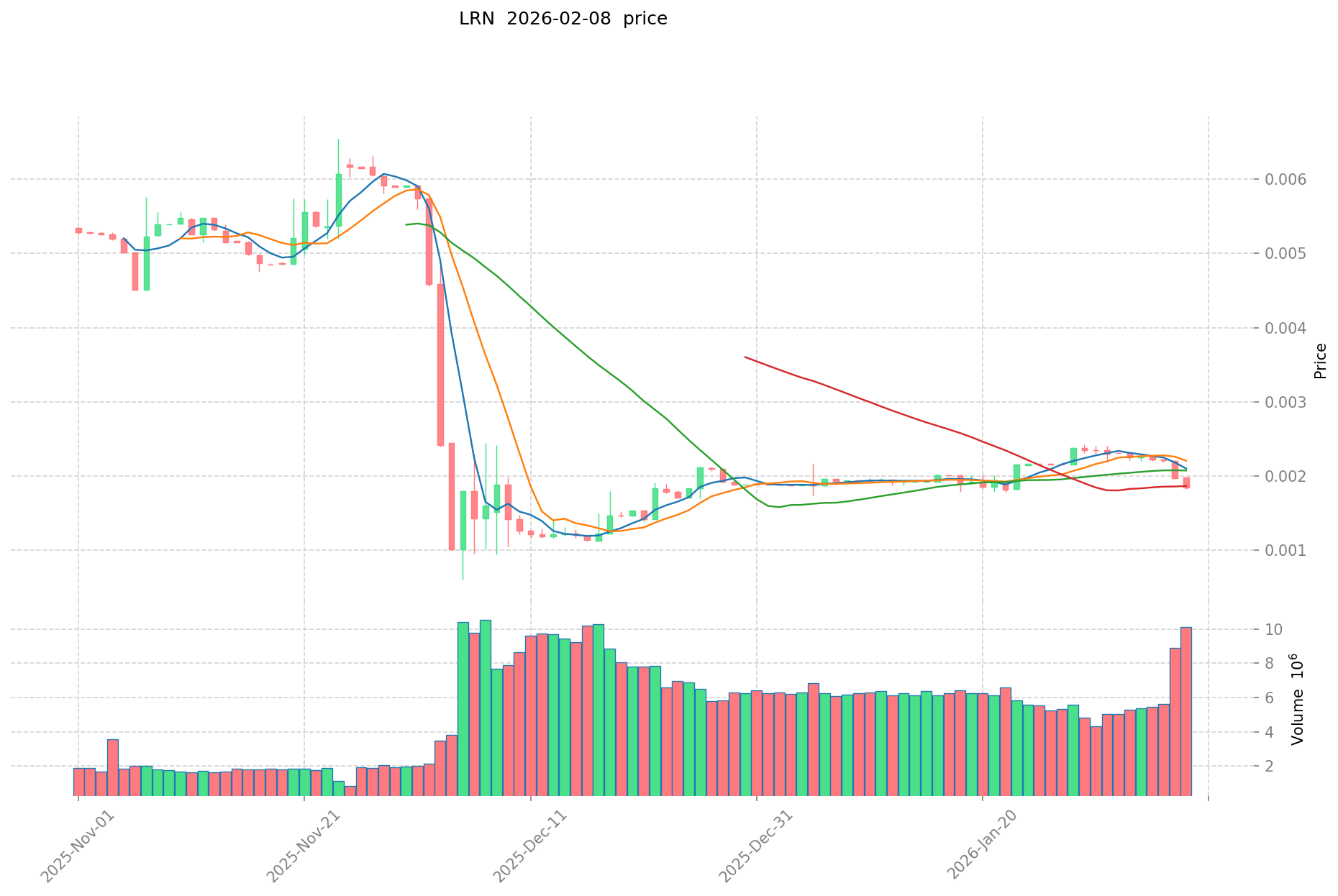
LRN reached its all-time high of $3.40441 on November 01, 2018, during a period of heightened interest in decentralized exchange protocols and blockchain asset trading solutions. The token experienced its lowest price of $0.000601091773 on May 09, 2025, reflecting broader market adjustments and shifts in trading dynamics. These price movements demonstrate the impact of market sentiment, adoption patterns, and technological developments in the decentralized exchange sector.
Click to view the current LRN market price
Recent Price Trends
- 1-Hour Change: +6.41% (showing short-term upward momentum)
- 24-Hour Change: +0.05% (indicating relative price stability)
- 7-Day Change: -14.51% (reflecting recent market pressure)
- 30-Day Change: +2.17% (demonstrating modest recovery)
- 1-Year Change: -5.68% (indicating moderate annual decline)
LRN Ecosystem Applications and Strategic Partners
Core Use Cases
LRN's ecosystem centers on decentralized exchange functionality:
- Decentralized Trading Protocol: The Loopring protocol deployed on the NEO network enables token-to-token trading within the NEO ecosystem, providing risk-free exchange mechanisms through off-chain order matching and on-chain settlement.
- Multi-Exchange Competition Model: The protocol allows multiple exchanges to compete for order matching on the same orders, enhancing trading efficiency and liquidity.
Strategic Collaborations
As part of the broader Loopring ecosystem, LRN benefits from the protocol's open-source architecture, which enables developers to build decentralized exchanges using the provided smart contracts and software tools.
Controversies and Challenges
LRN faces several challenges in the current market:
- Technical Difficulties: The token has experienced significant price volatility, with performance declining over various timeframes
- Market Competition: Competition from other blockchain networks and decentralized exchange protocols continues to intensify
- Liquidity Concerns: With limited exchange listings and trading volume of approximately $17,504 over 24 hours, liquidity remains a constraint
These issues have prompted ongoing discussions within the community about the project's future direction and market positioning.
LRN Community and Social Media Atmosphere
Community Engagement
LRN operates within the NEO ecosystem, supporting decentralized token trading functionality. The project maintains connections through official Loopring channels, fostering engagement among NEO ecosystem participants.
Social Media Sentiment
Sentiment surrounding LRN reflects mixed perspectives:
- Supporters emphasize the protocol's decentralized architecture and zero-risk trading model, viewing it as an important infrastructure component for NEO-based token exchanges.
- Critics point to price performance concerns and limited trading activity, questioning the token's long-term viability in an increasingly competitive landscape.
Recent trends show the token experiencing short-term gains while facing longer-term price pressure, with a 6.41% increase over 1 hour but a 14.51% decline over 7 days.
Discussion Topics
Community discussions often focus on trading volume sustainability, ecosystem development within NEO, and competitive positioning against other decentralized exchange solutions.
LRN Additional Information Sources
- Official Website: Visit Loopring Official Site for protocol features, technical documentation, and ecosystem updates.
- White Paper: Technical documentation available through the Loopring protocol repositories provides detailed architectural information.
- X Platform: Follow updates through @loopringorg for protocol developments, community activities, and partnership announcements.
- Development Resources: Access GitHub repositories for open-source code and developer documentation.
- Community Discussions: Join conversations on Medium for in-depth analysis and project updates.
LRN Future Roadmap
As part of the Loopring protocol ecosystem, LRN's development aligns with broader protocol enhancements focused on improving decentralized exchange functionality and expanding support for token trading within the NEO network.
How to Participate in LRN?
- Purchase Channels: Acquire LRN through Gate.com and other supporting exchanges
- Storage Solutions: Utilize NEO-compatible wallets for secure token storage
- Blockchain Explorer: Track transactions and token information via NEO Tracker
- Ecosystem Engagement: Explore the Loopring protocol documentation to understand decentralized exchange mechanisms and potential integration opportunities
Summary
LRN represents the Loopring protocol's deployment on the NEO network, providing decentralized token-to-token trading infrastructure with enhanced security through its unique off-chain matching and on-chain settlement model.
Despite facing market challenges including limited liquidity and price volatility, the protocol's innovative approach to decentralized exchange architecture maintains relevance within the NEO ecosystem.
The project's open-source foundation and focus on risk-free trading mechanisms position it as a technical solution for decentralized asset exchange, though market performance and adoption levels suggest ongoing development is needed to achieve broader recognition.
Whether you're exploring decentralized exchange technologies or interested in NEO ecosystem infrastructure, LRN offers insights into alternative approaches to cryptocurrency trading protocols.
FAQ
What is LRN cryptocurrency and what practical uses does it have?
LRN is a token issued by Loopring Foundation on the NEO platform, designed to support decentralized token-to-token trading within the NEO ecosystem. It facilitates trading activities and enables users to participate in the NEO DeFi landscape efficiently.
How to acquire and purchase LRN tokens? Which exchanges support trading?
You can acquire LRN tokens through major cryptocurrency exchanges that support ERC20 tokens. LRN is fully distributed and non-inflationary. Simply deposit funds on supported platforms and trade for LRN tokens in the market.
What are the main characteristics and innovations of the LRN project? How does it differ from other Learn2Earn projects?
LRN specializes in ethical leadership assessment and behavioral impact analysis. Its innovation lies in patented activity mapping systems that evaluate role-specific training needs. Unlike other Learn2Earn projects, LRN focuses on building sustainable organizational cultures and continuous leadership improvement through comprehensive program assessment frameworks.
What are the ways to earn rewards by holding LRN tokens? How do mining, staking, or other mechanisms work?
LRN token holders can earn rewards through staking mechanisms, which generate passive income over time. Staking involves locking tokens to secure the network and receive rewards. Additionally, HODL strategy allows long-term holders to benefit from potential appreciation and ecosystem growth.
What are the risks of the LRN project? What should I pay attention to before investing?
LRN faces technology implementation risks and financial forecast uncertainties. Before investing, monitor its financial guidance and platform operational performance. Management may have underestimated technical complexity in core infrastructure deployment.
What is the total supply, circulation supply, and token allocation scheme of LRN?
LRN total supply is one-tenth of LRC total supply. 60% of tokens will be distributed via airdrop in three phases, with holders receiving 2 LRN per 100 LRC held each phase. Remaining 40% allocated for ecosystem development and team incentives.
Share
Content
LRN's Positioning and Significance
Origin and Development History
How Does LRN Work?
LRN's Market Performance
LRN Ecosystem Applications and Strategic Partners
Controversies and Challenges
LRN Community and Social Media Atmosphere
LRN Additional Information Sources
LRN Future Roadmap
How to Participate in LRN?
Summary
FAQ
How to Buy Cryptocurrency


Trending Cryptocurrencies



What will be the market capitalization of USDC in 2025? Analysis of the stablecoin market landscape.

How is DeFi different from Bitcoin?

What is DeFi: Understanding Decentralized Finance in 2025

USDC stablecoin 2025 Latest Analysis: Principles, Advantages, and Web3 Eco-Applications
Development of Decentralized Finance Ecosystem in 2025: Integration of Decentralized Finance Applications with Web3

2025 USDT USD Complete Guide: A Must-Read for Newbie Investors
Is Dmail (DMAIL) a good investment?: A Comprehensive Analysis of Its Market Potential and Risk Factors

What is Fiat Currency?
What is a node in cryptocurrency and how do you set one up
How to Get Free NFTs: 5 Simple Ways
Who is Satoshi Nakamoto, or who created Bitcoin