Matrix Layer Protocol (MLP) is an AI-driven decentralized communication infrastructure protocol launched in 2024, addressing inefficiencies in multi-dimensional data transmission across IoT, Web3, and Metaverse applications. The protocol operates on BSC (BEP-20 standard) with a decentralized node network, featuring layered architecture and advanced cryptographic security mechanisms. As of February 2026, MLP has 15,621 holders and 618 million circulating tokens with current trading price around $0.0004105 on Gate. The ecosystem supports IoT integration, Web3 infrastructure, and metaverse connectivity while facing market volatility and competitive pressures. This comprehensive guide explores MLP's technical architecture, market performance, community dynamics, and participation methods for investors and developers interested in decentralized communication infrastructure.
Matrix Layer Protocol's Positioning and Significance
In 2024, the team behind Matrix Layer Protocol launched Matrix Layer Protocol (MLP), aiming to address inefficiencies in multi-dimensional data transmission and the lack of robust infrastructure for decentralized networks.
As an AI-driven communication and infrastructure protocol, Matrix Layer Protocol plays a key role in IoT, Web3, and Metaverse applications.
As of 2026, Matrix Layer Protocol has established itself as an emerging infrastructure solution in the decentralized ecosystem, with over 15,621 holders and an active development community.
This article will provide an in-depth analysis of its technical architecture, market performance, and future potential.
Origin and Development History
Birth Background
Matrix Layer Protocol was created by its development team in 2024, aiming to solve challenges in efficient, flexible multi-dimensional data transmission for decentralized network ecosystems.
It emerged during the rapid expansion of Web3 and decentralized technologies, with the goal of providing low-latency, high-security services across various network environments to transform the landscape.
The launch of Matrix Layer Protocol brought new possibilities to developers building IoT, Web3, and Metaverse applications.
Key Milestones
- November 2024: Official launch with initial listing, introducing AI-driven communication protocols for decentralized networks.
- December 2024: Market activity peaked with significant trading volume.
- 2025: Continued ecosystem development and community growth, with the holder base expanding to over 15,000 participants.
- Early 2026: Maintained active development and community engagement despite market fluctuations.
With the support of its community and development team, Matrix Layer Protocol continues to optimize its technology, security, and real-world applications.
How Does Matrix Layer Protocol Work?
No Central Control
Matrix Layer Protocol operates on a decentralized network of computers (nodes) distributed globally, free from control by banks or governments.
These nodes collaborate to validate transactions, ensuring system transparency and attack resistance, granting users greater autonomy and enhancing network resilience.
Blockchain Core
Matrix Layer Protocol's blockchain is a public, immutable digital ledger that records every transaction.
Transactions are grouped into blocks and linked through cryptographic hashes to form a secure chain.
Anyone can view the records, establishing trust without intermediaries.
The protocol's layered structure and multi-dimensional network topology further enhance performance and scalability.
Ensuring Fairness
Matrix Layer Protocol operates on the BSC (BEP-20) standard to validate transactions and prevent fraud such as double-spending.
Network participants maintain network security through participation in the decentralized infrastructure, supporting the protocol's operations.
Its innovations include AI-driven optimization for low-latency communication and efficient data transmission.
Secure Transactions
Matrix Layer Protocol uses public-private key cryptography to protect transactions:
- Private keys (like secret passwords) are used to sign transactions
- Public keys (like account numbers) are used to verify ownership
This mechanism ensures fund security while maintaining privacy in transactions.
The protocol's layered architecture provides additional security features for multi-dimensional data transmission across decentralized networks.
Circulation Overview
As of February 08, 2026, Matrix Layer Protocol (MLP) has a circulating supply of 618,000,000 tokens, with a total supply of 5,000,000,000 tokens. The maximum supply is capped at 5,000,000,000 tokens, representing a fixed supply model.
The current circulation ratio stands at approximately 12.36%, indicating that a significant portion of the total supply remains to be released into the market. This gradual release mechanism may influence the supply-demand dynamics of MLP over time.
Price Fluctuations
MLP experienced notable price volatility since its launch. The token was listed at an initial price of $0.01 in November 2024.
The token reached a peak price of $0.077 on December 31, 2024, representing a substantial increase from its launch price. This price movement occurred during a period of heightened interest in AI-driven infrastructure protocols within the decentralized ecosystem.
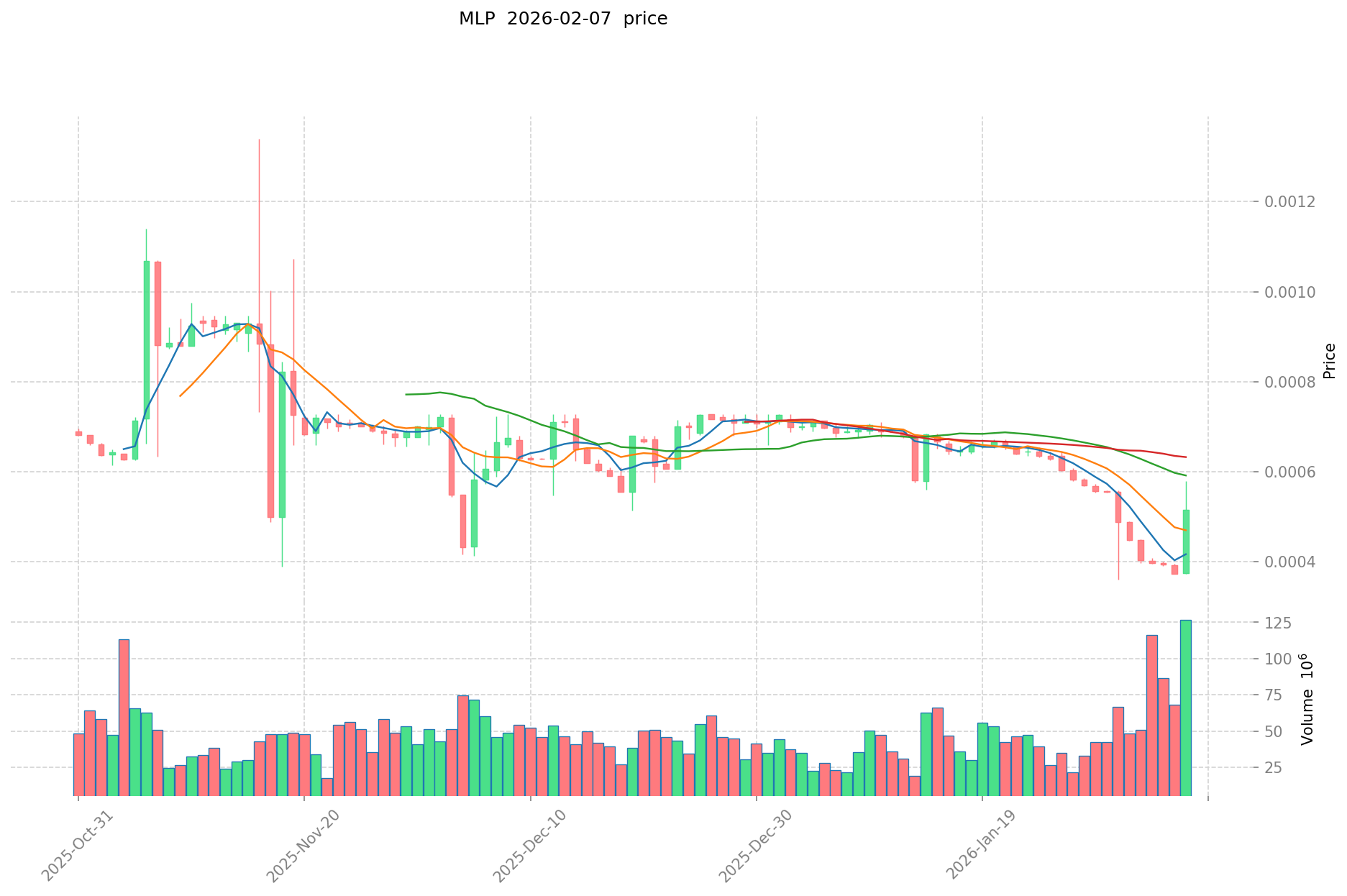
Conversely, MLP recorded its lowest price of $0.00024 on October 22, 2025, marking a significant decline from its peak. As of the latest update on February 08, 2026, the token is trading at approximately $0.0004105, with a 24-hour trading volume of $34,361.29.
Recent price trends show:
- 1H: +1.23%
- 24H: -17.14%
- 7D: -15.98%
- 30D: -40.42%
- 1Y: -99.11%
These fluctuations reflect evolving market sentiment, adoption trends, and broader conditions within the cryptocurrency market.
Click to view the current MLP market price
On-Chain Metrics
- Holders: As of the latest data, MLP has approximately 15,621 holders, indicating a growing community of users participating in the ecosystem
- Contract Standard: MLP operates on the BEP-20 standard and is deployed on the BSC (Binance Smart Chain) network
- Market Capitalization: The current market cap stands at approximately $253,689, with a fully diluted market cap of $2,052,500
- Market Dominance: MLP represents approximately 0.000082% of the total cryptocurrency market
Matrix Layer Protocol Ecosystem Applications and Partners
Core Use Cases
Matrix Layer Protocol's ecosystem supports multiple applications:
- IoT Integration: Matrix Layer Protocol provides efficient data transmission solutions for Internet of Things devices, enabling low-latency communication across distributed sensor networks.
- Web3 Infrastructure: The protocol facilitates decentralized network operations, supporting multi-dimensional data routing and secure information exchange in Web3 environments.
- Metaverse Connectivity: Matrix Layer Protocol enables seamless communication within virtual worlds, powering real-time interactions and immersive experiences across metaverse platforms.
Strategic Partnerships
Matrix Layer Protocol continues to develop its technological capabilities and market presence through ecosystem collaborations.
These partnerships aim to provide a foundation for Matrix Layer Protocol's ecosystem expansion.
Challenges and Considerations
Matrix Layer Protocol faces several challenges:
- Technical Development: Scaling solutions require ongoing optimization to maintain performance across growing network demands
- Market Competition: The infrastructure protocol space includes numerous blockchain communication solutions competing for adoption
- Regulatory Environment: Evolving regulatory frameworks for decentralized networks may impact protocol development
These factors generate ongoing discussion within the community and drive continuous innovation efforts.
Matrix Layer Protocol maintains an active community presence with 15,621 token holders as of February 2026.
On X platform, discussions around Matrix Layer Protocol and related topics appear regularly within crypto infrastructure conversations.
Community interest reflects attention to AI-driven communication protocols and decentralized infrastructure developments.
X platform sentiment shows varied perspectives:
- Supporters highlight Matrix Layer Protocol's AI-driven approach and multi-dimensional network architecture, viewing it as infrastructure for future decentralized communications.
- Observers monitor price volatility and early-stage development progress, noting the protocol's recent market performance.
Recent trends indicate cautious interest in AI-enhanced blockchain infrastructure projects.
Trending Topics
X users discuss Matrix Layer Protocol's positioning within the Web3 infrastructure landscape, AI integration in decentralized networks, and early-stage project development risks,
showcasing both innovation potential and considerations for mainstream adoption.
- Official Website: Visit Matrix Layer Protocol official website for features, use cases, and latest updates.
- Whitepaper: Matrix Layer Protocol documentation details the technical architecture, objectives, and vision.
- X Updates: On X platform, Matrix Layer Protocol maintains an active presence through @Matrix_MLP,
sharing content about protocol development, AI integration advancements, and ecosystem updates, generating engagement within the Web3 infrastructure community.
Matrix Layer Protocol Future Roadmap
- Ongoing Development: Enhancement of AI-driven communication layers and network topology optimization, improving data transmission efficiency and security
- Ecosystem Objectives: Expansion of protocol adoption across IoT, Web3, and metaverse applications
- Long-term Vision: Establishing Matrix Layer Protocol as foundational infrastructure for next-generation decentralized communication networks
How to Participate in Matrix Layer Protocol?
- Purchase Options: Acquire MLP through Gate.com and other supporting platforms
- Storage Solutions: Use compatible BEP-20 wallets for secure token storage
- Community Participation: Follow official channels for updates and community discussions
- Ecosystem Building: Access developer documentation to explore integration possibilities
Summary
Matrix Layer Protocol represents an AI-driven approach to decentralized communication infrastructure, offering efficient data transmission, layered network architecture, and flexibility across multiple application scenarios.
Its active development, innovative technology focus, and market presence position it within the emerging Web3 infrastructure landscape.
While facing market volatility and competitive pressures, Matrix Layer Protocol's technological approach and development roadmap contribute to the evolution of decentralized communication protocols.
Whether you are exploring infrastructure projects or following Web3 developments, Matrix Layer Protocol presents an interesting case study in AI-enhanced blockchain communication.
FAQ
What is Crypto MLP? What are its core functions?
Crypto MLP is an innovative protocol in decentralized networks, featuring hierarchical architecture and multi-dimensional design. Its core functions include enabling decentralized communication, facilitating multi-party value sharing, and providing economic incentives through MLP tokens to participants across the ecosystem.
What is the difference between MLP and other crypto liquidity protocols such as Uniswap and Curve?
MLP focuses on decentralized liquidity pools with broader functionality, while Uniswap targets universal crypto assets and Curve specializes in efficient stablecoin trading. MLP offers more diversified features compared to their specialized approaches.
How to participate in MLP? What conditions and steps are needed?
To participate in MLP, install the mlp-mixer-pytorch library using pip install mlp-mixer-pytorch. Then import torch and test the code. Follow the setup documentation for detailed configuration steps and requirements.
What are the main risks of investing in MLP?
Main risks include high leverage, capital market financing dependence, and low debt coverage ratios. These factors may lead to financial instability and dividend reductions.
What is the economic model of MLP tokens and how to earn rewards?
MLP operates on three core mechanisms: basic pool mining, accelerated pool staking, and referral rewards. Users earn stable daily yields by purchasing MLPhone or NFT to participate in mining. Rewards come from token incentives and market demand growth.
What are MLP's development prospects and market application scenarios?
MLP serves as fundamental infrastructure for decentralized liquidity provision. Its prospects include expanded protocol integrations, cross-chain expansion, and increased institutional adoption. Market applications span automated market making, yield farming, and collateral solutions across DeFi ecosystems.
* The information is not intended to be and does not constitute financial advice or any other recommendation of any sort offered or endorsed by Gate.