What is MUSE: A Comprehensive Guide to Multi-Scale Unsupervised Sentence Embeddings

Muse's Positioning and Significance
In 2021, the NFT20 team launched Muse (MUSE), aiming to address inefficiencies in NFT trading and liquidity fragmentation. As a governance token for a permissionless NFT tokenization protocol, Muse plays a key role in the NFT and DeFi sectors.
As of 2026, Muse has established itself within the NFT infrastructure landscape, with 3,943 holders and an active community participating in protocol governance. This article will provide an in-depth analysis of its technical architecture, market performance, and future potential.
Origin and Development History
Birth Background
Muse was created by the NFT20 team in 2021, aiming to solve liquidity and accessibility challenges in the NFT market. It emerged during the NFT boom and the expansion of DeFi ecosystems, with the goal of enabling seamless NFT trading through tokenization and decentralized exchanges to transform the status quo. Muse's launch brought new possibilities for NFT collectors, traders, and DeFi users.
Important Milestones
- March 2021: Muse launched on Gate.com, enabling governance participation and fee distribution mechanisms.
- 2021: NFT20 protocol integrated with decentralized exchanges like UniSwap and SushiSwap, expanding NFT trading accessibility.
- 2021-2026: The protocol continued evolving its tokenization infrastructure, supporting various NFT collections and enabling liquidity provision.
Under the support of the NFT20 community and governance participants, Muse has continued optimizing its protocol functionality, security, and real-world applications.
How Does Muse Work?
No Central Control
Muse operates within the NFT20 protocol, which runs on a decentralized network of smart contracts deployed on Ethereum. These smart contracts enable permissionless NFT tokenization and trading without reliance on centralized intermediaries. This architecture ensures transparency, reduces counterparty risk, and gives users greater autonomy over their NFT assets.
Blockchain Foundation
Muse is deployed on the Ethereum blockchain, leveraging its robust, immutable ledger for all transactions. The Ethereum blockchain records every Muse transaction and governance action in an auditable, tamper-proof manner. Anyone can verify token transfers and protocol operations without requiring intermediaries. The protocol utilizes ERC-20 token standards, ensuring compatibility with Ethereum's extensive DeFi ecosystem and wallet infrastructure.
Ensuring Fairness
Muse relies on Ethereum's Proof of Stake (PoS) consensus mechanism to validate transactions and maintain network integrity. Ethereum validators secure the network through staking ETH, preventing double-spending and malicious activities. Muse token holders participate in governance by voting on protocol proposals, determining fee structures, and influencing platform development. This governance model ensures that protocol evolution reflects community consensus rather than centralized decision-making.
Secure Transactions
Muse utilizes Ethereum's public-private key cryptography to protect transactions:
- Private keys (similar to secret passwords) are used to sign transactions and authorize token transfers
- Public keys (similar to account numbers) are used to verify ownership and receive tokens
This mechanism ensures fund security, and transactions maintain pseudonymous privacy through blockchain addresses. All Muse transactions benefit from Ethereum's established security infrastructure, including extensive network validators and battle-tested smart contract standards.
Muse's Market Performance
Circulation Overview
As of February 08, 2026, Muse's circulating supply stands at 827,602.74 tokens, with a total supply of 829,194.43 tokens and a maximum supply capped at 1,000,000 tokens. The circulating supply represents approximately 82.76% of the total supply, indicating a relatively high proportion of tokens already in circulation. The fixed maximum supply model creates a deflationary framework that may influence long-term scarcity dynamics.
Price Fluctuations
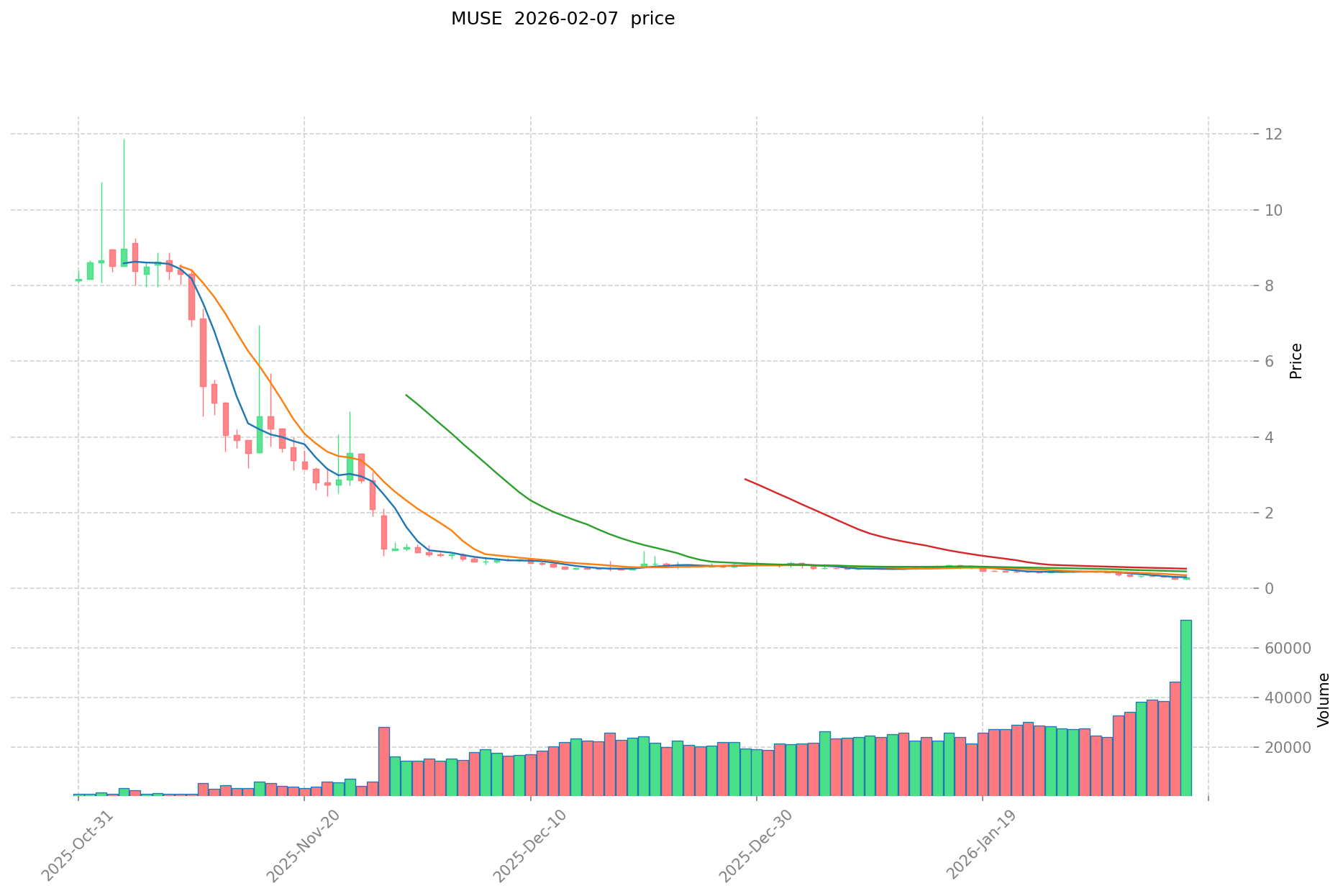
Muse reached its all-time high price of $124.14 on March 14, 2021, driven by the broader NFT market boom and increased interest in NFT tokenization protocols during that period. The token's lowest price of $0.124326 occurred on January 22, 2021, shortly after its initial market entry. As of the latest data, Muse is trading at $0.2909, reflecting significant volatility from its peak. Recent price movements show a 0.20% increase over 1 hour, a -0.3% decline over 24 hours, an -18.45% decrease over 7 days, a -42.89% drop over 30 days, and a -97.17% decline over the past year. These fluctuations reflect shifting market sentiment, adoption trends in the NFT space, and broader cryptocurrency market conditions.
Click to view current MUSE market price
On-Chain Metrics
- Market Capitalization: $240,749.64 (reflecting current circulating supply valuation)
- 24-Hour Trading Volume: $20,051.39 (indicating current market activity levels)
- Holder Count: 3,943 addresses (demonstrating community distribution)
- Market Dominance: 0.0000096% (representing Muse's position in the overall cryptocurrency market)
Muse Ecosystem Applications and Partners
Core Use Cases
Muse's ecosystem supports multiple applications:
- DeFi: Integrated with decentralized exchanges like UniSwap and Sushiswap, providing decentralized trading capabilities for tokenized NFTs.
- NFT: Through the NFT20 protocol, Muse enables NFT tokenization and fractional ownership, facilitating the liquidity of non-fungible assets in decentralized marketplaces.
Strategic Partnerships
Muse operates within the NFT20 ecosystem, leveraging integrations with established DeFi protocols to enhance its technical capabilities and market reach. These partnerships provide a foundation for Muse's ecosystem expansion in the NFT liquidity space.
Controversies and Challenges
Muse faces several challenges:
- Technical Difficulties: As an ERC-20 token on Ethereum, Muse may experience network congestion and high gas fees during peak periods.
- Regulatory Risks: The evolving regulatory landscape for NFTs and DeFi protocols presents ongoing uncertainty.
- Competition Pressure: The emergence of alternative NFT liquidity solutions and competing platforms creates a dynamic competitive environment.
These issues have sparked discussions within the community and market, driving continuous innovation in the Muse ecosystem.
Muse Community and Social Media Atmosphere
Fan Enthusiasm
Muse's community maintains an active presence with approximately 3,943 token holders. The project engages with its community through various channels, including its official forum at forum.musedao.io. Community discussions often center around governance proposals, fee distribution mechanisms, and platform development updates.
Social Media Sentiment
Sentiment on X shows varied perspectives:
- Supporters praise Muse's innovative approach to NFT liquidity and its governance model, viewing it as a solution for democratizing access to NFT markets.
- Critics focus on price volatility and the challenges facing NFT market liquidity overall.
Recent trends reflect the broader NFT market conditions and community engagement with governance features.
Hot Topics
X users actively discuss Muse's role in NFT liquidity provision, the effectiveness of tokenization protocols, and the sustainability of NFT market infrastructure, highlighting both its innovative potential and the obstacles to mainstream adoption.
Muse Additional Information Sources
- Official Website: Visit Muse official website for features, use cases, and latest updates.
- X Updates: On X platform, Muse maintains an active presence through @niftymuseum, sharing updates on technical developments, community activities, and partnership announcements.
Muse Future Roadmap
Based on available information, Muse continues to focus on enhancing the NFT20 protocol's functionality and expanding its role in NFT liquidity provision. The project aims to strengthen its position in decentralized NFT markets through ongoing technical improvements and community governance initiatives.
How to Participate in Muse?
- Purchase Channels: Muse can be traded on Gate.com
- Storage Solutions: Use Ethereum-compatible wallets such as MetaMask to securely store Muse tokens
- Participate in Governance: Engage with community decisions through the MuseDAO forum at forum.musedao.io
- Build Ecosystem: Visit the project's GitHub repository at github.com/verynifty to explore development opportunities
Summary
Muse leverages blockchain technology to address NFT liquidity challenges, providing transparency, decentralized governance, and efficient tokenization mechanisms. Its active community, established infrastructure, and focus on NFT market innovation distinguish it within the cryptocurrency space. Despite facing regulatory uncertainty and market volatility, Muse's commitment to NFT liquidity solutions and its clear governance framework position it as a noteworthy participant in decentralized NFT markets. Whether you are new to NFTs or an experienced participant, Muse offers opportunities for engagement in the evolving NFT ecosystem.
FAQ
What is Crypto MUSE and what is its main purpose?
Crypto MUSE is the governance token for nft20.io, designed to enhance the NFT ecosystem. Its primary purpose is to enable community governance, allowing token holders to participate in platform decisions and shape the future of NFT innovation.
How can I buy and store MUSE tokens?
Create an account and purchase USDT with fiat currency. Swap USDT for MUSE tokens. Store MUSE in a secure wallet or hardware wallet for optimal security.
What is the tokenomics and total supply of MUSE?
MUSE has a maximum supply of 950,001 tokens. The total supply is 829,194.43 MUSE, with a circulating supply of 508,554 MUSE. The tokenomics structure ensures controlled distribution and long-term sustainability for the ecosystem.
What are the risks and security considerations when investing in MUSE?
MUSE involves credit risk from potential defaults and exposure to various credit instruments. Market volatility and regulatory changes may impact performance. Smart contract risks and liquidity fluctuations also apply. Review documentation for comprehensive risk assessment.
How does MUSE compare to other similar cryptocurrency projects?
MUSE stands out in the Ethereum ecosystem with strong market fundamentals and consistent performance. It offers competitive tokenomics and active community engagement, often outperforming similar projects. MUSE maintains robust liquidity and continues gaining adoption across decentralized platforms.
Share
Content
Muse's Positioning and Significance
Origin and Development History
How Does Muse Work?
Muse's Market Performance
Muse Ecosystem Applications and Partners
Controversies and Challenges
Muse Community and Social Media Atmosphere
Muse Additional Information Sources
Muse Future Roadmap
How to Participate in Muse?
Summary
FAQ
How to Buy Cryptocurrency


Trending Cryptocurrencies



What will be the market capitalization of USDC in 2025? Analysis of the stablecoin market landscape.

How is DeFi different from Bitcoin?

What is DeFi: Understanding Decentralized Finance in 2025

USDC stablecoin 2025 Latest Analysis: Principles, Advantages, and Web3 Eco-Applications
Development of Decentralized Finance Ecosystem in 2025: Integration of Decentralized Finance Applications with Web3
2025 USDT USD Complete Guide: A Must-Read for Newbie Investors
Is Bnext (B3X) a good investment?: A Comprehensive Analysis of the Digital Banking Platform's Potential and Risks

Smart Chain Platform for Beginners: A Comprehensive Guide

In-Depth Analysis of Cryptocurrency Scam "Rug Pull" Techniques and Countermeasures
7 Top Overseas Cryptocurrency-Related Stocks You Can Buy Through Domestic Brokerages

Top 6 Bitcoin ATMs for Low Fees and Privacy