What is NBOT: A Comprehensive Guide to Neural Bot Technology and Its Applications in Modern Business
NBOT's Positioning and Significance
In 2019, the Bodhi team launched NBOT (NBOT), aiming to address challenges in decentralized prediction markets and DeFi accessibility. As a token bridging traditional prediction market platforms with DeFi ecosystems, NBOT plays a key role in decentralized finance and derivatives trading.
As of 2026, NBOT has evolved into a core asset within the Naka Chain ecosystem, with 787 holders and an active development community focused on synthetic asset trading. This article will explore its technical architecture, market performance, and future potential.
Origin and Development History
Birth Background
NBOT was created by the Bodhi team in 2019, aiming to solve inefficiencies in prediction markets and limited access to cryptocurrency-denominated derivatives. It emerged during the growth of DeFi infrastructure and demand for decentralized financial products, with the goal of providing users with synthetic asset trading capabilities denominated in crypto assets to transform existing paradigms. The launch of NBOT brought new possibilities to DeFi users and prediction market participants.
Important Milestones
- January 2019: Naka Chain mainnet launched, establishing an independent blockchain platform for the Bodhi ecosystem.
- 2019: NBOT token created through the merger of previous Bodhi projects—Bodhi Token (BOT) and Bodhi On Ethereum (BOE)—at ratios of 1 BOT = 0.59 NBOT and 1 BOE = 0.41 NBOT.
- Post-2019: DeFi ecosystem development around NBOT, introducing Deerfi.com, a synthetic asset exchange allowing users to trade financial derivatives denominated in cryptocurrency.
- Ongoing: Deerfi Long platform enables NBOT holders to take long positions on BTC and ETH without liquidation risks and participate in liquidity pools to earn fee revenue.
With support from the Bodhi team and Naka Chain foundation, NBOT continues to optimize its technology, security, and real-world applications.
How Does NBOT Work?
Decentralized Control
NBOT operates on the Naka Chain, a decentralized network of computers (nodes) distributed globally, independent of banks or governments. These nodes collaboratively validate transactions, ensuring system transparency and attack resistance, granting users greater autonomy and enhancing network resilience.
Blockchain Foundation
NBOT's blockchain serves as a public, immutable digital ledger recording every transaction. Transactions are grouped into blocks and linked through cryptographic hashes to form a secure chain. Anyone can view the records, establishing trust without intermediaries. The Naka Chain infrastructure supports the deployment of DeFi applications and synthetic asset protocols.
Ensuring Fairness
Naka Chain employs a consensus mechanism to validate transactions and prevent fraud such as double-spending. Network participants maintain security through node operation and transaction validation, receiving NBOT rewards. The system's design focuses on supporting DeFi applications and prediction market functionalities.
Secure Transactions
NBOT utilizes public-private key cryptography to protect transactions:
- Private keys (similar to secret passwords) are used to sign transactions
- Public keys (similar to account numbers) are used to verify ownership
This mechanism ensures fund security while transactions maintain transparency appropriate for DeFi operations. The ERC-20 standard implementation on Ethereum provides additional interoperability and security features for cross-platform functionality.
NBOT's Market Performance
Circulation Overview
As of February 9, 2026, the circulating supply of NBOT is 21,332,428 tokens, with a total supply of 100,000,000 tokens. The maximum supply is capped at 100,000,000 tokens, indicating a fixed supply model.
NBOT originated from the merger of two previous projects by the Bodhi team: Bodhi Token (BOT) and Bodhi On Ethereum (BOE), converted at ratios of 1 BOT = 0.59 NBOT and 1 BOE = 0.41 NBOT respectively. This merger mechanism influenced the initial token distribution and market entry dynamics.
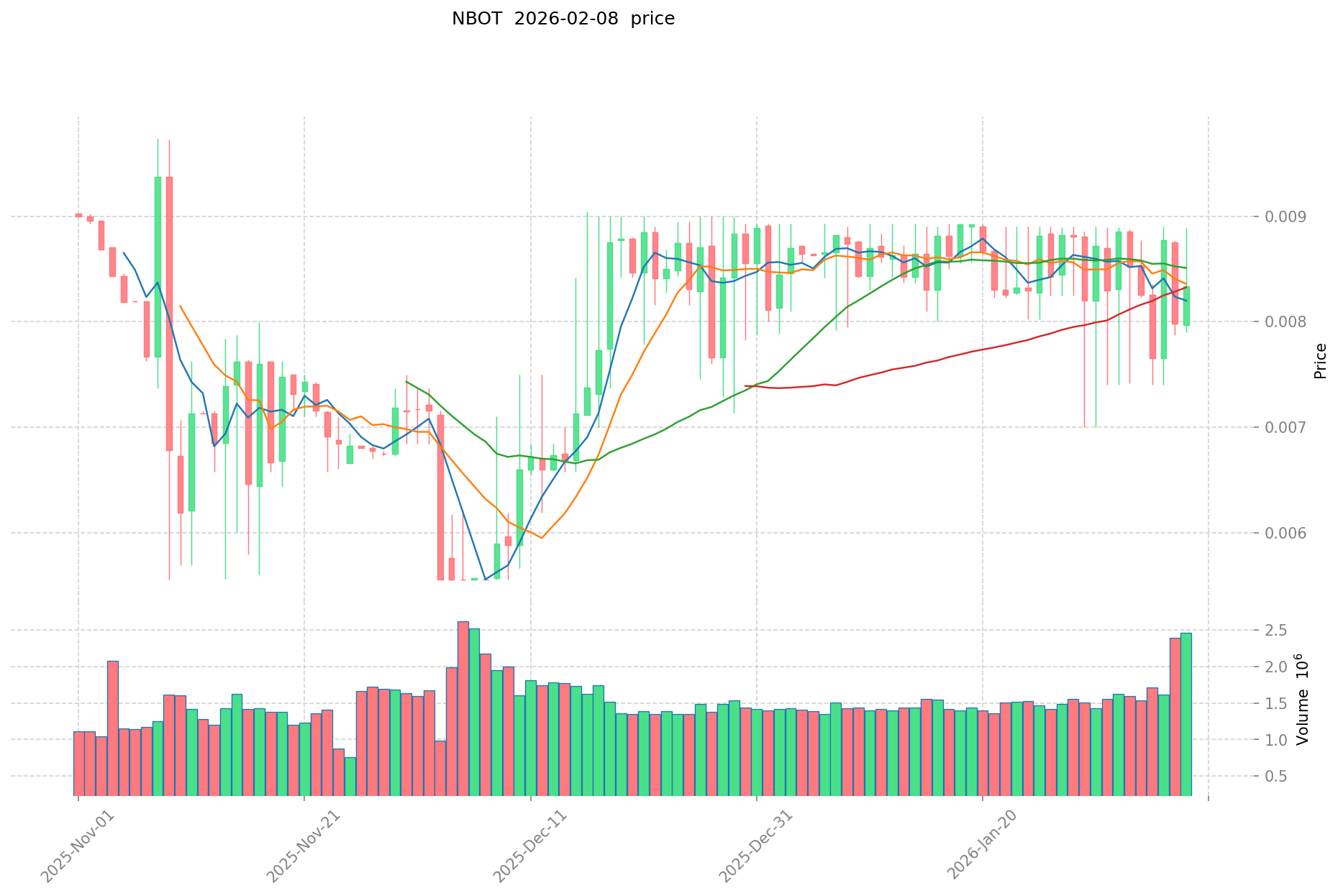
Price Volatility
NBOT reached a notable price level of $0.076389 on June 24, 2019, during a period characterized by early adoption and initial market enthusiasm following the launch of the Naka chain platform.
The token's lowest recorded price was $0.00190929 on March 13, 2020, coinciding with broader market volatility and uncertainty in the cryptocurrency sector during that period.
These price movements reflect varying market sentiment, adoption patterns, and external market conditions affecting the cryptocurrency ecosystem.
Click to view the current NBOT market price
On-Chain Metrics
- Holder Addresses: 787 (reflecting current user base)
- 24-Hour Trading Volume: $11,385.63 (indicating current market activity level)
- Circulating Supply Ratio: 21.33% of total supply is currently in circulation
NBOT Ecosystem Applications and Partners
Core Use Cases
NBOT's ecosystem supports multiple applications:
- DeFi: Deerfi.com, providing synthetic asset trading functionality. Users can engage in financial derivatives trading denominated in cryptocurrency terms.
- Prediction Markets: The Bodhi team has launched a new DeFi prediction market product, driving decentralized forecasting innovation.
Strategic Partnerships
NBOT has established collaborations to enhance its technological capabilities and market influence. These partnerships provide a solid foundation for NBOT's ecosystem expansion.
Controversies and Challenges
NBOT faces the following challenges:
- Technical Issues: Platform adoption and liquidity concerns
- Competition Pressure: The rise of other blockchain platforms and DeFi protocols
These issues have sparked discussions within the community and market, while also driving NBOT's continuous innovation.
NBOT Community and Social Media Atmosphere
Community Engagement
NBOT's community shows activity with 787 holders as of February 09, 2026. The project maintains presence on X platform through its Twitter handle, with discussions around the platform's DeFi applications and prediction market features. New feature releases and platform updates have generated community interest.
Social Media Sentiment
Sentiment on X shows mixed perspectives:
- Supporters praise NBOT's DeFi innovation and liquidity provision mechanisms, recognizing its potential in decentralized prediction markets.
- Critics focus on price volatility and market adoption challenges.
Recent trends show cautious optimism regarding the platform's DeFi applications.
Trending Topics
X users discuss NBOT's DeFi ecosystem development, prediction market innovation, and liquidity mining opportunities, showcasing both its transformative potential and the obstacles in achieving mainstream adoption.
NBOT Additional Information Sources
- Official Website: Visit NBOT Official Website for features, use cases, and latest updates.
- X Updates: On X platform, NBOT is active through @nakacoin, with posts covering technical updates, community events, and platform developments.
NBOT Future Roadmap
- Ecosystem Goals: Expand DeFi applications and prediction market capabilities
- Long-term Vision: Establish position in decentralized financial derivatives trading
How to Participate in NBOT?
- Purchase Channels: Purchase NBOT on Gate.com
- Storage Solutions: Securely store using compatible ERC-20 wallets
- Participate in Ecosystem: Join liquidity pools on Deerfi.com to earn platform fee income
- Build Ecosystem: Visit GitHub repository to contribute to development
Summary
NBOT through blockchain technology redefines DeFi prediction markets and synthetic asset trading, providing transparency, coin-denominated derivatives, and liquidity provision opportunities. Its community, platform resources, and market performance position it within the cryptocurrency space. Despite facing competition and market adoption challenges, NBOT's innovative approach and clear focus on DeFi applications give it relevance in the future of decentralized technology. Whether you are a newcomer or experienced player, NBOT deserves attention and participation.
FAQ
What is NBOT crypto and what does it do?
NBOT is a cryptocurrency built on the Ethereum blockchain with a total supply of 1 trillion tokens. It functions as a digital asset for decentralized applications and smart contract interactions within the Ethereum ecosystem.
How can I buy and store NBOT tokens?
Purchase NBOT tokens through major cryptocurrency platforms that support the token. Store them securely in a Web3 wallet or a custodial wallet. For maximum security, consider using hardware wallets for long-term storage.
What is the technology and use case behind NBOT?
NBOT is an AI-powered content curation platform that leverages advanced algorithms to scan and aggregate web content based on user interests. It delivers personalized insights and summaries, enabling users to efficiently stay informed on topics that matter most to them.
Is NBOT a safe investment and what are the risks?
NBOT presents moderate risk with high volatility potential. Main risks include market fluctuations, liquidity constraints, and regulatory changes. Success depends on market conditions and individual risk tolerance levels.
How does NBOT differ from other cryptocurrency projects?
NBOT stands out through its decentralized, community-driven architecture and advanced consensus mechanisms. Unlike centrally managed projects, NBOT prioritizes transparency and security while operating without central authority control, offering users true ownership and governance participation.
Share
Content
NBOT's Positioning and Significance
Origin and Development History
How Does NBOT Work?
NBOT's Market Performance
NBOT Ecosystem Applications and Partners
Controversies and Challenges
NBOT Community and Social Media Atmosphere
NBOT Additional Information Sources
NBOT Future Roadmap
How to Participate in NBOT?
Summary
FAQ
How to Buy Cryptocurrency


Trending Cryptocurrencies



What will be the market capitalization of USDC in 2025? Analysis of the stablecoin market landscape.

How is DeFi different from Bitcoin?

What is DeFi: Understanding Decentralized Finance in 2025
USDC stablecoin 2025 Latest Analysis: Principles, Advantages, and Web3 Eco-Applications
Development of Decentralized Finance Ecosystem in 2025: Integration of Decentralized Finance Applications with Web3

2025 USDT USD Complete Guide: A Must-Read for Newbie Investors
Rafał Zaorski – Who Is He? What Is His Net Worth?

Games You Can Earn Money From – TOP 11 Games in 2025
Six Cryptocurrencies That Have Achieved Over 1,000x Total Growth

How to Choose and Set Up the Best Cryptocurrency Wallet in Recent Years

NANO/XNO Cryptocurrency Project: Future Prospects and Analysis