Overlay Protocol is a decentralized data derivatives protocol launched in 2025, addressing liquidity constraints and counterparty risks in long-tail asset trading. Operating on BSC with the $OVL token, it enables counterparty-free trading of real-world data streams including ETH metrics and Twitch statistics through an innovative mint-and-burn mechanism. As of February 2026, OVL trades at $0.05678 with 2,306 token holders and a market cap of $807,637.54. Available on Gate and other exchanges, Overlay Protocol provides traders access to alternative data sources while maintaining on-chain transparency. The protocol represents a significant innovation in DeFi derivatives, though it faces adoption and liquidity optimization challenges requiring ongoing community engagement and ecosystem development.
Overlay Protocol's Positioning and Significance
In 2025, the Overlay Protocol team launched Overlay Protocol (OVL), aiming to address liquidity constraints and counterparty risks in long-tail asset and heterogeneous market trading.
As the first decentralized data derivatives protocol, Overlay Protocol plays a key role in decentralized finance (DeFi) and on-chain derivatives trading.
As of 2026, Overlay Protocol has established itself within the emerging data derivatives space, featuring a dynamic mint-and-burn model built around the $OVL token and serving 2,306 holders.
This article will provide an in-depth analysis of its technical architecture, market performance, and future potential.
Origin and Development History
Background
Overlay Protocol was created in 2025, aiming to solve the bilateral liquidity limitations and counterparty dependencies that have historically constrained niche and heterogeneous market derivatives trading.
It emerged within the evolving DeFi landscape, with the goal of enabling counterparty-free trading of real-world data streams—from ETH burn metrics to Twitch statistics, CS2 skins, and various unconventional data trends—all executable on-chain.
The launch of Overlay Protocol opened new possibilities for traders seeking exposure to alternative data sources and long-tail assets.
Key Milestones
- August 2025: The protocol's market debut occurred, with the token reaching an early peak price of $0.5 on August 14, 2025.
- January 2026: The token recorded its lowest price of $0.03171 on January 5, 2026, reflecting market volatility and broader crypto sector trends.
- February 2026: As of February 4, 2026, Overlay Protocol is listed on 7 exchanges and maintains a presence on Gate.com, demonstrating ongoing market accessibility and liquidity provision.
Supported by its community and ongoing protocol development, Overlay Protocol continues to refine its technology, security measures, and real-world application scenarios.
How Overlay Protocol Works
No Central Control
Overlay Protocol operates on a decentralized network of nodes distributed globally, independent of banks or government oversight.
These nodes collaborate to validate transactions, ensuring system transparency and attack resistance, granting users greater autonomy and enhancing network resilience.
Blockchain Foundation
Overlay Protocol's blockchain is a public, immutable digital ledger that records every transaction.
Transactions are grouped into blocks and linked through cryptographic hashes to form a secure chain.
Anyone can view the records, establishing trust without intermediaries.
The protocol is deployed on the BSC (BNB Smart Chain) network, leveraging its infrastructure for transaction processing and smart contract execution.
Ensuring Fairness
Overlay Protocol utilizes the BEP-20 token standard on BSC, operating within BSC's consensus framework to validate transactions and prevent fraudulent activities such as double-spending.
Network participants maintain security through standard BSC node operations and validation processes, with the protocol's innovative approach centered on its dynamic mint-and-burn mechanism that eliminates the need for traditional counterparties.
Secure Transactions
Overlay Protocol employs public-private key cryptography to protect transactions:
- Private keys (similar to secret passwords) are used to sign transactions
- Public keys (similar to account numbers) are used to verify ownership
This mechanism ensures fund security, with transactions maintaining pseudonymous characteristics typical of blockchain-based systems.
The protocol's design focuses on enabling data derivatives trading without requiring matched counterparties, representing a fundamental innovation in derivatives market structure.
Circulating Supply Overview
As of February 4, 2026, Overlay Protocol's circulating supply stands at 14,223,979.30 OVL tokens, with a total supply of 88,888,888 and a maximum supply cap of 100,000,000 tokens. The circulating supply represents approximately 18.12% of the maximum supply, indicating a relatively controlled token distribution model.
The protocol operates on a dynamic mint/burn mechanism built around the $OVL token, where new tokens enter the market through protocol interactions rather than traditional mining or staking rewards. This unique issuance model is designed to support counterparty-free trading and address liquidity challenges in long-tail assets and heterogeneous markets.
Price Dynamics
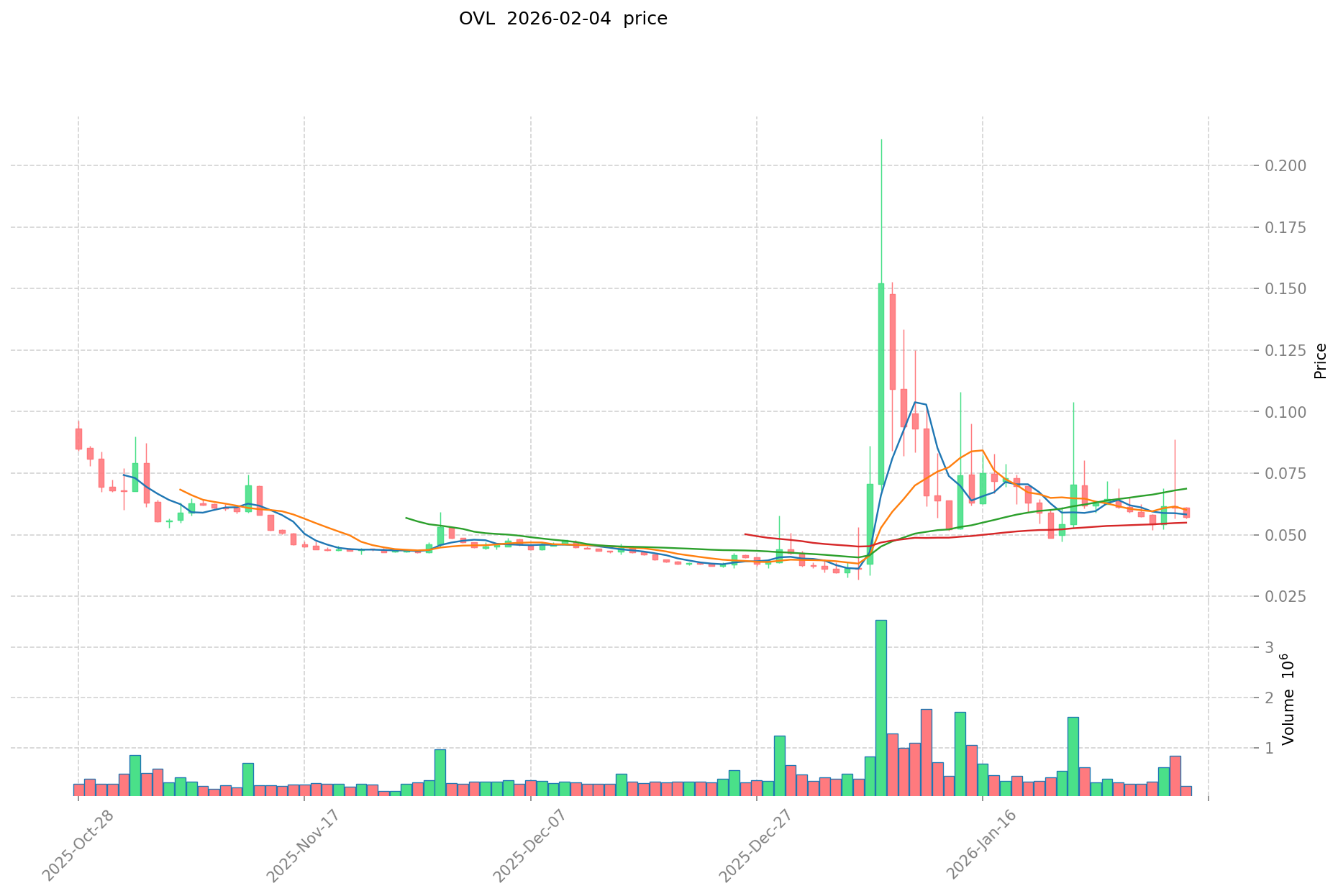
Overlay Protocol reached a notable price level of $0.5 on August 14, 2025, driven by increased interest in decentralized data derivatives and early protocol adoption. The token subsequently experienced a low of $0.03171 on January 5, 2026, reflecting broader market adjustments and volatility in the crypto derivatives sector.
As of the latest data, OVL trades at $0.05678, with recent price movements showing a -0.05% change over the past hour, -6.11% over 24 hours, and -12.25% over the past week. However, the 30-day performance indicates a recovery trend with a 54.87% increase, though the one-year performance shows an -89.46% decline from previous levels.
These fluctuations reflect the evolving dynamics of the decentralized derivatives market, adoption patterns, and broader cryptocurrency market sentiment.
Click to view current OVL market price
On-Chain Metrics
- 24-Hour Trading Volume: $14,461.59 (indicating current market activity levels)
- Token Holders: 2,306 addresses (reflecting user participation and distribution)
- Market Capitalization: $807,637.54 (representing current market valuation)
- Fully Diluted Market Cap: $5,047,111.06 (indicating potential valuation at maximum supply)
Overlay Protocol Ecosystem Applications and Partners
Core Use Cases
Overlay Protocol's ecosystem supports innovative applications in the derivatives space:
- Data Derivatives: The protocol enables trading of real-world metrics including ETH burn rates, Twitch statistics, CS2 skins, and temperature trends, providing decentralized access to diverse data streams.
- Counterparty-Free Trading: Through its dynamic mint/burn model built on the $OVL token, Overlay facilitates trading without traditional counterparties, breaking the bilateral liquidity constraints that previously limited similar products.
The protocol addresses liquidity challenges that affect long-tail assets and heterogeneous markets, expanding trading possibilities beyond conventional financial instruments.
Challenges and Considerations
Overlay Protocol faces several areas of ongoing development:
- Market Adoption: As a novel protocol introducing data derivatives, building user understanding and adoption requires continued education and ecosystem development.
- Liquidity Dynamics: The innovative mint/burn model, while solving traditional liquidity issues, presents unique mechanics that require careful monitoring and optimization.
- Competition: The broader DeFi derivatives space continues to evolve with various protocols offering alternative trading mechanisms.
These considerations drive the protocol's ongoing innovation and community engagement efforts.
Overlay Protocol maintains an active community presence with 2,306 token holders participating in the ecosystem. The protocol's community connects through Discord, where members discuss trading strategies, protocol developments, and data derivative opportunities.
X platform discussions around Overlay Protocol reflect diverse perspectives:
- Supporters highlight the protocol's innovative approach to data derivatives and counterparty-free trading, viewing it as a significant expansion of DeFi capabilities.
- Observers focus on market performance trends and the learning curve associated with novel derivative mechanics.
Recent sentiment has been influenced by price movements, with the token experiencing varied performance across different timeframes.
Discussion Topics
X users engage with topics including the protocol's unique trading mechanics, real-world data integration, and the broader implications of decentralized derivatives markets, showcasing both the innovation potential and the educational needs in this emerging sector.
- Official Website: Visit Overlay Protocol for protocol features, trading mechanics, and latest updates.
- White Paper: The Overlay Protocol Whitepaper details its technical architecture, mint/burn model, and vision for decentralized data derivatives.
- X Updates: Follow Overlay Protocol on X at @OverlayProtocol for protocol announcements, feature releases, and community updates.
- Blockchain Explorer: Track OVL transactions on BSC Scan for on-chain transparency.
How to Participate in Overlay Protocol?
- Acquisition: OVL is available on Gate.com and other supported platforms
- Storage: Secure your tokens using compatible wallets that support BEP-20 tokens
- Trading: Access the Overlay Protocol platform to explore data derivative trading opportunities
- Community: Join the Discord community to connect with other traders and stay updated on protocol developments
Summary
Overlay Protocol introduces a novel approach to derivatives trading through its decentralized data derivatives protocol, offering counterparty-free trading and access to diverse real-world metrics. Its innovative mint/burn model built on the $OVL token addresses traditional liquidity constraints affecting long-tail assets and heterogeneous markets. With an active community, transparent on-chain operations through BSC, and a focus on expanding tradable data streams, Overlay Protocol represents an emerging category within DeFi. While the protocol faces adoption and education challenges common to innovative financial products, its unique value proposition positions it as a noteworthy development in decentralized derivatives. Whether you're exploring new DeFi mechanisms or seeking exposure to data-driven trading, Overlay Protocol offers a distinctive approach worth consideration.
FAQ
What is OVL (Overlay) and what problem does it solve?
OVL (Overlay) is a DeFi protocol enabling users to trade non-manipulable streaming data directly. It solves the problem of data integrity and manipulation risks in decentralized finance by providing transparent, trustless access to verifiable market information.
How does the OVL token work and what are its use cases?
OVL operates via a dynamic mint/burn model enabling counterparty-free decentralized trading without intermediaries. It powers the Overlay Protocol, allowing users to trade synthetic assets with unlimited liquidity and reduced slippage.
Where can I buy OVL tokens and how do I store them securely?
Purchase OVL tokens through decentralized exchanges or DEPs. Store them securely in hardware wallets like Ledger or Trezor for maximum protection against unauthorized access.
What is the total supply of OVL and what is the tokenomics structure?
OVL has a total supply of 88 million tokens with a maximum supply cap of 100 million. Circulating supply is 18 million. The tokenomics follows a fixed supply model designed for sustainable ecosystem growth.
What are the main risks and security considerations when investing in OVL?
OVL investment risks include market volatility, liquidity concerns, and fund management performance. Smart contract vulnerabilities and crypto market fluctuations are key considerations. Maintain discipline in trading and understand underlying protocol mechanisms thoroughly.
How does OVL compare to other similar cryptocurrency projects in the same space?
OVL focuses on blockchain scalability with a unique approach. While projects like ATOM lead in adoption, OVL offers distinct market dynamics and investment potential. As of 2026, OVL maintains a specialized niche with growing ecosystem development and competitive technological advantages.
* The information is not intended to be and does not constitute financial advice or any other recommendation of any sort offered or endorsed by Gate.