This comprehensive guide explores Phil Token, a community-driven memecoin launched in 2024 by an experienced OG developer to address trust deficits and fragmentation in the memecoin ecosystem. As an ERC20 token operating on Ethereum's Proof of Stake network, Phil Token emphasizes transparency, decentralization, and secure transactions through public-private key cryptography. The article examines Phil's market performance, including its circulation of 1 billion tokens and price dynamics since launch, while analyzing its ecosystem applications centered on memecoin collaboration and community governance. It addresses challenges inherent to memecoin projects, including market volatility and competitive pressures, while highlighting Phil's active community of 11,361 holders across 10 exchanges including Gate. The guide provides practical information on purchasing, storing, and participating in Phil's ecosystem, positioning it as a significant movement toward establishing new standards for community-driven memecoin
Phil Token's Position and Significance
In 2024, an experienced OG developer launched Phil Token (PHIL), aiming to address trust deficits and fragmentation within the memecoin ecosystem.
As a community-driven memecoin focused on integrity and collaboration, Phil Token plays a key role in building a more secure and interconnected crypto ecosystem.
As of 2026, Phil Token has established itself as a movement towards transparency in the memecoin space, with 11,361 holders and an active community.
This article will provide an in-depth analysis of its technical architecture, market performance, and future potential.
Origin and Development History
Birth Background
Phil Token was created by an experienced OG developer in 2024, aiming to solve the lack of transparency, trust, and meaningful collaboration in the memecoin sector.
It was born during the continued expansion of the memecoin phenomenon, with the goal of setting a new standard by uniting top memecoins and fostering a safer crypto environment.
Phil Token's launch brought a fresh approach to community-driven projects with a focus on genuine partnerships.
Key Milestones
- August 2024: Mainnet launch on Ethereum, achieving initial distribution and community establishment.
- August 2024: Listed on Gate.com, expanding accessibility and trading volume.
- 2024-2026: Growing holder base surpassed 11,000 participants, demonstrating sustained community engagement.
- 2026: Continued ecosystem development with focus on collaboration initiatives among leading memecoins.
With support from its dedicated community and transparent development approach, Phil Token continues to refine its mission and expand its collaborative network.
How Phil Token Works
No Central Control
Phil Token operates on the decentralized Ethereum network, a global system of computers (nodes) that functions without banks or government oversight.
These nodes collaboratively validate transactions, ensuring the system remains transparent and resistant to attacks, granting users greater autonomy and enhancing network resilience.
Blockchain Core
Phil Token's blockchain is a public, immutable digital ledger that records every transaction.
Transactions are grouped into blocks and linked through cryptographic hashes to form a secure chain.
Anyone can view these records, establishing trust without intermediaries.
As an ERC20 token, it leverages Ethereum's established infrastructure for reliability and compatibility.
Ensuring Fairness
Phil Token relies on Ethereum's Proof of Stake (PoS) consensus mechanism to validate transactions and prevent fraudulent activities like double-spending.
Validators secure the network by staking ETH and processing transactions, earning rewards for their participation.
This approach offers improved energy efficiency compared to older consensus models.
Secure Transactions
Phil Token utilizes public-private key cryptography to protect transactions:
- Private keys (like secret passwords) are used to sign transactions
- Public keys (like account numbers) verify ownership
This mechanism ensures fund security while maintaining pseudonymous transaction privacy.
As an ERC20 token, Phil Token benefits from Ethereum's battle-tested security features and widespread wallet compatibility.
Circulation Overview
As of February 06, 2026, Phil's circulating supply is 1,000,000,000 coins, with a total supply of 1,000,000,000. The token follows a fixed supply model with a maximum supply capped at 1,000,000,000 PHIL tokens. Currently, 100% of the total supply is in circulation, indicating that all tokens have been released into the market. The token operates on the Ethereum blockchain as an ERC20 standard token.
Price Fluctuations
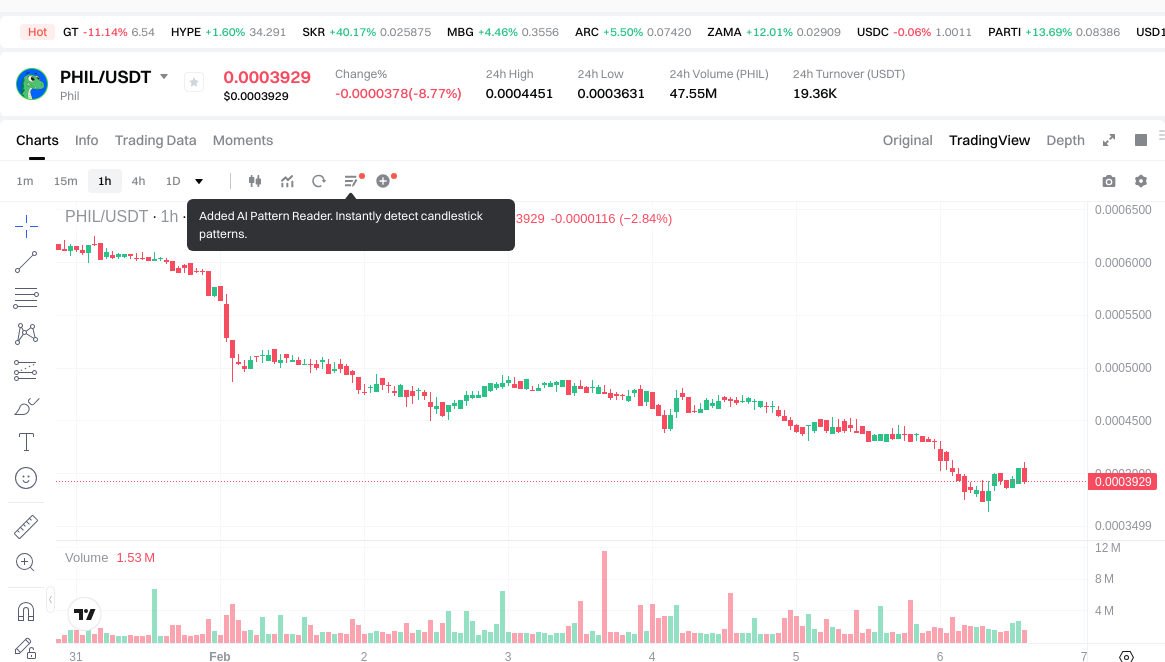
Phil reached its all-time high of $0.0735 on August 30, 2024, shortly after its initial launch on August 29, 2024. The price discovery phase following the token's debut reflected initial market enthusiasm and trading activity.
The lowest price point of $0.0003631 was recorded on February 06, 2026, representing a significant decline from its peak levels. Over the past year, the token has experienced a price decrease of approximately 93.16%, with notable volatility across different timeframes including a 48.18% decline over 30 days and a 35.77% decrease over the past week. These fluctuations reflect broader market sentiment shifts and the evolving dynamics within the memecoin sector.
Click to view the current PHIL market price
On-chain Metrics
- Daily Trading Volume: The 24-hour trading volume stands at approximately $19,795.66, indicating active trading activity on supported exchanges.
- Active Addresses: The token has attracted 11,361 holders, demonstrating a growing community base participating in the ecosystem.
- Market Availability: Phil is currently listed on 10 exchanges, providing multiple trading venues for participants in the cryptocurrency market.
Phil Ecosystem Applications and Partners
Core Use Cases
Phil's ecosystem centers on its community-driven memecoin model:
- Memecoin Collaboration: Phil Token aims to unite the top 50 memecoins, fostering cooperation and transparency within the broader memecoin space.
- Community Governance: The project emphasizes decentralized decision-making through its community-driven approach, enabling holders to participate in shaping the token's direction.
Strategic Partnerships
Phil Token focuses on building meaningful partnerships within the crypto ecosystem to enhance credibility and expand its reach.
These collaborative efforts provide a foundation for Phil's vision of creating a more interconnected and secure memecoin community.
Challenges and Controversies
Phil faces several challenges common to memecoin projects:
- Technical Considerations: As an ERC20 token, Phil operates within Ethereum's network constraints, which may include transaction fee fluctuations.
- Market Volatility: The token has experienced significant price fluctuations, with a decline from earlier levels reflecting broader market dynamics.
- Competition: The memecoin sector features intense competition from numerous projects, requiring continuous innovation to maintain relevance.
These factors generate ongoing discussions within the community and drive the project's evolution.
Phil's community demonstrates notable activity, with approximately 11,361 holders as of February 2026.
On X platform, discussions around Phil Token and related hashtags generate regular engagement among memecoin enthusiasts.
Key drivers of community enthusiasm include transparency initiatives and collaborative efforts within the memecoin space.
X platform discussions reflect diverse perspectives:
- Supporters highlight Phil's community-driven ethos and transparency standards, viewing it as a potential model for memecoin development.
- Critics focus on price volatility and the speculative nature inherent to memecoin projects.
Recent trends indicate mixed sentiment reflecting broader market conditions and the project's positioning.
Popular Topics
X users actively discuss Phil's mission to unite memecoins, transparency standards, and community governance,
showcasing both its innovative approach and the challenges of gaining mainstream recognition.
- Official Website: Visit Phil Token Official Site for features, use cases, and latest updates.
- X Updates: On X platform, Phil Token maintains an active presence at @Philtokeneth,
sharing content about community developments, partnership announcements, and project milestones that generate engagement within the memecoin community.
Phil Future Roadmap
- Ongoing Development: Continued focus on transparency standards and community collaboration, advancing the mission of uniting top memecoins
- Ecosystem Goals: Building a more secure and interconnected crypto ecosystem through meaningful partnerships
- Long-term Vision: Establishing a new standard for community-driven memecoin projects
How to Participate in Phil?
- Purchase Channels: Phil can be traded on multiple platforms, with availability on approximately 10 exchanges
- Storage Solutions: Use compatible ERC20 wallets for secure storage
- Community Participation: Engage with the community through official social channels to stay informed about developments
- Ecosystem Building: Connect with the Phil community to explore collaboration opportunities
Summary
Phil Token represents a community-driven approach to the memecoin sector, emphasizing transparency, collaboration, and meaningful partnerships.
Its active community, clear mission, and focus on uniting the memecoin space distinguish it within the crypto landscape.
Despite facing market volatility and competitive pressures, Phil's commitment to integrity and community governance positions it as a project worth monitoring.
Whether you're new to crypto or an experienced participant, Phil offers an interesting perspective on community-driven token development.
FAQ
What is PHIL cryptocurrency? What are its uses and value?
PHIL is a community-driven meme coin focusing on trust and transparent partnerships. It incentivizes community participation through reward mechanisms and aims to bring security and legitimacy to the meme coin ecosystem.
How to buy and store PHIL tokens? Which exchanges can trade it?
You can purchase PHIL tokens on major cryptocurrency exchanges and store them securely in digital wallets. Simply create an account on your preferred exchange, complete verification, deposit funds, and trade for PHIL. Transfer your tokens to a personal wallet for enhanced security and long-term holding.
What is PHIL project's team background, technical features, and development roadmap?
PHIL project features an experienced Web3 team with blockchain expertise. Technical highlights include decentralized architecture, smart contract innovation, and scalability solutions. The roadmap focuses on ecosystem expansion, community growth, and strategic partnerships through 2026-2027, targeting mainstream adoption and market leadership.
What are the risks of investing in PHIL? What should I pay attention to?
PHIL investment carries market volatility risk and potential capital loss. Investors should monitor market conditions, understand token economics, and only invest amounts they can afford to lose. Stay informed about project developments.
What is the difference between PHIL and mainstream cryptocurrencies like Bitcoin and Ethereum?
PHIL differs from Bitcoin and Ethereum primarily in its blockchain architecture and consensus mechanism. While Bitcoin prioritizes decentralization and security with longer block times, Ethereum focuses on smart contract functionality. PHIL offers enhanced scalability, faster transaction processing, and optimized tokenomics designed for specific use cases within the Web3 ecosystem.
What is the total supply of PHIL tokens? How does the inflation mechanism work?
PHIL token total supply data is not publicly disclosed. The inflation mechanism details have not been clearly published by the project team.
* The information is not intended to be and does not constitute financial advice or any other recommendation of any sort offered or endorsed by Gate.