What is Proof-of-Work in simple terms

2026-02-03 07:47:45
Bitcoin
Blockchain
Crypto Tutorial
Mining
PoW
Article Rating : 3
13 ratings
Discover the fundamentals of Proof of Work—the blockchain consensus mechanism—including how mining works, key PoW principles, and the distinctions between Proof of Work and Proof of Stake. This comprehensive guide is designed for developers, investors, and cryptocurrency enthusiasts, covering topics such as security, energy usage, and cryptocurrencies built on PoW.
What is Proof-of-Work in simple terms
What Is PoW in Simple Terms

PoW, or Proof-of-Work, is a consensus algorithm that forms the backbone of cryptocurrency technology. The term "PoW" stands for Proof-of-Work, which literally translates as "proof of work."

PoW governs how new blocks are mined in cryptocurrency blockchains. It plays a crucial role in verifying transactions and authenticating blockchain data on the computers of participants in a decentralized network. Because this mechanism is distributed, every transaction undergoes multi-layered checks by numerous independent network nodes.

Proof-of-Work notably solves the double-spending problem—a situation where the same coins could be used twice within a single time frame. PoW also effectively prevents other network abuses, such as spam attacks and attempts to manipulate transaction history.

What Is Proof-of-Work?

PoW sets the structure for decentralized networks, providing both security and reliability. The PoW system relies on miners—market participants who connect specialized computing hardware to a cryptocurrency network. Miners solve advanced mathematical problems in exchange for rewards, which consist of transaction fees and network incentives for each newly mined block. This process is known as mining.

The operation of PoW systems in cryptocurrencies works as follows:

  • Users initiate a transaction by specifying the recipient’s address and the transfer amount. When creating a transaction, they set a fee—the reward for the miner who processes and adds the transaction to the blockchain. There’s a direct relationship: the higher the fee a user is willing to pay, the faster miners will process the request, since they prioritize transactions with higher fees.

  • Miners use computing hardware to solve a cryptographic puzzle related to forming a new block. Specialized network nodes, known as "nodes," hold a complete copy of the blockchain and verify transaction validity. If all data is correct and the transaction meets network rules, it’s included in a new block. That block is then added to the blockchain, becoming a permanent part of transaction history.

Who Invented PoW?

The concept of Proof-of-Work dates back to the early 1990s. Programmers Cynthia Dwork and Moni Naor introduced it in 1993. Their academic paper clearly defined the algorithm, which was later called Proof-of-Work. Initially, it was intended to address spam and denial-of-service—not cryptocurrency.

In 1997, renowned programmer and cryptographer Adam Back implemented the concept in Hashcash, a project designed to protect email from spam by requiring computational work before sending messages.

In 1999, Markus Jakobsson and Ari Juels published research that refined the concept and officially named it PoW. Their work organized earlier ideas and laid the theoretical groundwork for future applications.

In 2009, an anonymous developer or group known as Satoshi Nakamoto launched Bitcoin, built on the Proof-of-Work algorithm. This milestone demonstrated PoW’s practical use in decentralized digital currency.

How Does Mining Work in Proof-of-Work?

Mining in PoW systems is the process of acquiring digital assets by solving complex computational challenges. In Proof-of-Work networks, miners compete to add new blocks to the blockchain. The miner who solves the cryptographic puzzle first earns the bulk of the reward, which is directly tied to their total computing power.

The mining process involves several steps:

  • The miner gathers unconfirmed transactions from the mempool (the pool of pending transactions)
  • Builds a candidate block from these transactions
  • Searches for a special number (nonce) that, when combined with the block data, produces a hash with required characteristics
  • Once the correct solution is found, the block is broadcast to the network for validation by other nodes
  • If successfully verified, the miner receives a reward

Here are key features of Proof-of-Work mining:

  • Mining difficulty is dynamically adjusted based on miner activity. As more participants join and overall computing power increases, the cryptographic puzzles become more difficult. This automatic adjustment maintains a stable rate of new block generation.

  • PoW mining forces miners into a continuous race for better hardware. Manufacturers of specialized devices (ASIC miners) regularly release new models that outperform previous generations in energy efficiency and performance. Staying competitive requires constant upgrades.

Criticisms of PoW

Proof-of-Work receives significant criticism from environmentalists and sustainability experts. The main concern is that PoW mining is viewed as highly unsustainable. Miners are locked in an ongoing arms race for computing power, leading to constant increases in hardware capacity and exponential growth in energy consumption. Large PoW networks reportedly use electricity on par with entire countries.

Many also argue that PoW mining leads to centralization. Acquiring competitive hardware requires major financial investment, so only large companies and mining pools typically have the resources to be effective. This concentrates computing power among a few players and can threaten blockchain decentralization.

Other commonly cited issues include:

  • High entry barriers for newcomers due to expensive equipment
  • Rapid hardware obsolescence, resulting in electronic waste
  • Mining profitability depends on electricity costs, creating geographic inequality
  • Risk of 51% attacks if a single entity controls a majority of computing power

Supporters of PoW note that high energy consumption is the tradeoff for unmatched network security, and that renewable energy development could address environmental concerns.

Which Cryptocurrencies Use Proof-of-Work?

PoW remains one of the most widely used consensus algorithms in crypto. It's the basis for Bitcoin, the largest and earliest cryptocurrency by market capitalization. Until September 2022, Ethereum—the second largest—also relied on Proof-of-Work, but switched to Proof-of-Stake with the Merge upgrade.

Other notable PoW cryptocurrencies include:

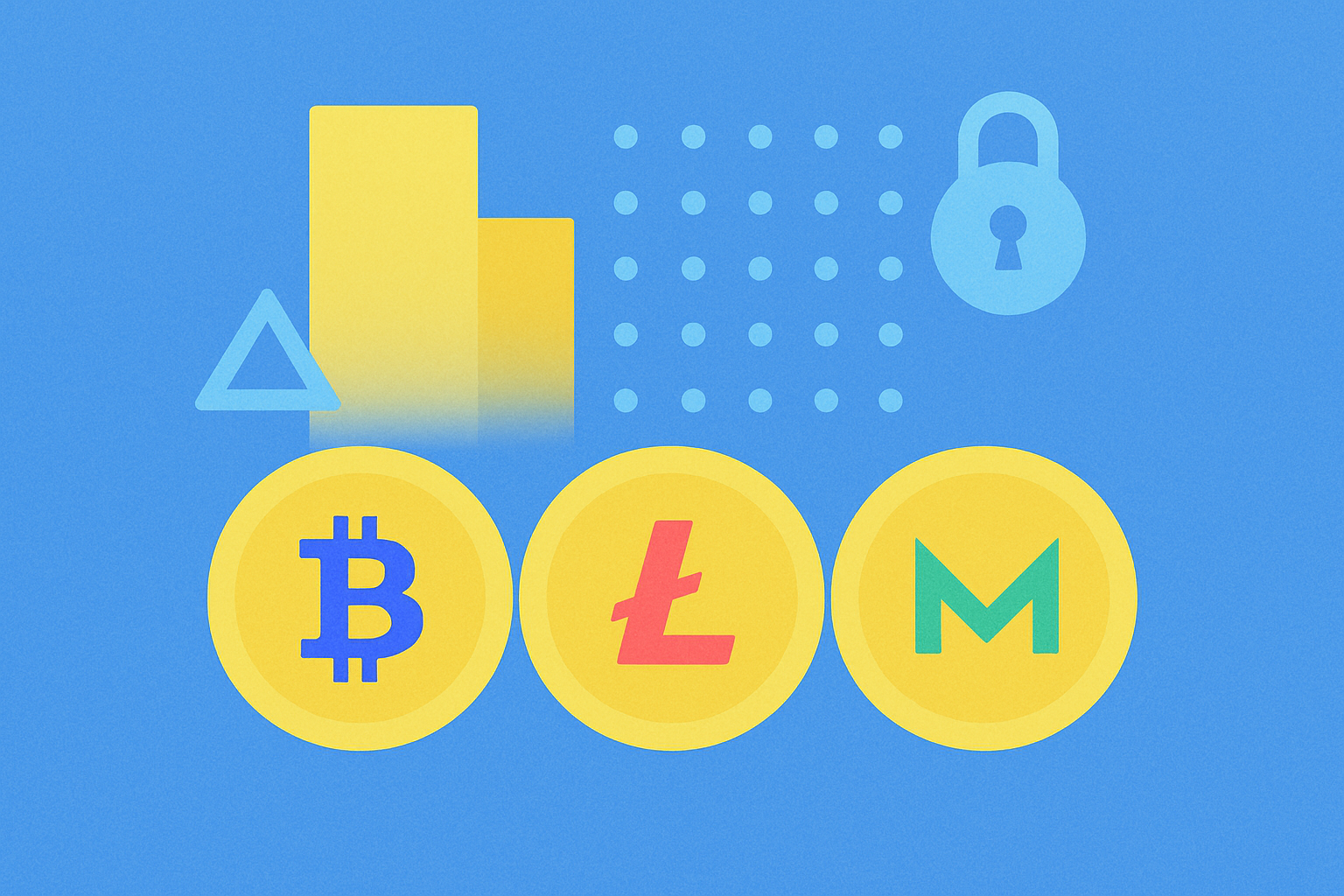
  • Dogecoin — a cryptocurrency originally created as a parody of Bitcoin that gained widespread popularity through its active community and celebrity endorsements. It uses the Scrypt algorithm.

  • Ethereum Classic — the original Ethereum blockchain that retained PoW after a 2016 split, representing an immutable record of Ethereum’s history.

  • Litecoin — one of the oldest altcoins, known as the "silver" to Bitcoin’s "gold." It features faster block times and uses Scrypt.

  • Monero — a cryptocurrency that emphasizes privacy and transaction anonymity, powered by the RandomX algorithm optimized for standard CPUs.

  • Zcash — another privacy-focused project, leveraging zero-knowledge proofs for strong anonymity.

  • Bitcoin Cash — a Bitcoin fork designed to boost network throughput by increasing block size.

  • Bitcoin SV — another Bitcoin fork that aims to fulfill Satoshi Nakamoto’s original vision.

Each of these cryptocurrencies has its own PoW implementation, but all share the principle of securing the network through computational effort.

FAQ

What Is Proof-of-Work and Why Does Blockchain Need It?

Proof-of-Work is a consensus method where miners solve advanced mathematical problems to verify transactions and create new blocks. This process secures the network and guarantees blockchain decentralization.

What’s the Difference Between Proof-of-Work and Proof-of-Stake?

Proof-of-Work relies on computing power to solve cryptographic challenges, while Proof-of-Stake selects validators based on the amount of cryptocurrency they own and are willing to stake. PoW is energy-intensive; PoS is energy-efficient.

How Does Proof-of-Work Mining Operate? What Do Miners Actually Do?

Miners tackle advanced mathematical problems to verify transactions and create new blocks. They compete to find the correct hash, and the first to succeed adds the block to the blockchain and earns cryptocurrency rewards. This mechanism protects the network from attacks.

Is the High Energy Consumption of Proof-of-Work Really Justified?

Proof-of-Work’s high energy use guarantees the security and decentralization of the blockchain. Although electricity costs are substantial, they’re a necessary tradeoff for maintaining network integrity. The balance between energy consumption and security defines PoW’s fundamental value.

Which Cryptocurrencies Use the Proof-of-Work Consensus Mechanism?

Bitcoin and Monero use Proof-of-Work. Other examples include Zcash and Ethereum Classic. These cryptocurrencies depend on mining to validate transactions and secure the network.

Is Proof-of-Work Secure? What Is a 51% Attack?

Proof-of-Work is generally secure, but there’s a risk of a 51% attack. If an attacker controls more than half the network’s computing power, they can reverse blocks, enable double-spending, and steal funds. Large networks are less vulnerable due to distributed computing power and high attack costs, but smaller public blockchains face greater risk. Increasing confirmation requirements and upgrading algorithms help strengthen network security.

* The information is not intended to be and does not constitute financial advice or any other recommendation of any sort offered or endorsed by Gate.
Related Articles
XZXX: A Comprehensive Guide to the BRC-20 Meme Token in 2025

XZXX: A Comprehensive Guide to the BRC-20 Meme Token in 2025

XZXX emerges as the leading BRC-20 meme token of 2025, leveraging Bitcoin Ordinals for unique functionalities that integrate meme culture with tech innovation. The article explores the token's explosive growth, driven by a thriving community and strategic market support from exchanges like Gate, while offering beginners a guided approach to purchasing and securing XZXX. Readers will gain insights into the token's success factors, technical advancements, and investment strategies within the expanding XZXX ecosystem, highlighting its potential to reshape the BRC-20 landscape and digital asset investment.
2025-08-21 07:51:51
Bitcoin Fear and Greed Index: Market Sentiment Analysis for 2025

Bitcoin Fear and Greed Index: Market Sentiment Analysis for 2025

As the Bitcoin Fear and Greed Index plummets below 10 in April 2025, cryptocurrency market sentiment reaches unprecedented lows. This extreme fear, coupled with Bitcoin's 80,000−85,000 price range, highlights the complex interplay between crypto investor psychology and market dynamics. Our Web3 market analysis explores the implications for Bitcoin price predictions and blockchain investment strategies in this volatile landscape.
2025-04-29 08:00:15
5 ways to get Bitcoin for free in 2025: Newbie Guide

5 ways to get Bitcoin for free in 2025: Newbie Guide

In 2025, getting Bitcoin for free has become a hot topic. From microtasks to gamified mining, to Bitcoin reward credit cards, there are numerous ways to obtain free Bitcoin. This article will reveal how to easily earn Bitcoin in 2025, explore the best Bitcoin faucets, and share Bitcoin mining techniques that require no investment. Whether you are a newbie or an experienced user, you can find a suitable way to get rich with cryptocurrency here.
2025-04-30 06:45:39
Top Crypto ETFs to Watch in 2025: Navigating the Digital Asset Boom

Top Crypto ETFs to Watch in 2025: Navigating the Digital Asset Boom

Cryptocurrency Exchange-Traded Funds (ETFs) have become a cornerstone for investors seeking exposure to digital assets without the complexities of direct ownership. Following the landmark approval of spot Bitcoin and Ethereum ETFs in 2024, the crypto ETF market has exploded, with $65 billion in inflows and Bitcoin surpassing $100,000. As 2025 unfolds, new ETFs, regulatory developments, and institutional adoption are set to drive further growth. This article highlights the top crypto ETFs to watch in 2025, based on assets under management (AUM), performance, and innovation, while offering insights into their strategies and risks.
2025-05-13 02:29:23
Bitcoin Market Cap in 2025: Analysis and Trends for Investors

Bitcoin Market Cap in 2025: Analysis and Trends for Investors

The Bitcoin market cap has reached a staggering **2.05 trillion** in 2025, with the Bitcoin price soaring to **$103,146**. This unprecedented growth reflects the cryptocurrency market capitalization's evolution and underscores the impact of blockchain technology on Bitcoin. Our Bitcoin investment analysis reveals key market trends shaping the digital currency landscape through 2025 and beyond.
2025-05-15 02:49:13
2025 Bitcoin Price Prediction: Trump's Tariffs' Impact on BTC

2025 Bitcoin Price Prediction: Trump's Tariffs' Impact on BTC

This article discusses the impact of Trump's 2025 tariffs on Bitcoin, analyzes price fluctuations, institutional investors' reactions, and Bitcoin's safe haven status. The article explores how the depreciation of the US dollar is advantageous to Bitcoin, while also questioning its correlation with gold. This article provides insights for investors in market fluctuations, considering geopolitical factors and macroeconomic trends, and offers updated forecasts for the price of Bitcoin in 2025.
2025-04-17 04:11:25
Recommended for You
What is Leverage Trading? A Cryptocurrency Investment Strategy to Maximize Returns

What is Leverage Trading? A Cryptocurrency Investment Strategy to Maximize Returns

Cryptocurrency leverage trading enables traders to control larger positions with minimal capital by borrowing funds using their own assets as collateral, with multipliers up to 50x on platforms like Gate. While leverage amplifies profit potential through capital efficiency and strategic flexibility—allowing traders to profit from both market upswings and downturns—it equally magnifies losses and introduces liquidation risk when account equity falls below maintenance thresholds. The guide outlines critical safety strategies including starting with minimal capital and conservative 2x-5x leverage ratios, implementing mandatory stop-loss orders for automated risk protection, and practicing disciplined profit-taking at predetermined levels. Success requires comprehensive risk management, emotional discipline, and respecting leverage as a high-risk tool where losses can exceed initial investment. Beginners must treat leverage capital as entirely disposable funds separate from essential reserves, maintain adequate m
2026-02-03 09:21:26
A Complete Guide to the 1inch Swap

A Complete Guide to the 1inch Swap

This comprehensive guide explores 1inch, a leading DeFi aggregator revolutionizing token trading through multi-chain swapping capabilities. Designed for both beginners and experienced traders, 1inch offers three distinct swap modes—Simple, Advanced, and Limit Orders—each tailored to different trading needs and experience levels. The platform's innovative Fusion protocol enables gasless swaps with MEV protection, while Fusion+ delivers secure, bridgeless cross-chain transactions without relying on third-party bridges. You'll discover how intent-based swaps work through Dutch auctions powered by professional resolvers, alongside 1inch's robust security infrastructure including blocklist screening, transaction simulations, and smart contract audits. This guide compares 1inch advantages against traditional DEX platforms, addresses potential drawbacks, and helps you determine if 1inch aligns with your specific trading requirements for optimized execution quality and cost efficiency.
2026-02-03 09:16:57
Understanding the Stock-to-Flow Model: Bitcoin's Scarcity and Price Relationship

Understanding the Stock-to-Flow Model: Bitcoin's Scarcity and Price Relationship

The Stock-to-Flow Model is a statistical framework predicting Bitcoin price based on scarcity by calculating the ratio between total Bitcoin supply and annual mining production. Developed by analyst PlanB in 2019, this model demonstrates strong historical correlation with Bitcoin price movements, particularly following halving events that reduce new production. The model offers investors a fundamental valuation approach grounded in supply economics, positioning Bitcoin similarly to precious metals like gold with absolute scarcity of 21 million coins. However, critical limitations exist: the model ignores demand fluctuations, cannot account for regulatory changes, and may fail during bear markets, making it a retrospective analysis rather than guaranteed prediction. This article examines the Stock-to-Flow Model's theoretical framework, historical accuracy, investment applications through Gate trading strategies, and comparisons with gold, while emphasizing that successful Bitcoin investing requires combining S
2026-02-03 09:02:50
Top Stablecoin Interest Rate Solutions for Passive Income

Top Stablecoin Interest Rate Solutions for Passive Income

Discover the best stablecoin platforms to maximize passive income with competitive yield returns. This comprehensive guide explores top-performing CeFi and DeFi platforms offering stablecoin interest rates ranging from 3% to 24% APY, including CoinDepo, Trust Wallet, Stargate, Gate, Zengo, Balancer, Curve, Compound, and Aave. Learn how stablecoins generate yield through lending and staking mechanisms, understand different stablecoin types (fiat-collateralized, crypto-collateralized, commodity-collateralized, and algorithmic), and evaluate platform security features and reserve transparency. Compare interest rates, TVL, supported networks, and withdrawal flexibility across platforms to select the optimal solution for your investment strategy. Whether you're an experienced crypto investor or newcomer, this guide helps you generate consistent passive income while minimizing volatility exposure through informed platform selection and risk assessment.
2026-02-03 08:59:55
Top 7 Solutions to Survive Cryptocurrency Bear Markets

Top 7 Solutions to Survive Cryptocurrency Bear Markets

This comprehensive guide equips cryptocurrency investors with proven strategies to navigate bear markets effectively. As crypto winters test even seasoned traders, understanding market dynamics becomes essential for portfolio survival. The article covers seven practical approaches including emotional discipline, dollar-cost averaging, staking rewards, and proper asset custody. Key strategies emphasize staying calm during volatility, avoiding market-timing pitfalls, and systematically accumulating quality assets at lower valuations. Whether you're a long-term HODLer or active trader, these tactics address critical challenges like panic selling, exchange risks, and leveraged trading dangers. By implementing sound risk management and maintaining conviction through downturns, investors can preserve capital and position themselves for gains when markets recover. The guide clarifies that bear markets, while challenging, are natural market cycles that reward disciplined, patient investors with proper preparation and
2026-02-03 08:50:48
Top 10 Profitable Play-to-Earn NFT Games

Top 10 Profitable Play-to-Earn NFT Games

2024 Updated Ranking of the Best Earning NFT Games. Explore the top 10 NFT games for generating income through Play to Earn, featuring titles like Axie Infinity and The Sandbox. This guide provides clear instructions for beginners on how to get started, maximize earnings, and manage associated risks.
2026-02-03 08:47:26