What is PSTAKE: A Comprehensive Guide to the Liquid Staking Protocol


pSTAKE Finance's Position and Significance
In the era of Proof-of-Stake (PoS) blockchain expansion, the team behind pSTAKE Finance launched pSTAKE Finance (PSTAKE), aiming to address the liquidity constraints faced by staked PoS assets and the trade-off between earning staking rewards and maintaining asset flexibility.
As a liquid staking protocol for PoS-based assets, pSTAKE Finance plays a key role in DeFi and cross-chain liquidity solutions.
As of 2026, pSTAKE Finance continues to serve as a liquidity enabler for staked assets across multiple blockchain ecosystems, with an active development community focused on expanding interoperability.
This article will provide an in-depth analysis of its technical architecture, market performance, and future potential.
Origin and Development History
Background
pSTAKE Finance was created to solve the liquidity problem inherent in traditional staking mechanisms, where users must lock tokens to earn rewards, sacrificing immediate access and composability in DeFi.
It emerged during the rapid growth of PoS networks and DeFi protocols, with the goal of enabling stakers to maintain liquidity while earning staking rewards through synthetic wrapped tokens.
pSTAKE Finance's introduction brought new possibilities for PoS token holders seeking to maximize capital efficiency.
Key Milestones
- The protocol enabled users to deposit PoS tokens and mint 1:1 pegged ERC-20 wrapped unstaked tokens (pTOKENs, such as pATOM), representing their staked positions.
- Custom bridge infrastructure was developed to facilitate Cosmos ecosystem growth while enhancing liquidity and composability of assets.
- The platform expanded support for multiple PoS assets beyond ATOM, broadening its utility across different blockchain networks.
- Integration with DeFi protocols allowed pTOKEN holders to use their liquid staked assets in lending, trading, and yield farming activities.
With support from its development team and community, pSTAKE Finance continues to refine its protocol security, user experience, and cross-chain functionality.
How pSTAKE Finance Works
Decentralized Infrastructure
pSTAKE Finance operates on a decentralized network that interacts with multiple blockchain ecosystems, eliminating reliance on centralized intermediaries.
The protocol coordinates with validators and bridge mechanisms across different chains to ensure transparent and secure operations, giving users control over their staked assets while maintaining network integrity.
Blockchain Foundation
pSTAKE Finance leverages blockchain technology to create a transparent and immutable record of wrapped token issuance and redemption.
Transactions involving pTOKENs are recorded on public ledgers, allowing anyone to verify the backing and movement of assets.
Custom bridge technology enables seamless interaction between different blockchain networks, enhancing cross-chain liquidity and composability.
Consensus and Security
pSTAKE Finance relies on the underlying consensus mechanisms of supported PoS networks to ensure transaction validity and prevent manipulation.
Validators on respective networks maintain security through staking and block validation, while the pSTAKE protocol uses smart contracts to manage token wrapping and unwrapping processes.
The protocol's innovation includes enabling liquid representation of staked assets through 1:1 pegged synthetic tokens, allowing holders to access DeFi opportunities without unstaking.
Secure Transactions
pSTAKE Finance utilizes public-private key cryptography to protect user assets:
- Private keys (like secret passwords) authorize token deposits and withdrawals
- Public keys (like account identifiers) verify ownership and transaction authenticity
This mechanism ensures asset security while maintaining pseudonymous transaction records on public blockchains.
Smart contract architecture adds additional security layers through automated execution and multi-signature requirements where applicable.
PSTAKE's Market Performance
Circulation Overview
As of February 09, 2026, PSTAKE's circulating supply is 500,000,000 tokens, with a total supply of 500,000,000 tokens. The token operates with a fixed supply model, as the maximum supply is capped at 500,000,000 tokens.
The circulating supply represents 100% of the total supply, indicating that all tokens have been fully released into the market. This complete circulation may influence supply and demand dynamics, as no additional tokens are scheduled for future issuance.
Price Fluctuations
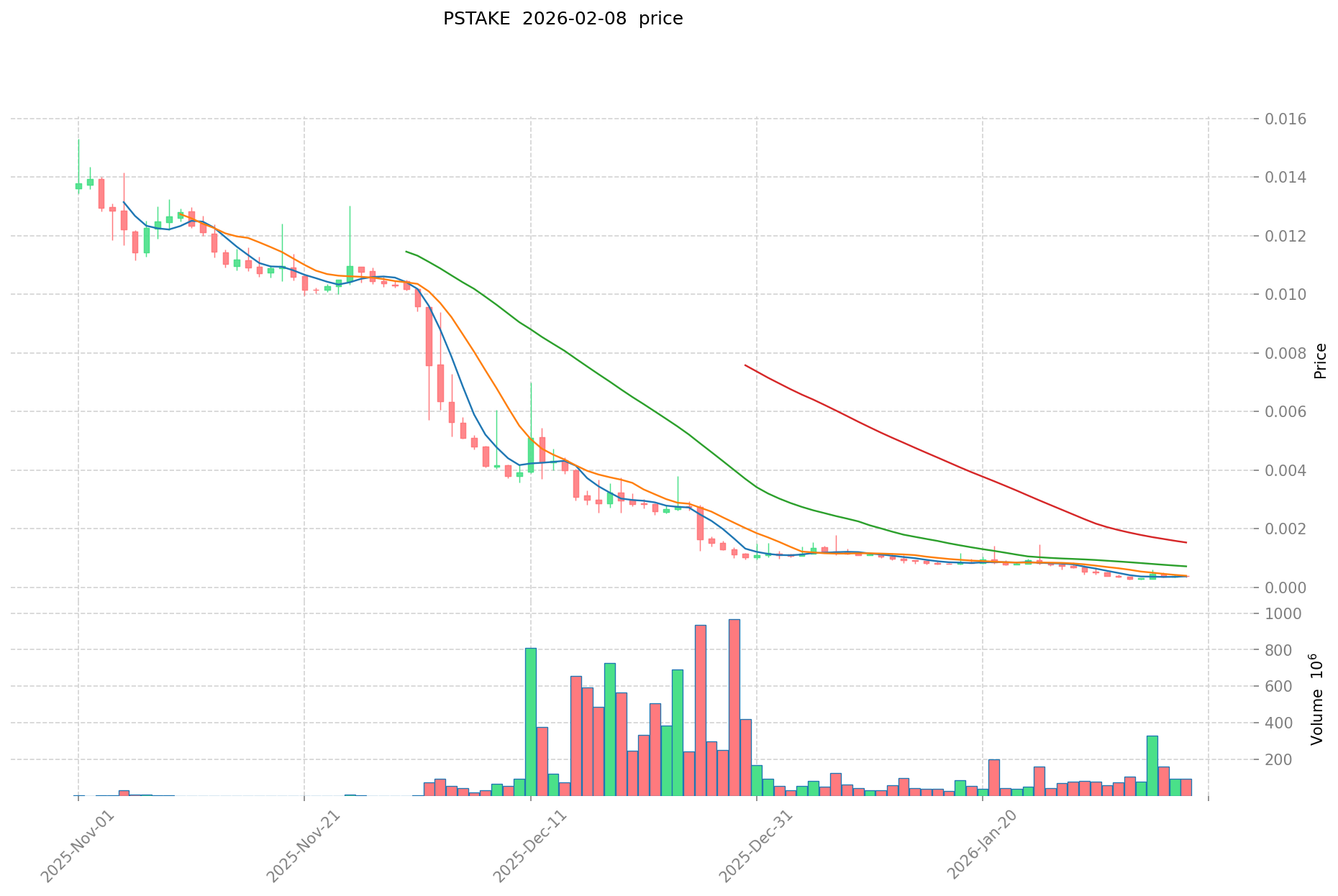
PSTAKE reached a notable price level of $1.21 on March 07, 2022. This price movement occurred during a period of broader market activity in the crypto space.
The token's lowest recorded price was $0.00027458 on February 03, 2026, representing a significant decline from previous levels. As of the latest update on February 09, 2026, PSTAKE is trading at $0.0003441.
Recent price trends show:
- 1H: -1.09% ($-0.000003792)
- 24H: -5.04% ($-0.000018263)
- 7D: -3.67% ($-0.000013110)
- 30D: -69.58% ($-0.000787064)
- 1Y: -98.63% ($-0.024772688)
These fluctuations reflect evolving market sentiment, adoption patterns, and external factors affecting the liquid staking sector.
Click to view current PSTAKE market price
On-Chain Metrics
- 24-Hour Trading Volume: $25,763.74 (indicating current market activity levels)
- Token Holders: 14,205 addresses (reflecting the user base distribution)
- Market Capitalization: $172,050 (representing the current market valuation)
- Market Cap to FDV Ratio: 100% (indicating full token circulation)
pSTAKE Finance Ecosystem Applications and Partners
Core Use Cases
pSTAKE Finance's ecosystem supports multiple applications:
- DeFi (Decentralized Finance): The protocol enables liquid staking for Proof-of-Stake assets, allowing users to maintain liquidity while earning staking rewards. Users can deposit PoS tokens on the pSTAKE platform to mint 1:1 pegged ERC-20 wrapped unstaked tokens, represented as pTOKENs (such as pATOM).
- Cross-Chain Infrastructure: pSTAKE utilizes custom bridges to facilitate Cosmos ecosystem growth while enhancing liquidity and composability of Ethereum ecosystem assets.
Strategic Partnerships
The reference materials do not provide specific information about strategic partnerships or collaborations.
Controversies and Challenges
pSTAKE Finance faces the following challenges:
- Market Performance: The token has experienced significant price volatility, with a 30-day decline of 69.58% and a 1-year decline of 98.63%.
- Market Competition: As a liquid staking protocol, pSTAKE operates in an increasingly competitive landscape with other staking solutions.
- Liquidity Concerns: With a 24-hour trading volume of approximately $25,763, the token faces relatively limited market liquidity.
These issues have prompted ongoing discussions within the community and market, driving continuous innovation.
pSTAKE Finance Community and Social Media Atmosphere
Community Engagement
The pSTAKE Finance community shows notable participation, with the token held by approximately 14,205 wallet addresses. The project maintains a circulating supply of 500,000,000 PSTAKE tokens, representing 100% of the total supply.
Social Media Sentiment
The reference materials do not provide detailed information about social media sentiment or X platform engagement metrics.
Popular Topics
Discussions within the crypto community focus on liquid staking mechanisms, cross-chain bridge technology, and the integration between Cosmos and Ethereum ecosystems.
pSTAKE Finance Additional Information Sources
- Official Website: Visit pSTAKE Finance Official Website for features, use cases, and latest updates.
- Blockchain Explorer: Track PSTAKE token transactions on Etherscan.
- Contract Address: The PSTAKE token operates on the Ethereum network with contract address 0xfB5c6815cA3AC72Ce9F5006869AE67f18bF77006.
pSTAKE Finance Future Roadmap
The reference materials do not provide specific information about the project's future roadmap or planned upgrades.
How to Participate in pSTAKE Finance?
- Purchase Channels: PSTAKE is available for trading on Gate.com and 3 other cryptocurrency exchanges.
- Storage Solutions: Use compatible Ethereum wallets such as MetaMask or hardware wallets to securely store PSTAKE tokens.
- Ecosystem Participation: Explore the pSTAKE platform to participate in liquid staking for PoS assets and earn rewards while maintaining asset liquidity.
- Development: Visit the official website for technical documentation and development resources.
Summary
pSTAKE Finance redefines liquid staking through blockchain technology, offering transparency, security, and efficient asset utilization. The protocol enables PoS token holders to unlock liquidity while earning staking rewards, bridging Cosmos and Ethereum ecosystems through custom infrastructure. With a fully circulating supply of 500,000,000 tokens and presence on multiple exchanges including Gate.com, pSTAKE Finance has established itself within the DeFi landscape. Despite facing market volatility and competitive pressures, the protocol's innovative approach to liquid staking and cross-chain functionality positions it as a noteworthy participant in decentralized finance. Whether you are new to crypto or an experienced participant, pSTAKE Finance's liquid staking solutions merit attention and exploration.
FAQ
What is pSTAKE and what is its role in the Cosmos ecosystem?
pSTAKE is a liquidity staking protocol enabling PoS token holders to stake assets while maintaining liquidity. In Cosmos, it supports ATOM and XPRT, issuing stkATOM and stkXPRT tokens. XPRT pays ecosystem fees, making pSTAKE a core infrastructure for liquid staking across PoS networks.
How to perform liquid staking through PSTAKE? What are the yield rates?
Deposit your assets into pSTAKE to earn liquid staking rewards. Yield rates vary based on market conditions and network participation, typically ranging from 8% to 15% annually. Check the platform for real-time rates.
What are the risks of staking PSTAKE and what should I pay attention to?
Staking pSTAKE carries market volatility and price depreciation risks. Monitor market changes closely and assess your risk tolerance before participating in staking activities.
What is the difference between pSTAKE and other liquid staking protocols like Lido?
pSTAKE focuses on multi-chain liquid staking across Ethereum, BNB Chain, and Cosmos, while Lido primarily concentrates on Ethereum. pSTAKE offers broader blockchain support and plans further expansion, providing more diverse staking opportunities.
What is the purpose of PSTAKE token and how to obtain it?
PSTAKE is the governance and incentive token for pSTAKE protocol. Holders participate in protocol governance and earn rewards. Obtain PSTAKE through trading on exchanges or by participating in protocol incentive programs and staking activities.
What blockchain networks and assets does pSTAKE support for staking?
pSTAKE supports multiple blockchain networks including Binance Smart Chain (BSC) and other chains, enabling staking of various assets. The supported networks and assets may expand over time as the protocol develops.
Share
Content
pSTAKE Finance's Position and Significance
Origin and Development History
How pSTAKE Finance Works
PSTAKE's Market Performance
pSTAKE Finance Ecosystem Applications and Partners
Controversies and Challenges
pSTAKE Finance Community and Social Media Atmosphere
pSTAKE Finance Additional Information Sources
pSTAKE Finance Future Roadmap
How to Participate in pSTAKE Finance?
Summary
FAQ
How to Buy Cryptocurrency


Trending Cryptocurrencies



What will be the market capitalization of USDC in 2025? Analysis of the stablecoin market landscape.

How is DeFi different from Bitcoin?

What is DeFi: Understanding Decentralized Finance in 2025
USDC stablecoin 2025 Latest Analysis: Principles, Advantages, and Web3 Eco-Applications

Development of Decentralized Finance Ecosystem in 2025: Integration of Decentralized Finance Applications with Web3
2025 USDT USD Complete Guide: A Must-Read for Newbie Investors
Rafał Zaorski – Who Is He? What Is His Net Worth?

Games You Can Earn Money From – TOP 11 Games in 2025

Six Cryptocurrencies That Have Achieved Over 1,000x Total Growth

How to Choose and Set Up the Best Cryptocurrency Wallet in Recent Years

NANO/XNO Cryptocurrency Project: Future Prospects and Analysis