DappRadar is the world's leading dApp tracking and analytics platform, launched in 2021 to address fragmentation in decentralized application discovery. This comprehensive guide explores DappRadar's decentralized infrastructure, blockchain-based architecture, and community governance model powered by the RADAR token. Learn how DappRadar aggregates transparent data across multiple blockchain ecosystems, its current market performance including token circulation and price volatility, and core use cases in dApp analytics and discovery. The article covers strategic partnerships, community engagement with 13,623 token holders, competitive challenges, and practical guidance on acquiring RADAR tokens on Gate exchange. Whether you're a developer, investor, or Web3 participant, discover how DappRadar provides essential insights and opportunities for meaningful participation in the decentralized ecosystem.
DappRadar's Positioning and Significance
In 2021, the DappRadar team launched DappRadar (RADAR), aiming to address the fragmentation of decentralized application discovery and the lack of transparent data across blockchain ecosystems.
As the world's leading dApp tracking and analytics platform, DappRadar plays a key role in decentralized application discovery, blockchain data analytics, and Web3 ecosystem transparency.
As of 2026, DappRadar has become a core infrastructure project in the Web3 analytics space, serving users across multiple blockchain protocols and verticals.
This article will provide an in-depth analysis of its technical architecture, market performance, and future potential.
Origin and Development History
Birth Background
DappRadar was created by its founding team in 2021, aiming to solve the challenge of tracking and ranking decentralized applications across fragmented blockchain ecosystems.
It emerged during the explosive growth of DeFi and NFT sectors, with the goal of providing transparent, comprehensive data and insights for the rapidly expanding dApp ecosystem.
The launch of DappRadar brought new possibilities for Web3 developers, investors, and users seeking reliable application data.
Key Milestones
- 2021: Platform launch, establishing a comprehensive tracking system for decentralized applications across multiple blockchains.
- 2021: Introduction of the RADAR token, creating governance and incentive mechanisms within the DappRadar ecosystem.
- 2021: Token reached an all-time high price on December 23.
With support from the community and ecosystem contributors, DappRadar continues to enhance its data coverage, analytical capabilities, and real-world applications.
How DappRadar Works
Decentralized Data Aggregation
DappRadar operates through a distributed network of data collectors and validators, aggregating information from blockchain networks worldwide without central control.
These nodes collaborate to verify application metrics, ensuring transparency and resistance to data manipulation, empowering users with accurate insights and enhancing ecosystem reliability.
Blockchain-Based Infrastructure
DappRadar leverages blockchain technology to create a transparent and verifiable system for tracking dApp activity.
The RADAR token is deployed on the Ethereum network, utilizing smart contracts to enable governance and reward distribution.
Anyone can verify token transactions through public blockchain explorers, establishing trust without intermediaries.
The platform's architecture ensures data integrity while maintaining accessibility across the Web3 ecosystem.
DappRadar employs a token-based governance model to enable community participation in platform decisions.
RADAR token holders can vote on proposals, contribute to data curation, and shape the future direction of the platform while earning rewards for their contributions.
This mechanism promotes community-driven development and sustainable ecosystem growth.
Secure Token Economics
RADAR uses standard cryptographic protocols to protect transactions:
- Private keys secure user wallets and enable transaction signing
- Public addresses allow transparent verification of token holdings
This mechanism ensures asset security while maintaining transparent on-chain activity.
The token contract on Ethereum (0x44709a920fCcF795fbC57BAA433cc3dd53C44DbE) implements standard security features including ownership controls and supply management.
Circulation Overview
As of February 06, 2026, RADAR's circulating supply stands at 1,525,808,338.019161 tokens, with a total supply of 10,000,000,000 tokens and a maximum supply cap of 10,000,000,000 tokens, indicating a fixed supply model.
The current circulation ratio is approximately 15.26%, suggesting a substantial portion of tokens remains undistributed.
Price Volatility
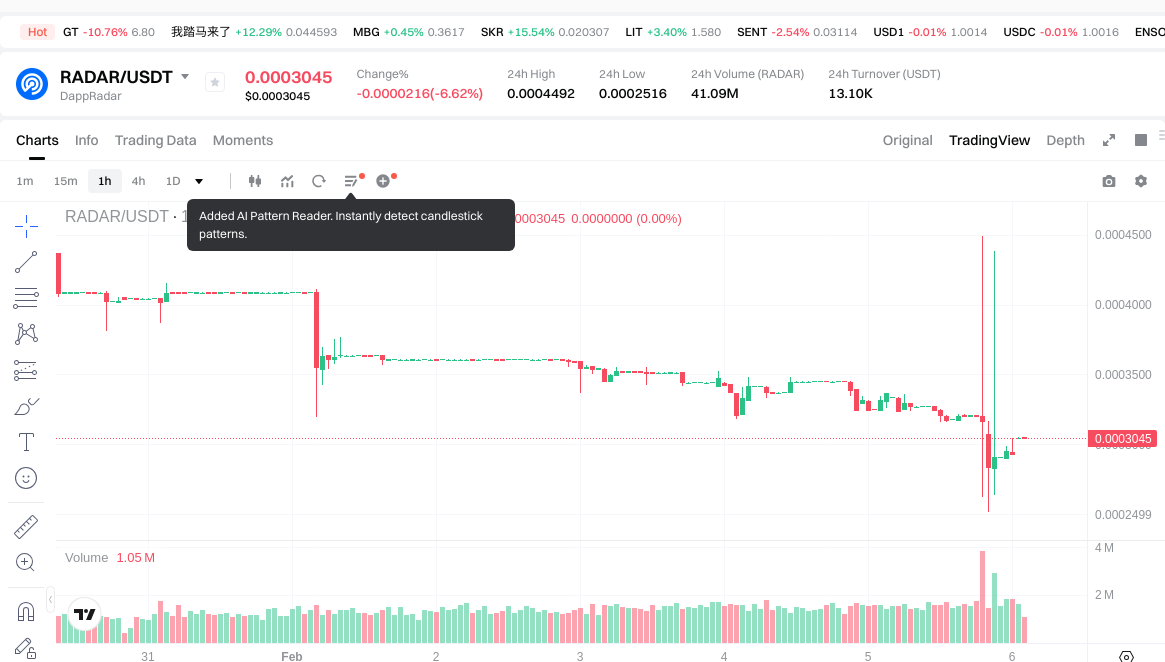
RADAR reached its highest price of $0.057067 on December 23, 2021, during a period of heightened market activity in the decentralized application ecosystem.
Its lowest price was $0.00025308, recorded on February 05, 2026, reflecting recent market pressures and broader cryptocurrency volatility.
These fluctuations demonstrate the token's sensitivity to market sentiment, adoption trends, and external factors affecting the DApp tracking and analytics sector.
Click to view the current RADAR market price
On-Chain Metrics
- Holder Count: 13,623 addresses (indicating community engagement levels)
- 24-Hour Trading Volume: $13,111.26 (reflecting current market activity)
- Market Capitalization: $465,829.29 (representing circulating supply valuation)
DappRadar Ecosystem Applications and Partners
Core Use Cases
DappRadar's ecosystem supports multiple applications:
- Dapp Discovery and Analytics: DappRadar platform provides decentralized application tracking and ranking across multiple blockchains and verticals.
- Data Intelligence: Community members can access enhanced insights and early industry reports through RADAR token holdings.
Strategic Partnerships
DappRadar has established collaborations to enhance its technical capabilities and market influence.
These partnerships provide a solid foundation for DappRadar's ecosystem expansion.
Challenges and Controversies
DappRadar faces the following challenges:
- Market Volatility: Price fluctuations and market competition
- Technical Evolution: Continuous adaptation to multi-chain ecosystem developments
- Competitive Pressure: Competition from emerging blockchain analytics platforms
These issues have sparked discussions within the community and market, driving DappRadar's continuous innovation.
DappRadar's community demonstrates active participation, with 13,623 token holders as of February 06, 2026.
The RADAR token enables community members to contribute, govern, and earn rewards through curation activities.
Community enthusiasm is driven by platform developments and ecosystem expansion.
Sentiment on social platforms shows diverse perspectives:
- Supporters praise DappRadar's comprehensive dapp tracking capabilities and decentralized governance model, considering it a valuable resource for blockchain ecosystem insights.
- Critics focus on price volatility and market performance challenges.
Recent trends reflect mixed sentiment influenced by broader market conditions.
Popular Topics
Community discussions center on DappRadar's ecosystem development, governance mechanisms, and platform enhancements, showcasing both its transformative potential and the obstacles toward mainstream adoption.
- Official Website: Visit DappRadar Official Site for features, use cases, and latest updates.
- Blockchain Explorer: Etherscan Contract provides transaction and contract information.
- Social Media: Follow DappRadar on X Platform for technical updates, community events, and partnership announcements.
- Community: Join discussions on Reddit to engage with the community.
DappRadar Future Roadmap
- Ecosystem Goals: Expand dapp coverage and enhance analytical capabilities across multiple blockchain protocols
- Long-term Vision: Become the leading decentralized application discovery and analytics platform
How to Participate in DappRadar?
- Purchase Channels: Acquire RADAR tokens on Gate.com
- Storage Solutions: Securely store RADAR using compatible wallets like MetaMask
- Participate in Governance: Engage in community decisions through the DappRadar ecosystem
- Build the Ecosystem: Visit GitHub to contribute to development or access technical resources
Summary
DappRadar leverages blockchain technology to provide comprehensive dapp tracking and analytics, offering transparency, decentralized governance, and valuable industry insights.
Its active community, diverse resources, and market presence distinguish it within the cryptocurrency analytics sector.
Despite facing market volatility and competitive challenges, DappRadar's innovative approach and clear ecosystem vision position it as a valuable resource in the decentralized technology landscape.
Whether you are a newcomer or an experienced participant, DappRadar offers opportunities for engagement and contribution.
FAQ
What is Crypto RADAR and what does it do?
Crypto RADAR is Europe's leading cryptocurrency price comparison engine. It helps investors understand the crypto market by comparing prices across sources, providing accurate data on trading volumes, market trends, and cryptocurrency valuations in real-time.
How can I use Crypto RADAR to monitor cryptocurrency markets?
Create an account and log in to Crypto RADAR. Use customizable watchlists to track your favorite cryptocurrencies, monitor real-time prices, trading volumes, and market trends to stay informed about market movements.
What are the key features and benefits of the RADAR token?
RADAR tokens provide enhanced insights, advanced filtering options, and powerful discovery tools for identifying top dapps. Benefits include improved data analysis capabilities and better decision-making support for users.
How do I buy and hold RADAR tokens?
Create an account on a major cryptocurrency exchange, purchase a stablecoin like USDT, swap it for RADAR tokens, then transfer them to your personal wallet for secure holding.
Is Crypto RADAR safe and what are the associated risks?
Crypto RADAR carries inherent risks including fraud, hacking, and market volatility due to limited regulation. Users should conduct thorough research and implement robust security measures before participation.
RADAR tracks and ranks decentralized applications across protocols, while other crypto analysis tools focus on financial metrics and trading data. RADAR emphasizes application performance rather than market analysis alone.
What is the tokenomics and supply of RADAR?
RADAR has a total supply of 85 million tokens. The allocation includes 25 million tokens for private/pre-sale (29.41%) and a significant reserve of approximately 23.875% for future development and ecosystem growth.
* The information is not intended to be and does not constitute financial advice or any other recommendation of any sort offered or endorsed by Gate.