SaaSGo is a code-free DeFi Dapp builder platform launched in 2024, designed to eliminate technical barriers and high costs in creating decentralized applications and peer-to-peer marketplaces. Built on ERC-20 standard across Ethereum and BSC networks, it enables users to deploy customized DeFi exchanges with configurable governance structures, transaction fees, and staking mechanisms without coding expertise. The platform democratizes DeFi infrastructure creation, empowering communities and organizations to establish tailored decentralized trading ecosystems. SAAS token trades on Gate, with active ecosystem development and community engagement focused on making blockchain marketplace deployment accessible to all. This comprehensive guide explores SaaSGo's architecture, market metrics, use cases, and positioning within the competitive DeFi infrastructure landscape.
SaaSGo's Positioning and Significance
In 2024, the SaaSGo team launched SaaSGo (SAAS), aiming to address the technical barriers and high costs associated with building decentralized applications and DeFi marketplaces.
As a code-free DeFi Dapp builder platform, SaaSGo plays a key role in DeFi infrastructure and marketplace creation.
As of 2026, SaaSGo has established itself as an innovative solution in the DeFi builder space, with an active community and focus on enabling peer-to-peer marketplace deployment.
This article will provide an in-depth analysis of its technical architecture, market performance, and future potential.
Origin and Development History
Genesis Background
SaaSGo was created in 2024, aiming to solve the complexity and technical expertise required to launch DeFi marketplaces and decentralized exchanges.
It emerged during the expansion of DeFi ecosystems, with the goal of democratizing DeFi marketplace creation through code-free deployment tools.
SaaSGo's launch brought new possibilities for individuals, organizations, and communities seeking to establish their own DeFi platforms.
Key Milestones
- December 2024: Token launched on Gate.com, enabling global trading access.
- 2024-2025: Platform development focused on DeFi Dex Builder functionality, allowing users to customize transaction fees, staking pools, referral rewards, and governance protocols.
- 2025: Ecosystem expansion with deployment on both Ethereum and BSC networks, enhancing accessibility and interoperability.
With support from its development team and growing community, SaaSGo continues to refine its platform capabilities and user experience.
How SaaSGo Works
No Central Control
SaaSGo operates as a decentralized platform enabling peer-to-peer Dapp marketplace creation, removing dependency on centralized service providers.
Users can deploy their own DeFi marketplaces with customized governance structures, ensuring community-driven control and greater autonomy in marketplace operations.
Blockchain Foundation
SaaSGo is built on ERC-20 standard and deployed on Ethereum and BSC networks, leveraging their established blockchain infrastructure.
These blockchains provide a transparent, immutable ledger for all transactions and smart contract interactions.
Users can verify all marketplace activities without intermediaries, building trust through cryptographic validation.
The multi-chain deployment enhances accessibility and provides users with options for network selection based on their preferences for transaction costs and speed.
Ensuring Fairness
SaaSGo leverages the underlying consensus mechanisms of Ethereum (Proof of Stake) and BSC (Proof of Staked Authority) to validate transactions and prevent fraudulent activities.
Validators on these networks maintain security through staking and block validation, receiving network rewards for their contributions.
The platform's innovation includes code-free marketplace deployment with customizable governance parameters, enabling community-specific economic models.
Secure Transactions
SaaSGo utilizes public-private key cryptography inherited from its underlying blockchain networks to protect transactions:
- Private keys (similar to secret passwords) are used to sign transactions
- Public keys (similar to account numbers) are used to verify ownership
This mechanism ensures fund security while transactions maintain pseudonymous privacy typical of blockchain systems.
Additional security features include smart contract-based governance protocols and customizable staking mechanisms that align incentives across marketplace participants.
Circulation Overview
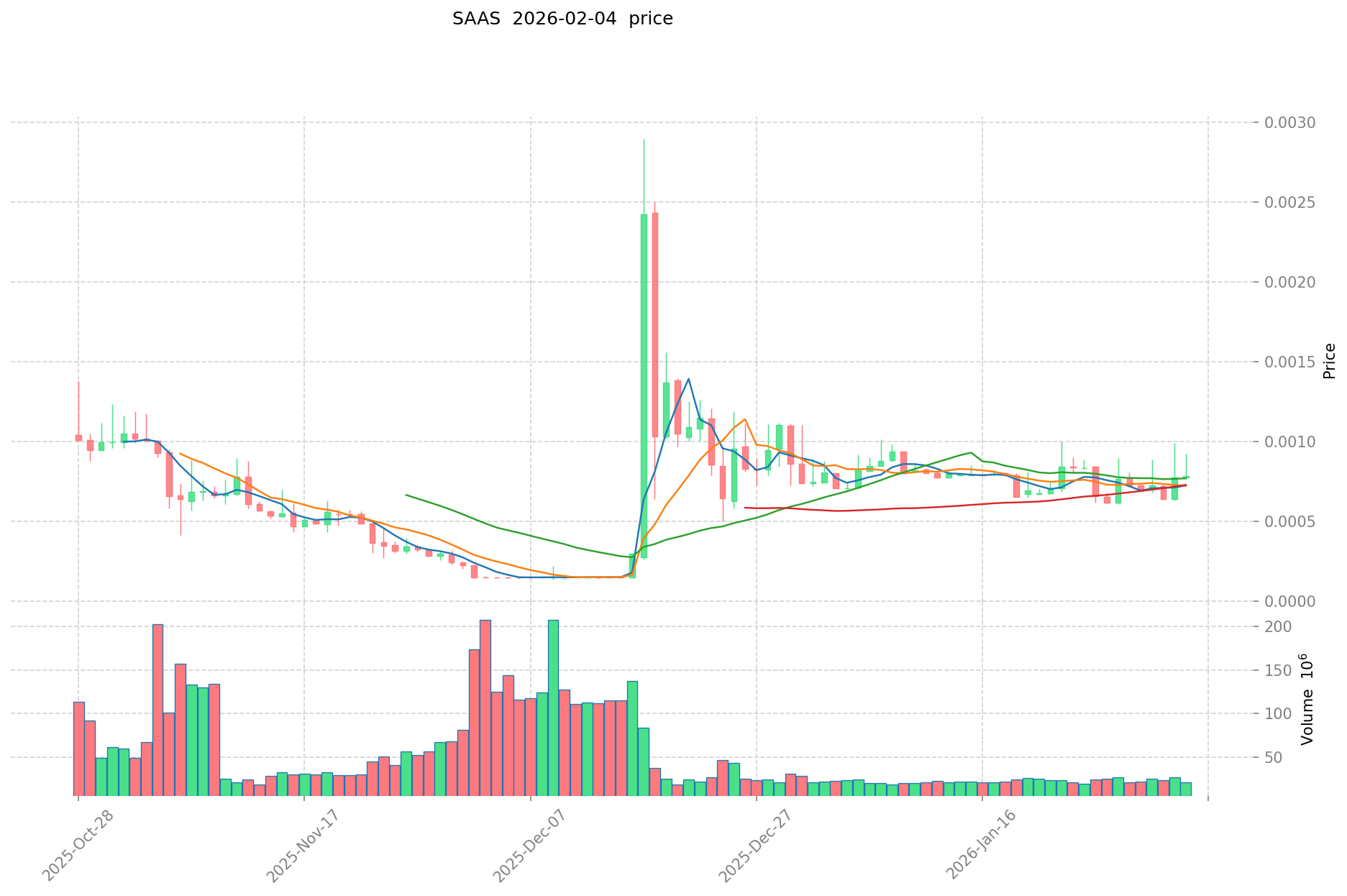
As of February 5, 2026, the circulating supply of SAAS is 800,000,000 tokens, with a total supply of 1,000,000,000 tokens and a maximum supply of 1,000,000,000 tokens, indicating a fixed supply model.
The circulating supply represents 80% of the total supply, with new tokens entering the market according to the project's distribution mechanism.
Price Fluctuations
SAAS reached a notable price point of $0.1182 on December 20, 2024, driven by initial market enthusiasm and trading activity following its launch.
The token experienced its lower price point of $0.000134 on December 9, 2025, reflecting market corrections and volatility in the broader cryptocurrency ecosystem.
These price movements demonstrate the impact of market sentiment, adoption trends, and external factors on the token's valuation.
Click to view the current SAAS market price
On-Chain Metrics
- 24-hour Trading Volume: $17,653.54 (indicating current market activity)
- Holder Addresses: 30 addresses (reflecting early-stage adoption)
- Market Capitalization: $660,720 (representing the current valuation of circulating tokens)
SaaSGo Ecosystem Applications and Partners
Core Use Cases
SaaSGo's ecosystem supports multiple applications:
- DeFi Infrastructure: SaaSGo DeFi Dex Builder enables users to deploy peer-to-peer decentralized exchange marketplaces without coding, providing customizable trading platforms with farming and staking capabilities.
- Community Governance: The platform allows organizations to establish tailored governance protocols with adjustable transaction fees, stake-pool interest rates, and referral reward systems.
Strategic Partnerships
Based on available information, SaaSGo focuses on empowering individual creators and organizations to build their own DeFi ecosystems. The platform's architecture enables communities to develop custom incentive structures and governance mechanisms suited to their unique missions.
Challenges and Considerations
SaaSGo faces several challenges in the competitive DeFi landscape:
- Market Performance: The token has experienced significant price fluctuations, with the current price representing a substantial decrease from its earlier valuations.
- Competition Pressure: The DeFi infrastructure space includes numerous established platforms offering similar decentralized exchange and staking solutions.
- Adoption Growth: With approximately 30 holders, the platform is working to expand its user base and community engagement.
These factors contribute to ongoing discussions within the crypto community about SaaSGo's market positioning and development trajectory.
SaaSGo maintains an active presence through its official channels, with the project emphasizing code-free deployment solutions for DeFi applications. The platform's community includes users interested in building customized decentralized marketplaces.
On X platform, SaaSGo engages with followers through its official account, sharing updates about the platform's capabilities and development progress.
Discussions on X regarding SaaSGo reflect diverse perspectives:
- Supporters highlight SaaSGo's user-friendly approach to DeFi deployment and customizable governance features, viewing it as an accessible solution for communities seeking to launch their own decentralized exchanges.
- Observers monitor token price movements and platform adoption metrics as indicators of project development.
Community discussions focus on the platform's potential to democratize DeFi infrastructure creation.
Discussion Topics
X users discuss SaaSGo's code-free deployment model, customization options for transaction fees and staking rewards, and the platform's approach to community-driven governance, exploring both opportunities and challenges in the competitive DeFi builder space.
- Official Website: Visit SaaSGo Official Website for platform features, use cases, and latest updates.
- Whitepaper: SaaSGo Whitepaper provides detailed information about the platform's technical architecture, objectives, and vision for code-free DeFi marketplace deployment.
- X Updates: On X platform, SaaSGo uses @SaaSGoOfficial for official communications, sharing content about platform capabilities, DeFi builder tools, and community developments, generating engagement from users interested in decentralized exchange solutions.
SaaSGo Future Roadmap
Based on available information, SaaSGo focuses on:
- Enhancing the DeFi Dex Builder platform with additional customization options
- Expanding ecosystem support for diverse community governance models
- Developing tools that empower users to create tailored DeFi marketplaces
How to Participate in SaaSGo?
- Purchase Options: SAAS token is available on Gate.com
- Storage Solutions: Store SAAS tokens securely using ERC-20 compatible wallets supporting Ethereum and BSC networks
- Platform Exploration: Visit the official website to explore the DeFi Dex Builder and its customization capabilities
- Community Engagement: Follow SaaSGo on X for updates and community discussions about platform development
Summary
SaaSGo addresses the complexity of DeFi marketplace creation through its code-free deployment platform, offering customizable governance structures, adjustable fee mechanisms, and farming/staking capabilities. The platform's approach to empowering communities and organizations to build tailored DeFi ecosystems represents an interesting development in blockchain infrastructure. While facing market volatility and competitive pressures, SaaSGo's focus on accessibility and customization positions it as a tool for communities seeking to establish their own decentralized trading platforms. Whether you're exploring DeFi infrastructure or interested in community-driven governance models, SaaSGo offers a platform worth monitoring as it develops.
FAQ
What is Crypto SaaS and how does it work?
Crypto SaaS is a white label infrastructure solution enabling businesses to offer digital asset trading, wallets, custody, and payment services without building proprietary technology. It provides exchange-grade tools, compliance features, and global liquidity access, allowing companies to serve crypto customers quickly and efficiently.
What are the main benefits of using Crypto SaaS solutions?
Crypto SaaS solutions simplify blockchain integration, reduce development costs, and accelerate time-to-market. They provide built-in compliance, security, and scalability, enabling businesses to focus on core operations rather than infrastructure complexity.
Common use cases include digital asset management for institutions, streamlined crypto transactions, regulatory compliance automation, portfolio tracking, payment processing, and DeFi protocol integration for enterprises.
How is Crypto SaaS different from traditional SaaS?
Crypto SaaS leverages blockchain technology for decentralized, transparent transactions with enhanced security, while traditional SaaS operates on centralized servers. Crypto SaaS enables peer-to-peer interactions, immutable records, and greater user control over data.
What security features should Crypto SaaS providers have?
Crypto SaaS providers should implement multi-factor authentication, end-to-end encryption, cold storage for assets, regular security audits, role-based access controls, and comprehensive monitoring systems to protect user data and transactions.
How much does Crypto SaaS typically cost?
Crypto SaaS typically costs between $30,000 and $300,000 or more, depending on features, customization level, and specific requirements. Pricing varies based on transaction volume, user base, and integration complexity.
What are the risks and challenges of Crypto SaaS?
Crypto SaaS faces security vulnerabilities, regulatory compliance complexity, and scalability limitations. Key challenges include smart contract risks, custody concerns, and market volatility exposure. Solutions require robust infrastructure, continuous audits, and adaptive compliance frameworks.
* The information is not intended to be and does not constitute financial advice or any other recommendation of any sort offered or endorsed by Gate.