What is SNET: A Comprehensive Guide to the Singularitynet Ecosystem and Its Decentralized AI Services

Snetwork (SNET) Positioning and Significance
In 2018, the Snetwork team launched Snetwork (SNET), aiming to address inefficiencies in computing resource utilization and high costs for bandwidth, storage, and online entertainment services.
As a distributed shared cloud computing platform based on blockchain, Snetwork plays a key role in connecting resource suppliers and demanders, enabling monetization of idle computing resources.
As of 2026, Snetwork has established itself within the blockchain application ecosystem, with over 558 token holders and an active community. This article will provide an in-depth analysis of its technical architecture, market performance, and future potential.
Origin and Development History
Birth Background
Snetwork was created by the Snetwork development team in 2018, aiming to solve inefficient utilization of idle computing resources and high operational costs for enterprises and individuals.
It emerged during the blockchain technology boom, with the goal of creating a decentralized platform that connects resource suppliers with demanders through blockchain technology.
Snetwork's launch brought new possibilities for enterprises, individuals, and blockchain smart hardware users seeking cost-effective computing solutions.
Key Milestones
- 2018: Official token launch, implementing a 1:1 exchange mechanism with LLT (Liuliang Kuangshi) tokens.
- 2018: Listed on multiple exchanges including Gate.com, establishing initial market presence.
- Ongoing: Planned ecosystem expansion to support various blockchain smart hardware products including smart routers, traffic ore treasure boxes, smart phones, smart watches, smart speakers, OTT boxes, and other common household smart network terminals.
Under the support of the Snetwork foundation and development team, Snetwork continues to optimize its platform, security measures, and real-world applications.
How Snetwork (SNET) Works
Decentralized Architecture
Snetwork operates on a distributed network built on blockchain technology, eliminating centralized control by traditional cloud service providers.
The platform connects computing resource suppliers with demanders, enabling idle resources to be monetized while reducing costs for resource consumers, ensuring system transparency and network resilience.
Blockchain Foundation
Snetwork's operations are recorded on the Ethereum blockchain, utilizing a public, immutable digital ledger that tracks all transactions.
Transactions are grouped into blocks and linked through cryptographic hashing to form a secure chain. Anyone can view the records, establishing trust without intermediaries.
The platform's smart contract address (0xFf19138b039D938db46bDDA0067DC4BA132ec71C) on Ethereum ensures transparent and verifiable operations.
Token Economics Mechanism
SNET tokens serve as contribution vouchers for node co-owners and the sole medium for resource demanders to exchange services.
With a total supply of 1 billion SNET tokens, the platform initially implemented a 1:1 exchange mechanism with LLT tokens. Token holders can use SNET to exchange various services within the Snetwork ecosystem.
This exchange is unidirectional and irreversible, with consumed SNET tokens re-entering locked addresses. The platform maintains strict issuance control based on locked LLT quantities, with the sum of locked SNET and locked LLT totaling 1 billion.
Transaction Security
Snetwork leverages Ethereum's security infrastructure, using public-private key cryptography to protect transactions:
- Private keys (similar to secret passwords) are used to sign transactions
- Public keys (similar to account numbers) are used to verify ownership
This mechanism ensures fund security while maintaining transaction transparency on the Ethereum blockchain. The platform's contract-based architecture provides additional security features through smart contract verification and execution.
Snetwork (SNET) Market Performance
Circulation Overview
As of February 07, 2026, Snetwork (SNET) has a circulating supply of 238,603,999 tokens, with a total supply of 1,000,000,000 tokens. The maximum supply is unlimited, indicating a potentially inflationary model.
SNET tokens initially entered the market through a 1:1 exchange mechanism with LLT (LiuLiang Tokens). Token holders can exchange SNET for various services within the Snetwork ecosystem, and this consumption process is unidirectional and irreversible, affecting the supply-demand dynamics.
According to the project's initial design, SNET follows a lock-up distribution model where 924,000,000 SNET were locked at the project's inception, with 76,000,000 LLT correspondingly locked. The issuance strictly correlates with the number of locked LLT tokens, maintaining a combined total of 1 billion between locked SNET and LLT.
Price Fluctuation
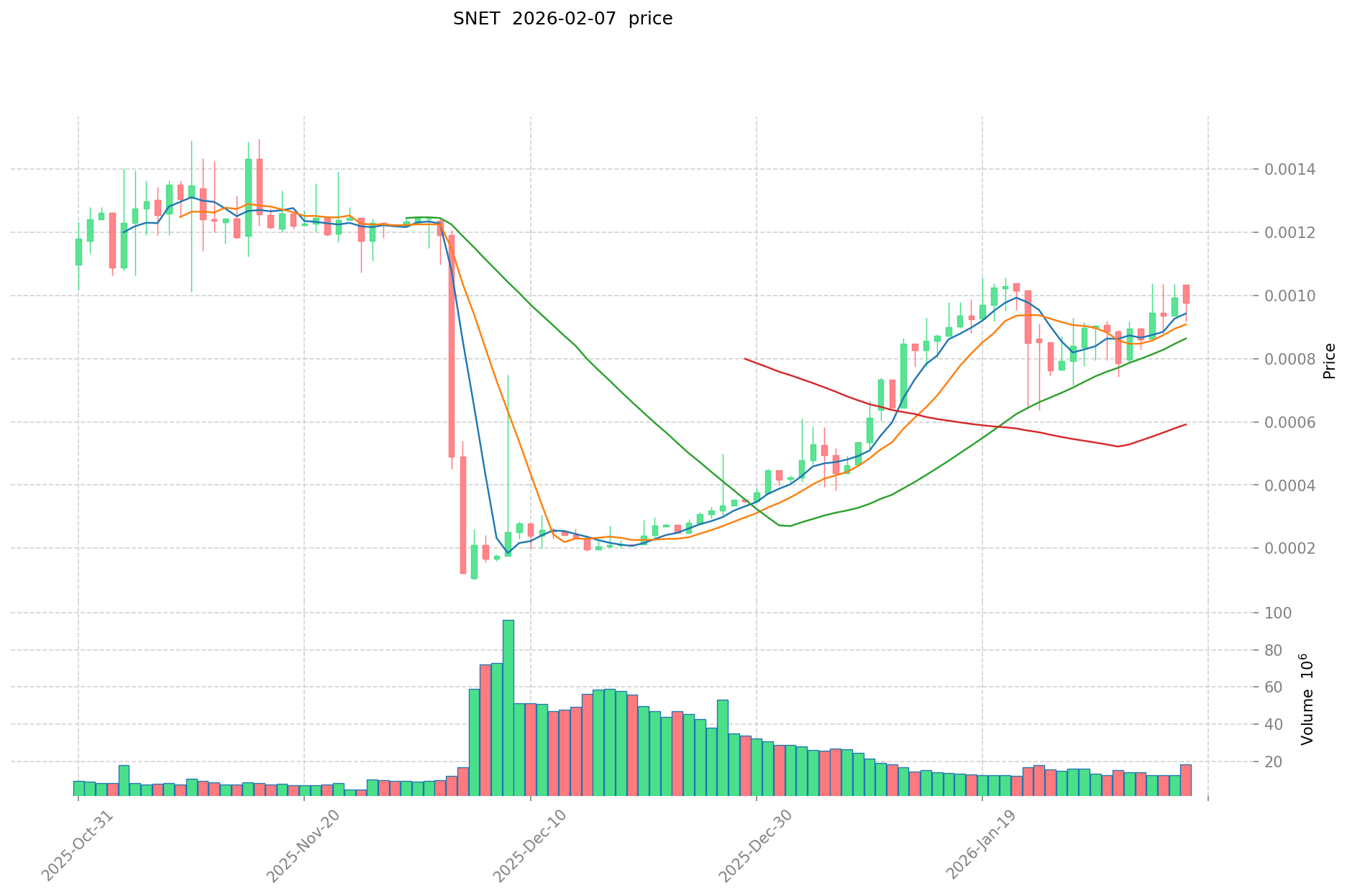
Snetwork (SNET) reached its peak price of $0.0490 on November 07, 2021, during a period of broader market optimism in the cryptocurrency sector.
The token experienced its lowest price of $0.000449 on February 09, 2025, reflecting market challenges and potential liquidity constraints.
As of February 07, 2026, SNET trades at $0.001148, with a 24-hour high of $0.001175 and a low of $0.000918. The token has shown notable volatility, with a 12.71% increase over the past 24 hours, a 50.51% gain over the past 7 days, and a substantial 114.03% increase over the past 30 days. The 1-year performance shows an 87.08% appreciation.
These fluctuations reflect evolving market sentiment, adoption patterns, and external factors influencing the distributed cloud computing sector.
Click to view current SNET market price
On-Chain Metrics
- 24-Hour Trading Volume: $21,304.64 (indicating current market activity levels)
- Token Holders: 558 addresses (reflecting user participation in the ecosystem)
- Market Capitalization: $273,893.53 (representing the current market valuation)
- Circulating Supply Ratio: 23.86% of total supply is currently in circulation
- Market Cap to FDV Ratio: 23.86%, indicating the proportion of realized market value relative to fully diluted valuation
Snetwork (SNET) Ecosystem Applications and Strategic Partners
Core Use Cases
Snetwork's ecosystem supports multiple applications:
- Distributed Computing: Through its shared cloud computing network, SNET enables node participants to monetize idle computing resources, improving overall resource utilization efficiency.
- Blockchain Hardware Integration: The platform plans to support various blockchain-enabled smart hardware products, including smart routers, traffic mining boxes, smart phones, smart watches, smart speakers, and OTT boxes, expanding its reach into common household network terminals.
Strategic Collaborations
Snetwork has established a connection model linking resource suppliers and demanders, creating a foundation for ecosystem expansion. The platform's initial phase benchmarked against traffic mining protocols, facilitating a 1:1 token exchange mechanism that demonstrates its commitment to interoperability within the distributed computing space.
Challenges and Considerations
Snetwork faces several challenges:
- Technical Implementation: Managing the complexity of distributed resource allocation across diverse hardware devices and ensuring optimal performance across the network.
- Market Competition: Operating in the competitive distributed computing sector where multiple blockchain projects target similar use cases.
- Token Economics: The one-way, irreversible token exchange mechanism requires users to carefully evaluate their decisions before converting SNET for ecosystem services.
These factors have prompted ongoing discussions within the community about the project's evolution and market positioning.
Snetwork (SNET) Community and Social Media Environment
Community Engagement
Snetwork's ecosystem connects resource providers and consumers through its distributed shared computing platform. As of February 07, 2026, the token has 558 holders participating in the network. The project's focus on blockchain-enabled smart hardware devices reflects its strategy to expand user participation across multiple device categories.
Market Sentiment
The community discusses SNET's role in the distributed computing sector:
- Supporters highlight the platform's approach to idle resource monetization and its potential to reduce costs for enterprises and individuals requiring bandwidth, storage, and computing resources.
- Observers note the project's token exchange mechanism and its implications for long-term ecosystem sustainability.
Recent market data shows price movements reflecting broader interest in distributed computing solutions.
Discussion Topics
Community members engage with topics around distributed resource sharing, blockchain hardware integration, and the practical applications of shared computing networks, demonstrating interest in both the technology's potential and its real-world implementation challenges.
Additional Resources for Snetwork (SNET)
- Official Website: Visit Snetwork's official site for information about platform features, use cases, and latest developments.
- Blockchain Explorer: Track SNET transactions and smart contract activity on Etherscan.
- Contract Address: SNET operates on Ethereum with the contract address 0xFf19138b039D938db46bDDA0067DC4BA132ec71C.
Snetwork (SNET) Future Development
- Ecosystem Expansion: Continued integration with additional blockchain-enabled smart hardware products to broaden the distributed computing network.
- Platform Enhancement: Development of services that allow SNET holders to exchange tokens for various ecosystem features while maintaining the platform's resource allocation mechanisms.
- Long-term Vision: Establishing a comprehensive distributed shared cloud computing network that connects diverse device types and user categories.
How to Participate in Snetwork (SNET)?
- Acquisition: SNET is available for trading on Gate.com and other supporting platforms.
- Storage: As an ERC-20 token on Ethereum, SNET can be stored in Ethereum-compatible wallets that support custom token contracts.
- Ecosystem Participation: Users can engage with the platform by contributing computing resources or accessing services within the Snetwork ecosystem using SNET tokens.
- Information Access: Review the project documentation on the official website for detailed information about platform participation and token utility.
Summary
Snetwork (SNET) represents an approach to distributed shared cloud computing through blockchain technology, offering a platform that connects resource providers with consumers. With 558 token holders and availability on Gate.com, the project focuses on monetizing idle computing resources while reducing costs for resource demanders. The platform's roadmap includes expansion to support multiple smart hardware categories, from routers to entertainment devices. Despite operating in a competitive distributed computing landscape and requiring users to understand its one-way token exchange mechanism, Snetwork's focus on practical blockchain applications in resource sharing demonstrates its positioning within the decentralized technology sector. Whether exploring distributed computing solutions or evaluating blockchain-based resource platforms, Snetwork offers a perspective on shared economy models in the crypto space.
FAQ
What is SingularityNET (SNET) and what problem does it solve?
SingularityNET (SNET) is a decentralized AI marketplace on blockchain connecting AI services and users. It solves centralized AI control and privacy issues, enabling secure peer-to-peer AI interactions while democratizing access to artificial intelligence.
How does the SNET token work and what is its utility?
SNET token serves as the governance and utility token for the SNet AI network, enabling users to participate in decision-making and access decentralized AI services within the ecosystem.
Where can I buy SNET tokens and how do I store them safely?
Purchase SNET tokens through decentralized exchanges or platforms supporting Web3 Wallet. Store them securely in a hardware wallet or non-custodial Web3 wallet for maximum safety and full control over your assets.
What is the difference between SNET and other AI-focused blockchain projects?
SNET specializes in decentralized AI services and marketplace infrastructure, enabling AI developers to monetize their models. Unlike other AI projects, SNET provides a comprehensive ecosystem for AI service transactions, prioritizing practical utility and ecosystem growth over pure token speculation.
What are the main risks and security considerations for SNET investors?
SNET investors should monitor smart contract vulnerabilities, liquidity risks, and market volatility. Key concerns include potential regulatory changes, cybersecurity threats, and token concentration risks. Conduct thorough due diligence and secure wallet management.
What is the roadmap and future development plan for SingularityNET?
SingularityNET's roadmap emphasizes Hyperon Alpha development, real-world AI applications, and expanding network components. Future plans focus on enhancing interoperability and scalability to establish a fully decentralized AI infrastructure.
Share
Content
Snetwork (SNET) Positioning and Significance
Origin and Development History
How Snetwork (SNET) Works
Snetwork (SNET) Market Performance
Snetwork (SNET) Ecosystem Applications and Strategic Partners
Challenges and Considerations
Snetwork (SNET) Community and Social Media Environment
Additional Resources for Snetwork (SNET)
Snetwork (SNET) Future Development
How to Participate in Snetwork (SNET)?
Summary
FAQ
How to Buy Cryptocurrency


Trending Cryptocurrencies



XZXX: A Comprehensive Guide to the BRC-20 Meme Token in 2025

Survey Note: Detailed Analysis of the Best AI in 2025

Detailed Analysis of the Best 10 GameFi Projects to Play and Earn in 2025
Kaspa’s Journey: From BlockDAG Innovation to Market Buzz

Best Crypto Wallets 2025: How to Choose and Secure Your Digital Assets

Popular GameFi Games in 2025
Top 15 Web3 Wallets
Top 7 Hardware Choices for Cryptocurrency Mining
Cryptocurrency Staking Explained: A Guide to Earning Passive Income

Top 8 Telegram Channels for Crypto Signals in Recent Years

Comprehensive Guide to Leverage Trading