What Is Staking? How to Stake Coins to Boost Your Earnings

2026-02-04 06:59:01
Crypto staking
Crypto Tutorial
DeFi
Investing In Crypto
Web 3.0
Article Rating : 3.5
half-star
137 ratings
Explore staking fundamentals and learn how to stake coins efficiently to maximize passive income. This comprehensive guide covers Cardano, Polkadot, and Algorand staking on Gate, as well as alternative approaches. Annual APY returns range from 2% to 16%, offering opportunities for both newcomers and experienced crypto investors.
What Is Staking? How to Stake Coins to Boost Your Earnings

What Is Staking?

Staking coins are cryptocurrencies that you can contribute to a Proof of Stake (PoS) blockchain. PoS serves as a critical consensus mechanism, ensuring the blockchain’s stability and security.

When you stake your crypto assets, you gain the right to participate in network governance. This includes voting on key decisions and earning passive income from your holdings. Staking is one of the most popular ways for crypto investors to grow returns without frequent trading.

How Does Coin Staking Work?

Staking coins involves locking digital assets on a PoS network, typically by holding them in the blockchain’s native wallet. Alternatively, you can deposit your coins into a smart contract to help operate validator nodes.

These tokens help validate transactions, power network nodes, and support overall blockchain stability. In exchange, you’ll receive rewards—proportional to your share of total staked tokens.

This model differs from Proof of Work (PoW), where miners rely on computing power to validate transactions. With PoS, token ownership and lock-up determine your validation rights, making the process more energy-efficient and environmentally friendly.

Which Coins Can Be Staked?

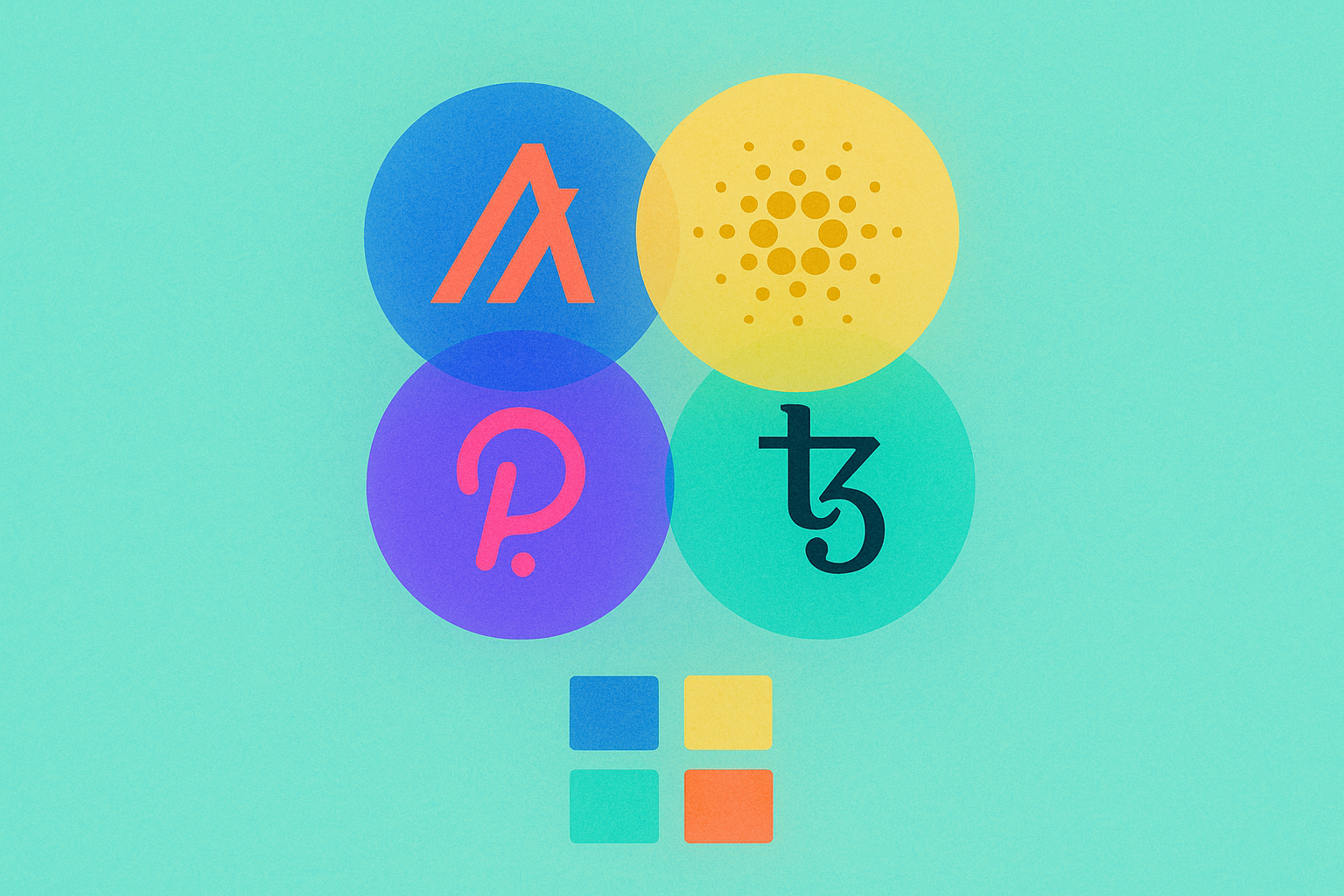
Widely trusted Proof of Stake coins include Synthetix, Algorand, Cardano, Polkadot, Avalanche, Cosmos, and Tezos. Each coin offers distinct yield rates, lock-up periods, and staking methods.

Many emerging blockchain projects also use PoS, allowing users to stake and earn rewards. Your choice of staking coin should reflect your risk tolerance, expected returns, and confidence in the project.

Is Coin Staking Profitable?

Despite the rise of alternative staking models, direct on-chain staking through Proof of Stake remains the most reliable way to generate stable income.

Staking coins not only supports network growth and smooth operations, but also provides regular rewards. Annual yields (APY) typically range from 2% to 15%, depending on the project and total staked tokens.

Rewards are paid in the blockchain’s native token and automatically deposited into your staking wallet. This generates compounding returns, as you can restake your earned tokens to further increase profits over time.

Best Coins for Staking

Algorand

Staking on Algorand is simple and offers attractive yields. Start by downloading the official Algorand wallet and transferring ALGO tokens to it.

Once your Algorand tokens are in the wallet, you can earn up to 6% annual yield. Algorand stands out for distributing rewards automatically every nine minutes, so you’ll see your earnings accumulate almost in real time.

Cardano

When you stake ADA on Cardano, the amount staked represents your share in the network. Cardano offers flexible delegation, allowing you to withdraw tokens at any time without penalty.

There are two main ways to earn Cardano rewards. You can delegate your stake to a pool managed by others—a straightforward option for beginners. Alternatively, you can operate your own stake pool, which suits those with technical expertise and a desire for full control.

Polkadot

Investors can earn up to 16% annual yield by becoming a "Nominator" on Polkadot’s blockchain—one of the highest rates among major PoS platforms.

To become a nominator, you must hold a minimum amount of DOT specified by the Polkadot network. This requirement may change over time based on overall participation and network governance policies.

Tezos

Staking Tezos is referred to as "Baking"—a unique feature of the project. Like Cardano, you can either delegate your assets or operate your own validator node.

Anyone can participate in Tezos staking with a low entry threshold. Average yields reach up to 6% per year, distributed by node operators ("Bakers") to delegators after deducting service fees.

Alternative Ways to Stake Coins

Crypto Exchanges

Major crypto exchanges now offer staking services with yields based on asset type and staking duration. This is a convenient option for users who prefer not to manage wallets or install technical software.

Trusted trading platforms support staking for dozens of cryptocurrencies, with annual yields ranging from 1% to 16%.

When staking on an exchange, remember your assets are held on their platform. Always choose exchanges with strong security and a solid reputation.

Crypto Savings Accounts

Crypto savings accounts offer another secure option, with yields from 1% to 20% per year depending on the asset and lock-up period.

Unlike traditional staking, these accounts work similarly to bank deposits. Your crypto is used by the platform to provide liquidity for lending, and you earn interest from these activities.

Crypto lending platforms often deliver higher yields than standard staking, but they also carry greater risk since your assets are lent to third parties.

DeFi Platforms

Decentralized finance (DeFi) platforms have surged in popularity thanks to their simplicity and high earning potential. They represent a new approach to passive crypto income.

DeFi platforms hold your assets in liquidity pools or smart contracts. By participating, you become a liquidity provider, enabling trading and lending for other users.

You’ll earn from transaction fees and platform-generated interest. Yields typically fall within the 20%–100% APY range, and sometimes even higher. Keep in mind, higher yields involve greater smart contract and price volatility risks.

Staking Service Providers

Recently, many “all-in-one” staking service providers have launched, offering comprehensive platforms where users can easily select coins and configure staking parameters with just a few clicks.

Popular providers include MyCointainer, Stake.Capital, EverStake, Staked, and Stakefish. These platforms support multiple coins, provide user-friendly interfaces, and offer responsive customer service.

The main advantage is that you don’t need technical expertise or worry about node operations or software updates. However, expect service fees ranging from 5% to 25% of your total rewards.

Conclusion

You can stake via official crypto wallets or alternative platforms such as exchanges, DeFi platforms, or staking service providers. No matter the method, you can reliably earn passive income by holding and contributing your assets to the network.

If you’re a long-term crypto investor who believes in blockchain’s potential, consider staking your assets rather than letting them sit idle. This not only maximizes your returns, but also supports the growth and security of trusted blockchain networks.

FAQ

What is staking? How does it work?

Staking involves holding coins and confirming blockchain transactions to earn crypto rewards. Participants lock a portion of their coins to secure the network and may be selected to add new blocks. Staking maintains system security, and users earn rewards for their involvement.

Which coins can be staked to earn income?

Leading Proof of Stake coins for staking include Cardano, Polkadot, Tezos, Algorand, Cosmos, Avalanche, and Synthetix. These coins let you lock capital for regular income.

How do I start staking? What do I need?

To start staking, you need a digital wallet and eligible coins. Deposit your coins into a wallet or staking account, ensure it’s online, select the coin, and choose your staking duration. You’ll receive regular rewards.

How much can I earn from staking? What are APY and APR?

Staking returns usually range from 5% to 20% or higher, depending on the coin. APY is the annual yield with compounding; APR is the annual rate without compounding.

What are the main risks of staking coins? Can you lose money?

Main risks include token price declines and project failures that can result in loss of capital. Lock-up periods also restrict liquidity. Technical risks from smart contracts may occur. You could lose money if you stake with unreliable projects.

How is staking different from mining? Which is better?

Mining requires substantial energy and hardware for transaction validation, while staking uses fewer resources and simply locks coins to support the network. Staking is more cost-effective, yet mining delivers higher overall network security.

* The information is not intended to be and does not constitute financial advice or any other recommendation of any sort offered or endorsed by Gate.
Related Articles
2025 best encryption staking platform recommendation: secure and profitable

2025 best encryption staking platform recommendation: secure and profitable

With the continuous development of the encryption market, **staking has become one of the most popular passive income methods. By locking your encrypted assets, you can support the operation of the blockchain network and receive corresponding rewards. However, it is not easy to choose from numerous platforms. This article will list reliable and profitable encryption staking platforms in 2025, focusing on their security and profitability.
2025-04-17 09:26:41
Ethereum 2.0 in 2025: Staking, Scalability, and Environmental Impact

Ethereum 2.0 in 2025: Staking, Scalability, and Environmental Impact

Ethereum 2.0 has revolutionized the blockchain landscape in 2025. With enhanced staking capabilities, dramatic scalability improvements, and a significantly reduced environmental impact, Ethereum 2.0 stands in stark contrast to its predecessor. As adoption challenges are overcome, the Pectra upgrade has ushered in a new era of efficiency and sustainability for the world's leading smart contract platform.
2025-04-25 06:36:13
 How to Buy Crypto: A Step-by-Step Guide with Gate.com

How to Buy Crypto: A Step-by-Step Guide with Gate.com

In today’s rapidly evolving digital asset landscape, more and more people are looking to invest in cryptocurrencies. If you’ve been searching for "how to buy crypto," Gate.com offers a secure, user-friendly platform that makes entering the crypto market both easy and safe. This article will guide you through the step-by-step process of purchasing cryptocurrencies, while highlighting the unique advantages of using Gate.com.

2025-04-25 07:15:52
Crypto Assets Stake Full Analysis: How to Earn Passive Income Through Tokens

Crypto Assets Stake Full Analysis: How to Earn Passive Income Through Tokens

In the vibrant world of crypto assets, earning passive income has become a popular choice for many investors. And one of the most popular methods is to achieve this through Crypto Staking. This article will explain in detail what crypto staking is, how it works, and how to start using your tokens to earn substantial passive income.
2025-04-17 09:22:38
MemeBox Price and Airdrop Guide 2025: What You Need to Know

MemeBox Price and Airdrop Guide 2025: What You Need to Know

In 2025, MemeBox has revolutionized meme coin trading, offering a seamless platform for enthusiasts and investors alike. With its recent price surge and ecosystem expansion, MemeBox stands out among meme coins. Discover how to buy MemeBox tokens, explore airdrop eligibility, and uncover why this innovative platform is reshaping the crypto landscape.
2025-05-07 07:31:01
Can AI Companions (AIC) Reach $0.2729 in Price Prediction?

Can AI Companions (AIC) Reach $0.2729 in Price Prediction?

Discover the future of digital companionship with AI Companions (AIC), a groundbreaking cryptocurrency project poised to revolutionize the $1.5T AI market by 2030. With its innovative blend of AI, blockchain, and virtual reality, AIC aims to redefine mental health support and social interactions, targeting a price of $0.2729 by 2030.
2025-04-24 03:14:54
Recommended for You
How Does Community and Ecosystem Activity Impact Cryptocurrency Token Value?

How Does Community and Ecosystem Activity Impact Cryptocurrency Token Value?

This article explores how community engagement and ecosystem activity directly drive cryptocurrency token value through three interconnected dimensions. Strong social media communities exceeding one million followers signal project viability and attract sustained investment momentum. Active developer ecosystems—measured through GitHub commits and innovation velocity—reduce implementation risk and accelerate real-world adoption. DApp ecosystem scale and user interaction frequency demonstrate tangible utility, moving tokens beyond speculation toward functional necessity. The 2025-2026 Web3 landscape prioritizes genuine application adoption and community participation over empty tokenomics. By analyzing social engagement metrics, developer contribution patterns, and DApp transaction volumes, investors gain reliable indicators for assessing long-term token sustainability and value foundation strength.
2026-02-04 08:27:34
What is TRIA crypto market overview with $34.71M market cap and 2.178B circulating supply?

What is TRIA crypto market overview with $34.71M market cap and 2.178B circulating supply?

TRIA is an emerging cryptocurrency with a $34.71M market cap and 2.178B circulating supply, positioned as a self-custodial crypto bank and Web3 infrastructure platform on Ethereum. Demonstrating real adoption with over 200,000 users and $100M+ transaction volume, TRIA distinguishes itself through practical utility beyond speculation. The token exhibits robust market penetration across eight major exchanges including Gate, ByBit, and Bitget, generating $15.5M in 24-hour trading volume despite a -9.36% price movement. Strong liquidity metrics with narrow bid-ask spreads enable efficient order execution for both retail and institutional traders. TRIA's market position reflects growing investor confidence in platforms prioritizing practical utility, self-custody, and compliance, making it relevant for users exploring innovative DeFi solutions and financial inclusion opportunities in the crypto ecosystem.
2026-02-04 08:25:47
Is Global Entertainment Token (GET) a good investment?: A Comprehensive Analysis of Tokenomics, Market Performance, and Future Growth Potential

Is Global Entertainment Token (GET) a good investment?: A Comprehensive Analysis of Tokenomics, Market Performance, and Future Growth Potential

This comprehensive analysis evaluates Global Entertainment Token (GET) as an investment opportunity, examining its position as a Cardano-native utility token designed for the global entertainment industry. The article covers GET's current market status—ranking 2,751 with $721,750 market capitalization and $0.0014435 price—alongside historical price performance showing significant volatility from $0.0336 peak to current levels. Key investment factors analyzed include tokenomics with 5% circulating supply ratio, ecosystem development, and adoption potential. Price forecasts through 2031 range from $0.00127 to $0.00313 depending on adoption scenarios, while detailed risk assessments address volatility, liquidity constraints from single-exchange listing on Gate, and regulatory uncertainties. The guide provides actionable investment strategies, risk management approaches, and security recommendations for diverse investor profiles considering GET exposure.
2026-02-04 08:24:39
Is Unagi (UNA) a good investment?: A Comprehensive Analysis of Token Fundamentals, Market Performance, and Future Potential

Is Unagi (UNA) a good investment?: A Comprehensive Analysis of Token Fundamentals, Market Performance, and Future Potential

This comprehensive analysis evaluates whether Unagi (UNA) represents a suitable investment opportunity within the Web3 gaming ecosystem. UNA serves as the universal access token for Unagi's multi-game platform deployed on the BASE network, with a current price of $0.0056 and market capitalization of approximately $725,614. The article examines critical investment factors including token supply mechanics (12.96% circulating supply), ecosystem adoption across gaming titles like Ultimate Champions, and historical price performance showing significant volatility. Price forecasts through 2031 range from conservative to optimistic scenarios, with potential returns dependent on gaming ecosystem expansion and mainstream adoption. Investment strategies address portfolio allocation recommendations (1-3% for conservative investors, 5-10% for aggressive investors) and risk management approaches. Key risks include high volatility, limited liquidity on 2 exchanges, and regulatory uncertainties. The analysis concludes that
2026-02-04 08:24:21
What are the key compliance and regulatory risks facing crypto projects in 2025?

What are the key compliance and regulatory risks facing crypto projects in 2025?

This comprehensive guide examines critical compliance and regulatory risks confronting crypto projects in 2025 across major jurisdictions. It analyzes the SEC's Howey Test framework in the US, Hong Kong's dual-licensing regime, and the EU's MiCA regulations, establishing distinct compliance pathways for digital asset service providers. The article emphasizes that stablecoin issuers must implement rigorous audit transparency and reserve management protocols aligned with AICPA standards. Through case studies comparing Circle's USDC success with UST's collapse, it demonstrates how institutional-grade KYC/AML compliance has become a competitive differentiator. Finally, it addresses multi-jurisdiction challenges, highlighting fragmented requirements across GENIUS Act, Hong Kong Stablecoin Ordinance, and MiCA frameworks, requiring crypto projects to conduct sophisticated legal analysis and structure operations accordingly to navigate overlapping yet distinct regulatory obligations effectively.
2026-02-04 08:23:36
Is Quantstamp (QSP) a good investment?: A Comprehensive Analysis of the Smart Contract Auditing Platform's Market Potential and Risk Factors

Is Quantstamp (QSP) a good investment?: A Comprehensive Analysis of the Smart Contract Auditing Platform's Market Potential and Risk Factors

Quantstamp (QSP) is a blockchain security audit protocol providing smart contract vulnerability detection on Ethereum, currently trading at $0.001025 with a market cap of $731,290 and ranking #2747. The token demonstrates mixed investment characteristics: established partnerships with Ethereum 2.0, Binance, MakerDAO, and Chainlink provide operational credibility, while a circulating supply of 713.8 million tokens (73.1% of maximum) supports the scarcity model. However, QSP faces significant challenges including high volatility (-15.12% weekly), limited trading volume ($13,056 daily), and regulatory uncertainty surrounding security tokens. Investment strategies range from conservative dollar-cost averaging (1-3% allocation) to active trading approaches, with 2026-2031 price scenarios ranging from $0.000759684 to $0.002594146586128 depending on blockchain security adoption rates. Risk management through portfolio diversification, secure cold wallet storage, and thorough due diligence remains essential for evalu
2026-02-04 08:23:13