Zulu Network is the first Native Bitcoin DePIN Layer launched in 2024, bridging Bitcoin's security with EVM-compatible infrastructure for decentralized physical infrastructure networks and AI applications. The project combines Bitcoin's robust consensus mechanism with flexible smart contract capabilities, enabling users to stake assets and earn ZULU rewards while supporting DePIN and AI protocol operations. With 375 active holders and a circulating supply of 144.5 million tokens, Zulu Network trades on Gate.com with a market cap of $1.445 million. This comprehensive guide explores its technical architecture, market performance trends, ecosystem applications, community sentiment, and participation opportunities, while addressing key challenges in the competitive blockchain landscape and outlining the platform's development roadmap.
Zulu Network's Positioning and Significance
In 2024, the Zulu Network team launched Zulu Network (ZULU), aiming to address the fragmentation between Bitcoin's security and the flexibility needed for AI and decentralized physical infrastructure networks (DePIN).
As the first Native Bitcoin DePIN Layer optimized for AI and DePIN applications, Zulu Network plays a key role in bridging Bitcoin's robust security with EVM-compatible infrastructure for emerging decentralized economies.
As of 2026, Zulu Network has established itself as an innovative protocol combining Bitcoin's security with EVM flexibility, with 375 holders and an active development community focused on DePIN innovation.
This article will provide an in-depth analysis of its technical architecture, market performance, and future potential.
Origin and Development History
Background of Creation
Zulu Network was created by its founding team in 2024, aiming to solve the challenge of enabling AI and DePIN protocols to operate securely on Bitcoin while maintaining EVM compatibility.
It emerged during the growing convergence of AI, blockchain, and physical infrastructure networks, with the goal of empowering users to stake assets and facilitate DePIN and AI protocol operations directly on the Bitcoin network.
The launch of Zulu Network brought new possibilities for developers and users seeking to build decentralized AI and infrastructure applications on Bitcoin.
Important Milestones
- November 2024: Official launch and listing, introducing the first Native Bitcoin DePIN Layer with EVM infrastructure compatibility.
- 2024-2025: Network development phase, expanding the ecosystem to support various DePIN and AI protocols.
- 2026: Continued evolution with 375 token holders participating in the ecosystem.
With support from its development team and community, Zulu Network continues to optimize its technology, security, and real-world applications.
How Zulu Network Operates
Decentralized Control
Zulu Network operates on a decentralized network of nodes distributed globally, eliminating dependence on centralized financial institutions or authorities.
These nodes collaborate to validate transactions, ensuring system transparency and attack resistance, granting users greater autonomy while enhancing network resilience.
Blockchain Foundation
Zulu Network's blockchain is a public, immutable digital ledger that records every transaction.
Transactions are grouped into blocks and linked through cryptographic hashing to form a secure chain.
Anyone can view the records, establishing trust without intermediaries.
The protocol combines Bitcoin's security architecture with EVM-compatible infrastructure, enabling flexible smart contract deployment while maintaining the foundational security of Bitcoin.
Consensus Mechanism
Zulu Network utilizes a hybrid approach leveraging Bitcoin's security foundation while enabling EVM-based smart contract execution to validate transactions and prevent fraudulent activities such as double-spending.
Participants maintain network security through staking assets and facilitating DePIN and AI protocol operations, earning ZULU rewards.
Its innovation includes bridging Bitcoin's proven security model with flexible infrastructure for AI and physical infrastructure applications.
Secure Transactions
Zulu Network employs public-private key cryptography to protect transactions:
- Private keys (similar to secret passwords) are used to sign transactions
- Public keys (similar to account numbers) are used to verify ownership
This mechanism ensures fund security while maintaining transaction pseudonymity.
The protocol's architecture enables users to stake assets securely while participating in DePIN and AI protocol operations on the Bitcoin network.
Circulation Overview
As of February 02, 2026, the circulating supply of Zulu Network stands at 144,500,000 ZULU tokens, with a total supply of 1,000,000,000 ZULU and a maximum supply cap of 1,000,000,000 ZULU. The circulating supply represents approximately 14.45% of the total supply, indicating a significant portion of tokens remains to be released into circulation. The token operates on an ERC-20 standard deployed on the Ethereum blockchain, with the contract address verified at 0x7b67d8b4da0b17a9b98eddc21230b60c8ede69a4.
Price Volatility
Zulu Network experienced notable price movements since its launch on November 10, 2024, with a publishing price of $0.1. The token's price trajectory has shown significant fluctuation, reflecting the dynamic nature of the cryptocurrency market and evolving project developments.
On November 11, 2024, ZULU recorded its price peak at $0.27599, shortly after its initial launch. This early price movement likely reflected initial market enthusiasm and trading activity surrounding the project's entry into the market.
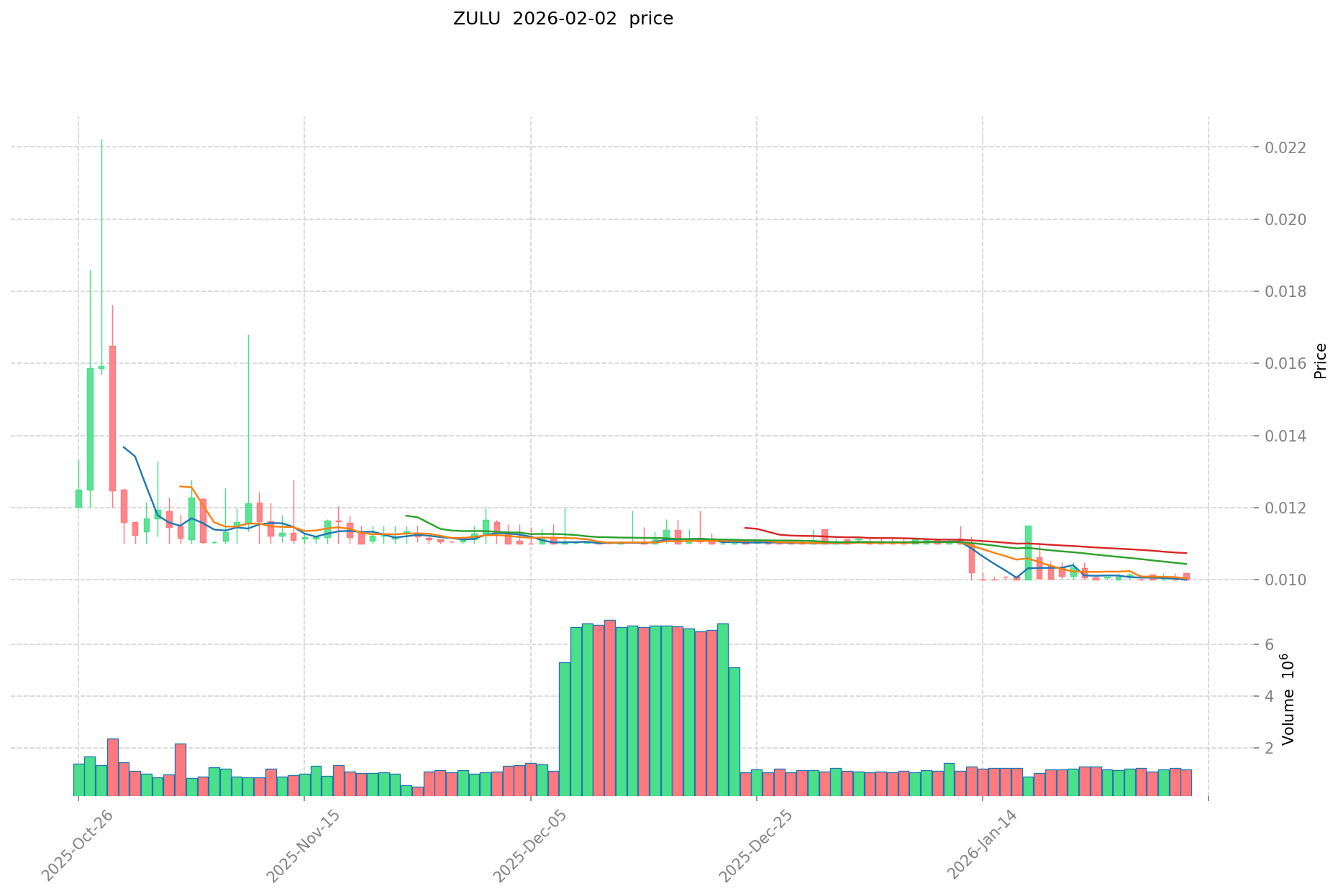
Conversely, the token reached its lowest recorded price of $0.001313 on July 10, 2025, representing a substantial decline from its peak. As of the current reporting period, ZULU trades at approximately $0.01, with recent price movements showing a 24-hour high of $0.010179 and a 24-hour low of $0.01.
Recent performance metrics indicate mixed short-term movements: the token experienced a 1.73% decline over the past hour and a 10.01% decrease over the past 30 days, while showing minimal movement (0.028% increase) over the past 7 days. Over a one-year period, ZULU has declined by 6.27%.
These price fluctuations reflect various market dynamics, including broader cryptocurrency market conditions, project development milestones, and trading activity patterns.
Click to view the current ZULU market price
On-Chain Metrics
- 24-Hour Trading Volume: Approximately $11,781.52, indicating current market liquidity and trading activity levels
- Market Capitalization: $1,445,000, representing the current valuation based on circulating supply
- Fully Diluted Market Cap: $10,000,000, reflecting the theoretical market value if all tokens were in circulation
- Active Holders: 375 addresses, demonstrating the current user base holding ZULU tokens
- Exchange Listings: Available on 1 exchange, with trading support on Gate.com
Zulu Network Ecosystem Applications and Partners
Core Use Cases
Zulu Network's ecosystem supports multiple applications:
- DePIN (Decentralized Physical Infrastructure Networks): The platform enables users to stake assets and help facilitate the operation of various DePIN protocols, providing decentralized infrastructure support.
- AI Applications: Zulu Network is optimized for AI implementations, allowing users to participate in AI protocol operations and earn rewards on the Bitcoin network.
Strategic Partnerships
Zulu Network combines Bitcoin's security with EVM infrastructure flexibility to foster innovation in the DePIN and AI sectors.
These technological integrations provide a solid foundation for Zulu Network's ecosystem expansion.
Controversies and Challenges
Zulu Network faces the following challenges:
- Technical Issues: As a nascent project launched in November 2024, the platform may encounter scalability and operational optimization challenges
- Market Volatility: The token has experienced notable price fluctuations, with current trading around $0.01 compared to previous levels
- Competition Pressure: The blockchain space includes numerous projects focused on AI and infrastructure solutions
These issues have sparked discussions within the community and market, while also driving Zulu Network's continuous innovation.
Zulu Network's community shows growing interest, with 375 token holders as of February 2026.
On X platform, relevant posts and hashtags (such as #ZuluNetwork) generate discussions about the project's DePIN and AI capabilities.
The platform's unique positioning as a Native Bitcoin DePIN Layer has attracted attention from the crypto community.
Sentiment on X presents varied perspectives:
- Supporters praise Zulu Network's innovative approach combining Bitcoin security with EVM flexibility, viewing it as a promising platform for DePIN and AI innovation.
- Observers monitor the project's development progress and token performance in the evolving DePIN landscape.
Recent trends show interest in the platform's staking mechanisms and reward structures.
Popular Topics
X users discuss Zulu Network's integration of Bitcoin security with DePIN applications and its potential to enable earning opportunities,
showcasing both its transformative potential and the challenges of establishing a new blockchain infrastructure.
- Official Website: Visit Zulu Network Official Site for features, use cases, and latest updates.
- White Paper: Zulu Network White Paper details its technical architecture, objectives, and vision for combining Bitcoin security with DePIN innovation.
- X Updates: On X platform, Zulu Network maintains an active presence using @zulu_network,
sharing content about technical developments, community initiatives, and ecosystem growth.
Zulu Network Future Roadmap
- Ecosystem Development: Support expansion of DePIN and AI protocols on the platform
- Technical Enhancement: Continue optimizing the integration between Bitcoin security and EVM infrastructure
- Long-term Vision: Establish itself as a leading platform for decentralized physical infrastructure and AI applications on Bitcoin
How to Participate in Zulu Network?
- Purchase Channels: Acquire ZULU on Gate.com and other supported exchanges
- Storage Solutions: Use compatible ERC-20 wallets to securely store ZULU tokens
- Participate in Staking: Engage with the platform's staking mechanisms to help operate DePIN and AI protocols while earning rewards
- Build Ecosystem: Visit the official documentation to explore development opportunities and contribute to the platform
Summary
Zulu Network leverages blockchain technology to create an innovative platform that combines Bitcoin's security with EVM flexibility, offering decentralized infrastructure support and AI application capabilities.
Its unique positioning, growing community, and clear focus on DePIN innovation distinguish it in the cryptocurrency landscape.
While facing challenges such as market volatility and competitive pressures, Zulu Network's innovative approach and development roadmap position it as a noteworthy project in the decentralized technology space.
Whether you are a newcomer or experienced participant, Zulu Network offers opportunities worth exploring and engaging with.
FAQ
What is Crypto ZULU and what is its purpose?
Crypto ZULU is the native token of the Zulu Network, designed to facilitate decentralized applications and enhance user empowerment within the Bitcoin ecosystem. Its purpose is to support Layer 2 solutions for scalability and efficiency.
How do I buy and store ZULU tokens?
You can purchase ZULU tokens through cryptocurrency exchanges using fiat or other cryptocurrencies. Store them securely in a hardware wallet or reputable cryptocurrency wallet that supports ZULU tokens for optimal security and control.
What is the total supply and current market cap of ZULU?
ZULU has a total supply of 1,000 million tokens. The current market cap is $1.453 million, with a circulating supply of 144 million tokens.
Is ZULU a legitimate project and what are the associated risks?
ZULU is a legitimate cryptocurrency project with solid fundamentals. Key risks include market volatility, regulatory changes, and liquidity fluctuations. Conduct thorough research before participation.
What blockchain does ZULU operate on and what are its key features?
ZULU operates on the Ethereum blockchain as an ERC-20 token. Its key features include a native Bitcoin DePIN protocol architecture, enabling decentralized physical infrastructure networks with enhanced interoperability and security.
How does ZULU compare to other similar cryptocurrency projects?
ZULU demonstrates competitive price performance within the Ethereum Ecosystem, with gains comparable to peer projects averaging 12.70%. While maintaining a niche market position, ZULU differentiates itself through its unique ecosystem features and community-driven development approach compared to similar projects.
* The information is not intended to be and does not constitute financial advice or any other recommendation of any sort offered or endorsed by Gate.