WNDR vs ICP: A Comprehensive Comparison of Two Emerging Blockchain Platforms and Their Impact on the Decentralized Internet

Introduction: Investment Comparison Between WNDR and ICP
In the cryptocurrency market, the comparison between WNDR vs ICP has always been a topic that investors cannot avoid. The two not only have significant differences in market cap ranking, application scenarios, and price performance, but also represent different crypto asset positioning. WNDR (Wonderman Nation): Launched in 2022, it has gained market recognition with its positioning as a play-to-earn gaming ecosystem that combines Final Fantasy battle mechanics, Axie Infinity's dual-token economy, and CryptoKitties breeding mechanics. ICP (Internet Computer): Since its inception in 2019, it has been regarded as a decentralized cloud blockchain, hosting secure applications, websites, and enterprise systems while enabling trustless multi-chain interactions. This article will comprehensively analyze the investment value comparison of WNDR vs ICP around historical price trends, supply mechanisms, institutional adoption, technical ecosystems, and future predictions, attempting to answer the question that investors are most concerned about:
"Which is the better buy right now?"
I. Historical Price Comparison and Current Market Status
Historical Price Trends of WNDR (Coin A) and ICP (Coin B)
- 2021: ICP experienced notable price volatility following its public launch, with the token initially trading around $365 before experiencing downward pressure. Early investors acquired ICP tokens at approximately $0.035 during funding rounds.
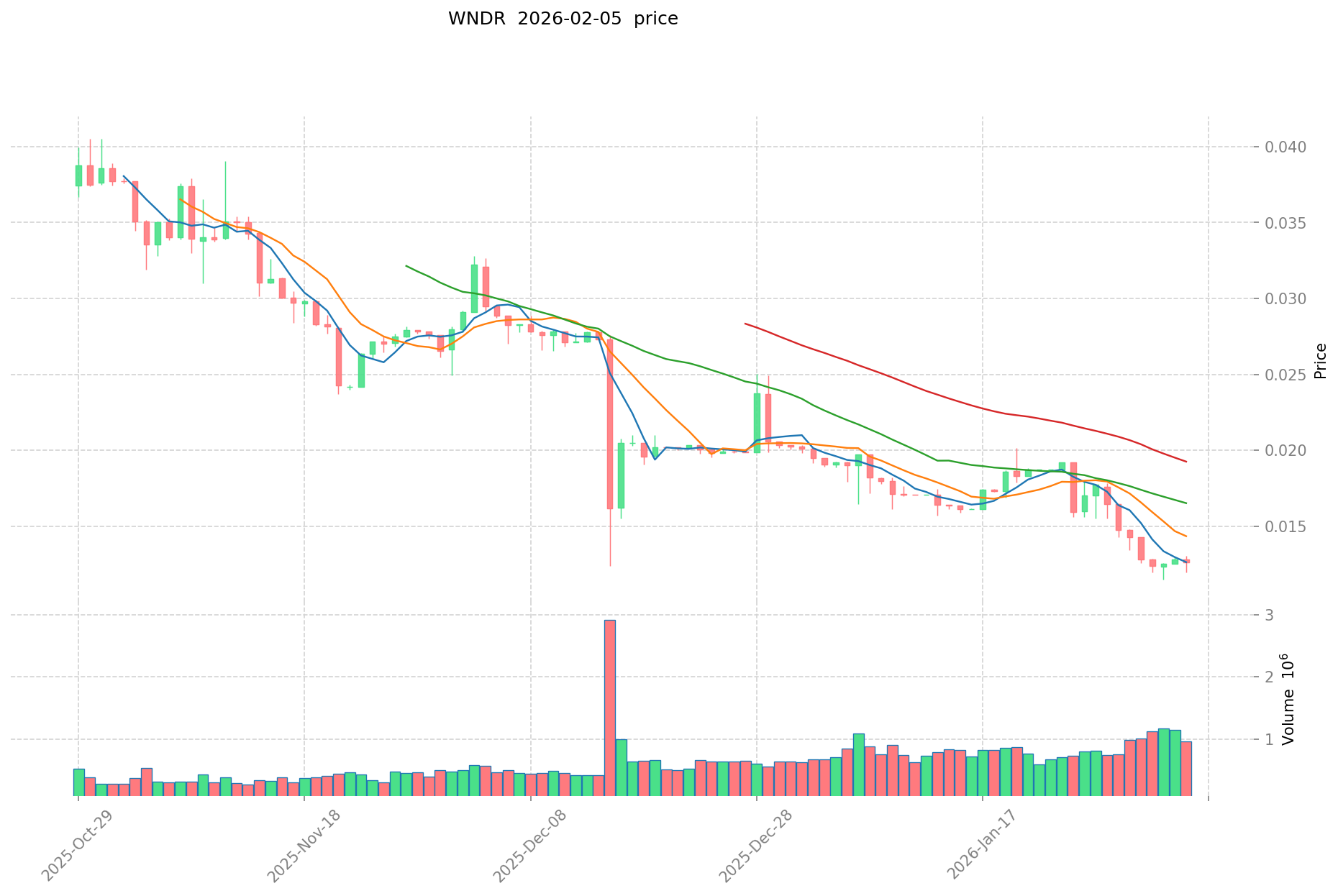
- 2022: WNDR reached a price level of $0.327695 on May 9, 2022, representing a significant point in its trading history.
- 2023: WNDR recorded a price of $0.00779408 on October 21, 2023, while market conditions remained challenging for both assets.
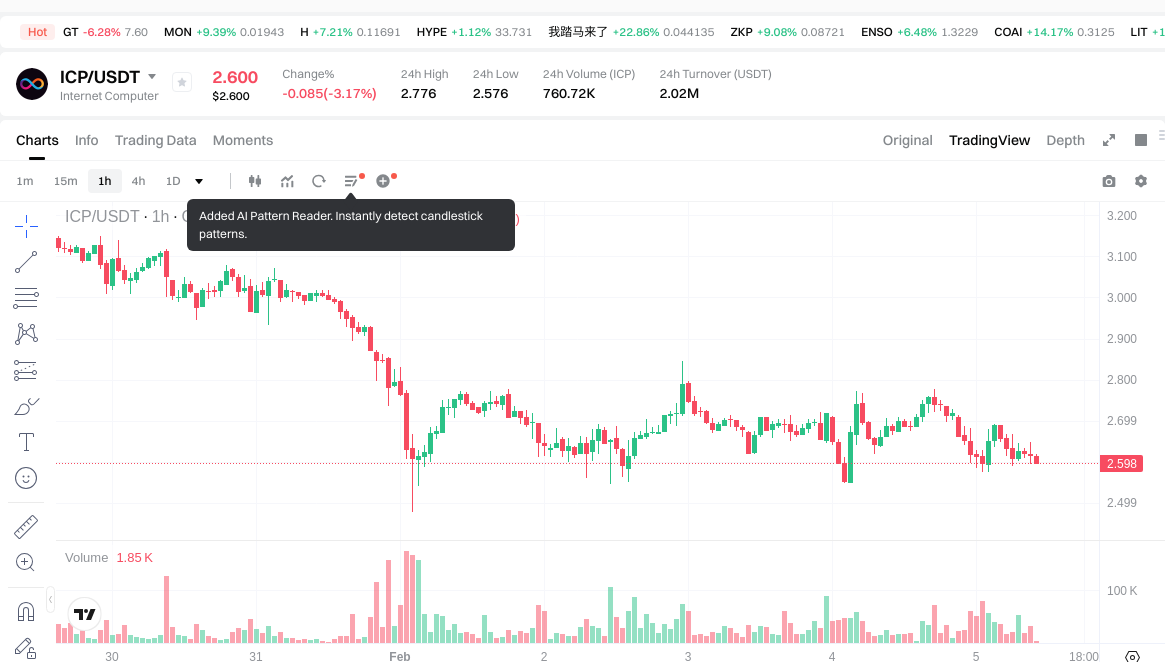
- 2025: ICP experienced further price decline, with the token reaching $2.23 on October 11, 2025.
- Comparative Analysis: During recent market cycles, WNDR declined from $0.327695 to current levels near $0.012496, while ICP decreased from $700.65 to approximately $2.616.
Current Market Status (February 5, 2026)
- WNDR current price: $0.012496
- ICP current price: $2.616
- 24-hour trading volume: WNDR $12,040.79 vs ICP $2,033,195.79
- Market capitalization: WNDR $583,229.49 vs ICP $1,433,031,057.77
- Market sentiment index (Fear & Greed Index): 12 (Extreme Fear)
Check real-time prices:
- View WNDR current price Market Price
- View ICP current price Market Price
II. Core Factors Influencing WNDR vs ICP Investment Value
Supply Mechanism Comparison (Tokenomics)
- WNDR: The reference materials do not provide specific information regarding WNDR's supply mechanism or tokenomics structure.
- ICP: The reference materials do not provide specific information regarding ICP's supply mechanism or tokenomics structure.
- 📌 Historical Pattern: Supply mechanisms can influence price cycles through controlled emission rates and deflationary pressures, though specific historical data for these tokens is not available in the provided materials.
Institutional Adoption and Market Application
- Institutional Holdings: The reference materials do not contain comparative data on institutional preference between WNDR and ICP.
- Enterprise Adoption: Information regarding the application of WNDR or ICP in cross-border payments, settlement systems, or investment portfolios is not available in the provided materials.
- National Policies: The regulatory attitudes of different countries toward WNDR and ICP are not covered in the reference materials.
Technological Development and Ecosystem Building
- WNDR Technical Upgrades: The reference materials do not provide information about WNDR's technological upgrades or their potential impact.
- ICP Technical Development: The reference materials do not provide information about ICP's technological development or potential impact.
- Ecosystem Comparison: Data comparing DeFi, NFT, payment systems, and smart contract implementation between WNDR and ICP is not available in the provided materials.
Macroeconomic Environment and Market Cycles
- Performance in Inflationary Environments: The reference materials do not provide comparative analysis of anti-inflation properties for either token.
- Macroeconomic Monetary Policy: The specific impact of interest rates and the US Dollar Index on WNDR and ICP is not discussed in the provided materials.
- Geopolitical Factors: Information regarding cross-border transaction demand and international situations affecting these tokens is not available in the reference materials.
III. 2026-2031 Price Forecast: WNDR vs ICP
Short-term Forecast (2026)
- WNDR: Conservative $0.0109-$0.0125 | Optimistic $0.0125-$0.0142
- ICP: Conservative $1.59-$2.60 | Optimistic $2.60-$2.97
Medium-term Forecast (2028-2029)
- WNDR may enter a consolidation phase, with estimated price range of $0.0094-$0.0178
- ICP may enter an expansion phase, with estimated price range of $1.89-$4.48
- Key drivers: institutional capital inflows, ETF developments, ecosystem growth
Long-term Forecast (2031)
- WNDR: Baseline scenario $0.0134-$0.0176 | Optimistic scenario $0.0176-$0.0241
- ICP: Baseline scenario $3.18-$4.61 | Optimistic scenario $4.61-$6.74
Disclaimer
WNDR:
| Year | Predicted High Price | Predicted Average Price | Predicted Low Price | Price Change |
|---|---|---|---|---|
| 2026 | 0.01415099 | 0.012523 | 0.01089501 | 0 |
| 2027 | 0.01613776395 | 0.013336995 | 0.0096026364 | 6 |
| 2028 | 0.01517950085925 | 0.014737379475 | 0.009431922864 | 17 |
| 2029 | 0.017800543798878 | 0.014958440167125 | 0.01316342734707 | 19 |
| 2030 | 0.018836415780452 | 0.016379491983001 | 0.010974259628611 | 31 |
| 2031 | 0.024122896817965 | 0.017607953881727 | 0.013382044950112 | 40 |
ICP:
| Year | Predicted High Price | Predicted Average Price | Predicted Low Price | Price Change |
|---|---|---|---|---|
| 2026 | 2.96628 | 2.602 | 1.58722 | 0 |
| 2027 | 3.4244922 | 2.78414 | 1.8375324 | 6 |
| 2028 | 3.383704549 | 3.1043161 | 1.893632821 | 18 |
| 2029 | 4.47673424781 | 3.2440103245 | 2.46544784662 | 24 |
| 2030 | 5.36591747775545 | 3.860372286155 | 3.088297828924 | 47 |
| 2031 | 6.735191527654628 | 4.613144881955225 | 3.183069968549105 | 76 |
IV. Investment Strategy Comparison: WNDR vs ICP
Long-term vs Short-term Investment Strategies
- WNDR: May appeal to investors focused on gaming ecosystems and play-to-earn models, with tolerance for higher volatility and smaller market capitalization assets
- ICP: May suit investors seeking exposure to decentralized cloud infrastructure and blockchain-based web hosting solutions, with preference for established projects with larger market presence
Risk Management and Asset Allocation
- Conservative investors: WNDR 10-15% vs ICP 85-90%
- Aggressive investors: WNDR 30-40% vs ICP 60-70%
- Hedging tools: stablecoin allocation, options strategies, cross-asset portfolio diversification
V. Potential Risk Comparison
Market Risk
- WNDR: Lower liquidity indicated by 24-hour trading volume of $12,040.79, potentially leading to increased price volatility and execution challenges during market stress
- ICP: Historical price fluctuations from launch levels, with sensitivity to broader cryptocurrency market cycles and sentiment shifts
Technical Risk
- WNDR: Scalability considerations, network stability factors related to gaming ecosystem infrastructure
- ICP: Network performance requirements, security considerations inherent to decentralized cloud computing platforms
Regulatory Risk
- Global regulatory developments may affect both projects differently, with gaming-focused tokens potentially facing distinct compliance requirements compared to infrastructure-oriented blockchain projects
VI. Conclusion: Which Is the Better Buy?
📌 Investment Value Summary:
- WNDR advantages: Gaming ecosystem positioning, play-to-earn model integration, potential for growth in emerging blockchain gaming sector
- ICP advantages: Larger market capitalization ($1.43 billion vs $583,229), higher trading volume ($2.03 million vs $12,040 daily), established infrastructure focus, decentralized cloud computing applications
✅ Investment Recommendations:
- Beginner investors: Consider ICP for greater market liquidity and established presence, with careful position sizing and risk assessment
- Experienced investors: Evaluate portfolio diversification between both assets based on risk tolerance, with emphasis on fundamental analysis and market conditions
- Institutional investors: Assess liquidity requirements and regulatory considerations, with ICP potentially offering more suitable trading volume and market depth
⚠️ Risk Warning: The cryptocurrency market exhibits high volatility. This analysis does not constitute investment advice.
VII. FAQ
Q1: What are the main differences between WNDR and ICP in terms of market positioning?
WNDR focuses on the play-to-earn gaming ecosystem combining elements from Final Fantasy, Axie Infinity, and CryptoKitties, while ICP targets decentralized cloud infrastructure for hosting applications and websites. WNDR appeals to gaming and NFT enthusiasts with a smaller market cap of $583,229, whereas ICP serves enterprise-level blockchain infrastructure needs with a significantly larger market capitalization of $1.43 billion. The fundamental difference lies in their use cases: WNDR emphasizes entertainment and gaming rewards, while ICP provides decentralized computing and web hosting solutions.
Q2: How do the trading volumes of WNDR and ICP compare, and what does this indicate?
ICP demonstrates substantially higher liquidity with a 24-hour trading volume of $2,033,195.79 compared to WNDR's $12,040.79—a difference of approximately 169 times. This significant disparity indicates that ICP offers better market depth, easier entry and exit positions, and reduced slippage risk during transactions. For investors, higher trading volume typically translates to more stable price discovery and lower execution risk, making ICP more suitable for larger position sizes and institutional participation.
Q3: What historical price performance patterns have WNDR and ICP exhibited?
Both tokens have experienced significant price corrections from their historical peaks. WNDR declined from $0.327695 (May 2022) to the current level of $0.012496, representing approximately 96% decline. ICP dropped from $700.65 to approximately $2.616, also experiencing substantial downward pressure. These patterns reflect broader cryptocurrency market cycles and demonstrate high volatility characteristics common in digital assets. Historical performance indicates both tokens are highly sensitive to market sentiment and macroeconomic conditions.
Q4: What are the price forecasts for WNDR and ICP through 2031?
For 2026, WNDR is forecasted between $0.0109-$0.0142 (conservative to optimistic), while ICP ranges from $1.59-$2.97. By 2031, WNDR's baseline scenario projects $0.0134-$0.0176 with an optimistic range of $0.0176-$0.0241, representing potential 40% growth. ICP's 2031 forecast shows $3.18-$4.61 (baseline) and $4.61-$6.74 (optimistic), indicating potential 76% growth. These projections suggest ICP may offer stronger growth potential based on institutional adoption, ecosystem development, and market capitalization expansion.
Q5: Which token is more suitable for different investor profiles?
Beginner investors should consider ICP due to its higher liquidity, larger market presence, and more established infrastructure, though careful position sizing remains essential. Experienced investors might evaluate diversification between both assets, allocating 30-40% to WNDR and 60-70% to ICP for aggressive strategies, or 10-15% WNDR and 85-90% ICP for conservative approaches. Institutional investors typically find ICP more suitable given its trading volume depth ($2.03 million daily) and market capitalization, which facilitate larger position management and reduced execution risk.
Q6: What are the primary risks associated with investing in WNDR versus ICP?
WNDR carries higher liquidity risk due to its low trading volume ($12,040.79 daily), which may result in increased price volatility and execution challenges during market stress. Additionally, its gaming ecosystem focus exposes it to sector-specific regulatory considerations and scalability challenges. ICP faces network performance requirements and security considerations inherent to decentralized cloud computing platforms, along with sensitivity to broader cryptocurrency market cycles. Both tokens are subject to regulatory developments, though gaming-focused tokens like WNDR may face distinct compliance requirements compared to infrastructure-oriented projects like ICP.
Q7: How do current market conditions affect WNDR and ICP investment decisions?
As of February 5, 2026, the market sentiment index stands at 12 (Extreme Fear), indicating heightened risk aversion and potential buying opportunities for contrarian investors. This environment typically amplifies volatility for smaller-cap assets like WNDR while potentially offering better entry points for established projects like ICP. The extreme fear reading suggests investors should exercise caution, implement strict risk management protocols, and consider dollar-cost averaging strategies rather than concentrated lump-sum investments. Both tokens remain highly sensitive to macroeconomic factors and cryptocurrency market cycles.
Q8: What role should WNDR and ICP play in a diversified cryptocurrency portfolio?
In a diversified cryptocurrency portfolio, ICP may serve as a core holding (5-15% allocation) due to its infrastructure focus, larger market cap, and higher liquidity, providing exposure to decentralized cloud computing trends. WNDR could function as a satellite position (1-5% allocation) for investors seeking gaming ecosystem exposure and higher risk-reward potential. Portfolio construction should incorporate stablecoin allocations for capital preservation, consider hedging tools like options strategies, and maintain cross-asset diversification beyond single cryptocurrency pairs. The allocation ratio should align with individual risk tolerance, investment horizon, and market outlook.
Share
Content
Introduction: Investment Comparison Between WNDR and ICP
I. Historical Price Comparison and Current Market Status
II. Core Factors Influencing WNDR vs ICP Investment Value
III. 2026-2031 Price Forecast: WNDR vs ICP
IV. Investment Strategy Comparison: WNDR vs ICP
V. Potential Risk Comparison
VI. Conclusion: Which Is the Better Buy?
VII. FAQ
How to Buy Cryptocurrency


Trending Cryptocurrencies



Detailed Analysis of the Best 10 GameFi Projects to Play and Earn in 2025

Popular GameFi Games in 2025

What Are the Key On-Chain Metrics Revealing About Litecoin's Whale Activity in 2025?

What is GameFi and How Does It Work?

What is DeFi: Understanding Decentralized Finance in 2025

How Will Virtuals Protocol's AI Agent Economy Evolve by 2030?

Top 7 Machine Learning Applications

What Is Treasure? A Comprehensive Overview of the MAGIC Cryptocurrency

Which cryptocurrency should you buy? A guide to selecting the top coins
Ultimate Guide to MVRV Z-Score for Bitcoin Price Forecasting and Trading

What Is Crypto Asset Staking? A Guide to Earning Passive Income