Ethereum Foundation (EF) once again faces a pivotal moment of leadership transition.
The Ethereum Foundation’s Co-Executive Director Tomasz Stańczak has announced he will step down at the end of this month. It has been only 11 months since he and Hsiao-Wei Wang succeeded long-time leader Aya Miyaguchi last March, forming a new leadership core.

Bastian Aue will take over. Public information about Aue is extremely limited—his X account was registered just eight months ago, and he has almost no posting history. He will co-lead the Foundation with Hsiao-Wei Wang, overseeing the core resources and direction of the Ethereum ecosystem.
While this leadership change seems abrupt, it is the inevitable outcome of internal tensions, external pressures, and strategic transformation within the Ethereum Foundation.
Taking Charge Amid Turbulence: A Year in Transition
To understand Stańczak’s departure, it’s essential to revisit the context of his appointment.
At the start of 2025, the Ethereum community was anxious. After the US presidential election, the broader crypto market surged, with Bitcoin hitting new highs and competitors like Solana gaining momentum. Yet Ethereum’s price lagged, and the Foundation itself became the focus of criticism.
Much of the criticism targeted then-Executive Director Aya Miyaguchi. Developers complained the Foundation was disconnected from frontline builders, conflicted in strategic direction, and lacked effective Ethereum advocacy. Some accused the Foundation of being too “hands-off,” claiming its “coordinator” stance was allowing Ethereum to lose its first-mover advantage.
As Ethereum’s “central bank,” the Foundation was expected to act decisively—not passively.
Amid these pressures, Miyaguchi stepped back and joined the board. Stańczak and Wang were thrust into leadership roles to guide the Foundation through uncertainty.
Stańczak was no outsider. As founder of Nethermind—a core Ethereum execution client and key infrastructure player—he brought technical expertise, entrepreneurial experience, and a deep understanding of community challenges.
He recalled his initial mandate: “The community is calling out—you’re too chaotic, you need to be more centralized and move faster to meet this critical moment.”
What did they accomplish?
Stańczak and Wang’s leadership brought visible changes.
First, organizational efficiency improved. The Foundation laid off 19 employees and streamlined its structure, aiming to shed its bureaucratic image. Strategic focus shifted from Layer 2 back to Layer 1, with a clear commitment to prioritizing mainnet scaling over letting L2s operate independently. Upgrade cycles accelerated, and EIP progress became more decisive.
Second, the Foundation adjusted its public stance. It launched a series of social media videos to proactively explain Ethereum’s technical roadmap and development direction, marking a sharp contrast to its previously closed, mysterious image.
Strategically, Stańczak championed new directions: privacy protection, quantum computing threat response, and integrating artificial intelligence with Ethereum. He especially highlighted AI, noting the emergence of “agent-based systems” and “AI-assisted discovery” as transformative trends.
Financially, the Foundation began discussing more transparent budgeting and fund allocation strategies to address concerns about treasury efficiency.
Vitalik Buterin praised Stańczak: “He helped significantly improve the efficiency of several Foundation departments, making the organization more responsive to the outside world.”
Reading Between the Lines of the Departure Statement
Why leave after less than a year?
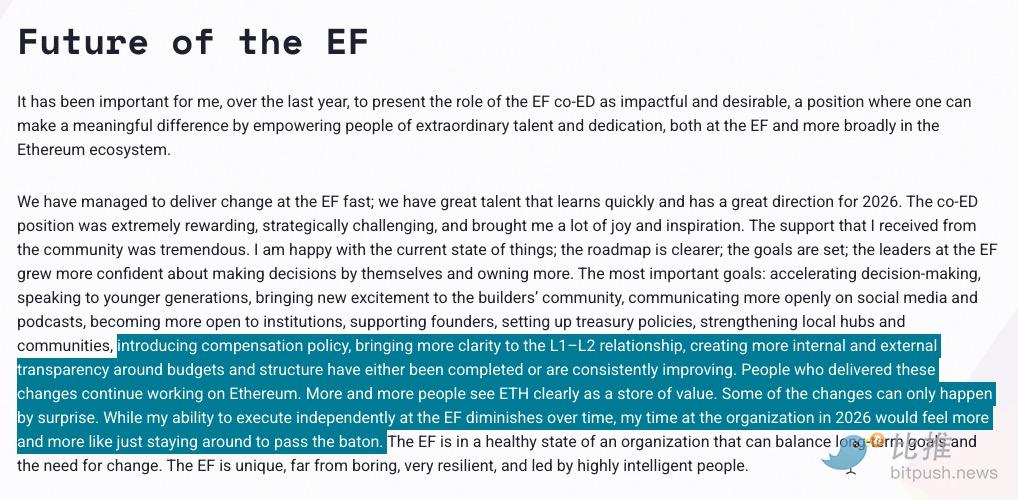
Stańczak’s departure statement was candid and thought-provoking. He shared several key insights:
First, he believes the Ethereum Foundation and ecosystem are “in a healthy state.” It’s time for a leadership handover.
Second, he wants to return to “hands-on product building,” focusing on AI and Ethereum integration. He says his mindset now is similar to when he founded Nethermind in 2017.
Third, and most telling: “The Foundation’s leadership is increasingly confident in making decisions and managing more affairs independently. Over time, my ability to act autonomously within the Foundation has diminished. If I stay, by 2026 I’ll mostly just be ‘waiting to hand over the baton.’”
This reveals two things: the new leadership is now self-driven and doesn’t need him involved in every detail; and his sphere of influence has shrunk. For someone used to hands-on involvement and entrepreneurial energy, this no longer fits.
He also remarked, “I know many ideas about agent-based AI may be immature or even useless, but playful experimentation defined Ethereum’s early innovation spirit.”
There’s a subtle critique here: as the Foundation becomes more “mature” and decisions more “steady,” is the wild, experimental spirit being lost?
Stańczak’s departure may seem personal, but it reflects the Foundation’s long-standing dilemma.
Since its inception, the Foundation has been in an awkward position. In theory, Ethereum is decentralized, and the Foundation shouldn’t be a central authority. In practice, it controls substantial funds, core developer resources, and coordination power—serving as both “central bank” and “planning commission.”
This paradox keeps the Foundation in a bind: do too much and it’s criticized for centralization; too little and it’s accused of inaction. Miyaguchi’s era leaned toward “coordination,” earning criticism for weakness. Stańczak shifted toward “execution,” raising efficiency but concentrating internal power.
His departure statement highlights this tension: as the Foundation becomes more efficient and decisive, individual founders’ room to operate shrinks. For an ecosystem balancing “decentralization spirit” and “competitive efficiency,” internal friction is inevitable.
So who is Bastian Aue?
Public information is scarce. On X, he describes his prior Foundation role as “unquantifiable but crucial work”: assisting management decisions, communicating with team leads, budgeting, strategic planning, and setting priorities. This understated approach contrasts sharply with Stańczak’s entrepreneurial style.
Upon taking office, Aue said: “My basis for decision-making is a principled commitment to certain attributes of what we are building. The Foundation’s mission is to ensure truly permissionless infrastructure—at its core, the cypherpunk spirit—can be established.”
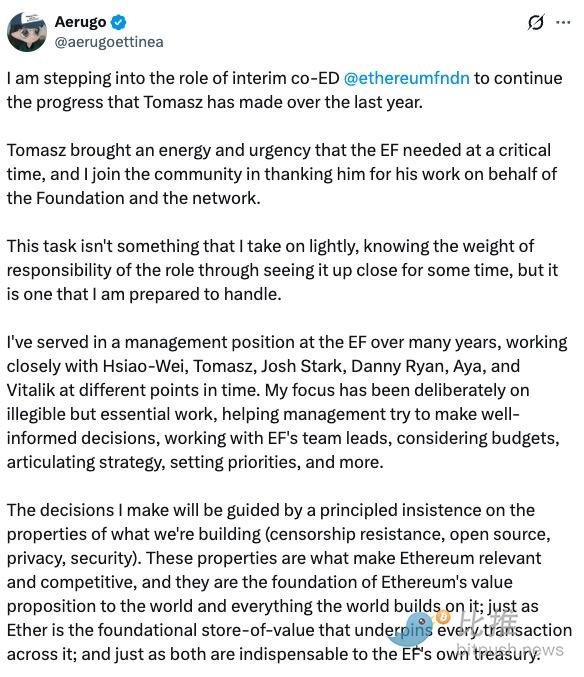
His statement echoes Miyaguchi’s era: emphasizing principles, spirit, and coordination over direct leadership.
Will the Foundation shift from “aggressive execution” back to “principled coordination”? That remains to be seen.
Ethereum’s Uncertainty
Stańczak’s departure comes as Ethereum debates several major proposals. He says the Foundation will soon release key documents, including “Lean Ethereum” specifics, a development roadmap, and a DeFi coordination mechanism.
The “Lean Ethereum” proposal, jokingly called “Ethereum’s weight-loss era” by some community members, aims to simplify the protocol, lighten the load, and make the mainnet more efficient.
These documents will shape Ethereum’s evolution for years to come. Changing the core executive leader now adds uncertainty to their implementation.
Ethereum faces broad challenges: competition from high-performance chains like Solana, Layer 2 fragmentation, new narratives around AI and blockchain integration, and crypto market volatility impacting ecosystem funding and attention.
On the day Stańczak announced his departure, ETH briefly dropped into the $1,800 range. If it continues below that threshold, an uncomfortable reality emerges: holding ETH may yield less than the dollar cash interest rate.
To put it in perspective: in January 2018, ETH first reached $1,400. Adjusted for US CPI inflation and compound interest, that $1,400 in February 2026 equals about $1,806.
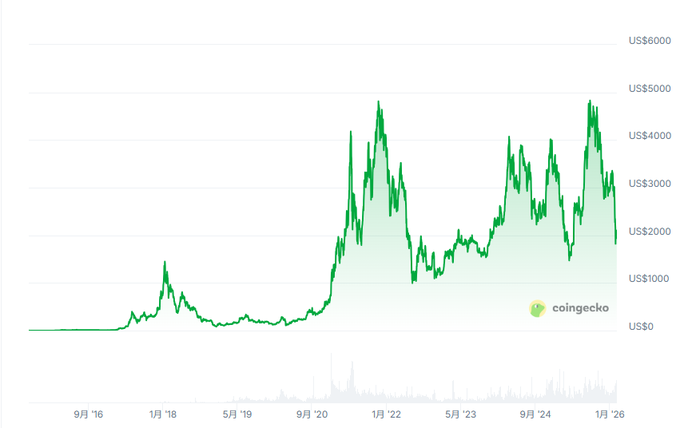
In other words, an investor who bought ETH in 2018 and simply held it—without staking—would not only have failed to earn profits after eight years, but would have underperformed dollar cash in a bank earning interest.
For the steadfast “E Guards,” the real question isn’t “who won the roadmap debate,” but: how much longer can they endure?
The only certainty: this core organization, managing one of crypto’s most vital ecosystems, is still searching for its place in a rapidly changing industry—and the journey will not be smooth.
Statement:
- This article is reprinted from [BitpushNews], with copyright belonging to the original author [bootly]. If you have any objections to the reprint, please contact the Gate Learn team, who will promptly address them according to relevant procedures.
- Disclaimer: The views and opinions expressed in this article are solely those of the author and do not constitute investment advice.
- Other language versions of this article have been translated by the Gate Learn team. Without mentioning Gate, do not copy, distribute, or plagiarize the translated article.