1. Introduction: Why Gold’s Price Outlook Matters Over the Next Five Years
Gold remains a globally recognized safe-haven asset, playing a pivotal role during economic cycles, periods of rising inflation, and shifts in monetary policy. In recent years, international gold prices have repeatedly set new records, prompting heightened market interest in its medium- and long-term trajectory.
With persistent global inflation, expanding sovereign debt, and continued central bank accumulation of gold reserves, gold’s value in asset allocation is being re-evaluated. “Gold price predictions for the next 5 years” has become a central research topic for both institutional and individual investors.
2. Current Gold Price Performance and Market Context
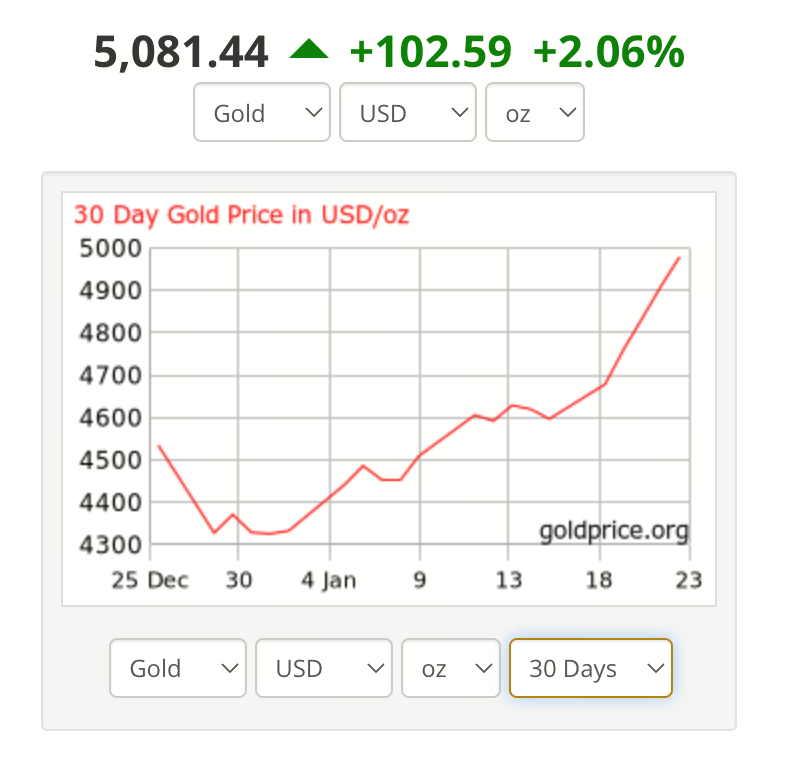
Chart: https://goldprice.org/
Currently, spot gold prices have surged past the $5,000 per ounce threshold, entering an unprecedented price range. This movement highlights rising global demand for safe-haven assets in an environment marked by macroeconomic uncertainty and geopolitical risk.
Major financial institutions have responded by raising their medium- and long-term gold price forecasts. For example, Goldman Sachs now projects gold will reach $5,400/oz by the end of 2026, underscoring Wall Street’s bullish outlook on the long-term value of precious metals.
Overall, the interplay of multiple macroeconomic variables has driven gold prices into a pronounced uptrend, providing a solid foundation for forecasting over the next five years.
3. Gold Price Forecast for 2026: Key Milestone Assessment
Looking forward, 2026 is widely viewed as a critical mid-term inflection point, with institutional forecasts centering on the following scenarios:
- Goldman Sachs expects gold to reach approximately $5,400/oz by year-end 2026;
- The World Gold Council and similar organizations anticipate gold prices will remain elevated, supported primarily by ongoing central bank purchases and safe-haven capital flows;
- Forecasting models focus on shifts in the dollar cycle, inflation expectations, and adjustments to central bank asset structures.
In summary, 2026 is more likely to mark a “high-level confirmation” rather than a reversal of the prevailing trend.
4. 2027–2028 Medium-Term Outlook
As the market moves into 2027–2028, focus shifts from short-term targets to medium-term stability:
- Most institutions estimate gold will trade within the $4,800–$5,800/oz range, with potential to set new record highs;
- If global macroeconomic uncertainty intensifies, price volatility could increase significantly;
- Compared to short-term moves, medium-term trends will be shaped more by monetary policy shifts, global economic growth rates, and evolving geopolitical risks.
During this phase, gold behaves more as a “high-volatility asset” rather than a commodity in a one-way rally.
5. 2029–2030: Long-Term Trends and Potential Highs
From a long-term perspective, 2029–2030 is the period that draws the greatest investor attention:
- Several long-term models suggest that if inflation remains above target, global debt continues to expand, and central banks keep accumulating gold, prices could challenge the $6,000–$7,000/oz range;
- In highly optimistic scenarios, some analysts expect gold could break all historical records around 2030;
- However, these projections are highly dependent on macroeconomic variables and are extremely sensitive to uncertainty.
As such, forecasts for this period serve better as strategic references than as precise price anchors.
6. Key Drivers Analysis
The main factors influencing gold prices over the next five years include:
- Macroeconomic conditions and monetary policy: If the Federal Reserve and other major central banks enter rate-cutting cycles or maintain accommodative policies, gold’s appeal as a non-yielding asset will grow.
- Geopolitical and financial risks: Trade disputes, regional conflicts, and concerns over financial system stability all boost safe-haven demand.
Central bank and institutional investor demand: Global central banks’ ongoing accumulation of gold reserves is becoming a fundamental long-term support for prices.
Risk Factors to Monitor
While most forecasts favor a medium- to long-term bullish view, the following risks require attention:
- A sustained strong dollar could temporarily weigh on gold prices;
- A faster-than-expected global economic recovery and rising risk appetite may reduce demand for gold as a portfolio allocation;
- Changes in market liquidity could amplify short-term price swings.
Therefore, no single forecasting model or institutional opinion should be regarded as a definitive conclusion.
8. Investment Strategy Summary
Drawing on a comprehensive assessment of gold price forecasts for the next five years:
- The medium- to long-term outlook remains broadly bullish;
- Ongoing monitoring of macroeconomic policy, dollar trends, and geopolitical risks is essential;
- Using gold as a diversification tool rather than a single-direction bet aligns best with prudent investment principles.